Legal jargon is the specialized language lawyers and courts use to describe rights, duties, and legal relationships with precision. Understanding it in plain English is not optional when you are signing contracts, filing claims, or making decisions that affect your finances or freedom. 61% of knowledge workers sign contracts without fully understanding the terms. That number shows the problem is not rare. This article breaks down common legal terms, exposes the most misused phrases, and gives you practical tools to read any legal document with confidence.
What are common legal terms you need to know?
Legal terminology falls into two categories. The first is genuine terms of art, words with fixed legal meanings that courts apply consistently. The second is vague phrasing that sounds official but carries no precise definition. Fewer than 100 bona fide terms of art exist across the entire legal system. Every other piece of complex language is either plain English dressed up in Latin or a phrase lawyers use out of habit.
Here are the core terms you will encounter most often, explained in plain English:
- Plaintiff: The person who files the lawsuit. If someone sues you, they are the plaintiff.
- Defendant: The person being sued. You are the defendant if someone brings a case against you.
- Liability: Legal responsibility for harm or a debt. If you are liable, you owe something.
- Indemnity: A promise to cover another party's losses. Common in service contracts and leases.
- Breach: Failing to do what a contract requires. A breach gives the other side the right to sue.
- Contingency fee: A payment structure where a lawyer is paid only upon recovery of money. If the case fails, you owe no attorney fee, though you may still owe court costs.
- Statute of limitations: The deadline to file a legal claim. Miss it, and you lose the right to sue, regardless of how strong your case is.
Understanding legal terms and your rights is not just about vocabulary. It is about knowing what you agreed to and what you can demand.
Pro Tip: When you see a Latin phrase in a document, look for its English equivalent nearby. Courts and lawyers are increasingly required to define Latin terms in plain language, especially in consumer contracts.

Why do lawyers use complex jargon, and how can you simplify it?
Legal language is designed for precision and consistency, not for easy reading. A word like "shall" in a contract carries a specific legal weight that "will" or "should" does not. The problem is that legal drafters frequently misuse "shall", creating ambiguity about who is actually required to act. That ambiguity can end up in court.
Professor Bryan Garner, one of the most respected legal writing scholars in the United States, has long argued that dense legal jargon adds confusion rather than clarity. His position is backed by decades of drafting research. Clear, simple language is harder to misinterpret and easier to enforce.
Here is a practical process for simplifying legal language when you encounter it:
- Read the definitions section first. Most contracts define key terms at the start or in a glossary. Those definitions control the entire document.
- Replace jargon with plain words as you read. Swap "indemnify and hold harmless" with "cover your losses." If the meaning changes, the original phrase was doing real work. If it does not, the jargon was filler.
- Ask your attorney to explain every term you do not recognize. Clients should request plain-English explanations before signing anything. A good attorney will not hesitate to do this.
- Flag any word that appears more than once. Repeated terms carry weight. If "material" appears in a clause, ask exactly what qualifies as material in that context.
- Use a legal glossary for quick lookups. Resources like Black's Law Dictionary and government court websites publish plain-language definitions for hundreds of common terms.
Pro Tip: Ask your attorney to send you a one-page summary of any contract before you sign. This forces them to translate the document into plain English and gives you a reference point during the signing meeting.
What are common pitfalls in legal documents caused by jargon?
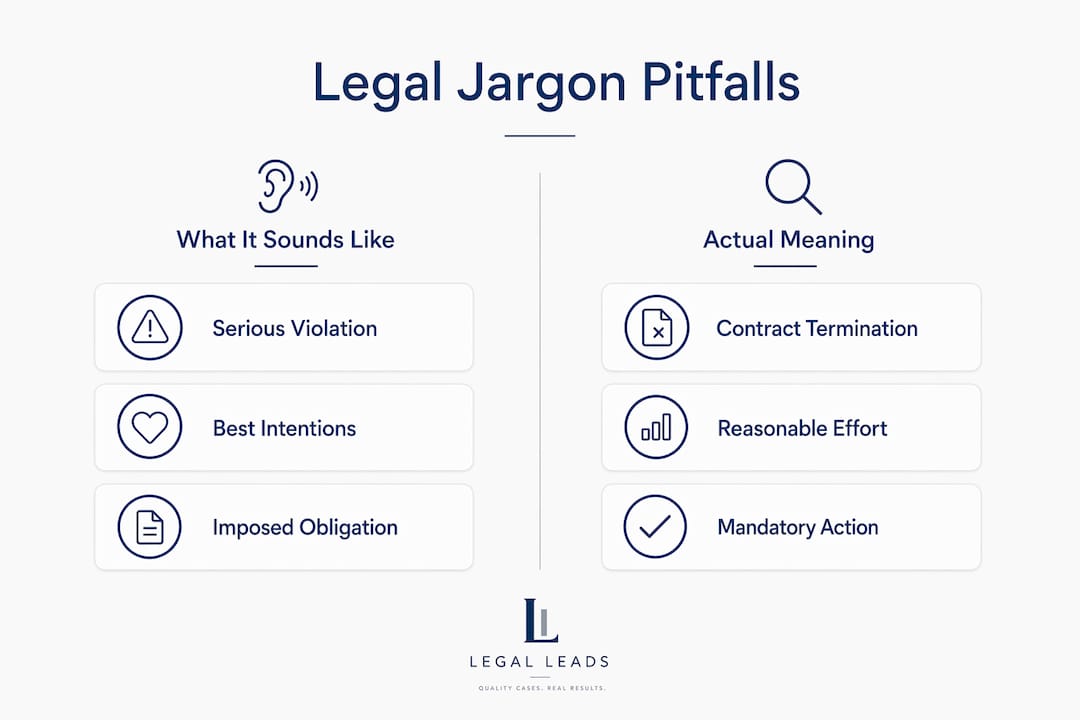
Vague legal language creates real financial and legal risk. Two of the most dangerous phrases in contracts are "material breach" and "best efforts." These terms are faux terms of art, meaning they sound precise but carry no fixed legal definition. Courts interpret them differently depending on the jurisdiction and the facts of the case.
The risks show up in predictable places. Here is what to watch for:
- "Material breach" without a definition: If a contract says you can terminate for material breach but never defines what counts as material, either party can argue almost anything qualifies. Always push for a specific list of triggering events.
- "Best efforts" and "reasonable efforts": These phrases sound demanding but are legally soft. One court may require exhaustive action; another may accept minimal steps. Contracts with specific performance benchmarks are far safer.
- Boilerplate arbitration clauses: Boilerplate sections often hide major contractual rules, including clauses that strip your right to sue in court. Many people sign away their right to a jury trial without realizing it.
- "Sole discretion" clauses: When a contract gives one party "sole discretion" to make a decision, the other party has almost no legal recourse if that decision goes against them.
| Vague term | What it sounds like | What it actually means |
|---|---|---|
| Material breach | A serious violation | Whatever a court decides is serious |
| Best efforts | Maximum possible effort | Varies widely by jurisdiction |
| Sole discretion | One party decides | The other party has almost no recourse |
| Reasonable notice | Fair warning | No fixed time period unless defined |
| As soon as practicable | Quickly | No enforceable deadline |
The safest approach is to review legal documents carefully before signing and push for specific numbers, dates, and definitions wherever vague terms appear.
How can you effectively understand legal jargon in your own situation?
Reading a legal document well is a skill, not a talent. You build it by following a consistent process every time you encounter legal language. Communicating your legal problem clearly starts with understanding what the document actually says.
Follow these steps each time you review a legal document:
- Read the entire document before signing anything. Never sign on the spot. Take the document home and read it in full, even if it takes an hour.
- Write down every term you do not understand. Bring that list to your attorney or use a trusted legal glossary to look up each one before your next meeting.
- Check how each key term is used in context. A word like "notice" may mean a formal written letter in one clause and an email in another. Context controls meaning.
- Ask specific questions, not general ones. Instead of "Is this contract okay?", ask "What happens if I miss a payment?" or "Can I cancel this agreement and under what conditions?"
- Look for legal processes simplified for beginners to understand the procedural side of your situation. Knowing the steps in a lawsuit or a contract dispute helps you ask better questions.
Confusing legal grammar mistakes can significantly affect the enforceability of contracts. That means a document with poor or inconsistent language may not hold up in court the way either party intended.
Pro Tip: Read the last paragraph of every contract section. Lawyers often bury the most consequential limitations, like caps on damages or waivers of rights, at the end of long paragraphs where readers lose focus.
Key Takeaways
Understanding legal language is the single most effective way to protect your rights before you sign anything.
| Point | Details |
|---|---|
| True terms of art are rare | Fewer than 100 legal terms have fixed court-recognized meanings; most jargon is filler. |
| Vague phrases carry real risk | Terms like "material breach" and "best efforts" have no fixed definition and invite disputes. |
| Boilerplate sections matter | Arbitration and sole-discretion clauses buried in standard text can eliminate your right to sue. |
| Plain-English requests are your right | Ask any attorney to explain every term before you sign; a good lawyer will always comply. |
| Context controls meaning | The same word can mean different things in different clauses; always read terms in full context. |
Why I think most people underestimate the cost of legal confusion
The legal profession has a communication problem, and it is not entirely accidental. Dense language protects lawyers from liability, signals expertise, and creates dependency. Clients who do not understand their contracts come back when things go wrong. That dynamic has persisted for decades.
What I have observed is that the people most harmed by legal jargon are not careless. They are busy, trusting, and often intimidated by the formality of legal documents. They sign because they feel they have no real choice, or because asking too many questions feels embarrassing. That is a reasonable human reaction to an unreasonable situation.
The good news is that the legal community is shifting. Plain-language drafting movements, court simplification initiatives, and consumer protection regulations are pushing lawyers toward clearer writing. The American Bar Association has published guidance encouraging plain English in client communications. That shift is real, but slow.
My honest advice: never treat a legal document as a formality. Treat it as a binding commitment with financial and legal consequences. If you do not understand a term, do not assume it is harmless. Ask. Push back. Request a rewrite if a clause is unclear. You have every right to understand what you are agreeing to, and any attorney worth hiring will respect that.
— Admin
How Legalleads connects you with attorneys who speak plain English
Finding an attorney who explains things clearly is as important as finding one with the right expertise. Legalleads makes that process direct and fast.

You describe your legal situation in plain English on the Legalleads platform. Within two minutes, you receive a professional case brief. Within 24 hours, you are connected to a qualified attorney, with no calls, no complicated forms, and no guesswork about whether the lawyer fits your needs. Whether you need a personal injury lawyer in Los Angeles or a family lawyer in Orange County, Legalleads matches you with attorneys who prioritize clear communication. You can also find a lawyer across a wide range of practice areas through the Legalleads directory.
FAQ
What is legal jargon, exactly?
Legal jargon is the specialized vocabulary used in law, including terms of art with fixed meanings and complex phrases that lawyers use for precision. Most of it can be translated into plain English without losing accuracy.
What are the most commonly misused legal phrases?
"Shall," "material breach," and "best efforts" are among the most commonly misused legal phrases. Courts interpret these terms inconsistently, which creates ambiguity and risk in contracts.
Can I ask my lawyer to explain legal terms in plain English?
Yes. Clients have every right to request plain-language explanations before signing any document. A qualified attorney will explain any term clearly and without additional charge for the clarification.
What happens if I sign a contract I did not fully understand?
Signing a contract creates binding obligations regardless of whether you understood the terms. Courts generally enforce contracts as written, which is why reading and understanding every clause before signing is critical.
What is a contingency fee in simple terms?
A contingency fee means your attorney gets paid only if you win money in your case. If the case fails, you owe no attorney fee, though you may still be responsible for court filing costs.