
Non-lawyer legal document review is the process of analyzing, organizing, and explaining legal documents without the involvement of a licensed attorney. Certified Legal Document Preparers (CLDPs), paralegals working independently, and AI-powered tools like Justee.ai, SUPERWISE, and Laine all fall under this category. These options give you real, affordable access to document analysis without the cost of full legal representation. The industry term for this broader practice is "non-attorney document review," and understanding how it works helps you make smarter decisions about your legal paperwork.
What is non-lawyer legal document review?
Non-lawyer legal document review covers a structured set of tasks: reading documents for accuracy, flagging risky clauses, identifying missing terms, and explaining legal language in plain English. Document review goes well beyond proofreading. It includes privilege reviews, quality control, risk tagging, and issue marking. Non-lawyer services must clearly define which of these phases they actually perform, since many only offer automated text analysis without legal judgment.
The key distinction is scope. Non-lawyer reviewers can help you understand what a document says and flag potential problems. They cannot tell you what to do about those problems or represent you in any legal proceeding. That boundary defines the entire category.

Who can perform non-attorney document review?
Three main types of non-lawyer specialists handle legal document analysis: paralegals, Certified Legal Document Preparers, and AI-powered tools.
Paralegals work under the direct supervision of a licensed attorney. They can review documents, draft summaries, and prepare filings, but their work product is always the legal responsibility of the supervising attorney. You typically access paralegals through a law firm, not independently.
Certified Legal Document Preparers (CLDPs) operate differently. CLDPs differ from paralegals by working independently, without attorney supervision, and serving self-represented individuals directly under state regulation. Arizona is the most established state for this model. In Arizona, CLDPs must pass a comprehensive exam and an FBI background check to verify good moral character. They also complete 20 hours of continuing education every two years, including legal ethics. That level of regulation makes Arizona CLDPs among the most credentialed non-lawyer document specialists in the country.
AI-powered tools represent the third option. Platforms like Justee.ai, SUPERWISE, and Laine analyze documents automatically, flag risks, and generate plain-English summaries. They are available on demand and often at low or no cost.
- CLDPs: independently regulated, state-certified, serve self-represented clients directly
- Paralegals: attorney-supervised, not independently accessible to the public
- AI tools: automated, fast, no certification required to use, but no human judgment included
Pro Tip: Before hiring any non-lawyer document preparer, ask directly whether they are certified under your state's regulatory body. In Arizona, that means CLDP certification. In other states, requirements vary significantly.
How do AI tools support legal document analysis?
AI-powered document review tools have changed the speed and cost of first-pass legal analysis. AI tools can process legal documents in under 2 minutes while referencing vast legal databases for risk and compliance checks. That speed matters when you are reviewing a lease, employment agreement, or settlement offer and need answers quickly.
The three leading tools in this space each have distinct strengths:
| Tool | Key Capability | Notable Feature |
|---|---|---|
| Justee.ai | Rapid clause analysis and risk flagging | Free access with plain-English explanations, no sign-up required |
| SUPERWISE | Managed AI-assisted review with compliance controls | Blocks PII/PHI, enforces model constraints, maintains audit trails |
| Laine | Jurisdiction-specific document benchmarking | Calibrated to governing law, not generic assumptions |
SUPERWISE reports that AI-assisted review can reduce contract review time by 50–70% compared to manual methods. That reduction translates directly into lower costs for individuals who would otherwise pay attorney hourly rates for the same first-pass work.
Laine takes a different approach to accuracy. AI analyzers calibrated to the actual governing law produce more precise risk assessments than tools that apply generic jurisdiction assumptions. If your contract is governed by California law, a tool calibrated to California statutes will catch issues that a generic tool misses.
"AI document review accelerates first-pass analysis, freeing humans for higher-level decision-making and strategic interpretation." — SUPERWISE
The critical limitation applies to all three tools: AI tools identify risks and missing clauses but cannot replace legal judgment. The final decision on what to do with that information remains your responsibility. AI is a support layer, not a substitute for human review when the stakes are high.
SUPERWISE also implements compliance safeguards including PII/PHI blocking, policy enforcement, and audit trails. Those guardrails matter when you are uploading sensitive contracts or personal legal documents to a third-party platform.
How to use non-lawyer review services effectively
Getting value from non-lawyer document review requires preparation. Showing up with a disorganized stack of papers and a vague question produces a vague answer. A clear process produces clear results.
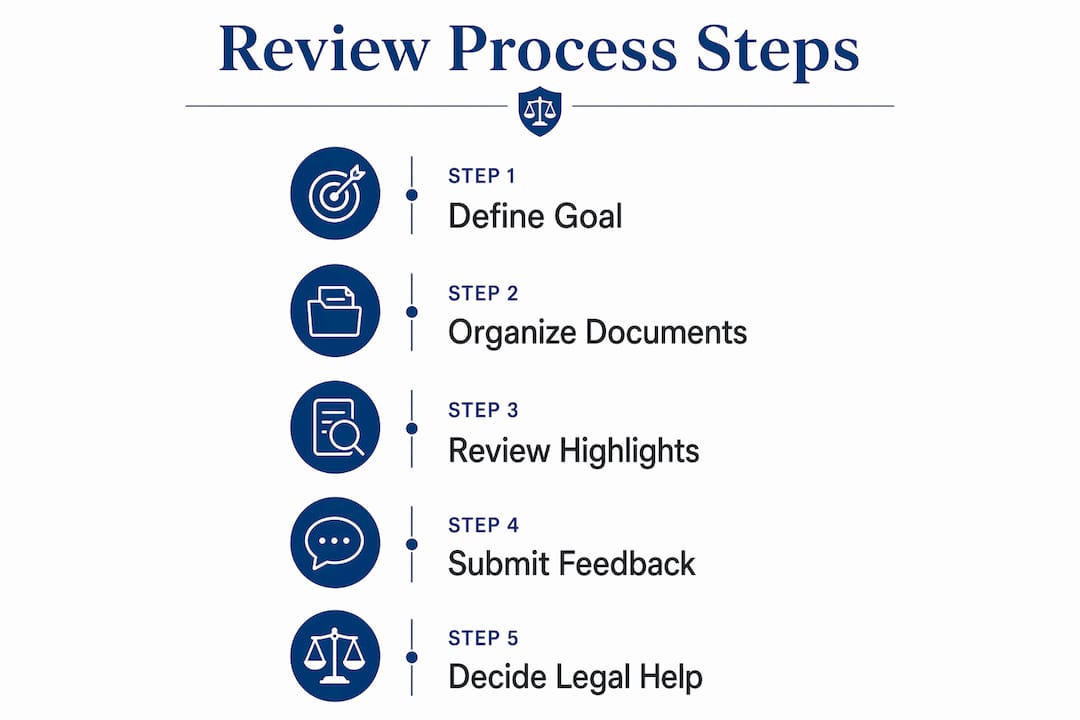
Step 1: Define your review goal. Decide what you need before you submit anything. Are you checking for unfair clauses in a lease? Verifying that a settlement agreement covers all your claims? Confirming that a business contract matches what you negotiated verbally? Your goal determines which service fits best.
Step 2: Gather all relevant documents. Related documents matter. A non-disclosure agreement often references a master services agreement. A lease addendum only makes sense alongside the original lease. Submit the full document set, not just the page you are worried about.
Step 3: Choose the right service type. The three options serve different needs:
- AI self-service tools (Justee.ai, SUPERWISE, Laine): best for fast, affordable first-pass analysis of standard contracts
- Certified Legal Document Preparers: best for preparing court filings or complex documents where a human needs to organize and explain the paperwork
- Managed review services with attorney supervision: best for higher-stakes documents where you need a structured report and a named professional taking responsibility
Step 4: Submit and review the feedback report. Most services return a summary of flagged clauses, missing terms, and plain-English explanations. Read the full report before acting on any single finding. Context matters.
Step 5: Decide whether you need legal counsel. A non-lawyer review tells you what the document says and where the risks are. It does not tell you whether to sign. That decision may require an attorney, especially for employment agreements or family law matters.
Cost is a real factor. AI tools often cost nothing or charge a flat fee per document. CLDPs typically charge flat fees by document type, which is far lower than hourly attorney rates. Managed review services with attorney supervision sit between the two in price.
Pro Tip: Always ask a managed review service to identify the supervising attorney by name. A serious review service publishes its attorney supervision structure and clarifies who holds ultimate legal responsibility for the work product.
When do you need a lawyer despite non-lawyer review?
Non-lawyer review has clear limits. Certain situations require attorney judgment, and using a non-lawyer service alone in those cases creates real risk.
You need a licensed attorney when:
- The document involves criminal liability or potential criminal consequences of any kind
- You are negotiating terms, not just reviewing them. Non-lawyers cannot advise you on negotiation strategy.
- The document will be filed in court and requires legal argument or representation
- The stakes involve significant financial loss, custody of children, or immigration status
- You receive a legal demand, lawsuit, or government notice requiring a formal response
- The contract involves complex intellectual property, business acquisitions, or multi-party agreements
ABA Model Rule 5.3 requires that a supervising attorney take responsibility for non-lawyer work product when that work is part of a legal matter. Reputable non-lawyer review services disclose this structure. If a service cannot name a supervising attorney, that is a warning sign.
The best approach combines both resources. Use a non-lawyer review service to understand the document and identify issues. Then bring that analysis to an attorney for a focused consultation on the specific risks. That combination costs far less than full attorney review from the start and produces better results than non-lawyer review alone.
For criminal defense matters or personal injury claims, non-lawyer review can help you understand documents in your case file. But those practice areas always require licensed attorney representation for any court proceedings.
Key takeaways
Non-lawyer legal document review works best when you match the right service type to the right document and know exactly when to bring in a licensed attorney.
| Point | Details |
|---|---|
| Know who can help | CLDPs, paralegals, and AI tools each serve different needs and operate under different rules. |
| AI tools save time | Platforms like Justee.ai and SUPERWISE cut review time by 50–70% and flag risks in plain English. |
| Verify supervision | Reputable services name a supervising attorney under ABA Model Rule 5.3. |
| Prepare before submitting | Gather all related documents and define your review goal before using any service. |
| Know the limits | Non-lawyer review explains documents. It does not replace attorney judgment for high-stakes decisions. |
The real value of non-lawyer review, from experience
Non-lawyer legal document review fills a gap that most people do not realize exists. The choice is not always "hire a lawyer" or "sign and hope." There is a middle layer of certified professionals and capable AI tools that gives you real clarity at a fraction of the cost.
What I have seen consistently is that people underestimate how much they can learn from a well-structured non-lawyer review before they ever speak to an attorney. Knowing which clauses are problematic before a consultation makes that consultation faster, cheaper, and more productive. You are not paying attorney rates to have someone read the document to you. You already know what it says.
The caution I would add is this: AI tools are genuinely useful, but they are not infallible. A tool calibrated to the wrong jurisdiction, or one that lacks PII protections, creates new problems while solving old ones. Stick to tools with published compliance controls and clear data privacy policies.
Certified Legal Document Preparers, particularly in states with rigorous certification like Arizona, represent the most underused resource in this space. They are regulated, accountable, and far more affordable than attorneys for document preparation tasks. If your state has a CLDP program, use it.
— Admin
Legalleads connects you to the right help, fast
Finding qualified legal help should not require hours of searching or confusing intake forms.
Legalleads makes it straightforward. Describe your legal situation in plain English and receive a professional case brief in under two minutes. The platform then connects you to qualified attorneys within 24 hours, with no calls or complicated forms required. Whether you need a certified document preparer for affordable document review or a licensed attorney for full legal counsel, Legalleads has the directory to match you quickly. Find a lawyer who fits your situation, or browse attorneys by practice area to compare your options directly.
FAQ
What is non-lawyer legal document review?
Non-lawyer legal document review is the analysis of legal documents by certified non-attorney professionals or AI tools to identify risks, explain terms, and flag missing clauses. It does not include legal advice or court representation.
Can a non-lawyer review a contract legally?
Yes. Certified Legal Document Preparers and AI tools can legally review contracts in most states. They cannot advise you on what action to take or represent you in court.
How accurate are AI tools for legal document analysis?
AI tools like Laine and SUPERWISE are highly accurate for clause identification and risk flagging, especially when calibrated to governing law rather than generic jurisdiction defaults. They do not replace human legal judgment.
How much does non-lawyer document review cost?
AI tools often charge flat fees per document or offer free access. Certified Legal Document Preparers charge flat fees by document type, which is significantly lower than attorney hourly rates.
When should I use a lawyer instead of a non-lawyer reviewer?
Use a licensed attorney when documents involve court filings, criminal liability, custody decisions, or any situation requiring negotiation or formal legal representation.