
Communicating a legal problem clearly means providing your attorney with concise, accurate facts and expectations so they can act on your behalf without delay. Most clients walk into a first consultation with a jumbled account of events, missing documents, and no defined goals. That gap costs time and money. The Maryland People's Law Library advises that clear client communication is about creating a workable partnership, not just recounting facts. When you prepare properly, your attorney spends less time reconstructing your story and more time building your case.
How to communicate your legal problem clearly before the first meeting
Preparation is the single biggest factor in how well your attorney understands your case from day one. Attorneys primarily need a clear, well-structured fact pattern to map onto legal claims or defenses. They do not need a fully formed legal argument from you. Your job is to give them the raw material in an organized form.
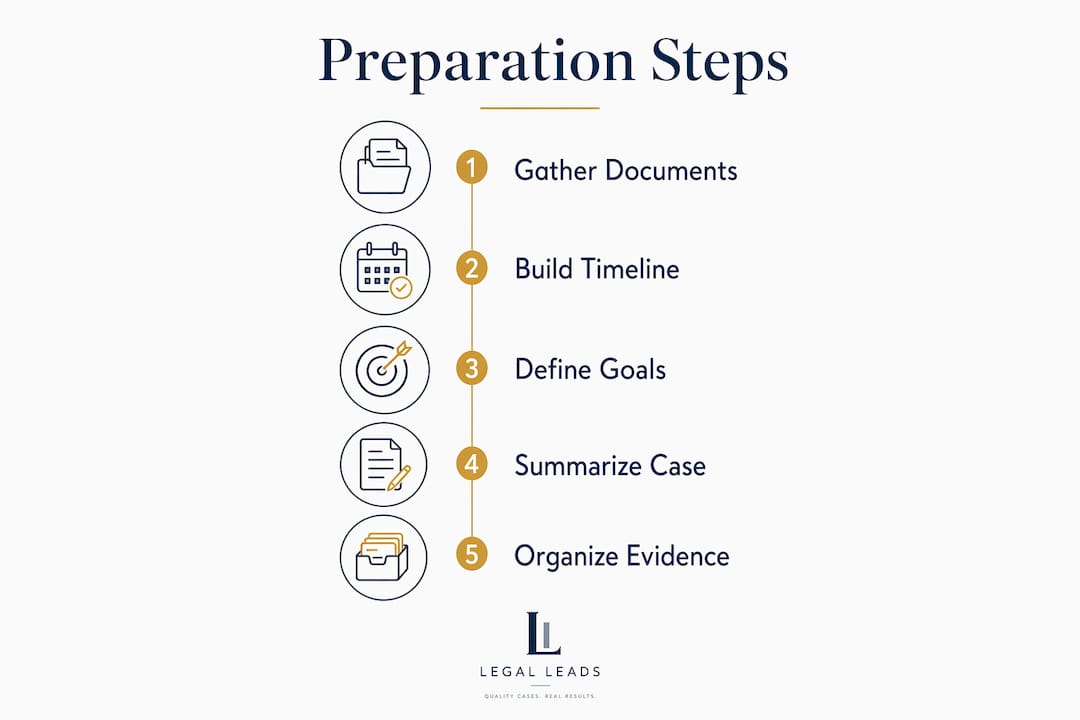
Gather your documents first
Start by collecting every document connected to your situation. The Maryland People's Law Library instructs clients to organize relevant documents such as contracts, correspondence, estimates, warranties, and photographs before any legal meeting. Keep originals separate from copies. Label each copy clearly so your attorney can find what they need without asking twice.

The documents you need depend on your case type. A personal injury matter calls for medical records, accident reports, and insurance correspondence. A family law dispute requires financial statements, custody agreements, and communication records. An employment issue needs your employment contract, pay stubs, and any written warnings or termination notices.
Build a chronological timeline
A timeline is the most useful tool you can bring to a first consultation. Structured, chronological narratives help lawyers identify key issues and next steps faster, reducing the risk of missed deadlines or overlooked facts. Write down each event in the order it happened, with dates, locations, and the names of everyone involved.
Understanding why legal timelines matter for your case goes beyond simple organization. A timeline forces you to identify gaps in your own account before your attorney does.
Pro Tip: If you are unsure of an exact date, write your best estimate and note it as approximate. Presenting approximate dates honestly is far better than guessing with false confidence.
Define your goals before you walk in
Know what outcome you want. Do you want financial compensation, a custody arrangement, a contract enforced, or criminal charges dropped? Attorneys work more efficiently when they understand your goal from the start. The Maryland People's Law Library recommends agreeing on roles and expectations upfront, including how often you will receive updates and how decisions will be made.
| Preparation step | What to prepare |
|---|---|
| Documents | Contracts, records, photos, correspondence, labeled copies |
| Timeline | Chronological list of events with dates and names |
| Goals | Your desired outcome stated in plain terms |
| Questions | A written list of what you need to know |
| Fee expectations | Budget range and preferred billing arrangement |
How to phrase and structure your legal issue effectively
The way you describe your situation shapes how your attorney interprets it. Plain, accurate language outperforms legal terminology every time. You are not expected to know legal terms. You are expected to describe what happened, when it happened, and who was involved.
Use plain language, not legal jargon
Clear, concise explanations are prioritized over comprehensive ones in legal communication. Say "my employer fired me after I reported a safety violation" rather than "I was subject to retaliatory termination following a whistleblower disclosure." The first version is faster to process and harder to misinterpret. Reading about types of legal processes in plain terms before your consultation helps you understand the framework your attorney will use.
Avoid these common phrasing mistakes:
- Mixing up what you witnessed directly with what someone told you. State the source clearly.
- Using words like "always," "never," or "everyone" when you mean "usually" or "most people."
- Describing your emotional reaction before you describe the facts. Lead with facts.
- Repeating the same event multiple times with slightly different details. Pick one version and stick to it.
Communicate uncertainty honestly
Clients who distinguish what they know for certain from what they infer or estimate build more credibility with their attorneys. If you are not sure whether a document was signed in march or april, say so. Attorneys can work with approximate information. They cannot work with information that later turns out to be wrong.
Ask your attorney directly what specific legal question your case needs to answer. Tailoring your narrative to the precise question the court or opposing party will focus on is more useful than telling your entire life story.
Pro Tip: Write a one-paragraph summary of your situation before your meeting. Limit it to five sentences. If you cannot summarize it in five sentences, your account needs more editing, not more detail.
How to use documents and evidence to support your explanation
Documents do not speak for themselves. You need to connect each piece of evidence to a specific point in your narrative. An attorney reviewing a stack of unlabeled papers wastes time that should go toward your case.
Organize documents to match your timeline
Number your documents to match the events in your timeline. If event three in your timeline is a termination letter dated june 14, that letter should be document three in your folder. This one-to-one alignment lets your attorney move through your account and your evidence at the same time.
- Separate originals from copies. Store originals in a secure location and bring labeled copies to every meeting.
- Highlight the specific sentences or clauses that are relevant. Do not ask your attorney to read an entire contract to find one paragraph.
- Write a one-line note on each document explaining why it matters. "This email shows my supervisor knew about the complaint before my termination" is more useful than a blank page.
- Group documents by category first, then by date within each category. Contracts together, correspondence together, financial records together.
- Bring a copy of your document index to every meeting so your attorney can request specific items quickly.
Organizing documents with labeled copies simplifies attorney review and prevents time lost reconstructing your narrative. That time savings translates directly into lower legal fees.
| Document type | Preparation action |
|---|---|
| Contracts and agreements | Highlight key clauses; note relevant dates |
| Correspondence | Sort by date; note sender and recipient |
| Financial records | Summarize totals; attach supporting receipts |
| Photographs or video | Label with date, location, and what is shown |
| Medical or official reports | Highlight diagnosis, findings, or conclusions |
Understanding the role of evidence in legal cases helps you decide which documents are worth bringing and which are background noise.
Common mistakes that block clear attorney communication
Most communication failures between clients and attorneys come from a small set of repeatable errors. Recognizing them before your first meeting saves significant time and frustration.
- Overloading with irrelevant detail. Attorneys need the facts that connect to your legal claim. Your neighbor's opinion of the situation is not a legal fact.
- Contradicting yourself. If your account changes between the first and second meeting, your attorney loses confidence in your reliability. Write your account down and stick to it.
- Skipping the fee conversation. The Maryland People's Law Library recommends putting fee arrangements in writing to avoid misunderstandings. Verbal agreements on fees create disputes.
- Assuming your attorney knows what you want. State your goal explicitly at the start of every meeting. Do not assume it carries over from the last conversation.
- Failing to confirm what you agreed on. After each meeting, send a brief written summary of what was decided. This protects both you and your attorney.
Pro Tip: Keep a dedicated notebook or digital file for your case. Log every conversation with your attorney, including the date, what was discussed, and what the next steps are. This record becomes your reference point if any disagreement arises.
Attorney-client communication is a two-way process. Ask your attorney to explain their reasoning when they recommend a course of action. If you do not understand a legal term, ask for a plain-language explanation. Attorneys who work with informed, prepared clients consistently produce better outcomes than those who must spend consultation time gathering basic facts.
Key takeaways
Clear legal communication requires organized facts, honest uncertainty, and defined goals delivered before the first attorney meeting.
| Point | Details |
|---|---|
| Prepare a timeline | Build a chronological account of events with dates, names, and locations before any meeting. |
| Use plain language | Describe what happened in simple terms; avoid legal jargon and emotional framing. |
| Organize your documents | Label copies, highlight key sections, and number documents to match your timeline. |
| State your goals upfront | Tell your attorney your desired outcome at the start, not after lengthy discussion. |
| Put agreements in writing | Confirm fees, roles, and decisions in writing after every significant conversation. |
Why preparation changes everything in legal communication
I have seen the same pattern repeat across dozens of legal situations. Clients who arrive prepared, with a one-page timeline and a folder of labeled documents, get more from their first consultation than clients who spend the same hour explaining background. The attorney spends less time asking clarifying questions and more time identifying the actual legal path forward.
The uncomfortable truth is that most communication failures in attorney-client relationships are not the attorney's fault. Clients arrive with a mix of facts, feelings, and assumptions, and expect the attorney to sort it out. That sorting takes time, and time in legal work costs money.
What I have found actually works is treating your first consultation like a business meeting, not a therapy session. You are presenting a problem that needs a solution. The cleaner your presentation, the faster and cheaper the solution. Attorneys are trained to spot the legal issues in a clear fact pattern. Give them the pattern, and let them do their job.
The attorney-client matching process works best when you arrive knowing what you need. A well-prepared client is not just easier to work with. They are more likely to get the outcome they want.
— Admin
Legalleads connects you with the right attorney fast
Finding the right attorney is the first step. Describing your situation clearly is the second. Legalleads handles both.

Legalleads lets you describe your legal situation in plain English and generates a professional case brief in under two minutes. That brief connects you to a qualified attorney within 24 hours, with no phone calls or complicated intake forms required. Whether you need a personal injury lawyer in Los Angeles or representation in a family law matter, Legalleads matches you based on your specific situation. The preparation work you do using this guide makes that match faster and more accurate. Find a lawyer through Legalleads and arrive at your first consultation ready to move forward.
FAQ
What does it mean to communicate a legal problem clearly?
Clear legal communication means giving your attorney a concise, chronological account of the relevant facts, your goals, and your supporting documents. It excludes irrelevant detail and emotional framing.
How do I prepare for my first attorney consultation?
Build a timeline of events, collect and label your documents, and write down your desired outcome before the meeting. The Maryland People's Law Library advises agreeing on roles and fees upfront to avoid later misunderstandings.
Should I use legal terms when explaining my situation?
No. Plain, accurate language is more effective than legal terminology. Describe what happened in simple terms and let your attorney apply the legal framework.
How do I handle facts I am not sure about?
State what you know for certain and flag anything approximate or inferred. Explicitly noting uncertainty builds credibility and prevents your attorney from building a strategy on incorrect assumptions.
How long should my initial case summary be?
One paragraph of five sentences is enough for a first summary. Focus on what happened, when, who was involved, and what outcome you want. Add your documents and timeline as supporting material.