
Business legal counsel is a qualified attorney who provides ongoing legal advice, risk management, and strategic guidance to help businesses stay compliant and avoid costly disputes. The industry term for this role is "corporate counsel" or "business attorney," though the function applies to companies of every size, not just large corporations. Understanding what is business legal counsel matters because the right attorney does far more than handle lawsuits. They protect your contracts, your employees, your intellectual property, and your long-term growth. This guide covers the full scope of that role, when you need it, and how to find it.
What is business legal counsel and what does it cover?
Business legal counsel is defined as a qualified attorney providing ongoing legal advice, risk management, and strategic guidance to businesses to ensure regulatory compliance and prevent legal disputes. The role covers business formation, contract drafting and review, intellectual property protection, and employment law compliance. This is not a reactive service you call when something goes wrong. It is a continuous advisory relationship that protects your business at every stage of its lifecycle.
The business lawyer definition extends beyond courtroom work. Most of what a business attorney does happens before any dispute arises. They review agreements before you sign, flag regulatory risks before you launch, and structure your business entity before you take on partners. That preventive work is where the real value lives.

A business legal brief is often the first document your attorney produces. It summarizes the legal facts of your situation and identifies the key risks and options. Think of it as the foundation for every decision your counsel will help you make.
What are the primary responsibilities of business legal counsel?
Business legal counsel handles a wide range of tasks that protect your company from financial and legal exposure. The core services fall into five categories.
- Contract drafting and negotiation. Your attorney drafts, reviews, and negotiates every significant agreement, from vendor contracts to client service agreements. A poorly written contract is one of the most common sources of business disputes.
- Business entity formation. Choosing between an LLC, S-Corp, C-Corp, or partnership has lasting tax and liability consequences. Counsel advises on the right structure before you file anything.
- Employment law compliance. Federal and state employment laws change frequently. Counsel keeps your hiring practices, employee handbooks, and termination procedures legally sound. You can review the scope of this work through employment law services to understand what compliance actually requires.
- Intellectual property protection. Trademarks, copyrights, and trade secrets need active protection. Counsel files registrations and enforces your rights when competitors cross the line.
- Dispute resolution and litigation. When disputes do arise, your attorney manages negotiations, mediation, and litigation if necessary.
Pro Tip: Ask your attorney to create a one-page legal risk summary for your business each year. It forces a structured review of contracts, compliance gaps, and IP exposure before problems develop.
How do in-house counsel and external business lawyers differ?
In-house counsel are full-time employees embedded within a company, while external legal counsel are hired firms or solo attorneys engaged for ongoing or project-specific needs. The distinction matters because the right choice depends on your company's size, budget, and legal volume.
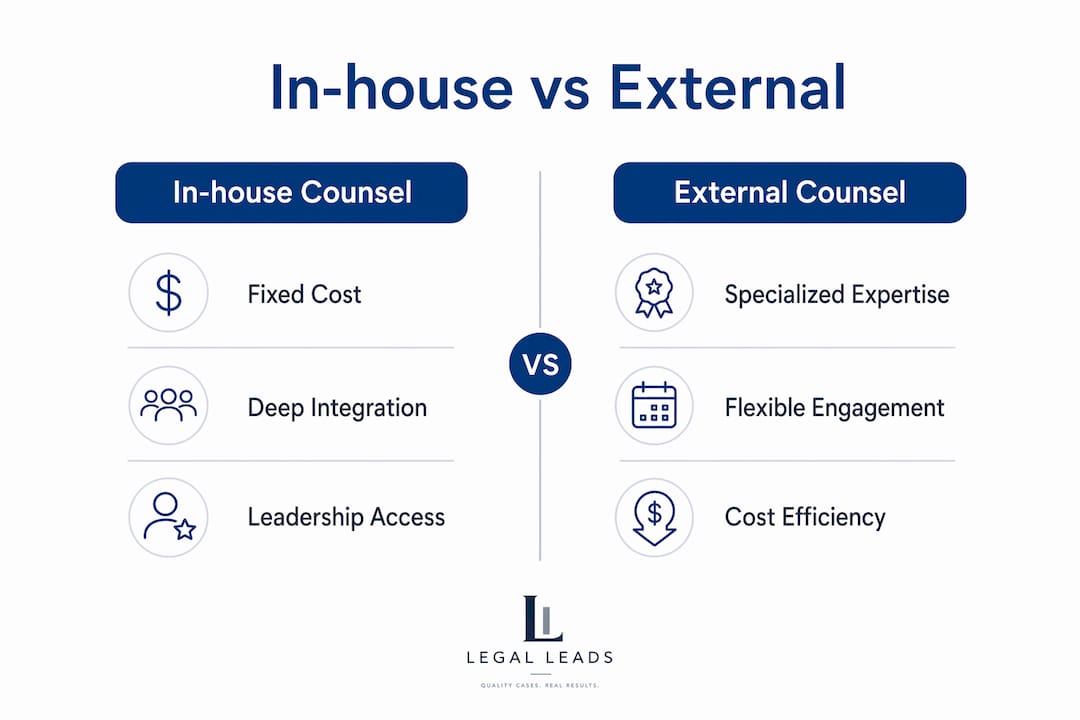
In-house counsel offers deep familiarity with your business. They attend leadership meetings, understand your products, and give real-time advice without billing by the hour. Large companies with high legal volume benefit most from this model. The tradeoff is cost. A full-time attorney carries salary, benefits, and overhead that most small businesses cannot justify.
External legal counsel gives you access to specialized expertise without the fixed cost. A small business owner can hire a business attorney for contract review, then bring in a separate IP specialist for a trademark filing, paying only for what is needed. Attorney-client matching platforms make this process faster by connecting you with attorneys whose experience fits your specific situation.
| Factor | In-house counsel | External legal counsel |
|---|---|---|
| Cost structure | Fixed salary and benefits | Hourly or project-based fees |
| Availability | Full-time, immediate access | Scheduled, may have other clients |
| Business knowledge | Deep, embedded familiarity | Builds over time with the client |
| Specialization | Generalist with broad scope | Access to multiple specialists |
| Best fit | Large companies, high legal volume | Small to medium businesses |
A generalist business lawyer often acts as a central risk manager, coordinating specialized counsel when needed. This model is preferred by small and medium businesses because it provides broad coverage without the cost of multiple retainers.
Pro Tip: If you are a small business owner, start with a generalist business attorney on retainer. They handle 80% of your needs and refer you to specialists for the rest.
When should business owners engage legal counsel?
The right time to engage legal counsel is before you need it, not after a problem surfaces. Engaging legal counsel before key business events, like forming entities, signing leases, or launching trademarked products, prevents costly structural mistakes that typically require expensive fixes within 1–3 years after startup.
The following trigger events signal that you need legal counsel immediately.
- Forming your business entity. The choice between an LLC and a corporation affects taxes, liability, and investor relations for years. Get counsel before you file.
- Signing your first commercial lease. Commercial leases are long, complex, and heavily weighted toward landlords. An attorney negotiates terms that protect you.
- Entering a partnership or shareholder agreement. Undefined ownership rights and exit terms are the leading cause of business partner disputes. Document everything before money changes hands.
- Hiring your first employee. Employment law obligations begin the moment you hire. Misclassification of workers and missing required policies create significant liability.
- Launching a product with a brand name or unique design. Trademark and copyright protection must be filed before competitors can claim your brand elements.
- Closing a financing round or taking on investors. Term sheets, convertible notes, and equity agreements require careful legal review to protect your ownership stake.
Retroactive legal fixes typically cost 3–5 times more than proper initial documentation. That figure alone makes the case for early engagement. The business owners who wait until a lawsuit arrives pay far more than those who invested in preventive counsel from the start.
What is the evolving role of legal counsel as a strategic advisor?
Business lawyers have shifted from adversarial roles to facilitators who structure deals and allocate risks in ways that benefit all parties. Corporate lawyers are now described as "handmaidens of the deal," a term that reflects their focus on creating legally sound transactions rather than simply winning arguments. This shift changes how you should think about your attorney's value.
Corporate counsel now serve as valued strategic advisors, with legal input sitting alongside financial and operational guidance at the highest decision-making levels. That means your attorney should be in the room when you are evaluating a major acquisition, entering a new market, or restructuring your company. Legal risk is business risk, and the two cannot be separated.
"Business lawyers now focus on facilitating legally sound transactions that benefit all parties, not just mitigating conflicts." — Corporate lawyer, Wikipedia
Proactive legal advice supports growth in concrete ways. An attorney who reviews your supplier contracts annually can identify unfavorable terms before renewal. One who monitors regulatory changes in your industry can alert you to compliance requirements before penalties apply. This is not crisis management. It is ongoing risk reduction that compounds over time.
The highest return on investment from legal counsel comes from preventive advice before contracts, leases, partnerships, or investments are finalized. Business owners who treat their attorney as a strategic partner, not a last resort, consistently spend less on legal costs over the life of their company.
Key Takeaways
Business legal counsel delivers the most value when engaged proactively, before contracts are signed, entities are formed, or disputes arise.
| Point | Details |
|---|---|
| Core definition | Business legal counsel is a qualified attorney providing ongoing legal advice, compliance support, and risk management. |
| Primary services | Counsel handles contracts, entity formation, employment compliance, IP protection, and dispute resolution. |
| In-house vs. external | Small and medium businesses benefit most from external generalist counsel who coordinates specialists as needed. |
| Best time to engage | Engage counsel before entity formation, contract signing, hiring, and any financing or partnership event. |
| Strategic value | Legal counsel now functions as a strategic business partner, not just a crisis responder. |
Why entrepreneurs consistently undervalue legal counsel
Most business owners I have worked with make the same mistake. They treat legal counsel as a fire extinguisher, something you grab only when something is burning. The reality is that the most expensive legal problems I have seen were entirely preventable. A partnership agreement drafted in a week costs a fraction of the litigation that follows when partners disagree and nothing is documented.
The entrepreneurs who get the most from their attorneys come prepared. Bringing a concise timeline and relevant documents to the initial consultation allows lawyers to identify deadlines and liability issues faster, which directly reduces billable hours. That preparation is not just courteous. It is financially smart.
The other misconception I see constantly is that a generalist attorney is somehow less valuable than a specialist. For most small businesses, the opposite is true. A generalist business lawyer serves as a hub managing overall legal risk and directing specialized counsel when necessary. That coordination function alone saves business owners from hiring three different attorneys and paying three separate retainers for work that overlaps.
My strongest advice: treat your business attorney the way you treat your accountant. Schedule regular check-ins, not just emergency calls. The ROI on that relationship shows up in disputes that never happen, contracts that hold up, and deals that close cleanly.
— Admin
Finding the right business attorney with Legalleads
Knowing you need legal counsel and finding the right attorney are two different problems. Legalleads solves the second one.

The Legalleads platform lets you describe your legal situation in plain English and receive a professional case brief in under two minutes. From there, you are matched with qualified attorneys experienced in business formation, contracts, employment law, and risk management, all within 24 hours. No calls, no complicated intake forms. You can find a qualified lawyer by practice area and location, or browse vetted attorneys to compare experience before you commit. Legalleads makes the first step toward solid legal protection fast and straightforward.
FAQ
What is the difference between a business lawyer and corporate counsel?
A business lawyer typically serves small to medium businesses on a range of general legal matters, while corporate counsel is a broader term for attorneys advising corporations, often in-house. Both roles cover contracts, compliance, and risk management.
When does a small business owner need legal counsel?
A small business owner needs legal counsel before forming a business entity, signing commercial leases, hiring employees, or entering partnership agreements. Early engagement prevents costly structural mistakes.
How much does business legal counsel cost?
Costs vary by engagement model. External attorneys typically charge hourly rates or flat fees for specific projects, while in-house counsel carries a fixed salary. External counsel is generally more cost-effective for businesses with moderate legal needs.
What does a business attorney do on a day-to-day basis?
A business attorney drafts and reviews contracts, advises on regulatory compliance, protects intellectual property, and counsels leadership on legal risks tied to business decisions. The work is largely preventive rather than reactive.
How do I find qualified legal counsel for my business?
Platforms like Legalleads match business owners with vetted attorneys by practice area and location, typically within 24 hours. Preparing a brief summary of your legal situation before the first consultation reduces time and cost.