
Legal representation timelines are the deadlines and critical time windows that determine whether you can protect your rights, preserve evidence, and secure a favorable outcome in any legal matter. Missing a single deadline can permanently close your case, regardless of how strong your facts are. Understanding why legal representation timelines matter is not optional knowledge. It is the foundation of every sound legal strategy.
Courts, attorneys, and opposing parties all operate on fixed schedules. The legal system enforces those schedules without sympathy. Early representation increases the likelihood of pretrial release by 28 percentage points and case dismissal by 36%. Those numbers reflect a clear pattern: timing shapes outcomes more than most people realize when they first face a legal problem.
Why legal representation timelines matter: the core deadlines
The legal system runs on a structured calendar of deadlines. Each type of case carries its own set of critical dates, and missing any one of them can end your case before it begins.
| Timeline type | Example | Impact of missing it |
|---|---|---|
| Post-arrest counsel window | Criminal cases: 24–48 hours | Risk of stacked charges, forced guilty plea |
| Statute of limitations | Personal injury: 2 years in most states | Permanent bar on filing any claim |
| Filing deadlines | Civil complaints, motions | Case dismissal on procedural grounds |
| Response windows | Answer to a lawsuit | Default judgment against you |
| Disability hearing dates | Social Security: 8–14 months wait | Loss of appeal rights, delayed benefits |
The 24–48 hour window after an arrest is the most urgent deadline in criminal law. An attorney secured within that window can influence plea negotiations, challenge evidence collection, and prevent prosecutors from building a stronger case through unchecked questioning.
Statutes of limitations are equally unforgiving. Missing filing windows permanently bars claims regardless of case merits. Courts grant dismissals on procedural grounds without exceptions in most cases. A valid personal injury claim with clear liability becomes worthless the day after the statute expires.
Social Security Disability claimants face a different kind of timeline pressure. Waiting periods of 8–14 months for initial hearings make early legal involvement critical to navigate the five-stage appeal process. Attorneys who work near hearing hubs handle that process more efficiently and maintain higher success rates.
- Secure criminal defense counsel within 24–48 hours of arrest
- File personal injury claims well before the statute of limitations expires
- Respond to all court documents within the required window to avoid default
- Engage a disability attorney at the application stage, not just at the appeal stage
- Track every court-ordered date as a hard deadline, not a suggestion
Pro Tip: Write every deadline on a physical calendar and set digital reminders 30 days, 7 days, and 24 hours before each date. Your attorney tracks these professionally, but you should track them independently as a backup.
How delays in securing legal representation affect your case
Delayed legal involvement does not simply slow things down. It actively damages your position in ways that are often irreversible.

Early representation can reduce pretrial jail time from 29 days to 6 days. That difference is not administrative. It reflects the direct impact of having an attorney present to argue for release, challenge detention conditions, and engage with prosecutors before positions harden.
Delayed lawyer involvement shifts the focus from strategy to damage control. Evidence disappears. Witnesses' memories fade. Opposing parties lock in their narratives. By the time a late-hired attorney reviews the case, the best options may already be gone.
A common misconception drives many of these delays. Most people wait too long to contact a lawyer because they believe doing so will escalate the conflict. The opposite is true. Early legal guidance clarifies rights, sets boundaries on communication, and often leads to faster, calmer resolutions.
The most common pitfalls caused by timeline delays include:
- Lost evidence. Surveillance footage is overwritten, accident scenes are cleared, and medical records become harder to obtain.
- Hardened opposing positions. Insurance adjusters and opposing counsel solidify their arguments before you have representation.
- Forced decisions. Without counsel, people accept plea deals or settlements under pressure that a lawyer would have rejected.
- Missed filing windows. A claim that could have been filed becomes permanently barred.
- Weakened credibility. Courts and juries notice gaps in documentation and response time.
Insurance adjusters rely on unrepresented claimants' lack of foresight, resulting in undervalued claims and premature settlements. Hiring a personal injury attorney early changes that dynamic immediately.
Why meeting legal deadlines is a fundamental risk management tool
Legal timelines are not just clerical deadlines. They are risk management tools that coordinate resources and reduce the chance of case disruption. Effective timeline management improves attorney performance and case outcomes across every practice area.
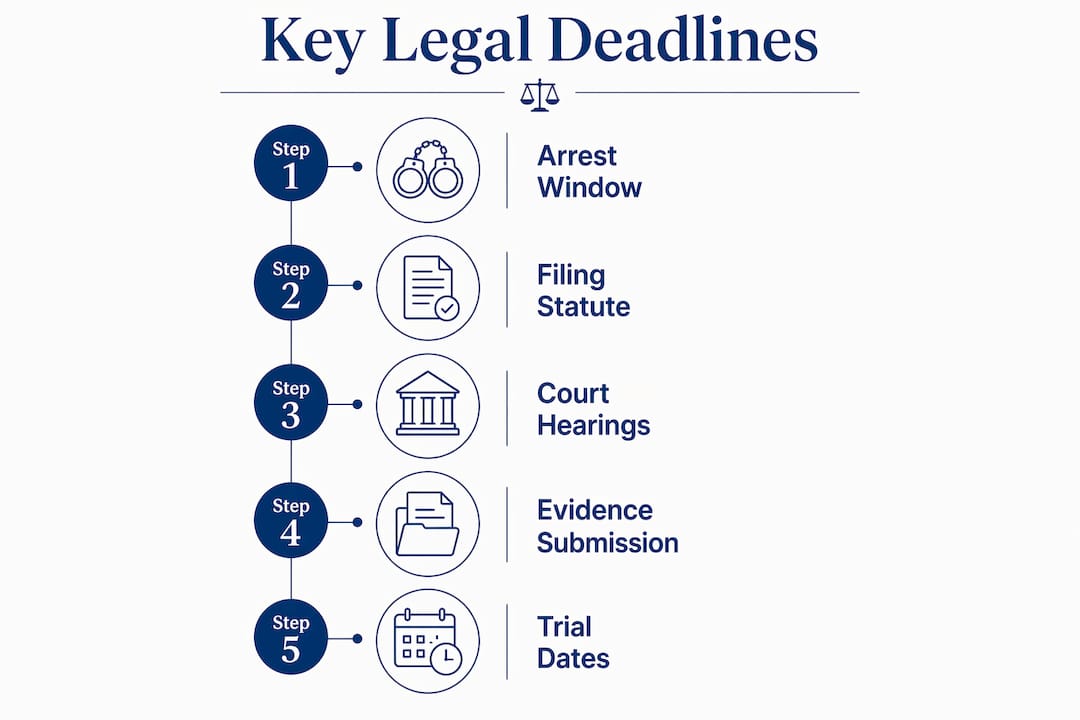
Courts set deadlines for a reason grounded in fairness. Memories fade and evidence disappears over time. Strict scheduling protects all parties by requiring prompt action. When one side delays, the other side gains an unfair advantage, and courts respond by enforcing deadlines without leniency.
Attorneys use timelines as strategic tools, not just administrative checklists. A well-constructed litigation timeline maps every procedural step, identifies dependencies between tasks, and flags risks before they become crises. Litigation timelines are dynamic and subject to adjustment as real-world developments unfold. That flexibility requires active management, not passive tracking.
The risks of overlooking deadlines include:
- Default judgments. If you fail to respond to a lawsuit in time, the court can rule against you automatically.
- Procedural dismissals. Cases dismissed on procedural grounds rarely get a second chance.
- Missed claims. In employment law cases, charges filed with the EEOC must meet strict windows or the right to sue is lost.
- Evidentiary gaps. A timeline with inconsistencies weakens case credibility and undermines attorney strategy.
Accurate timeline construction is vital evidence used to establish cause-and-effect relationships. Inconsistencies weaken case credibility and strategy. An attorney who builds a precise chronology gives the court a clear, verifiable account of events.
Pro Tip: Ask your attorney to provide a written timeline of all upcoming deadlines at your first meeting. Review it together and request updates whenever a court order or opposing filing changes the schedule.
Practical steps to make sure your legal timeline is handled correctly
Protecting your legal timeline starts before you hire an attorney. The actions you take in the first hours and days after a legal event directly affect what options remain available.
Gather and preserve every document related to your situation immediately. This includes contracts, medical records, correspondence, photos, receipts, and any written communication with opposing parties. Early hiring of a personal injury lawyer improves negotiation outcomes because the attorney can direct evidence collection from the start, before critical materials are lost or altered.
Work closely with your attorney to anticipate procedural requirements. Courts issue scheduling orders that govern every phase of a case, from discovery to trial. Missing a single date in that order can trigger sanctions or dismissal. Your attorney should walk you through each milestone and explain what is required of you at each stage.
Best practices for managing your legal timeline:
- Consult an attorney within 24–48 hours of any arrest, accident, or legal notice
- Create a dedicated folder (physical and digital) for all case documents
- Log every communication with opposing parties, insurers, or government agencies
- Ask your attorney to explain every deadline in plain language
- Set independent reminders for all key dates as a personal backup
- Request written confirmation of any deadline extensions granted by the court
Pro Tip: Use a free calendar app like Google Calendar to create a shared legal deadline calendar with your attorney's office. This keeps both parties aligned and reduces the risk of a missed date slipping through.
Attorneys who work near relevant courts or hearing centers process cases faster. Physical proximity to courts reduces procedural friction and bureaucratic delays. When selecting an attorney, location relative to the relevant courthouse is a practical factor worth considering.
Key Takeaways
Legal representation timelines are risk management tools that directly determine whether your rights are protected, your evidence is preserved, and your case reaches a fair resolution.
| Point | Details |
|---|---|
| Act within 24–48 hours | Securing counsel immediately after an arrest or legal event protects your strongest options. |
| Missed deadlines are permanent | Courts dismiss cases on procedural grounds without exceptions, regardless of case merits. |
| Delays cost you leverage | Late representation shifts focus to damage control and allows opposing positions to harden. |
| Timelines are strategic tools | Attorneys use case chronologies to build credibility and manage risk across every phase. |
| Early action improves outcomes | Early representation increases pretrial release likelihood by 28 percentage points. |
The timeline lesson most clients learn too late
The clients I see struggle most are not the ones with weak cases. They are the ones who waited. They waited to call a lawyer because they thought the situation would resolve itself. They waited because they assumed legal help was only for serious matters. By the time they reached out, evidence was gone, deadlines had passed, and their options had narrowed to a fraction of what they once were.
What strikes me most is how often the delay comes from a misunderstanding about what lawyers actually do in the early stages. People assume that contacting an attorney signals aggression or escalation. The reality is the opposite. An attorney's first job is to assess the situation clearly and help you understand what you are actually facing. That clarity alone is worth the early call.
Timelines also determine who controls the pace of a case. When you act early, your attorney sets the agenda. When you delay, the opposing side sets it for you. That shift in control has consequences that compound over time. A case that starts with strong evidence and a clear timeline is a case your attorney can build around. A case that starts with gaps and missed windows is a case your attorney has to defend around.
The legal system is not designed to wait for you to feel ready. It moves on a fixed schedule, and the clock starts the moment a legal event occurs. Respecting that reality is not pessimism. It is the most practical thing you can do for yourself.
— Admin
How Legalleads connects you with attorneys who prioritize your timeline
Timing is the one factor you cannot recover once it is lost. Legalleads is built to close the gap between a legal event and qualified attorney contact.
The Legalleads platform lets you describe your situation in plain English and receive a professional case brief in under two minutes. From there, you are connected with a qualified attorney within 24 hours, with no calls, no complicated forms, and no delays. Attorneys on the platform cover criminal defense, family law, employment, and personal injury cases, all areas where timeline adherence directly affects outcomes. Find a lawyer through Legalleads and put qualified representation in place before another deadline passes.
FAQ
What happens if I miss a statute of limitations?
Missing a statute of limitations permanently bars your claim. Courts dismiss cases on procedural grounds without exceptions, regardless of how strong the underlying facts are.
How soon should I contact a lawyer after an arrest?
Contact a lawyer within 24–48 hours of an arrest. Early counsel can influence plea negotiations, challenge evidence, and significantly reduce pretrial jail time.
Does hiring a lawyer early really improve my outcome?
Early legal representation increases the likelihood of pretrial release by 28 percentage points and case dismissal by 36%. It also preserves evidence and prevents opposing parties from locking in their positions unchallenged.
What is a statute of limitations?
A statute of limitations is the legal deadline by which a claim must be filed. Each case type carries its own window, ranging from one year to several years depending on the state and the nature of the claim.
Can I track legal deadlines myself without an attorney?
You can track deadlines independently using calendar tools, but an attorney must identify and confirm the correct deadlines for your specific case. Self-tracking is a backup measure, not a substitute for professional legal guidance.