
Evidence is defined as any information presented in court to prove or disprove a fact at issue in a legal dispute. The role of evidence in legal cases determines whether a party wins or loses, whether a defendant goes free or faces conviction, and whether justice is served or denied. Courts do not decide cases on intuition or argument alone. Every factual claim must be supported by evidence that meets strict legal standards. Understanding how evidence works gives law students, legal professionals, and anyone preparing for court a real advantage.
What legal standards define the role of evidence in legal cases?
Evidence must be relevant and admissible to be considered by a court. Relevance means the evidence logically relates to a fact that matters to the case. Admissibility means the evidence satisfies procedural and constitutional requirements set by rules like the Federal Rules of Evidence. Meeting both thresholds is not optional. Fail either one, and the evidence stays out.
The Federal Rules of Evidence govern federal courts and serve as the model for most state court systems. These rules define what qualifies as relevant, what counts as hearsay, and when expert testimony is appropriate. They exist to protect juries from confusion and to preserve constitutional rights, particularly in criminal proceedings.

Judges hold the gatekeeper role in this process. Trial judges decide which evidence gets admitted and which gets excluded, based on relevance and proper foundation. A judge who admits evidence without proper authentication, or who allows unfairly prejudicial material, creates grounds for appeal. That gatekeeper function shapes the entire trial.
One key concept every legal professional must understand is the balance between probative value and prejudicial effect. Evidence can be relevant but still excluded if its potential to unfairly sway the jury outweighs its logical value. A graphic photograph, for example, might be relevant to a murder charge but so inflammatory that a judge bars it from the jury's view.
- Evidence must logically connect to a material fact in the case
- Admissibility requires compliance with procedural rules, not just factual relevance
- Hearsay is generally excluded unless a recognized exception applies
- Judges weigh probative value against the risk of unfair prejudice
- Foundational authentication is required before most physical or digital evidence is admitted
Pro Tip: When preparing evidence for court, document every procedural step from collection to presentation. Judges exclude technically strong evidence when the foundation is missing.
How do evidentiary standards differ between criminal and civil cases?
The burden of proof is not the same in every courtroom. Criminal prosecutions require proof beyond a reasonable doubt, while civil litigation requires proof on the balance of probabilities. That difference reshapes how attorneys build cases and how juries evaluate evidence.
In a criminal case, the prosecution carries the entire burden. The defense does not need to prove innocence. It only needs to create reasonable doubt in the jury's mind. A single piece of contradictory evidence, a credible alibi witness, or a gap in the chain of custody can be enough. The stakes are higher because liberty is on the line.
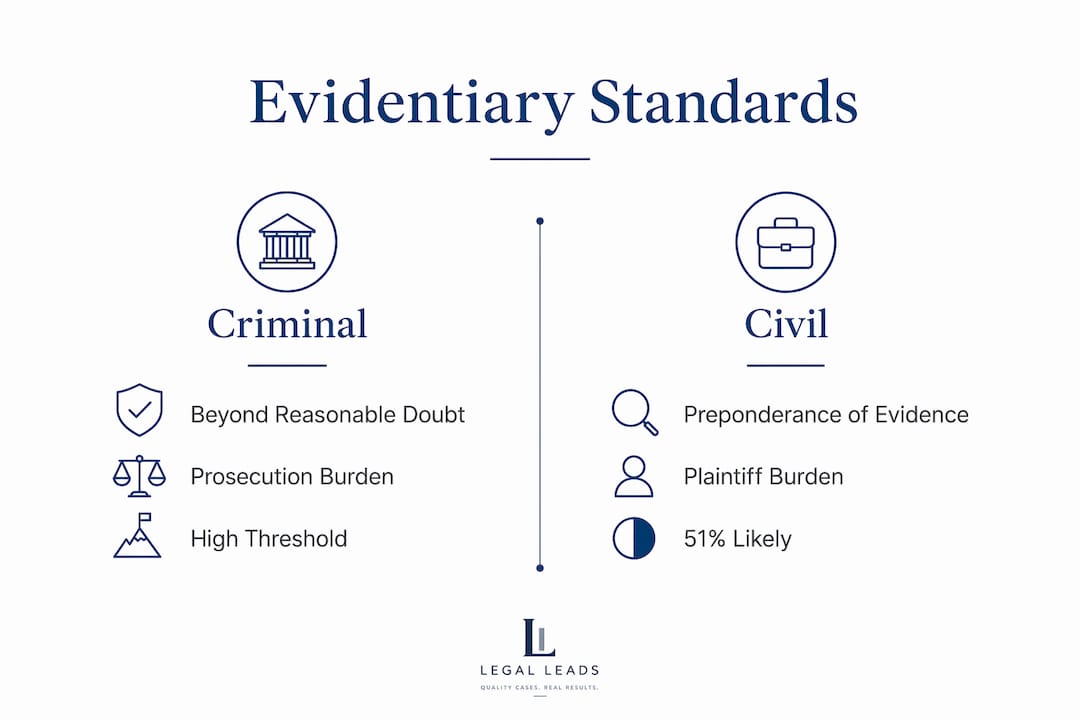
Civil cases operate differently. The plaintiff must show that their version of events is more likely true than not. A 51% probability is enough to win. That lower threshold means weaker evidence can still carry the day, and the impact of evidence on litigation outcomes is often determined by volume and consistency rather than a single decisive fact.
| Standard | Case type | Burden holder | Threshold |
|---|---|---|---|
| Beyond a reasonable doubt | Criminal | Prosecution | Near certainty of guilt |
| Balance of probabilities | Civil | Plaintiff | More likely true than not |
| Clear and convincing evidence | Some civil matters | Plaintiff | Substantially more probable |
The practical implication is significant. A defendant acquitted in a criminal trial can still lose a civil lawsuit based on the same conduct. The O.J. Simpson case is the most cited American example. Criminal acquittal did not prevent a civil judgment against him. The evidence was the same. The standard was different.
What are the main types of evidence used in court?
Courts recognize several distinct categories of evidence, and each serves a different function in building or dismantling a legal argument.
Physical evidence includes tangible objects such as weapons, documents, DNA samples, and fingerprints. These items must be authenticated before admission. Chain of custody records every transfer and handling of physical evidence to prove it remains unaltered from the moment of collection to the moment it appears in court. A break in that chain gives opposing counsel grounds to challenge admissibility.
Testimonial evidence comes from witnesses who testify under oath. Fact witnesses describe what they personally observed. Expert witnesses go further. Under Rule 702 of the Federal Rules of Evidence, expert testimony must be based on thorough and reliable methods. A forensic accountant who cannot explain their methodology, or a medical expert who relies on outdated studies, risks having their testimony excluded or discredited.
Circumstantial evidence does not directly prove a fact but allows a reasonable inference. A defendant's fingerprints at a crime scene do not prove they committed the crime. They prove presence, from which guilt may be inferred. Courts treat circumstantial evidence as fully valid. Many convictions rest entirely on it.
Digital evidence is now a defining category in modern litigation. Emails, text messages, social media posts, GPS data, and device metadata all qualify. Digital evidence and metadata such as timestamps and device identifiers are outcome-determinative in many cases. Forensic analysis is required to verify integrity, and early preservation is critical. Deleted files, overwritten data, or unpreserved metadata can permanently destroy a case.
- Physical evidence requires documented chain of custody from collection through trial
- Expert witnesses must apply rigorous, accepted methodologies under Rule 702
- Circumstantial evidence is legally valid and frequently decisive in criminal convictions
- Digital evidence must be forensically preserved and authenticated before admission
- Documentary evidence, including contracts and records, must be authenticated through witness testimony or certification
Pro Tip: In cases involving digital evidence, retain a forensic specialist before litigation begins. Courts increasingly reject digital evidence that was not preserved using accepted forensic protocols.
How does handling and presentation of evidence affect legal outcomes?
The quality of evidence matters. How it is handled matters just as much. Procedural failures in evidence management are among the most common causes of trial error and appellate reversal.
-
Chain of custody failures. Physical evidence excluded for chain of custody gaps has derailed prosecutions in high-profile cases. The 1995 O.J. Simpson murder trial is the most studied example in American legal education. Defense attorneys successfully challenged the handling of blood samples, and that challenge contributed to acquittal.
-
Evidentiary errors on appeal. Improper admission or exclusion of evidence is one of the most frequent trial errors cited in appeals. When a judge admits evidence that should have been excluded, or bars evidence that was properly authenticated, the error can taint the entire verdict. Appellate courts review these rulings and may order new trials.
-
Jury perception and narrative. Juries build mental narratives from the evidence they see and hear. Evidentiary errors distort that narrative. Even inadmissible evidence can influence jurors if they are exposed to it before a ruling excludes it. A curative instruction from the judge helps, but research on jury behavior shows that exposure itself leaves an impression.
-
Expert witness credibility. An expert who cannot withstand cross-examination on methodology undermines the entire side that called them. Courts now require that experts apply real-world scientific standards to avoid unfair bias in jury deliberations. Selecting the right expert is as important as finding the right evidence.
"Evidence rules manage how truth is presented to protect juries from confusion and ensure constitutional rights, particularly in criminal cases." — U.S. Courts
Key Takeaways
The role of evidence in legal cases is to establish facts through materials that meet strict standards of relevance, admissibility, and proper handling, directly determining case outcomes in both criminal and civil courts.
| Point | Details |
|---|---|
| Relevance and admissibility | Evidence must meet both thresholds to be considered; failing either standard means exclusion. |
| Burden of proof varies | Criminal cases require proof beyond a reasonable doubt; civil cases require the balance of probabilities. |
| Chain of custody is non-negotiable | Physical and digital evidence excluded for handling failures can collapse an otherwise strong case. |
| Digital evidence needs early action | Metadata and digital records must be preserved forensically before litigation begins or they may be lost. |
| Evidentiary errors drive appeals | Improper admission or exclusion of evidence is one of the most common grounds for appellate reversal. |
Why evidence strategy is the real difference-maker in court
Working through evidence issues across different case types reveals one consistent pattern: attorneys who treat evidence as a procedural checkbox lose cases they should win. The lawyers who succeed treat evidence strategy as the core of case preparation, not an afterthought.
Digital evidence is where I see the most preventable mistakes. Clients arrive with text messages, emails, and surveillance footage that could win their case. But the metadata was never preserved, the device was reset, or the footage was downloaded without forensic verification. Courts are increasingly strict about this. A screenshot is not evidence. A forensically authenticated file with documented chain of custody is evidence.
The judge's gatekeeper role is also underestimated by people preparing for court without legal counsel. Judges have wide discretion in evidentiary rulings. An attorney who anticipates those rulings, files motions in limine before trial, and prepares arguments for and against admission is operating at a different level than one who raises objections reactively. Preparation before the trial date is where evidence battles are actually won.
The other observation worth sharing: circumstantial evidence is consistently undervalued by non-lawyers. Clients often say "there's no direct proof." That framing misunderstands how courts work. A chain of circumstantial evidence, each link properly authenticated and presented, is legally sufficient for conviction or judgment. The strength is in the chain, not any single link.
— Admin
Finding the right attorney to handle your evidence
Evidence law is technical. The difference between a properly authenticated exhibit and an excluded one can determine the outcome of your entire case.

Legalleads connects you with qualified attorneys who understand evidence standards, chain of custody requirements, and courtroom procedure. Whether you need a criminal defense lawyer or representation in a civil matter, Legalleads matches you with the right legal professional in under 24 hours. Describe your situation in plain English, receive a professional case brief in under two minutes, and get connected without calls or complicated forms. Find a qualified lawyer through Legalleads and make sure your evidence is in the right hands from day one.
FAQ
What is the role of evidence in legal cases?
Evidence is any information used to prove or disprove a fact at issue in a legal dispute. Courts rely on evidence to establish truth and reach verdicts, making it the foundation of every legal proceeding.
What makes evidence admissible in court?
Evidence must be relevant to a material fact and satisfy procedural requirements under rules like the Federal Rules of Evidence. Judges act as gatekeepers, excluding evidence that is irrelevant, improperly obtained, or unfairly prejudicial.
What is the difference between direct and circumstantial evidence?
Direct evidence proves a fact without requiring an inference, such as eyewitness testimony. Circumstantial evidence requires the jury to draw a reasonable inference, and courts treat it as equally valid in reaching a verdict.
How does digital evidence affect case outcomes?
Digital evidence such as emails, GPS data, and device metadata can be outcome-determinative in modern cases. It must be forensically preserved and authenticated early, because lost or altered metadata is often permanently inadmissible.
Why do evidentiary errors matter on appeal?
Improper admission or exclusion of evidence is one of the most frequent grounds for appeal in American courts. These errors can distort jury perception and result in reversed verdicts or orders for new trials.