Documenting your injury for attorney review means compiling accurate, complete records that prove your injury occurred, show its severity, and connect it directly to the incident that caused it. Personal injury attorneys rely on this evidence to assess legal merit, calculate damages, and build a claim that holds up under scrutiny. A complete case file includes medical records and bills, police or incident reports, photographs, witness contact information, and a written timeline. Without these, even a legitimate claim can fall apart before it reaches a settlement table.
What documents and evidence do you need to document injury for attorney review?
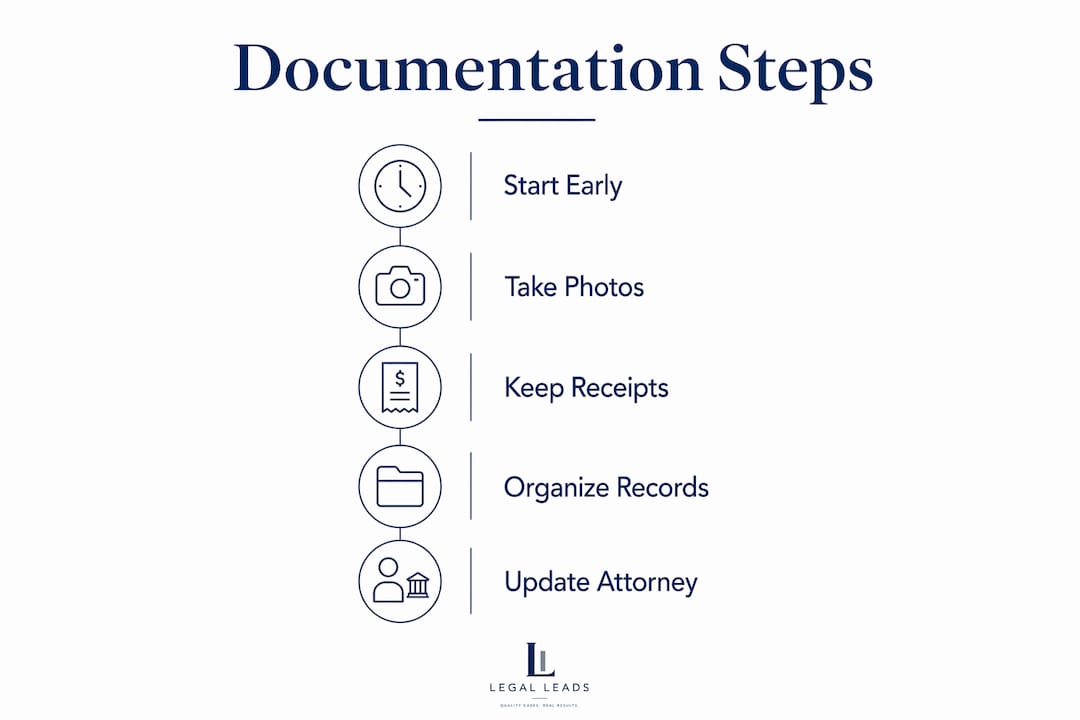
The injury documentation process starts within hours of the incident, not days. Start documenting injuries and accident details within 24–48 hours, including photographs with a scale reference, emergency room records, and a pain journal with date, time, and pain ratings. Waiting longer allows injuries to heal visually, memories to fade, and physical evidence to disappear.
The core documents every personal injury claimant needs to collect are:
- Medical records and bills from every provider, including emergency rooms, primary care physicians, specialists, and physical therapists
- Police or incident reports filed at the scene, which establish the official record of what happened
- Photographs of visible injuries, the accident scene, property damage, and any contributing hazards
- Witness contact information including full names, phone numbers, and a brief note on what each person saw
- A written timeline covering the incident, each medical visit, missed workdays, and any follow-up appointments
- Receipts and expense logs for out-of-pocket costs like prescriptions, medical equipment, and transportation to appointments
Photographs deserve special attention. Shoot injuries against a neutral background, include a ruler or coin for scale, and take multiple angles. Repeat this process every few days to document how bruising, swelling, or wounds progress over time. Ongoing photos show treatment relevance in a way that a single snapshot cannot.
Pro Tip: Keep a dedicated folder, physical or digital, for every receipt related to your injury from day one. Attorneys use these to calculate special damages, and missing receipts are nearly impossible to reconstruct later.

How to organize and present your injury documentation effectively
An attorney-ready evidence packet is organized chronologically and grouped by document type. Organized, complete documentation helps attorneys analyze legal merit and identify case challenges faster. Disorganized files slow the review process and increase the chance that critical records get overlooked.
Follow these steps to build a clear, attorney-ready packet:
- Create a master timeline. List every relevant event in date order: the incident, each medical visit, missed workdays, and follow-up appointments. A simple timeline from incident through treatment helps attorneys and insurers verify claim validity by comparing dates across all records.
- Group records by provider and date. Place all records from a single provider together in date order. Separate emergency records, specialist notes, imaging results, therapy progress notes, and billing statements into labeled sections.
- Include witness information with context. List each witness name, contact number, and a one-sentence description of their vantage point. This saves your attorney time when deciding who to contact for statements.
- Start and maintain a symptom journal. Write a daily entry covering your pain level on a 1–10 scale, specific symptoms, and how your injury limits daily activities. Attorneys want documentation of functional limitations, not just pain intensity. Bring this journal to every medical appointment so your doctor can connect your reported symptoms to treatment decisions.
- Add a cover sheet. One page summarizing the incident date, injury type, providers seen, and total documented expenses gives your attorney an instant overview before reading the full file.
Pro Tip: Use a free tool like Google Drive or a physical three-ring binder with labeled tabs to keep everything in one place. Digital folders make it easy to share files with your attorney without losing originals.
How do attorneys review medical records and why completeness matters?
Medical record review is the core of any personal injury attorney's case preparation. Attorneys check whether records support injury claims, confirm timeline consistency, establish causation arguments, and verify that key documents like imaging and therapy notes are present. They also look for billing alignment, meaning the charges on your invoices should match the treatments documented in clinical notes.
Building an attorney-ready evidence chain means linking clinical timestamps from the emergency baseline through specialist visits and therapy progress. This chronological chain lets your attorney verify the injury and damages timeline without relying on your word alone. Gaps in that chain raise questions that opposing counsel will exploit.
Attorneys specifically look for these red flags during their review:
- Gaps in treatment. Missing weeks or months between appointments suggest the injury was not serious enough to require consistent care.
- Inconsistent histories. If you described the incident differently to different providers, those discrepancies appear in the records and undermine credibility.
- Missing imaging or diagnostic results. A claimed back injury without X-rays, MRIs, or CT scans is difficult to prove.
- Absent mental health or pain records. Claims for emotional distress or chronic pain require documented clinical support, not just self-reporting.
- Billing without corresponding notes. Charges that lack matching clinical documentation raise fraud concerns and weaken the entire file.
A well-documented injury file does not just support your claim. It reduces the time your attorney spends reconstructing evidence and increases the credibility of every demand made on your behalf.
How to request and obtain medical records for your case
HIPAA grants you the legal right to access your own medical records. Under HIPAA, providers must fulfill record requests within 30 days, though reasonable fees may apply. Knowing this right prevents providers from stalling your request.
Follow these steps to obtain records efficiently:
- Submit a written request to each provider. Ask specifically for all clinical notes, imaging results, lab reports, therapy progress notes, and billing statements related to your injury.
- Request both electronic and paper copies. Electronic copies are easier to share with your attorney. Paper copies serve as backups.
- Ask for records from every provider you visited. This includes urgent care clinics, ambulance services, and any specialist you saw even once.
- Verify completeness when records arrive. Check that every visit date appears in the records. Missing dates mean missing documentation.
- Keep your own copies before submitting anything to your attorney. Never hand over originals without retaining a duplicate set.
Providers sometimes send incomplete files. If a record set covers fewer visits than you actually had, call the medical records department directly and request the missing dates by name.
Common mistakes that weaken your injury claim
Common documentation failures include missing appointments, stopping treatment early, and incomplete mental health or pain level records. These errors reduce settlement value because they suggest the injury was minor or resolved quickly. Insurance adjusters and opposing attorneys look for exactly these gaps.
The most frequent mistakes claimants make are:
- Stopping treatment before a doctor clears them. Early treatment stoppage signals recovery and undercuts ongoing damage claims.
- Failing to photograph injuries at multiple points in time. A single photo taken days after the incident does not show the full progression.
- Not reporting all symptoms to their doctor. If a symptom is not in the clinical notes, it effectively does not exist for legal purposes.
- Losing or discarding receipts and expense records. Out-of-pocket costs are recoverable damages, but only with documentation.
- Waiting too long to consult an attorney. Legal representation timelines affect what evidence is still available and what deadlines apply to your claim.
The fix for most of these errors is consistency. Attend every scheduled appointment, report every symptom, and update your records every time something changes.
Pro Tip: Send your attorney a brief update by email whenever you have a new medical visit, a new expense, or a change in symptoms. This keeps your file current and prevents gaps from forming.
Key takeaways
Thorough, chronological injury documentation gives your attorney the evidence needed to build a credible claim and negotiate from a position of strength.
| Point | Details |
|---|---|
| Start documenting immediately | Collect photos, ER records, and a pain journal within 24–48 hours of the incident. |
| Organize by date and provider | Group records chronologically and by provider type to speed up attorney review. |
| Maintain a symptom journal | Record daily pain levels and functional limitations to support damage claims. |
| Request complete medical records | Use your HIPAA rights to obtain all clinical notes, imaging, and billing from every provider. |
| Avoid treatment gaps | Consistent medical care prevents insurers from arguing your injury was minor or resolved early. |
What I have seen make or break injury cases
After reviewing how personal injury claims succeed and fail, one pattern stands out clearly. The claimants who receive the strongest outcomes are not always the ones with the most severe injuries. They are the ones who documented everything from the start.
Attorneys work with what you give them. Effective medical record review aligns client-reported timelines and injury causation with clinical documentation to prepare strong settlement demands. When your records are incomplete, your attorney has to fill gaps with arguments instead of evidence. Arguments are weaker than facts.
The symptom journal is the most underused tool in personal injury documentation. Most claimants skip it because it feels tedious. But symptom journals with pain ratings and functional limitation descriptions directly support treatment decisions and damage claims in ways that medical records alone cannot capture. A doctor's note says you reported pain. Your journal shows how that pain affected your ability to work, sleep, and care for your family.
Start your documentation the same day the incident happens. Do not wait to feel worse or to decide whether you need an attorney. The records you create in the first 48 hours are often the most credible because they are closest to the event.
— Admin
Find a personal injury attorney who knows what to look for
Proper injury claims documentation is only half the equation. The other half is having an attorney who knows how to use it.

Legalleads connects you with qualified personal injury attorneys who specialize in reviewing injury files and building claims from the ground up. Describe your situation in plain English, receive a professional case brief in under two minutes, and get matched with a qualified attorney within 24 hours. No calls, no complicated forms. Use Legalleads to find a lawyer who can review your documentation and tell you exactly where your claim stands.
FAQ
What documents does an attorney need to review an injury claim?
A complete injury file includes medical records and bills, police or incident reports, photographs, witness contact information, and a written timeline of the incident and treatment. Attorneys use these to assess claim validity and match facts to documented injuries.
How soon should I start documenting my injury?
Document visible injuries and accident details within 24–48 hours of the incident. Early documentation captures injury severity before healing begins and preserves evidence that may otherwise disappear.
What are my rights to access my own medical records?
HIPAA grants you the right to request copies of your medical records from any provider. Providers must fulfill requests within 30 days and may charge reasonable fees for copies.
Why does a gap in medical treatment hurt my injury claim?
Gaps in treatment suggest to insurers and opposing counsel that your injury was not serious enough to require consistent care. Missing appointments or stopping treatment early can reduce the settlement value of your claim.
What is a symptom journal and why does it matter?
A symptom journal is a daily record of your pain levels, specific symptoms, and how your injury limits daily activities. Attorneys use it to document functional limitations that medical records alone do not capture, which directly supports damage claims.