
California is an at-will state under Labor Code §2922, so an employer can fire you for almost any reason, or no reason at all. But firing you for an illegal reason changes everything.
A termination becomes wrongful when the real motive is discrimination under the Fair Employment and Housing Act (FEHA), retaliation for reporting misconduct, whistleblowing, a violation of public policy, or a breach of contract. When that's the case, you may be entitled to reinstatement, back pay, and damages.
- The reason behind the firing matters more than the firing itself.
- Deadlines to file vary by claim type, some as short as 180 days.
- Acting fast preserves both evidence and your legal options.
Key Takeaways
A California firing is wrongful when the true reason violates FEHA, retaliation protections, whistleblower law, public policy, or an employment contract, and every claim type carries its own filing deadline.
| Point | Details |
|---|---|
| At-will has limits | §2922 sets the default, but FEHA and Tameny carve out illegal reasons to fire someone. |
| Timing signals retaliation | Termination within roughly 90 days of protected activity often supports an inference of retaliation. |
| Deadlines vary sharply | CRD gives about 3 years, EEOC gives 180 or 300 days, and some Labor Code claims allow just 1 year. |
| Documentation comes first | Request your personnel file and wage records in writing before deadlines start slipping. |
| Legalleads speeds up matching | A plain-English intake produces a case brief in minutes and an attorney match within 24 hours. |
This article is general information, not a substitute for advice from a qualified lawyer. Consult a qualified legal professional about your own circumstances before acting on anything here.
Table of Contents
- What Wrongful Termination Means Under California Employment Law
- Common Unlawful Reasons and the Red Flags to Watch For
- Evidence Checklist: What to Save Before You Do Anything Else
- Where to File Your Claim and How Long You Have
- When to Talk to an Employment Attorney and What It Costs
- Your First 30 Days: What to Do Right Now
- What to Do if Your Employer Retaliates After You File
- An Honest Read on What Actually Moves These Cases Forward
- Get a Case Brief and an Attorney Match Without the Runaround
- Sources
- FAQ
What Wrongful Termination Means Under California Employment Law
At-will employment means your employer doesn't need cause to let you go. Labor Code Article 4 codifies that presumption, but California courts carved out a major exception in Tameny v. Atlantic Richfield Co.: you can't be fired for reasons that violate a fundamental public policy, even if you're at-will.
FEHA prohibits termination based on race, sex, age, disability, religion, pregnancy, sexual orientation, and several other protected categories. It applies to employers with five or more employees, and it covers more ground than federal anti-discrimination law, including uncapped compensatory damages in successful cases.
Separately, whistleblower protections under Labor Code §1102.5 shield employees who report suspected legal violations, internally or to a government agency. Labor Code §6310 extends similar protection to workers who report unsafe conditions, and can trigger a parallel federal OSHA complaint.
- At-will (§2922) is the default, not the whole story.
- FEHA covers discrimination and harassment-based firings.
- §1102.5 and §6310 protect whistleblowers and safety reporters.
- Some claims require an administrative filing before you can sue.
Quick fact: FEHA claims typically require filing with the California Civil Rights Department before you can go to court, and that filing window is usually three years from the termination date.
Common Unlawful Reasons and the Red Flags to Watch For
Most wrongful termination cases don't come with a smoking gun. They come with a pattern.
- Discrimination: You're fired shortly after disclosing a pregnancy, a disability, or your age, while similarly-situated coworkers keep their jobs.
- Retaliation: You file an internal harassment complaint, and weeks later you're written up for something you'd never been flagged for before.
- Whistleblowing: You report safety violations or suspected fraud, and your hours get cut right after.
- Firing after protected leave: You return from medical or family leave and find your position "eliminated."
- Breach of contract: Your offer letter promised progressive discipline, and you were fired without any warning at all.
Timing is often the strongest clue. When termination follows protected activity within roughly 90 days, courts and agencies are more willing to infer retaliation. Inconsistent explanations, shifting performance narratives, or being replaced by someone outside your protected class all point toward pretext.
Pro Tip: Write down the exact date of any protected activity, like filing a complaint or requesting leave, next to the date you were fired. That gap is often the first thing an attorney or investigator checks.
Evidence Checklist: What to Save Before You Do Anything Else
Evidence disappears fast once you're locked out of your work email. Start collecting immediately, even if you're not sure yet whether you'll file a claim.
- Emails and texts referencing your performance, complaints, or leave requests
- Performance reviews, especially any that contradict the stated reason for termination
- Written warnings or the absence of them, if your employer claims a disciplinary history
- Pay stubs, offer letters, and benefit statements
- Names and contact information for coworkers who witnessed relevant events
- Verbatim notes of anything a manager said about the termination, with dates
You also have statutory rights to employer records. Under Labor Code §1198.5, you can request a copy of your personnel file, and your employer generally has 30 days to produce it. Under Labor Code §226, you're entitled to wage statements covering your employment. Send these requests in writing, keep a copy, and note the date sent.
If you still have access to work devices, don't delete anything, but also don't take confidential company data. Preserve what's yours: personal emails, texts on your own phone, and documents you're legally entitled to.

| Point | Details |
|---|---|
| Request personnel file | Ask in writing under §1198.5; employer has 30 days to respond. |
| Save communications | Screenshot or forward emails and texts before losing account access. |
| Log witnesses | Write down names and what each person saw or heard, with dates. |
Where to File Your Claim and How Long You Have
Filing in the wrong place, or too late, can permanently close the door on relief. Each claim type has its own venue and its own clock.
| Claim Type | Where to File | Typical Deadline |
|---|---|---|
| FEHA discrimination/harassment | California Civil Rights Department (CRD) | Within a few years |
| Federal discrimination | Equal Employment Opportunity Commission (EEOC) | Within several months |
| Wage/retaliation under Labor Code | Labor Commissioner (DLSE) | Typically within about a year |
| Workers' comp retaliation | Workers' Compensation Appeals Board (WCAB) | Varies by claim |
| Public policy (Tameny) or contract breach | Superior Court | Set by civil statute of limitations |
FEHA claims generally go through the CRD first, and you'll need a right-to-sue letter before heading to court. Federal discrimination claims go to the EEOC, and the CRD and EEOC often cross-file so you don't have to submit twice. Labor Code retaliation and wage complaints, including safety-related retaliation under §6310, typically go to the Labor Commissioner, and some OSHA-related complaints must reach federal OSHA within 30 days.
Not every claim requires this administrative detour. Tameny-based public-policy claims and straightforward breach-of-contract cases can often go directly to Superior Court.
- Some Labor Code sections, like §1197.5 on equal pay, allow up to two years to file.
- Missing a 180-day EEOC window doesn't necessarily kill a parallel CRD claim, but don't count on it.
- When in doubt about venue, file with more than one agency rather than guessing wrong.
When to Talk to an Employment Attorney and What It Costs
Some situations call for a lawyer right away, not after you've sat on the decision for a month.
- You've been handed a severance agreement with a release of claims and a deadline to sign
- Your filing window is already ticking, especially anything under 180 days
- Your case involves multiple overlapping claims (discrimination plus retaliation plus contract)
- Your employer is pressuring you to sign something before you've had time to think
Most employment attorneys in California offer a free or low-cost initial consultation to evaluate whether your case has merit. During that consult, expect to walk through your timeline, hand over the documents you've collected, and get a candid read on your options. If a lawyer takes the case, contingency fees are standard, often landing somewhere between 25% and 40% of any recovery, though hourly arrangements exist for certain matters.
Pro Tip: Bring a simple written timeline to your first consult, dates, names, and what happened. A clear intake summary helps an attorney assess your case in minutes instead of an hour.
If you're not sure where to start, Legalleads turns your situation into a professional case brief in under two minutes and matches you with employment attorneys covering areas like Irvine and Riverside within 24 hours, without the back-and-forth of cold-calling firms.
Your First 30 Days: What to Do Right Now
- Do not sign a severance release or any waiver until an attorney has reviewed it.
- Save every document and message tied to your employment, starting today.
- Request your personnel file and wage records in writing.
- Apply for unemployment benefits promptly; a wrongful termination claim doesn't disqualify you.
- Note every deadline that applies to your claim type, and mark the earliest one first.
- Get a quick attorney consult, or generate a case brief through a service like Legalleads to speed up matching.
The single biggest mistake is delay. Records get harder to find, memories fade, and short filing windows close while you're still deciding what to do.
What to Do if Your Employer Retaliates After You File
Retaliation after you file a complaint is itself illegal, and it often strengthens your original case rather than weakening it.
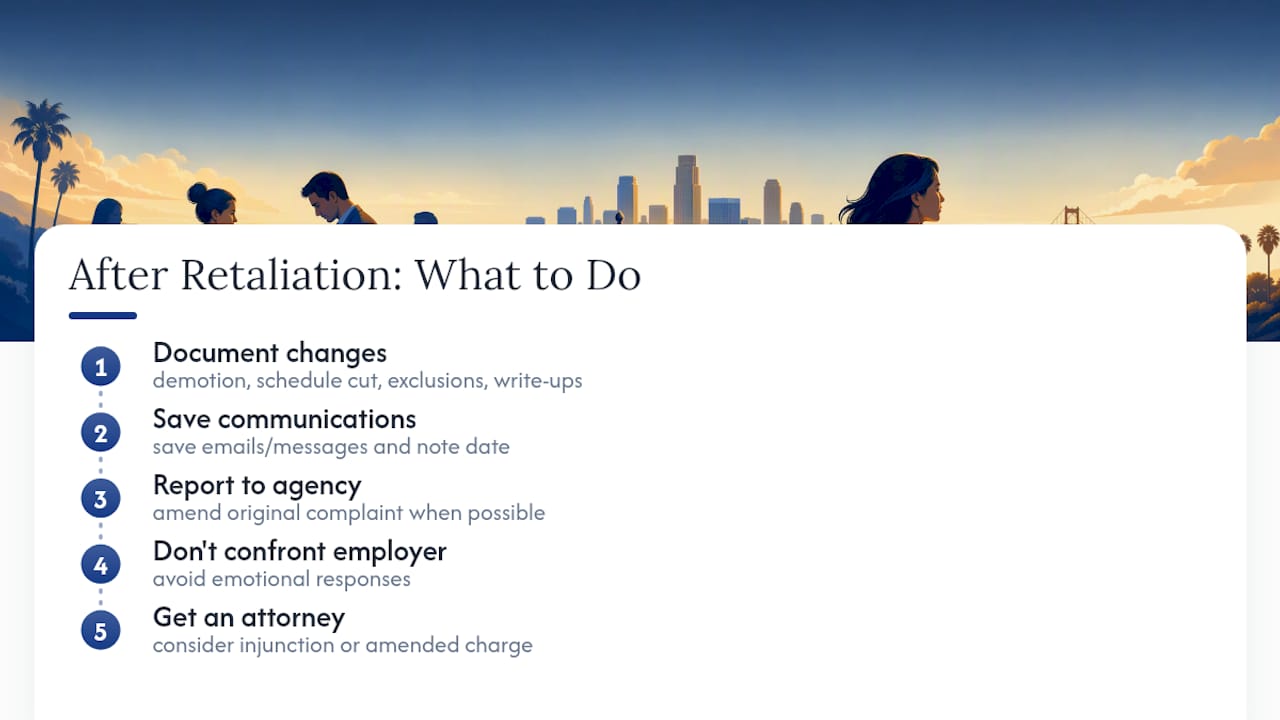
If you notice a sudden change, like a demotion, a schedule cut, exclusion from meetings, or write-ups that appear out of nowhere shortly after you filed with the CRD, EEOC, or Labor Commissioner, document it the same way you documented the original termination concern. Save the communication that triggered the change, note the date, and write down exactly what happened while it's fresh.
Report the new retaliation to the same agency handling your original complaint. Many agencies allow you to amend an existing complaint to include retaliatory conduct rather than starting from scratch, which keeps your timeline intact. If your original filing was with the Labor Commissioner, retaliation complaints there generally follow the same one-year filing structure, though some Labor Code provisions extend that window.
Don't confront your employer directly about the retaliation without a plan. Emotional pushback in the moment can create a new set of "performance" documentation your employer will use against you later. Instead, route new evidence to your attorney or to the agency investigator assigned to your case.
If you don't have representation yet, this is often the moment to get it. A second wave of retaliatory conduct signals your employer is escalating, and an attorney can advise on whether to seek an injunction, file an amended charge, or negotiate from a stronger position given the new conduct on record.
An Honest Read on What Actually Moves These Cases Forward
Most articles on this topic treat the legal test as the hard part, whether your firing meets the definition of discrimination, retaliation, or a public-policy violation. That's not usually where cases fall apart. They fall apart because employees wait too long, sign a release without reading it closely, or lose the emails that would have proven timing and pretext.
The conventional advice to "consult an attorney" undersells how much groundwork happens before that meeting ever occurs. An attorney can't build a timing argument you didn't preserve. The employees who get real outcomes are the ones who wrote down dates, saved messages, and requested their personnel file within days, not months.
If there's one place the standard advice falls short, it's speed. California's shortest windows run 180 days, and that clock starts the day you're fired, not the day you decide you're ready to deal with it. Prioritize documentation first, filing venue second, and full legal strategy third. Get the facts locked down before you get the legal theory perfect.
Get a Case Brief and an Attorney Match Without the Runaround
Piecing together which agency to file with, what deadline applies, and which attorney actually handles wrongful termination cases in your area takes real time, time you may not have given how short some of these filing windows run. Legalleads shortens that entire process into one step.
Describe what happened in plain English, and Legalleads turns it into a professional case brief in under two minutes. From there, you're matched with a qualified California employment attorney within 24 hours, no cold calls, no forms to hunt down, no guessing which firm actually takes cases like yours. The service focuses specifically on California claims, so the attorneys in the network already understand CRD filings, Labor Commissioner deadlines, and FEHA procedure.
If you're still deciding whether to sign anything or where to file, find a lawyer through Legalleads and get a free case brief started today.
Sources
- DLSE FAQ — Retaliation (California Department of Industrial Relations)
- California Labor Code — Article 4: Termination of Employment
- California wrongful termination claims — FindLaw
- Wrongful termination laws in California — Lawmercer
FAQ
What Qualifies as Wrongful Termination in California?
A firing is wrongful when the real motive is discrimination, retaliation, whistleblowing, a public-policy violation, or a breach of contract, rather than a legitimate business reason.
How Do I Prove Wrongful Termination?
You typically need documentation showing timing, inconsistent employer explanations, and evidence like emails, performance reviews, and witness statements that point to an unlawful motive rather than the stated reason.
Where Do I File a Wrongful Termination Claim in California?
It depends on the claim: FEHA claims go to the CRD, federal discrimination claims go to the EEOC, wage and retaliation claims go to the Labor Commissioner, and public-policy or contract claims can go directly to Superior Court.
How Long Do I Have to File a Wrongful Termination Claim?
CRD claims generally allow about three years, EEOC claims require filing within 180 or 300 days, and many Labor Code retaliation claims must be filed within one year.
Do I Need a Lawyer to File a Wrongful Termination Claim?
Not always, but a lawyer becomes important quickly if you're facing a severance deadline, a short filing window, or a multi-claim case. Legalleads can generate a case brief and match you with a California employment attorney within 24 hours if you decide you need one.