
Legal triage is defined as the systematic process of receiving, evaluating, prioritizing, and routing legal requests so the most urgent and high-risk matters get addressed first. Borrowed from emergency medicine, the term "triage" in law describes a structured intake method that legal teams use to sort requests by urgency, complexity, and risk before assigning resources. Without this process, legal teams operate reactively, missing deadlines and misallocating attorney time. Legalleads connects individuals to qualified attorneys once triage clarifies what kind of legal help they need. Understanding the legal triage process gives you a real advantage when navigating any legal situation.
How does the legal triage process work step by step?
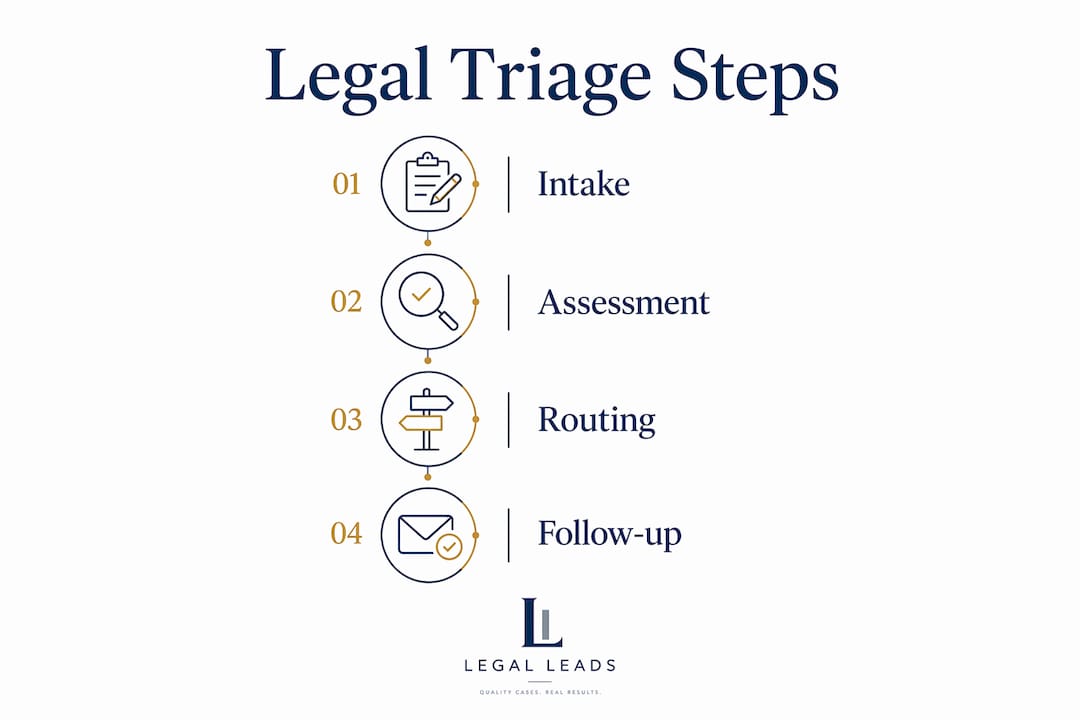
The legal triage process follows four sequential stages: intake, assessment, routing, and follow-up. Each stage builds on the last, and skipping any one of them creates gaps that lead to missed deadlines or misdirected resources.
Stage 1: Centralized intake

Every request enters through a single, documented channel. Centralizing requests into one digital system prevents lost requests and improves tracking across the team. Without a central intake point, requests arrive by email, phone, chat, and hallway conversation, making consistent handling impossible.
Stage 2: Standardized assessment
Each request is evaluated against a fixed set of criteria. The team asks: How urgent is this? What is the legal risk? What expertise does it require? This assessment step is where triage decisions are actually made, and it must follow a documented framework rather than individual judgment.
Stage 3: Routing
Requests are assigned to the right resource based on the assessment. Low-risk, routine matters go to self-service tools or junior staff. High-risk matters escalate to senior attorneys. Automated routing uses "if-then" logic and risk thresholds to direct requests without manual intervention, cutting cycle time significantly.
Stage 4: Follow-up and monitoring
The request does not disappear after routing. Legal intake systems track key metrics like time-to-first review and volume to demonstrate legal team value and flag bottlenecks before they become crises.
Pro Tip: Document your manual triage workflow completely before adding any automation. Teams that automate chaotic, undocumented intake processes consistently see worse results than those that standardize first.
What criteria are used to prioritize legal matters during triage?
Effective triage evaluates every request against a consistent set of factors. Five core criteria drive legal triage prioritization: strategic alignment, departmental mandate, expertise needed, urgency, and risk or complexity. Each criterion carries weight, and together they determine where a request lands in the queue.
- Strategic alignment: Does this matter support a core business goal or legal obligation? Matters tied to regulatory compliance or active litigation rank higher than routine contract reviews.
- Departmental mandate: Is the legal team required to handle this, or can another department manage it? HR matters, for example, may not require attorney involvement at all.
- Expertise needed: Does the matter require a specialist, such as an IP attorney or a criminal defense lawyer, or can a generalist handle it?
- Urgency: Is there a court deadline, a regulatory filing date, or an imminent financial risk? Hard deadlines override complexity scores.
- Risk and complexity: High-stakes contracts, employment disputes, and personal injury claims carry higher risk scores and require more senior attention.
These criteria feed directly into routing decisions. A low-risk, non-urgent contract question routes to a self-service template. A high-risk employment dispute with a filing deadline routes immediately to a senior attorney.
| Priority Level | Criteria Profile | Typical Routing |
|---|---|---|
| Critical | High urgency, high risk, specialist needed | Senior attorney, same day |
| High | Moderate urgency, regulatory mandate | Experienced associate, 24 hours |
| Standard | Low urgency, routine complexity | Junior staff or self-service |
| Deflect | No legal expertise required | FAQ, template, or business unit |
The deflect category deserves attention. Self-service tools like FAQs and document templates handle routine legal questions without involving attorneys at all. This preserves senior legal capacity for matters that genuinely require it.
Why is legal triage important for individuals and legal teams?
Legal triage matters because it replaces guesswork with a repeatable system. Systematic legal intake and triage can reduce response times by up to 50% by eliminating manual back-and-forth. That reduction is not just a convenience. It directly affects case outcomes, especially when deadlines are involved.
"Legal triage is about visibility and control rather than speed alone. When you can see every open request, its priority level, and who owns it, you make better resource decisions. Speed is a byproduct of that clarity, not the goal itself."
For individuals, the importance of legal triage shows up in a concrete way: your request gets to the right attorney faster. Without triage, a personal injury claim might sit in a general inbox while a routine contract question gets answered first, simply because it arrived earlier. Triage corrects that imbalance.
For legal teams, effective triage allows workload allocation based on complexity and expertise, which improves results across the board. Senior attorneys spend their time on high-impact matters. Junior staff and self-service tools handle the rest. That division of labor is only possible when triage is working correctly.
Pro Tip: If you are submitting a legal request to any organization, always include the deadline, the financial or legal risk involved, and the specific type of expertise you need. Requests with this information move through triage faster and reach the right attorney sooner.
Legal representation timelines are directly shaped by how well triage functions at the point of intake. A well-run triage system protects both the legal team and the individual seeking help.
How can you navigate the legal triage process effectively?
Understanding triage from the requester's side gives you a clear advantage. Most individuals submit vague or incomplete requests, which slows triage down and often results in lower priority scores. The steps below apply whether you are submitting a request to an in-house legal team or reaching out to an attorney through a platform.
- Be specific about the legal issue. Name the type of matter: employment dispute, contract review, criminal defense, slip and fall. Vague descriptions like "I need legal help" require follow-up before triage can even begin.
- State the deadline clearly. If there is a court date, a regulatory filing, or a contract expiration, include the exact date. Urgency scores drive routing decisions, and a missing deadline can drop your request to a lower priority tier.
- Quantify the risk. Describe the financial exposure, the parties involved, and the potential consequences. A request that mentions a $50,000 contract dispute routes differently than one that says "contract issue."
- Use self-service tools first. Many legal teams and platforms offer self-service resources for routine questions. Using them for standard matters frees attorney time for your more complex needs.
- Communicate your legal problem clearly. A well-written request that follows a structured format moves through triage faster. Legalleads provides guidance on communicating your legal problem in plain English, which directly improves triage outcomes.
- Set realistic expectations. Triage assigns priority based on objective criteria, not submission order. A lower-risk matter submitted first will still route after a high-risk matter submitted later.
The most common mistake individuals make is assuming that submitting a request guarantees immediate attention. Triage exists precisely to prevent that assumption from causing harm to higher-priority cases. Work with the system, not against it, by providing complete information from the start.
Key Takeaways
Legal triage is the structured process of evaluating, prioritizing, and routing legal requests so urgent, high-risk matters reach the right attorney first, reducing response times and improving outcomes for everyone involved.
| Point | Details |
|---|---|
| Triage follows four stages | Intake, assessment, routing, and follow-up form the complete legal triage cycle. |
| Five criteria drive priority | Strategic alignment, mandate, expertise, urgency, and risk determine where each request routes. |
| Response times drop significantly | Systematic triage can cut response times by up to 50% by removing manual back-and-forth. |
| Deflection preserves attorney capacity | Self-service tools handle routine matters so senior attorneys focus on high-stakes work. |
| Complete requests move faster | Submitting a request with a deadline, risk level, and matter type speeds up triage routing. |
Why I think most people misunderstand what legal triage actually does
Most people assume legal triage is just a fancy word for a waiting list. It is not. A waiting list is passive. Triage is active. It continuously re-ranks requests as new information arrives, which means a matter submitted yesterday can move ahead of one submitted this morning if the risk profile changes.
The part that surprises most individuals is the deflection category. The most impactful triage outcome is often not routing your request to an attorney. It is routing you to a template, an FAQ, or a self-service tool that resolves your question in minutes without attorney involvement. That is not a failure of the system. That is the system working exactly as designed.
Where I see triage fail consistently is in organizations that automate before they document. Automating an undocumented intake process produces faster chaos, not faster results. The teams that get triage right spend weeks mapping their manual "if-then" logic on paper before they touch any software. That discipline is unglamorous, but it is the difference between a triage system that works and one that creates new problems.
For individuals, the practical lesson is this: the legal triage process is not your adversary. It is the mechanism that gets your urgent matter to the right expert. Feed it complete, specific information, and it works in your favor. Submit a vague request, and you will wait longer than necessary.
— Admin
Legalleads connects you to the right attorney after triage identifies your need
Once triage clarifies the type of legal matter you are facing, the next step is finding a qualified attorney who specializes in exactly that area.
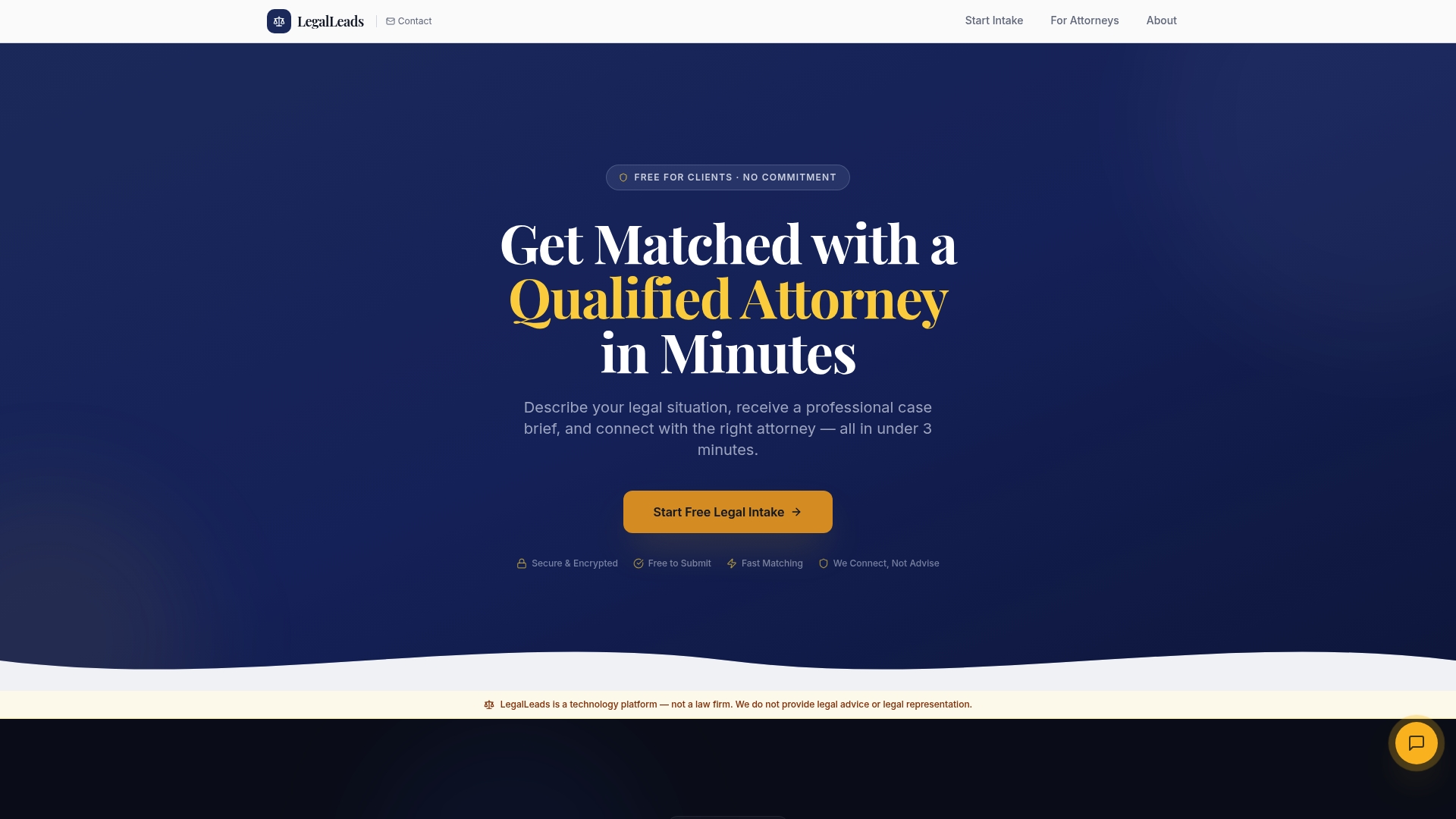
Legalleads makes that step fast and direct. You describe your legal situation in plain English, and the platform generates a professional case brief in under two minutes. From there, Legalleads connects you to qualified attorneys within 24 hours, matched to your specific legal need, whether that is a family law matter, a personal injury claim, or an employment dispute. No calls, no complicated forms. You can also browse attorneys by specialty to find the right fit before you commit.
FAQ
What is the legal triage process in simple terms?
Legal triage is the process of sorting incoming legal requests by urgency, risk, and complexity so the most critical matters get addressed first. It follows a structured intake, assessment, routing, and follow-up cycle.
What does triage mean in a legal context?
In law, triage means systematically evaluating legal requests against set criteria to assign the right resource, whether that is a senior attorney, a junior associate, or a self-service tool.
How does legal triage reduce response times?
Systematic triage eliminates manual back-and-forth by routing requests automatically based on documented criteria, which can cut response times by up to 50%.
What are the most common legal triage criteria?
The five standard criteria are strategic alignment, departmental mandate, expertise required, urgency, and risk or complexity. These factors together determine a request's priority level and routing destination.
Can individuals use legal triage principles when seeking an attorney?
Yes. Submitting a request with a clear matter type, a specific deadline, and a description of the financial or legal risk mirrors the criteria legal teams use during triage, which speeds up the process of reaching the right attorney.