
Removal proceedings are the formal court process the U.S. government uses to decide whether a noncitizen must leave the country. If you or someone you know just received a Notice to Appear (Form I-862), three things matter immediately: check the notice for a court date, confirm your address is current with the court, and get legal help as fast as possible.
The Department of Homeland Security (DHS) files the Notice to Appear, not the court itself, and the government does not provide a free lawyer for this process the way it does in criminal cases. That single fact surprises most people. You are entitled to counsel, but only at your own expense or through pro bono and low-cost organizations you find yourself.
- Check the form number. It should read "Form I-862" and list a charging agency (usually DHS).
- Confirm the hearing date. Some notices arrive without one; a date gets mailed later, but the clock on your case still starts.
- Move fast on counsel. Immigration court dockets move quickly for detained cases and slowly for non-detained cases, but deadlines for relief and appeals do not bend either way.
Pro Tip: Keep the original NTA and the envelope it arrived in. The mailing date and address on that envelope can matter later if you ever need to argue you didn't receive proper notice.
Key Takeaways
Removal proceedings hinge on strict deadlines, and missing an address update or a hearing date carries consequences as severe as losing the underlying legal case.
| Point | Details |
|---|---|
| An NTA starts the clock | Even without a hearing date listed, proceedings are officially underway once DHS files Form I-862. |
| Detained cases move faster | Initial hearings often happen quickly for detained respondents, versus months or years for non-detained cases. |
| Missing a hearing is costly | An in‑absentia removal order follows automatically unless you file a motion to reopen within 180 days. |
| Appeals run on a 30‑day clock | A Notice of Appeal to the BIA must generally be filed within 30 days of the immigration judge's decision. |
| Legalleads speeds up counsel access | The platform generates a case brief in under two minutes and matches respondents with vetted attorneys within 24 hours. |
Table of Contents
- What Is Removal Proceedings Explained in Plain Terms?
- How Removal Proceedings Start: The Notice to Appear
- Where Hearings Happen and Who Runs the Process
- What Happens at Each Stage: Types of Hearings
- Possible Outcomes and Forms of Relief
- Your Rights and Who Carries the Burden of Proof
- Appeals, Motions, and Filing Deadlines
- How Long Removal Proceedings Take and What Happens if You Miss a Hearing
- What to Do Immediately After You Receive an NTA
- Why Speed in Legal Intake Changes Outcomes
- The Real Gap in How People Understand Removal Proceedings
- Get Matched With an Immigration Attorney Fast
- Where to Find Official Guidance
- Sources
- FAQ
What Is Removal Proceedings Explained in Plain Terms?
Removal proceedings are civil, not criminal, but the stakes feel just as high: the outcome decides whether someone can legally remain in the United States. The process runs through the immigration court system, which sits inside the Department of Justice rather than the regular federal court system most people picture.
More than 500 immigration judges preside over more than 60 immigration courts nationwide, each hearing dozens of cases a day. That scale explains why dockets back up and why non-detained cases can take years to reach a final hearing. Understanding removal proceedings starts with understanding that this is an administrative legal system with its own rules, its own court, and its own appeals body, separate from anything you'd encounter in a criminal courtroom.
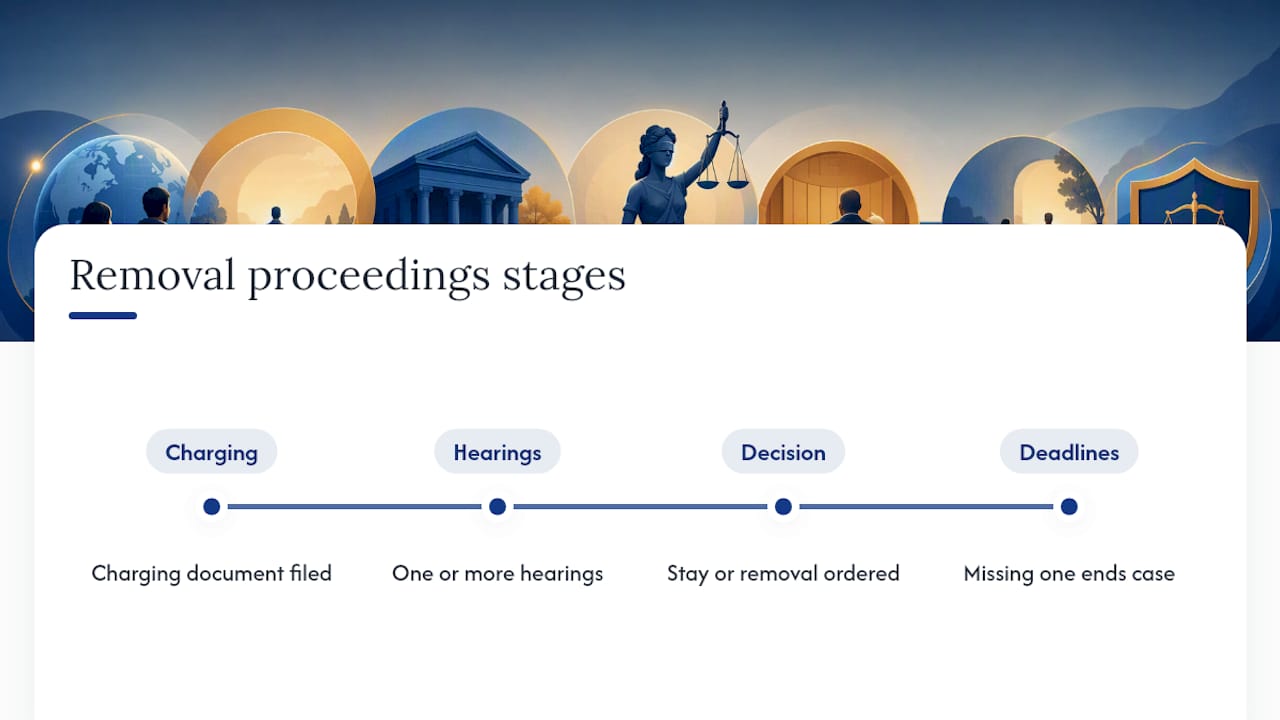
The process itself unfolds in stages: it begins with a charging document, moves through one or more hearings, and ends with a decision that either lets someone stay or orders them removed. Each stage carries its own deadlines, and missing one can end a case before it's fairly heard.
How Removal Proceedings Start: The Notice to Appear
Removal proceedings begin the moment DHS files a Notice to Appear (Form I-862) with an immigration court. The NTA lists the allegations against the respondent (the person facing removal) and the legal grounds DHS believes make them removable. It sounds procedural, but the specifics buried in that document often decide the entire defense strategy.
A quirk in the process trips up a lot of people: an NTA does not have to include a hearing date to start proceedings. DHS can serve someone with an NTA that says a date will be set "at a time to be determined," and the case is still officially underway. EOIR's own guidance confirms an NTA can be served by mail or in person, and service alone triggers certain legal consequences even before the court schedules anything.
There's also a meaningful difference between formal removal under INA § 240 and expedited removal under INA § 235. Formal proceedings guarantee a hearing before an immigration judge, the right to present evidence, and the right to appeal. Expedited removal, used mostly at the border or ports of entry, skips most of that and can result in removal within days, with far fewer protections attached.
One detail favors respondents more than people realize: if DHS serves an NTA but never actually files it with the court by the first scheduled hearing, that failure to file can be treated as a failure to prosecute. Defense attorneys watch for this. It won't make a case disappear, but it can pause proceedings until DHS corrects its own paperwork.
- DHS, ICE, or in some cases USCIS can initiate the charging document.
- Service can happen by mail or in person.
- A missing hearing date does not mean the case isn't real. Act as though it is.
Where Hearings Happen and Who Runs the Process
Every removal case runs through the Executive Office for Immigration Review (EOIR), the DOJ agency that operates the immigration courts. EOIR is not part of DHS. DHS acts as the prosecuting side (through its own trial attorneys), while EOIR's immigration judges act as neutral decision-makers, at least in structure, if not always in caseload pressure.
The immigration judge (IJ) controls the courtroom: setting hearing dates, ruling on motions, weighing evidence, and issuing decisions. Judges also handle credible fear and reasonable fear reviews for people who claim they'd face persecution if returned home. DHS counsel, sometimes called the trial attorney, argues the government's case, similar to a prosecutor, but in a civil rather than criminal setting.
Above the immigration courts sits the Board of Immigration Appeals (BIA), the administrative body that reviews IJ decisions when either side appeals. The BIA doesn't hold new hearings or take new testimony. It reviews the existing record and either affirms, reverses, or sends the case back down.
With over 60 courts spread across the country, finding the right one matters. Every NTA lists a specific court, and case status can usually be checked through the court's automated case information system using the respondent's alien registration number. Getting this wrong, checking the wrong court or missing a venue change, is a common and avoidable mistake.
What Happens at Each Stage: Types of Hearings
Removal proceedings unfold across several distinct hearing types, and knowing which one you're walking into changes what you should bring and how you should prepare.
Master calendar hearings come first and often happen more than once. These are short, administrative sessions where the judge confirms the respondent's identity, reads the charges, takes pleadings (admit or deny the allegations), and sets a schedule for the case to move forward. An attorney can file an entry of appearance here, and continuances to find counsel are common, though not guaranteed.
Individual hearings, also called merits hearings, are where the real case gets decided. This is the full trial: testimony, documentary evidence, cross-examination, and expert witnesses if the case calls for them. Formal removal proceedings under INA §§ 239 and 240 guarantee the right to present evidence and call witnesses at this stage, which is why preparation here matters more than at any other point in the process.
Bond hearings apply to detained respondents seeking release while their case proceeds. Not everyone qualifies. Eligibility depends on the charges, criminal history, and flight risk, and the respondent must affirmatively request one.
Credible fear and reasonable fear interviews apply mainly in expedited removal contexts, screening people who claim they cannot safely return to their home country. A positive credible fear finding usually routes someone into full immigration court proceedings instead of expedited removal; a negative finding can lead to fast removal unless a judge reviews and reverses it.
- Master calendar: pleadings, scheduling, entry of counsel.
- Individual/merits: evidence, testimony, the actual decision.
- Bond: eligibility-dependent, must be requested.
- Credible/reasonable fear: screening tool, mainly for expedited removal cases.
Pro Tip: Never skip a master calendar hearing thinking it's "just paperwork." Failing to appear at any scheduled hearing, master calendar included, can trigger an in‑absentia removal order.
Possible Outcomes and Forms of Relief
A removal case ends one of four ways: termination (the government drops or loses the charges), a grant of relief (the respondent qualifies to stay), an order of removal (the judge orders departure), or voluntary departure (the respondent leaves on their own terms within a set window, avoiding a formal removal order on their record).
That last distinction, removal versus voluntary departure, carries weight far beyond the immediate case. A formal removal order can trigger reentry bars of five, ten, or twenty years depending on the circumstances, along with inadmissibility consequences described in federal guidance on the deportation process. Voluntary departure avoids that formal bar, which is why attorneys often negotiate for it even when a stronger defense isn't available.
| Relief Type | Who It's For | Statutory Basis |
|---|---|---|
| Asylum | People facing persecution based on race, religion, nationality, political opinion, or social group | INA provisions governing asylum |
| Withholding of removal | Similar to asylum but harder to win, blocks removal to a specific country | INA provisions governing withholding of removal |
| Convention Against Torture protection | People likely to face torture if returned | CAT regulations |
| Cancellation of removal | Long-term residents (LPRs or non-LPRs) meeting continuous presence and hardship tests | INA § 240A |
| Adjustment of status | People eligible for a green card through family, employment, or other categories | INA provisions governing adjustment of status |
| Waivers | People with certain inadmissibility grounds (fraud, some crimes, unlawful presence) | Various INA provisions |
Each relief category carries its own eligibility rules and its own burden of proof, and most require filing a separate application well before the individual hearing. Missing a filing deadline for relief can be just as damaging as missing a hearing altogether.
Your Rights and Who Carries the Burden of Proof
Due process protections apply in immigration court, but they look different from criminal court protections. Respondents have the right to notice of the charges, the right to a hearing before a neutral judge, the right to present evidence and call witnesses, and the right to an interpreter if they don't speak English well. What respondents do not get is a government-appointed attorney.
INA §§ 239 and 240 guarantee the right to counsel, but only at the respondent's own expense. That single gap between "you have a right to an attorney" and "the government pays for one" leaves a large share of respondents representing themselves, often against trained DHS trial attorneys.
The burden of proof shifts depending on the situation. In most cases, DHS carries the burden of proving removability by clear and convincing evidence. But once removability is established, the burden often flips: the respondent must then prove eligibility for any relief they're seeking, usually by a preponderance of the evidence or, for some forms of relief, by clear and convincing evidence. Knowing which side carries the burden at each stage shapes what evidence to gather and when.
- The government must prove removability in most cases; the respondent typically must prove eligibility for relief.
- Interpreters are provided in the courtroom, but not for gathering evidence outside of it.
- Legal aid organizations, law school immigration clinics, and pro bono panels are the main paths to low-cost representation when a private attorney isn't affordable.
Appeals, Motions, and Filing Deadlines
Losing at the immigration court level is not necessarily the end of a case. Both DHS and the respondent can appeal an immigration judge's decision to the BIA, and understanding the deadlines here is critical because they run fast and rarely bend.
| Action | Typical Deadline | Notes |
|---|---|---|
| Notice of Appeal to BIA | 30 days from the IJ's decision | Missing this deadline is usually fatal to the appeal |
| Motion to reconsider | 30 days from the final order | Argues the judge made a legal or factual error |
| Motion to reopen (general) | 90 days from the final order | Typically requires new evidence not available earlier |
| Motion to reopen (in‑absentia order) | 180 days | Requires showing exceptional circumstances or lack of notice |
A Notice of Appeal to the BIA generally must be filed within 30 days of the immigration judge's decision. The BIA reviews the existing record; it does not take new testimony or hold a new trial. If the BIA affirms the removal order, the next and final step is judicial review in a federal circuit court of appeals, though jurisdiction there is limited. Federal courts generally cannot review certain discretionary decisions, and some grounds for removal (particularly criminal-related ones) sharply restrict what a circuit court can even consider.
Motions to reopen or reconsider offer another path, but they run on strict clocks and narrow grounds: new evidence that wasn't available before, changed country conditions for an asylum claim, or ineffective assistance of prior counsel. Filing late without a recognized exception almost always means the motion gets denied without ever reaching the merits.
How Long Removal Proceedings Take and What Happens if You Miss a Hearing
Timelines differ sharply depending on whether someone is detained. Detained respondents typically get an initial hearing scheduled within one to two weeks of the NTA being filed, and their entire case, master calendar through individual hearing, can wrap up in a matter of weeks. Non-detained respondents face the opposite problem: dockets are so backed up that a merits hearing can take months or, in many courts, years to arrive.
That gap matters practically. Detained respondents have far less time to gather evidence, locate witnesses, or hire counsel, which is exactly why early action matters more, not less, when someone is in custody. Non-detained respondents have more time on paper, but that time can work against them too: memories fade, witnesses move, and documents get harder to obtain the longer a case drags on.
Missing a scheduled hearing after receiving proper notice carries serious consequences. Under 8 C.F.R. § 1240.8, the immigration judge is required to order the respondent removed in absentia, meaning the case proceeds and concludes without them present. Rescinding that order requires filing a motion to reopen within 180 days showing exceptional circumstances (a serious illness, for example) or proving the notice itself was defective.
A final removal order carries consequences well beyond the immediate case: mandatory departure, a formal bar on future admissibility, and reentry restrictions that can last five to twenty years depending on the removal ground. That's not a technicality. It's often the difference between someone being able to petition to return legally someday and being permanently barred from doing so.
What to Do Immediately After You Receive an NTA
The first 24 to 72 hours after receiving a Notice to Appear set the tone for the entire case. Here's the order that matters most:
- Confirm the NTA is authentic and record every detail. Note the court name, address, alien registration number, and hearing date (if listed). Keep the original document and its envelope.
- Update your mailing address with the court immediately, using the required change of address form. This single step prevents the most common cause of in‑absentia orders.
- Check your case status online through the immigration court's automated case information system using your alien registration number.
- Gather core documents: government-issued ID, prior immigration filings, criminal history records (if any), and family documents like marriage or birth certificates that might support a relief application.
- Contact counsel or a low-cost legal service the same day, not after the first hearing. Continuances to find an attorney happen, but they're not guaranteed, and evidence gets harder to gather with every week that passes.
- Never assume "no hearing date yet" means no urgency. Proceedings are already underway.
- Save copies of everything you send to the court, and use certified mail or the court's e-filing system when available.
- If you're detained, ask family or friends to start the document-gathering and attorney search on your behalf right away.
Why Speed in Legal Intake Changes Outcomes
Removal cases are often decided less by the strength of someone's underlying claim and more by whether the right evidence reached the right hands in time. That's a hard truth conventional explainers gloss over: a strong asylum claim, cancellation case, or adjustment application can still lose if key documents, witness statements, or country-condition evidence never got assembled before the deadline.

A useful checklist for preparing a case brief mirrors what attorneys actually ask for in an intake call: the NTA itself, any prior immigration filings, proof of continuous physical presence (for cancellation claims), evidence of hardship to U.S. citizen or LPR family members, and documentation supporting a fear of return if the claim involves asylum or CAT protection. Attorneys who receive this material upfront can file protective motions and start building a defense days earlier than attorneys working from a first meeting with nothing in hand.
Early counsel matters most for three practical reasons: evidence has a shelf life (witnesses relocate, records get purged, country conditions shift), filing windows for relief applications are often tied to the individual hearing date, and credible fear or reasonable fear interviews happen fast, sometimes within days of detention, leaving almost no room to assemble evidence after the fact. Technology that speeds up the intake and document-collection process has made a measurable difference in how quickly attorneys can act once a case reaches them.
Pro Tip: If your case involves a fear-based claim (asylum, withholding, CAT), prioritize gathering anything dated: news articles, police reports, medical records, or messages that show when specific threats or incidents occurred. Immigration judges weigh timelines heavily, and vague or undated claims are far easier to challenge.
The Real Gap in How People Understand Removal Proceedings
Most explainers treat removal proceedings like a single event: you get a notice, you go to court, you find out if you can stay. That framing undersells how much the process is actually a series of narrow windows, each with its own deadline, and how often cases are lost not on the merits but on a missed filing or a stale address on file with the court.
The conventional advice, "hire a lawyer before your hearing", isn't wrong, but it's incomplete. The stronger advice is to treat the period between receiving the NTA and the first master calendar hearing as the most valuable window in the entire case. That's when evidence is freshest, when continuances are easiest to get, and when a competent attorney can still shape the strategy rather than react to it. Waiting until a merits hearing is scheduled to start looking for representation is the single most common, and most avoidable, mistake respondents make.
If there's one thing worth prioritizing above all else, it's this: keeping your address current with the court is not a formality, it is the single control point that determines whether you get to argue your case at all. An in-absentia order doesn't ask whether your underlying claim had merit. It only asks whether you showed up.
Get Matched With an Immigration Attorney Fast
Every deadline covered here, the 30-day appeal window, the address update, the evidence you need before your first hearing, depends on getting a qualified attorney involved quickly. Legalleads was built for exactly this kind of time pressure: describe your situation in plain English, and the platform generates a professional case brief in under two minutes, then connects you with a vetted attorney within 24 hours. No intake calls, no lengthy forms to fill out while your hearing date approaches.

To get the fastest match, have your NTA details ready: the court location, hearing date if one's been set, and a short summary of your immigration history. That's enough for the intake to generate a case brief attorneys can act on immediately, whether your issue involves a credible fear claim, cancellation of removal, or a straightforward adjustment application. Readers in Southern California can also go directly to Legalleads' immigration attorney matching page for the Los Angeles area, or the Orange County and Riverside pages for those regions.
If your case also touches criminal history that affects your removability, Legalleads' criminal defense attorney network can help address that side of the case in parallel. Start your attorney match request today and get connected before your next filing deadline arrives.
Where to Find Official Guidance
Government sources remain the most reliable references for forms, filing rules, and court procedures, and they're worth bookmarking directly rather than relying on secondhand summaries.
- EOIR's policy manual on commencement of removal proceedings explains how and when DHS files the NTA, plus failure-to-prosecute rules.
- EOIR's "Learn About the Immigration Court" page covers how courts operate, the role of immigration judges, and the appeals process to the BIA.
- Congressional Research Service report IF11536 breaks down the statutory basis for formal proceedings under INA §§ 239 and 240.
- 8 C.F.R. § 1240.8 sets out the rules for in‑absentia orders and decisions.
- Usa summarizes detention, hearings, and readmission rules in plain language.
This article provides general information about the removal proceedings process and is not a substitute for advice from a licensed immigration attorney. Confirm current deadlines and procedures with EOIR or qualified counsel for your specific case.
Sources
- Executive Office for Immigration Review | 3.2 - Commencement of Removal Proceedings | United States Department of Justice
- Learn About the Immigration Court | Executive Office for Immigration Review
- Congressional Research Service: Immigration Court Proceedings: Process and Data (CRS product IF11536)
- 8 C.F.R. § 1240.8 — Decisions and notices
- Usa
FAQ
What happens when you are put in removal proceedings?
DHS files a Notice to Appear with an immigration court, which starts a legal process involving one or more hearings before an immigration judge to determine whether you can stay in the country or must be removed.
How long do removal proceedings last?
Detained cases can conclude in a matter of weeks, with initial hearings often scheduled within one to two weeks of filing, while non-detained cases can take months or years to reach a final merits hearing.
Is removal proceedings the same as a deportation order?
No. Removal proceedings are the legal process itself; a removal order (sometimes still called a deportation order) is one possible outcome of that process, issued after a hearing or through an in‑absentia decision.
Can removal proceedings be dismissed?
Yes. A judge can terminate proceedings if DHS fails to prove removability, if there's a procedural defect like a failure to properly file the NTA, or if the respondent qualifies for and is granted relief that resolves the case.
Do I need a lawyer for removal proceedings?
You're not required to have one, but the government does not provide free counsel in immigration court, and unrepresented respondents face a real disadvantage against trained DHS attorneys. Services like Legalleads can connect you with a vetted immigration attorney within 24 hours of describing your case.