
Legal rights protection means enforceable legal guarantees that let an individual demand a remedy when their rights are violated. A right without an enforcement route is just a claim. In the United States, those guarantees come from the Constitution, federal and state statutes, regulations, and court decisions — and they are backed by courts, agencies, and regulatory bodies with real power to act.
If you believe a right has been violated, three steps matter immediately:
- Document everything. Write down dates, names, and what happened. Save texts, emails, contracts, and any physical evidence.
- Preserve evidence. Do not delete messages or discard documents. Courts and agencies rely on contemporaneous records.
- Check your deadline. Statutes of limitations vary by claim type. Missing a filing window can permanently eliminate your right to a remedy.
This guide covers where rights come from, how they are enforced, what remedies exist, practical filing steps with timelines, common limits, and where to get help.
Table of Contents
- What counts as a legal right versus a moral or social claim?
- Where do your legal rights come from in the U.S.?
- How legal rights are enforced and what remedies you can get
- Common legal areas where rights protection applies
- How to assert your rights: a step-by-step checklist
- Common limits on legal rights protection you should know
- Getting legal help quickly: why speed changes outcomes
- Key Takeaways
- Why legal literacy and fast access to counsel matter
- Legalleads connects you to the right attorney fast
- Useful sources and agencies for U.S. legal rights
- FAQ
What counts as a legal right versus a moral or social claim?
A legal right is a power or privilege recognized by a constitution, statute, regulation, or judicial precedent and enforceable by legal institutions. Courts can be invoked to protect it. That enforceability is what separates a legal right from a moral claim or a social expectation.
The distinction matters in practice. Consider these four categories:
- Legal rights: — Enforceable entitlements backed by law. Examples include the right to due process, the right to be free from workplace discrimination, and the right to a fair housing opportunity. Violation triggers a legal remedy.
Rights are also divided into enumerated rights — those explicitly written into a document like the Bill of Rights — and unenumerated rights, which courts have recognized as implied by constitutional structure or precedent (the right to privacy, for example).
Legal standing is the threshold requirement: to bring a claim, you must have suffered a concrete injury, the injury must be traceable to the defendant's conduct, and a court order must be capable of redressing it. Without standing, a court will not hear the case regardless of how valid the underlying right may be. Understanding legal terms like standing early prevents wasted effort.
Where do your legal rights come from in the U.S.?
Rights in the United States flow from a clear hierarchy of sources. Higher sources override lower ones when they conflict.
- The U.S. Constitution: The supreme law of the land. The Bill of Rights (Amendments 1–10) protects free speech, religion, assembly, the press, and the right against unreasonable searches. The Fourteenth Amendment guarantees equal protection and due process against state government action. Courts apply different levels of scrutiny depending on the right at stake: strict scrutiny for fundamental rights and suspect classifications, intermediate scrutiny for gender-based distinctions, and rational basis for most other government actions.
- Federal statutes: Congress creates rights through legislation. Title VII of the Civil Rights Act of 1964 prohibits employment discrimination based on race, color, religion, sex, or national origin. The Fair Housing Act covers housing discrimination. The Americans with Disabilities Act covers disability access. Each statute typically designates an enforcement agency.
- Federal regulations: Agencies like the Equal Employment Opportunity Commission (EEOC) and the Federal Trade Commission (FTC) issue regulations that fill in the details of statutory rights and create specific procedural rules for asserting them.
- Case law: Court decisions interpret statutes and the Constitution, creating binding precedent. A Supreme Court ruling on what "equal protection" requires becomes the law for every court below it.
- Contracts and agreements: Private agreements create enforceable rights between the parties. An employment contract, a lease, or a consumer warranty can all be the source of a legally enforceable claim.
State law adds another layer. States can grant broader protections than federal law but generally cannot offer less. California's Fair Employment and Housing Act, for example, covers employers with five or more employees, while Title VII covers employers with 15 or more. When a state agency enforces state law, it often runs parallel to the federal process.
Due process runs through all of this. Before the government deprives you of life, liberty, or property, it must follow fair procedures. That principle applies whether the deprivation comes from a criminal prosecution, a license revocation, or a benefits termination.
How legal rights are enforced and what remedies you can get
Enforcement routes depend on the type of right and the nature of the violation. Three main channels exist: civil courts, administrative agencies, and criminal prosecution.

Administrative agencies can investigate, mediate, and sometimes provide remedies faster and at lower cost than full litigation. For many individuals, the agency route is the practical first step. See the table below for a breakdown of routes and typical remedies.
| Enforcement Route | Who Uses It | Typical Remedies | Examples |
|---|---|---|---|
| Civil court (federal or state) | Individuals suing for damages or injunctive relief | Compensatory damages, punitive damages, injunctions, declaratory judgments | Personal injury lawsuit, breach of contract, civil rights claim under 42 U.S.C. § 1983 |
| Administrative agency | Individuals filing complaints with a regulatory body | Back pay, reinstatement, cease-and-desist orders, fines against violators | EEOC complaint for employment discrimination; FTC complaint for deceptive trade practices |
| Criminal prosecution | Government prosecuting a defendant | Fines, imprisonment, restitution to victims | Hate crime prosecution, criminal civil rights violation under federal statute |
| State attorney general | State AG acting on behalf of the public | Injunctions, restitution, civil penalties | Consumer fraud investigation; housing discrimination enforcement |
Damages compensate for actual losses. Compensatory damages cover lost wages, medical bills, and pain and suffering. Punitive damages punish egregious conduct and deter future violations — courts award them in cases involving intentional or reckless wrongdoing.
Injunctive relief is a court order requiring a party to stop doing something (or start doing something). It is the remedy when money alone cannot fix the harm — for example, ordering an employer to reinstate a wrongfully terminated employee or stopping a landlord from an illegal eviction.
Declaratory judgments establish what the law is without ordering specific action. They are useful when parties dispute their legal obligations before a violation has fully occurred.
Enforceability depends on three things: standing (you have a concrete injury), jurisdiction (the court or agency has authority over the claim), and remedy availability (the law provides a specific relief for the violation). All three must be present for a claim to move forward. For a clearer picture of legal processes by type, the enforcement route you choose shapes both the timeline and the outcome.
Common legal areas where rights protection applies
Rights protection shows up differently depending on the area of law. Here is a practical breakdown by category.
Constitutional rights
The First Amendment protects free speech, religion, and assembly. The Fourth Amendment protects against unreasonable searches and seizures. These protections apply against government actors — federal, state, and local. A private employer can restrict what you say at work without violating the First Amendment. File constitutional claims in federal court under 42 U.S.C. § 1983 (for state actors) or directly under federal law.
Employment rights
Title VII, the Age Discrimination in Employment Act, and the Americans with Disabilities Act prohibit discrimination in hiring, firing, pay, and working conditions. The EEOC handles federal employment discrimination complaints. California workers can also file with the California Civil Rights Department. File with the EEOC within the applicable deadline for such claims (or 300 days if a state agency also covers the claim). Missing this window forfeits the right to sue in federal court.
Housing rights
The Fair Housing Act prohibits discrimination in the sale, rental, and financing of housing based on race, color, national origin, religion, sex, familial status, or disability. File complaints with the U.S. Department of Housing and Urban Development (HUD) or your state's fair housing agency. HUD complaints must be filed within one year of the discriminatory act.

Consumer protection rights
The FTC Act prohibits unfair or deceptive business practices. State consumer protection statutes often go further. For individual disputes involving smaller dollar amounts, small claims court is a practical option. For larger fraud or systemic violations, file with the FTC at ftc.gov/complaint or your state attorney general's office.
Privacy rights
Federal privacy protections are sector-specific: HIPAA covers medical records, the FCRA covers credit reporting, and the COPPA covers children's online data. California residents have additional rights under the California Consumer Privacy Act (CCPA). File complaints with the relevant federal agency (HHS for HIPAA, FTC for FCRA) or the California Privacy Protection Agency for CCPA matters.
Family law rights
Custody, support, and adoption rights are primarily governed by state law. Family courts handle these matters. If domestic violence is involved, protective orders are available through state courts, often on an emergency basis. Family law attorneys in Los Angeles and across California handle these cases regularly.
Property rights
The Fifth Amendment prohibits the government from taking private property for public use without just compensation ("takings"). State property law governs landlord-tenant disputes, boundary disputes, and title issues. File landlord-tenant complaints with your local housing authority or pursue claims in state civil court.
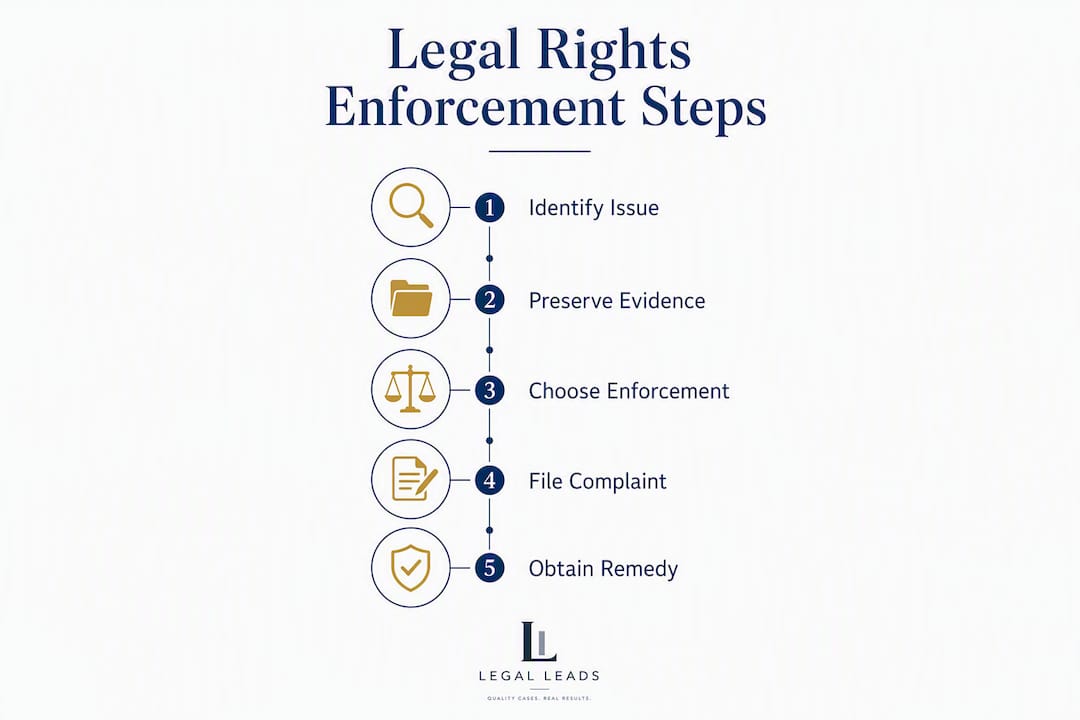
How to assert your rights: a step-by-step checklist
Knowing your rights is the starting point. Converting that knowledge into relief requires following a specific sequence. Missing procedural steps is one of the most common reasons valid claims fail.
- Preserve evidence immediately. Save all documents, communications, photos, and records related to the incident. Write a contemporaneous account with dates, times, and witnesses. Do not alter or delete anything.
- Identify the right and its source. Determine whether the claim is constitutional, statutory, regulatory, or contractual. This determines which agency or court has jurisdiction.
- Check the statute of limitations. Look up the deadline for your specific claim type in your state. See the table below for representative examples.
- File an internal complaint if required. Many employment and housing claims require an internal grievance or notice before proceeding to an agency or court. Skipping this step can bar later claims.
- File with the relevant agency. For employment discrimination, file with the EEOC or your state fair employment agency. For consumer fraud, file with the FTC or state AG. Agency complaints are often free and can result in investigation and remedies without litigation.
- Request a "right to sue" letter if needed. For federal employment discrimination claims, you generally need an EEOC right-to-sue letter before filing in federal court. The EEOC may issue one after 180 days or earlier on request.
- Consult an attorney. For complex claims, significant damages, or tight deadlines, get legal counsel before filing. Many civil rights and personal injury attorneys work on contingency — no upfront fee.
- File in court if agency remedies are insufficient. If the agency closes the case without resolution, or if the claim requires court action, file suit in the appropriate state or federal court within the applicable deadline.
Pro Tip: Take a photo or screenshot of every piece of evidence the moment you collect it and store copies in a cloud folder separate from your device. Physical documents can be lost; digital copies with timestamps are harder to dispute.
Statute of limitations: representative examples
| Claim Type | Typical Deadline | Notes |
|---|---|---|
| Personal injury | 2–3 years in most states | Runs from date of injury; discovery rule may apply |
| Employment discrimination (EEOC) | 180–300 days | 300 days if a state agency also covers the claim |
| Breach of contract | 3–6 years (varies by state) | Written vs. oral contracts may differ |
| Civil rights (§ 1983) | Typically 2–3 years | Follows state personal injury statute |
| Housing discrimination (HUD) | 1 year | From the date of the discriminatory act |
Cost considerations
Agency complaints are generally free to file. Civil litigation costs vary. Personal injury and civil rights attorneys frequently work on contingency (typically 33% of recovery, no fee if you lose). Employment attorneys may charge hourly ($200–$500/hour is common) or contingency. Court filing fees for civil cases range from roughly $30 in small claims to several hundred dollars in federal district court. Legal aid organizations provide free or low-cost help for qualifying individuals.
Common limits on legal rights protection you should know
Rights are not absolute. Several limits apply frequently, and missing them leads to failed claims.
Government actors vs. private actors. Most constitutional protections apply only against government action. The First Amendment does not stop a private employer from firing you for your speech. The Fourth Amendment does not stop a private landlord from entering your apartment without notice (though state landlord-tenant law might). Most private disputes are governed by statutes — Title VII, the Fair Housing Act, state consumer protection laws — not direct constitutional claims.
Qualified immunity. Government officials performing discretionary functions are shielded from personal liability unless they violated a "clearly established" statutory or constitutional right. This doctrine frequently limits civil rights claims against police officers and other public employees.
Arbitration clauses. Many employment contracts and consumer agreements include mandatory arbitration clauses. Signing one without objecting can waive your right to a jury trial and public court access. Arbitration is private, faster, and often less favorable to individuals in high-stakes disputes.
Preemption. Federal law can preempt (override) state law in areas where Congress has legislated comprehensively. If a federal statute preempts a state claim, the state remedy disappears even if state law would otherwise provide one.
Sovereign immunity. The federal government and state governments generally cannot be sued without their consent. Congress and state legislatures have waived immunity in specific contexts (the Federal Tort Claims Act, for example), but the waiver is narrow. Suing a government entity requires identifying the specific statutory waiver that applies.
Waiver and forfeiture. Failing to raise a claim at the right time can forfeit it permanently. Not objecting to an arbitration clause, missing an administrative deadline, or failing to exhaust agency remedies before suing can each eliminate an otherwise valid claim.
Getting legal help quickly: why speed changes outcomes
Enforceability depends heavily on timing. Many claims fail not because the underlying right does not exist, but because a procedural step was missed or a deadline passed before counsel was retained.
The practical sequence practitioners follow is: identify the right, check standing and forum, preserve evidence, file within the deadline, and choose the remedy type. The front-end steps — identification and evidence preservation — are where most individuals lose ground.
Rapid intake that produces a usable case brief increases the odds that an attorney can preserve a claim and meet deadlines, making matching platforms a valuable triage tool. Platforms that generate structured case briefs and connect individuals to counsel can close the gap between recognizing a violation and initiating a formal claim. — LegalCasesCoach
The practical flow for getting help through a legal intake platform works like this:
- Describe your situation in plain language — what happened, when, and who was involved.
- Receive a structured case brief that organizes the facts and identifies the likely legal issues.
- Get matched to a qualified attorney in the relevant practice area, typically within 24 hours.
- Attend an initial consultation where the attorney assesses the claim, confirms deadlines, and advises on next steps.
Technology-driven intake platforms reduce the time between recognizing a problem and getting professional guidance. For claims with short administrative deadlines — like EEOC filings — that speed is not a convenience. It is a condition of enforceability.
Disclaimer: The information in this article is general in nature and does not constitute legal advice. Consult a qualified attorney or the relevant agency for guidance specific to your situation.
Key Takeaways
Legal rights protection is only as strong as the steps you take to enforce it — knowing the right, preserving evidence, and filing on time are what convert a legal entitlement into an actual remedy.
| Point | Details |
|---|---|
| Enforceability is the core test | A right without an enforcement route is unenforceable; courts, agencies, and statutes provide the mechanism. |
| Deadlines are non-negotiable | Personal injury claims typically run several years; EEOC employment discrimination filings must be made within a specified statutory time window. |
| Constitutional rights target government actors | Most constitutional protections do not apply to private employers or landlords; statutes like Title VII fill that gap. |
| Agency complaints are the practical first step | Filing with the EEOC, FTC, HUD, or your state AG is often free and can produce remedies without litigation. |
| Legalleads speeds up the intake process | Legalleads generates a case brief in under two minutes and connects individuals to a qualified attorney within 24 hours, helping preserve deadlines. |
Why legal literacy and fast access to counsel matter
The gap between knowing a right exists and actually enforcing it is wider than most people expect. Procedural rules, agency-specific deadlines, and the distinction between government and private-actor protections all create points where a valid claim can fail before it reaches a decision-maker.
What stands out from reviewing how rights protection works in practice is that the individuals who fare best are not necessarily those with the strongest underlying claims. They are the ones who documented early, identified the right forum, and got professional input before a deadline closed. Legal literacy — understanding why your rights require active assertion — is not a theoretical exercise. It is a practical condition for getting relief.
Fast access to counsel matters most at the front end of a claim, not after months of delay. The intake moment — when someone first describes their situation to a professional — is when evidence is freshest, deadlines are still open, and options are widest. Platforms that compress that intake window from weeks to hours change the practical odds for individuals who would otherwise navigate the process alone.
Legalleads connects you to the right attorney fast
Finding the right attorney quickly is the single most practical thing you can do after identifying a potential rights violation. Legalleads is built for exactly that situation.

Describe your legal situation in plain English on the Legalleads platform and receive a professional case brief in under two minutes. No phone calls, no complicated intake forms. Qualified attorneys in California covering personal injury, employment, family law, immigration, and criminal defense are matched to your case within 24 hours.
Use Legalleads when:
- You have a possible personal injury claim and need to confirm the statute of limitations applies to your facts
- You believe you have experienced employment discrimination and the EEOC filing window is approaching
- You need a family law attorney quickly for a custody or protective order matter
- You are unsure which type of attorney handles your specific situation
Legalleads is an intake and matching service, not a law firm, and does not provide legal advice. The platform connects individuals to licensed attorneys who can assess their specific situation.
Find a lawyer matched to your case or browse attorneys by practice area to get started.
Useful sources and agencies for U.S. legal rights
- LII / Legal Information Institute — Rights: Plain-language explanations of constitutional and statutory rights; a reliable starting point for understanding any legal concept.
- EEOC (Equal Employment Opportunity Commission): File employment discrimination complaints, access charge forms, and check filing deadlines. Covers Title VII, ADA, ADEA, and related statutes.
- U.S. Department of Justice Civil Rights Division: Handles federal civil rights enforcement across employment, housing, voting, and law enforcement. Accepts complaints and conducts investigations.
- Federal Trade Commission — Consumer Protection: File complaints about deceptive trade practices, identity theft, and consumer fraud. The FTC shares complaint data with law enforcement agencies.
- HUD — Fair Housing: File housing discrimination complaints online. Covers the Fair Housing Act and related state laws.
- ACLU (American Civil Liberties Union): Provides legal resources, takes civil liberties cases, and offers state-specific guidance through affiliate offices.
Always verify current deadlines and local procedures directly on the agency's official website before filing. Procedures and forms change, and the agency site is the authoritative source.
FAQ
What is an example of legal protection?
The Equal Protection Clause of the Fourteenth Amendment requires the government to justify treating people differently under the law, with courts applying strict, intermediate, or rational basis scrutiny depending on the right involved. A practical example is a Title VII complaint filed with the EEOC after an employer denies a promotion based on race.
What does protection of rights mean?
Protection of rights means the institutional mechanisms — courts, administrative agencies, and regulatory bodies — that allow an individual to enforce a legal entitlement and obtain a remedy when that entitlement is violated.
What is an example of protecting rights?
Filing a complaint with the EEOC within the 180–300 day window after experiencing workplace discrimination is a direct example of protecting a statutory right. The agency investigates, may mediate, and can authorize a federal lawsuit if the matter is not resolved.
What does it mean to have legal rights?
Having a legal right means holding an enforceable entitlement recognized by a constitution, statute, regulation, or court decision. It means you can invoke a legal institution — a court or agency — to demand a remedy if that entitlement is violated, provided you meet standing requirements and file within the applicable deadline.
When should you contact an attorney about a rights violation?
Contact an attorney as soon as you believe a right has been violated, particularly when a short administrative deadline applies (such as the 180–300 day EEOC window for employment discrimination) or when the potential damages are significant. Legalleads can match you to a qualified attorney in California within 24 hours through its intake platform.