
A legal situation assessment is a systematic, objective review of facts, evidence, and applicable law that evaluates the strengths, weaknesses, and risks of a legal matter before formal action begins. Known in legal practice as an early case assessment, this process gives you a clear picture of where you stand legally, what outcomes are realistic, and what your next steps should be. Skipping this step often leads to costly surprises. Understanding what is a legal situation assessment puts you in control of your legal decisions from day one.
What does the legal assessment process involve?
A legal assessment process follows a defined sequence of steps. Each step builds on the last, moving from raw facts to a clear, written evaluation of your case.
1. Scope definition
The attorney identifies the core legal questions at stake. This sets the boundaries for what evidence matters and which laws apply.

2. Document and evidence collection
You gather contracts, correspondence, medical records, photographs, police reports, or any other records relevant to your situation. The more complete your document set, the more accurate the assessment.
3. Legal analysis
The attorney applies relevant statutes, regulations, and court precedents to your facts. This step determines whether your claim or defense has legal merit.
4. Strengths and weaknesses evaluation
Every case has vulnerabilities. A good attorney identifies both the strongest arguments in your favor and the points opposing counsel will attack. This balanced view is what separates a real assessment from wishful thinking.
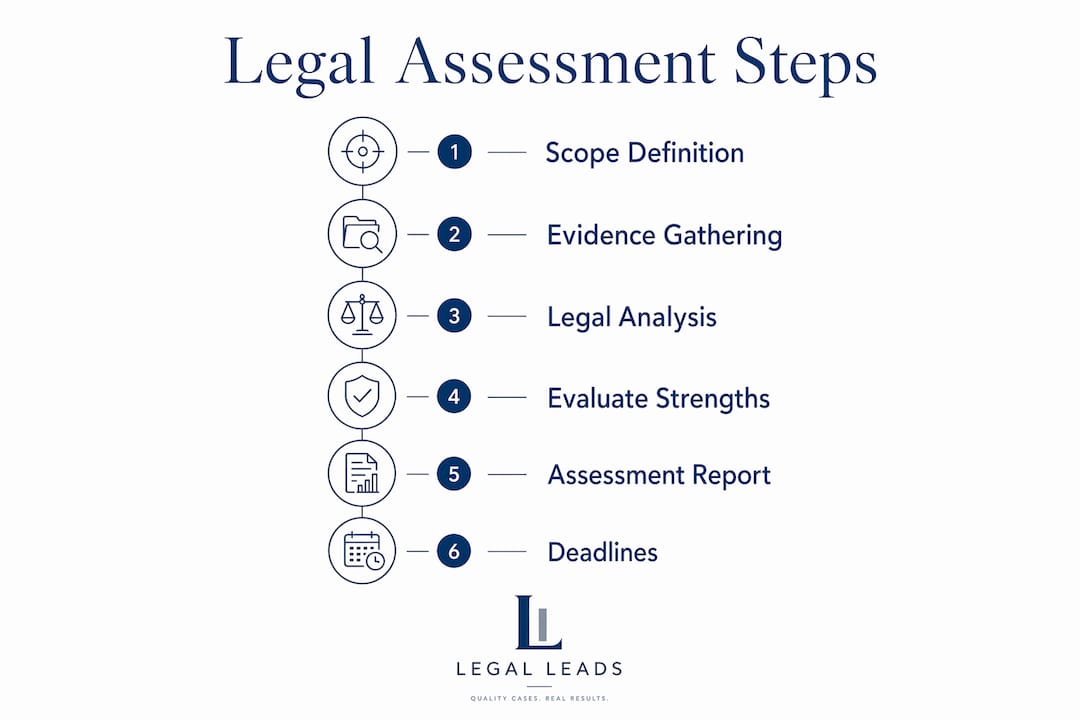
5. Assessment report
The attorney produces a written summary covering probable outcomes, estimated litigation costs, settlement ranges, and alternative resolution options such as mediation or arbitration.
6. Procedural deadlines
Timing matters. Formal litigation rules, including procedural frameworks like Rule 16(b), often require early assessments within 60–90 days. Missing those windows can limit your ability to collect evidence or raise certain defenses later.
Pro Tip: Ask your attorney for a written assessment report, not just a verbal summary. A written document gives you a reference point for every decision you make going forward.
How does legal analysis underpin a situation assessment?
Legal analysis is the engine inside every case evaluation. The standard method attorneys use is the IRAC framework: Issue, Rule, Application, Conclusion. IRAC gives the analysis a disciplined structure that prevents attorneys from jumping to conclusions based on gut feeling.
The most common mistake clients make is confusing objective legal analysis with persuasive advocacy. Advocacy is what your attorney does in court, arguing your side as forcefully as possible. Legal analysis, by contrast, is what your attorney does before court, evaluating your case honestly, including its weak points. A biased assessment that only highlights your strengths is not an assessment. It is a sales pitch.
Experienced litigators use a technique called a "hardest questions" document during the assessment phase. This memo lists the toughest challenges your case faces, forcing the attorney to confront weaknesses before opposing counsel does. The goal is to prevent confirmation bias from distorting the evaluation.
Key markers of a trustworthy legal analysis include:
- Balanced coverage. The analysis addresses both favorable and unfavorable facts.
- Cited legal authority. Every legal conclusion references a specific statute, regulation, or court decision.
- Honest probability estimates. The attorney states realistic odds, not guaranteed wins.
- Identified gaps. Missing evidence or unclear facts are flagged, not ignored.
Pro Tip: If your attorney's assessment contains no weaknesses or risks, ask them directly: "What is the strongest argument against us?" A good attorney will have a clear answer.
What distinguishes proactive legal risk assessments from case evaluations?
Not all legal reviews serve the same purpose. Two distinct types exist: proactive legal risk assessments and case-specific situation assessments. Understanding the difference helps you know which one you need.
| Feature | Proactive legal risk assessment | Case-specific situation assessment |
|---|---|---|
| Who uses it | Organizations, businesses | Individuals with a specific dispute |
| Timing | Ongoing, before any dispute arises | After a specific incident or claim |
| Focus | Governance, compliance, policy gaps | Facts, evidence, and legal merit of one case |
| Risk ranking | High, medium, and low severity categories | Probability of winning, losing, or settling |
| Output | Risk register, compliance recommendations | Written case evaluation report |
| Analogy | Annual financial audit | Pre-surgery diagnostic test |
Legal risk assessments for organizations function like routine audits. They identify governance gaps, compliance failures, and contractual vulnerabilities before regulators or opposing counsel expose them. Risks are ranked by severity: high (financial or criminal exposure), medium (regulatory non-compliance), and low (contractual ambiguities). That ranking tells leadership where to act first.
A case-specific assessment, by contrast, focuses entirely on one dispute. It answers a concrete question: given these facts and this law, what are your realistic options? For individuals dealing with a personal injury claim, a family law matter, or a contract dispute, the case-specific assessment is the relevant tool. It converts uncertainty into a clear picture of probable outcomes and costs.
How can individuals prepare for and use a legal situation assessment effectively?
Preparation determines the quality of your assessment. An attorney can only evaluate what you give them. Incomplete information produces incomplete analysis.
The single most important preparation step is sharing everything, including documents that hurt your case. Clients frequently omit unfavorable records, believing they protect themselves by doing so. The opposite is true. Withholding adverse evidence creates blind spots that surface during discovery, often at the worst possible moment. Over-sharing with your attorney is always safer than under-sharing.
Common pitfalls to avoid:
- Emotional decision-making. Anger, fear, or pride pushes people toward litigation when settlement would serve them better. A good assessment replaces emotion with data.
- Ignoring procedural deadlines. Missing early assessment windows set by court rules can permanently limit your evidence options and defense strategies.
- Treating the assessment as a guarantee. An assessment predicts probabilities, not certainties. Use it as a decision-making tool, not a promise.
- Failing to ask about costs. Litigation is expensive. Your assessment should include a realistic cost estimate so you can weigh legal fees against potential recovery.
Once you have your assessment, use it to make a concrete decision: pursue litigation, negotiate a settlement, seek mediation, or walk away. A successful legal evaluation shifts your mindset from "we think we'll win" to a data-informed view of costs, risks, and realistic outcomes. That shift is where the real value of the process lives.
You can also use your assessment to prepare your legal case more effectively if you decide to move forward. Knowing your weak points in advance lets you and your attorney address them before opposing counsel does.
Pro Tip: Before your first attorney meeting, write a one-page timeline of events in your own words. Attorneys consistently report that a clear chronology cuts assessment time and improves accuracy.
Key Takeaways
A legal situation assessment is the most reliable way to convert legal uncertainty into a clear, data-driven decision about your next step.
| Point | Details |
|---|---|
| Core definition | A legal situation assessment is a systematic review of facts, law, and risks before formal legal action begins. |
| IRAC framework | Attorneys use Issue, Rule, Application, Conclusion to structure objective legal analysis and avoid bias. |
| Share all documents | Withholding unfavorable evidence creates blind spots; over-sharing with your attorney produces more accurate risk predictions. |
| Know the deadlines | Court procedural rules often require early assessments within 60–90 days; missing them limits your legal options. |
| Use it to decide | The assessment output should drive a concrete choice: litigate, settle, mediate, or withdraw. |
Why I think most people misuse legal assessments
Most people treat a legal situation assessment as a formality before hiring an attorney. That is the wrong frame entirely. The assessment is the decision point, not the preamble to one.
I have seen clients walk into assessments hoping for validation of a decision they already made emotionally. They want the attorney to confirm they will win. When the assessment reveals real risks, they dismiss it or shop for a second opinion that tells them what they want to hear. That pattern is expensive. Litigation costs accumulate fast, and a case that looked emotionally satisfying at the start can drain resources for years.
The assessments I find most valuable are the ones that produce uncomfortable conclusions. An attorney who tells you your case has a significant weakness is doing their job correctly. That honesty gives you the information you need to negotiate a better settlement, adjust your strategy, or make a clean exit before costs escalate.
Transparency with your attorney is the other underrated factor. The more clearly you communicate your legal problem, including the facts that embarrass you or weaken your position, the more accurate and useful your assessment becomes. Legal counsel cannot protect you from information they do not have.
— Admin
How Legalleads connects you with the right attorney for your assessment
Getting a legal situation assessment starts with finding an attorney who has real experience in your specific area of law. That match matters. A family law attorney and a personal injury attorney approach case evaluations very differently, and the right fit affects the quality of your assessment.

Legalleads makes that match fast and straightforward. You describe your legal situation in plain English, and the platform generates a professional case brief in under two minutes. From there, Legalleads connects you with a qualified attorney within 24 hours, with no calls, no complicated forms, and no guesswork about whether the attorney handles your type of case. Whether you need a personal injury attorney in Los Angeles or a family law specialist, you can find a qualified lawyer through Legalleads and get your assessment started today.
FAQ
What is a legal situation assessment in simple terms?
A legal situation assessment is an objective review of your legal matter that evaluates the facts, applicable laws, and risks before you take formal action. It tells you whether your case has merit and what your realistic options are.
How long does a legal assessment process take?
The timeline varies by case complexity, but court procedural rules commonly require early assessments to be completed within 60–90 days of a dispute arising. Simpler matters can be assessed in days; complex litigation may take weeks.
What is legal analysis, and why does it matter in an assessment?
Legal analysis is the structured process of applying law to facts to reach a conclusion about a case. Attorneys use the IRAC framework (Issue, Rule, Application, Conclusion) to keep the analysis objective and prevent emotional or biased conclusions.
What documents should I bring to a legal situation review?
Bring every relevant document, including records that appear to hurt your case. Withholding unfavorable evidence creates blind spots that can surface during discovery and damage your position at the worst possible time.
How does a legal assessment help me decide whether to settle or go to trial?
A thorough assessment shifts your perspective from emotional assumptions to a data-informed view of costs, risks, and probable outcomes. That information gives you a concrete basis for choosing between settlement, mediation, or litigation.