
A business legal audit is a structured review of your company's legal position, risks, and controls that surfaces gaps, prioritizes exposures, and produces a remediation plan. For founders, it reduces the chance of a contract dispute, failed funding round, or regulatory penalty derailing operations.
A legal audit covers six core areas:
- Corporate governance — formation documents, bylaws, board minutes, shareholder agreements
- Contracts and commercial agreements — customer, vendor, and partner contracts
- Employment and HR — offer letters, handbooks, contractor classifications, wage compliance
- Intellectual property — ownership assignments, trademarks, licenses, NDAs
- Regulatory and licensing compliance — permits, industry-specific licenses, privacy policies
- Insurance and dispute history — coverage adequacy, pending or past litigation
Pro Tip: Assign one internal owner before the audit starts. That person coordinates document access, answers auditor questions, and tracks remediation tasks. Without a single point of contact, audits stall and cost more.
Table of Contents
- What does a business legal audit cover?
- How is a legal audit carried out, step by step?
- Who needs a legal audit, and when should you schedule one?
- What do auditors deliver, and what red flags do they find?
- How long does a legal audit take, and what does it cost?
- How to prepare for a legal audit
- How to choose qualified counsel to run your audit
- How to turn audit findings into ongoing controls
- Key Takeaways
- Why legal audits are worth the investment
- Legalleads connects you to qualified audit counsel fast
- FAQ
What does a business legal audit cover?
A legal audit examines the documents and practices that govern how your business operates, contracts, employs people, and protects its assets. The scope varies by industry and stage, but the domains below appear in nearly every business compliance review.

In California and other jurisdiction-heavy states, employment law, data privacy, and industry licensing often drive the audit's critical path more than corporate structure alone. That means HR manuals, contractor agreements, and customer-facing terms of service move to the top of the document list.
| Domain | Typical Documents Reviewed | Why It Matters to Business Risk |
|---|---|---|
| Corporate governance | Articles of incorporation, bylaws, board/shareholder minutes, operating agreement | Gaps here invalidate decisions and complicate M&A or fundraising |
| Contracts | Customer agreements, vendor contracts, NDAs, partnership agreements | Non-standard or missing terms create liability and revenue risk |
| Employment and HR | Offer letters, employee handbook, contractor agreements, I-9s, pay records | Misclassification and wage/hour errors carry significant penalties |
| Intellectual property | IP assignment agreements, trademark registrations, license agreements | Unassigned IP can block a sale or funding round entirely |
| Regulatory compliance | Business licenses, industry permits, privacy policy, data processing agreements | Lapsed permits or non-compliant policies trigger fines and enforcement |
| Insurance | Policy schedules, coverage limits, claims history | Gaps in coverage leave the business exposed to uninsured losses |
| Dispute history | Demand letters, settlement agreements, active litigation files | Undisclosed disputes create deal risk and affect valuation |
The role of legal counsel in contracts is especially relevant here. Counsel familiar with your industry will know which contract clauses and regulatory requirements carry the highest risk in your specific market.
How is a legal audit carried out, step by step?
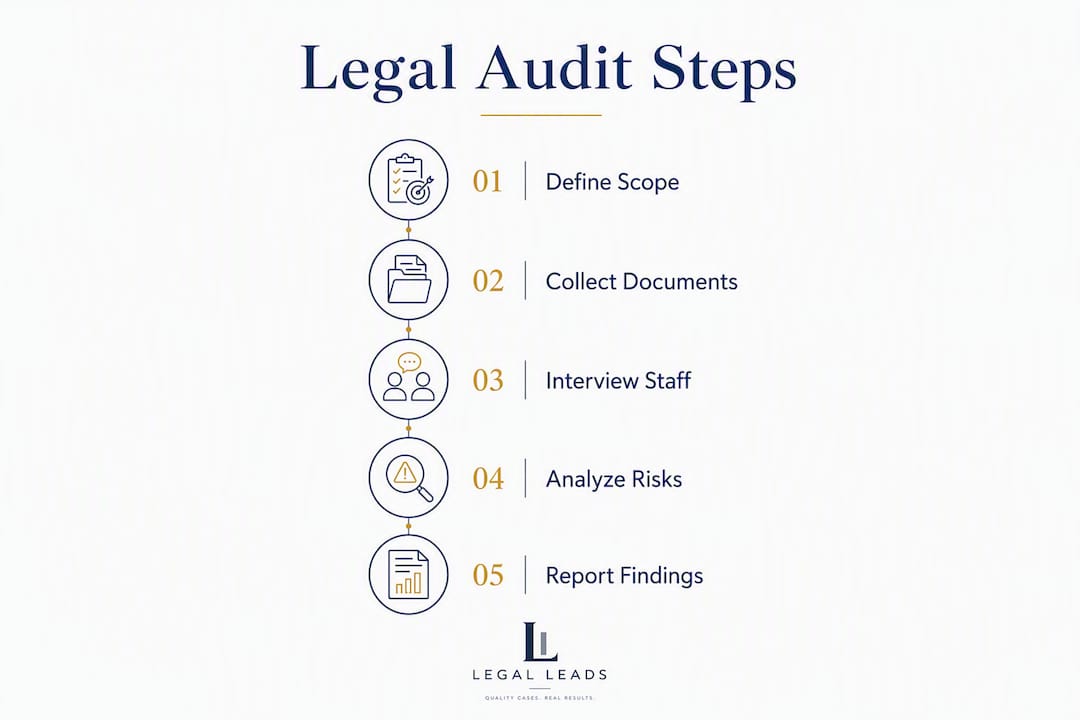
A legal audit moves through six phases: scope definition, document collection, interviews, analysis and risk assessment, written report, and a prioritized remediation plan. Each phase has a clear owner and a deliverable.
- Analysis and risk assessment — Counsel reviews documents against applicable law, flags non-compliance, and scores findings by severity and likelihood of harm.
A legal audit without a remediation plan is just a list of problems. The plan is what converts findings into reduced exposure and a stronger legal position for your next deal or regulatory review.
Pro Tip: During the interview phase, prepare a short written summary of your top three business risks and your growth plans for the next 12 months. Auditors use this to calibrate which findings deserve immediate attention versus longer-term monitoring.
A practical legal audit checklist covers the same sequence: identify subject areas, gather and organize documents, review for compliance, summarize findings, develop and approve an action plan, then execute and monitor. That monitoring step is what most founders skip, and it is where repeat issues originate.
Who needs a legal audit, and when should you schedule one?
A legal audit is usually voluntary, but it becomes effectively required when you are in a transaction, seeking investment, or when a lender or insurer asks for confirmation of compliance. Outside those triggers, the best time to run one is before a problem forces your hand.
Primary audiences:
- Startups preparing for a seed or Series A round
- Companies entering M&A discussions (buy-side or sell-side)
- Businesses adding a new product line, market, or jurisdiction
- Companies with rapid headcount growth or recent contractor-to-employee reclassifications
- Any business renewing commercial insurance or responding to a regulatory inquiry
Event-based triggers to act immediately:
- A term sheet or letter of intent is signed
- A key contract is disputed or a demand letter arrives
- A regulatory agency requests records or initiates an inquiry
- A co-founder or key executive departs and ownership of IP or equity is unclear
For businesses without a specific trigger, experts recommend conducting a full review at least annually or biannually, with more frequent targeted reviews for areas like marketing materials that face fast-moving regulatory change.
If bandwidth is limited, prioritize employment, contracts, and IP in year one. Add governance and regulatory compliance in year two. A phased approach still reduces risk substantially compared to no review at all. For M&A-specific timing, a business evaluation guide outlines how legal review fits into the broader due diligence process.
What do auditors deliver, and what red flags do they find?
The core deliverables from a legal audit are an executive summary, a risk matrix with prioritized findings, an annotated document register, and a remediation checklist. Together, these give you a clear picture of where you stand and what to fix first.
Common red flags auditors uncover:
- Missing or unsigned corporate minutes (board and shareholder meetings not documented)
- IP created by employees or contractors with no written assignment to the company
- Customer or vendor contracts with non-standard indemnification, limitation of liability, or auto-renewal terms
- Wage and hour exposure from misclassified contractors or unpaid overtime
- Lapsed business licenses or permits, or missing industry-specific certifications
- Insurance coverage gaps, especially for cyber liability, professional liability, or employment practices
- Undisclosed litigation, demand letters, or settlement agreements
Missing corporate minutes and unassigned IP are the two findings that most often delay or kill a funding round. Both are easy to fix in advance and expensive to fix under deal pressure.
When a red flag surfaces, the response falls into two categories. Short-term containment means stopping the bleeding: countersigning an IP assignment, correcting a payroll classification, or renewing a lapsed permit. Long-term remediation means updating templates, training staff, and building a process so the issue does not recur. For a closer look at the contract clauses that most often generate findings, examples of legal clauses to watch covers the patterns auditors flag most frequently.
How long does a legal audit take, and what does it cost?
Duration and cost depend on business size, the number of entities, the volume of contracts, and jurisdictional complexity. Typical ranges vary widely based on scope and complexity, with smaller businesses usually completing audits faster and at lower cost, and larger or transaction-focused audits taking longer and costing more.
Factors that affect price:
- Number of active contracts requiring individual review
- Multi-state or multi-jurisdiction operations
- Need for specialist counsel (employment, IP, data privacy, regulatory)
- Depth of document organization before the audit starts (disorganized records add billable hours)
- Whether the engagement includes post-audit remediation support
Fee structures vary. Flat project fees give founders budget certainty and work well for defined scopes. Hourly billing is more common when scope is unclear at the outset. Phased pricing, where each stage is quoted separately, suits companies that want to control spend incrementally.
Budget separately for remediation. The audit fee covers the review and the report. Fixing what the audit finds, whether that means redrafting contracts, filing IP assignments, or updating an employee handbook, carries its own cost. Founders who plan only for the audit fee and not the remediation work often delay acting on findings, which defeats the purpose.
How to prepare for a legal audit
Good preparation shortens the audit timeline and reduces fees. Auditors spend less time chasing documents and more time on analysis when records are organized before the engagement starts.
Documents to assemble by domain:
- Corporate records: Articles of incorporation or organization, bylaws or operating agreement, all board and shareholder meeting minutes, equity cap table, any amendments to formation documents
- Contracts: All active customer agreements, vendor and supplier contracts, partnership or joint venture agreements, NDAs
- HR and employment: Offer letters, employment agreements, independent contractor agreements, employee handbook, I-9 records, payroll records, any severance agreements
- IP: Patent, trademark, and copyright registrations; IP assignment agreements for all founders, employees, and contractors; license agreements
- Licenses and permits: All current business licenses, industry permits, professional certifications, and any correspondence with regulatory agencies
- Insurance: Current policy schedules and declarations pages for all lines of coverage
- Litigation and disputes: Any pending or past demand letters, complaints, settlement agreements, or regulatory notices
- Privacy and compliance: Privacy policy, terms of service, data processing agreements, any compliance certifications (SOC 2, HIPAA, PCI-DSS if applicable)
Store documents in a centralized, access-controlled repository. Use consistent naming conventions (domain, document type, date) so auditors can navigate without a guide. Restrict access to sensitive HR and equity records to counsel and the internal owner only.
Pro Tip: Appoint an internal sponsor with authority to pull records from every department. Without that authority, document collection stalls at department heads who are protective of their files.
How to choose qualified counsel to run your audit
The single most important criterion is relevant experience: counsel who has audited businesses at your stage and in your industry will know which risks are material and which are routine. Generic corporate counsel with no sector experience will miss industry-specific regulatory exposures.
Objective selection criteria:
- Demonstrated experience with companies at your stage (startup, growth, pre-transaction)
- Familiarity with your industry's regulatory environment
- A sample scope of work or prior audit deliverable they can share (redacted)
- Fixed-fee or phased pricing options, not open-ended hourly billing
- A named project manager or partner who owns the engagement day-to-day
- References from clients who went through a similar audit
- Use of technology to speed document review and track findings
Questions to ask during provider interviews:
- What is included in your scope, and what is explicitly excluded?
- What is your estimated timeline, and what causes delays?
- Who on your team will do the actual review work?
- What does your final deliverable look like? Can you show a sample?
- Do you provide post-audit remediation support, and how is that billed?
- How do you prioritize findings when a client has limited budget to remediate?
Red flags when screening providers:
- Vague scope with no written engagement letter before work begins
- No sample deliverable or refusal to share a redacted example
- No named project owner (the partner sells, a junior associate delivers)
- Remediation support is bundled into the audit fee with no separate estimate
For founders who need to understand the broader role of counsel in business operations before selecting a provider, what is business legal counsel covers the engagement models and credentials to look for.
How to turn audit findings into ongoing controls
The most consequential best practice is treating the audit as the start of a compliance lifecycle, not a one-time document review. Founders who file the report and move on typically face the same findings at the next audit.
-
Assign an internal owner to every finding. Each item in the remediation plan needs a named person, a due date, and a priority level (critical, moderate, low). Without ownership, nothing moves.
-
Prioritize by business impact. Fix IP assignments and employment misclassifications before updating contract templates. The order matters because some gaps create immediate liability while others are longer-term risks.
-
Set a review cadence. Annual or biannual full reviews work for most businesses. Marketing materials and areas with fast-moving regulatory change may need quarterly checks.
-
Build a living legal repository. Keep all executed agreements, licenses, and compliance records in one place with expiration date tracking. Automated reminders for license renewals and contract expirations prevent the lapsed-permit finding from recurring.
-
Integrate compliance into onboarding and vendor intake. New hires should sign IP assignments and confidentiality agreements on day one. New vendors should go through a standard contract review before work starts.
Pro Tip: Use a simple project management tool, such as Asana, Notion, or even a shared spreadsheet, to track remediation tasks by owner, status, and deadline. A living checklist reviewed monthly is more effective than a quarterly all-hands compliance meeting.
Legal risk management for executives covers how to embed these controls into governance structures so they survive leadership changes and rapid growth.
Key Takeaways
A business legal audit is the most direct way to identify and prioritize legal risks before they surface in a deal, a dispute, or a regulatory inquiry.
| Point | Details |
|---|---|
| Definition and purpose | A structured review of contracts, governance, employment, IP, and compliance that produces a prioritized remediation plan. |
| When to run one | Before fundraising, M&A, insurance renewal, or significant headcount changes; otherwise annually or biannually. |
| What to expect | A written report with an executive summary, risk matrix, annotated document register, and a remediation checklist. |
| How to prepare | Assemble documents by domain in a centralized repository and appoint one internal owner before the audit starts. |
| Finding qualified counsel | Legalleads matches founders to verified attorneys in under 24 hours, with a case brief generated in under two minutes to accelerate scoping. |
Why legal audits are worth the investment
Most founders schedule a legal audit only when something forces the issue: a term sheet arrives, an employee files a complaint, or an insurer asks for documentation. That reactive approach is more expensive than a proactive one. The cost of fixing a missing IP assignment or a misclassified contractor before a deal is a fraction of what it costs to fix the same issue under deal pressure or in litigation.
The audit itself is not the hard part. The hard part is acting on the findings. Founders who assign owners, set deadlines, and track remediation tasks get lasting value from the process. Those who file the report and return to daily operations find the same gaps at the next review.
If you have not run a legal health check in the past 12 months, or if a transaction, a new hire wave, or a regulatory change is on the horizon, the right time to start is before the pressure arrives.
Legalleads connects you to qualified audit counsel fast
Finding an attorney with the right experience to run a legal audit is the step most founders delay longest. Legalleads removes that delay. Describe your business situation in plain English, and the platform generates a professional case brief in under two minutes. That brief goes to verified attorneys in your practice area, and you receive a match within 24 hours, with no forms, no cold calls, and no retainer commitment required upfront.

For founders who need employment law expertise uncovered during an audit, Legalleads also connects businesses to employment attorneys in Los Angeles and across California. When you are ready to move from reading about audits to scheduling one, find a qualified attorney through Legalleads and get your case brief started today.
FAQ
What is a business legal audit?
A business legal audit is a structured review of a company's legal position, covering contracts, governance, employment, IP, and regulatory compliance. It produces a prioritized remediation plan to address identified risks.
Is a legal audit mandatory for businesses?
A legal audit is usually voluntary, but it becomes effectively required during M&A, fundraising due diligence, or when lenders and insurers request compliance confirmation.
What are common red flags found during an audit?
The most frequent findings include missing corporate minutes, unassigned intellectual property, misclassified contractors, lapsed licenses, and non-standard contract terms that create unintended liability.
How do you conduct a legal audit?
A legal audit follows six phases: scope definition, document collection, interviews with key staff, analysis and risk scoring, a written report, and a prioritized remediation plan. Engaging qualified counsel with relevant industry experience is the standard approach.
What happens when a small business gets audited?
Counsel reviews your documents and operations, identifies compliance gaps and legal exposures, and delivers a report with a remediation checklist. Most small business audits take 1–3 weeks and result in a short list of prioritized fixes.