
California insurers must offer uninsured motorist (UM) and underinsured motorist (UIM) coverage on every auto policy, though you may have waived it in writing. If you're hit by a driver with no insurance or not enough of it, your first moves determine whether your claim survives: get a police or CHP report, notify your insurer immediately, and preserve every photo, witness contact, and medical record before evidence disappears.
TL;DR:
- If you have not explicitly waived it, your auto policy likely includes uninsured and underinsured motorist coverage that protects your injuries and undercovers vehicle repairs.
- You must promptly gather a police report, photos, witness contacts, and medical records within the first 72 hours to preserve evidence for your claim.
- You have two years from the accident date to file a lawsuit, reach a settlement, or initiate arbitration, making timely action essential to preserve your rights.
- Always verify your coverage status by reviewing your declarations page and endorsement documents because many drivers unknowingly reject or reduce their UM/UIM benefits.
- Consulting an attorney early is crucial if your insurer delays, undervalues, or disputes your claim, especially before deadlines or statutory limitations pass.
Table of Contents
- Understanding Your Uninsured Motorist Claim in California
- Checking Whether You Actually Have UM/UIM Coverage
- What to Do in the First 48 to 72 Hours After the Crash
- Statutory Deadlines That Can Kill an Otherwise Valid Claim
- How the UM/UIM Claims Process Actually Unfolds
- When Your Insurer Drags Its Feet: Filing with the CDI
- When It's Time to Call an Attorney
- Why Preservation Beats Negotiation Every Time
- Get Matched With California Personal-Injury Counsel
- Sources
- FAQ
Understanding Your Uninsured Motorist Claim in California
An uninsured motorist claim in California pays for injuries an at-fault driver caused when that driver carries no liability insurance at all. Underinsured motorist coverage kicks in when the at-fault driver has insurance, but their limits fall short of covering your actual losses. Both live under the same statutory framework, but they trigger differently and it matters which one applies to your crash.
California Insurance Code §11580.2 requires every auto liability policy sold in the state to include UM bodily-injury coverage unless the named insured signs a written waiver rejecting it or reducing it below standard levels. Plenty of drivers sign that waiver without realizing it, often to shave a few dollars off a premium, and never think about it again until they're hit by someone with no insurance.
California Insurance Code §11580.26 ties UM and UIM together in how insurers must offer them, and it also governs uninsured motorist property damage (UMPD), the part of your policy that pays for vehicle repairs rather than injuries.
Here's what typically applies on a California policy:
- UM/UIM bodily injury limits commonly default to the state's financial-responsibility minimums, though many drivers carry higher limits.
- UMPD usually caps out at a set limit for vehicle damage on policies without collision coverage, under the terms set in §11580.26.
- Collision coverage, if you carry it, generally handles vehicle repairs more fully than UMPD does, since UMPD's $3,500 ceiling rarely covers a modern repair bill.
- UM/UIM bodily injury is where the real money sits: medical bills, lost wages, and pain and suffering from a crash caused by someone who can't pay for what they did.
The practical takeaway: UM/UIM protects your body, UMPD protects your bumper, and the two run on completely different tracks with different limits and different rules.
Checking Whether You Actually Have UM/UIM Coverage
Don't assume you have UM/UIM just because you've paid your premium for years. California's opt-out structure means coverage can vanish with a signature you might not remember giving, so a quick document check beats a nasty surprise after a crash.
Here's how to confirm what you're working with:
- Pull your declarations page. This one-page summary lists every coverage you carry, including UM/UIM bodily injury and UMPD limits, right at the top or in a clearly labeled section.
- Scan the endorsements. Look for language rejecting or reducing UM/UIM coverage, since insurers attach a specific waiver endorsement when a policyholder opts out.
- Check for named-driver restrictions. Some policies limit UM/UIM benefits to specific drivers on the household policy rather than anyone who drives the insured vehicle.
- Look for a signed rejection form. California requires insurers to get a written waiver on file, so if one exists, it's likely a separate signed document from years back.
- Request the full file if anything's missing. Call your insurer or agent and ask for the complete policy along with any signed UM waiver or reduction form.
Pro Tip: Request your declarations page and endorsements in writing, by email, rather than relying on a phone summary from a call center rep. Verbal descriptions of coverage are notoriously unreliable, and you want a paper trail before you're negotiating a claim, not during it.
If your insurer can't produce a signed waiver but claims you don't have UM/UIM, that's worth flagging. The absence of a valid rejection form can mean the coverage exists by default under §11580.2, regardless of what a customer service agent tells you over the phone.
What to Do in the First 48 to 72 Hours After the Crash
The steps you take immediately after an uninsured or hit-and-run accident often decide whether your claim holds up months later. Evidence disappears fast. Memories fade, skid marks wash away, and witnesses move on with their day.
- Get medical care first. Call 911 if anyone is hurt, and get checked out even if you feel fine, since some injuries surface hours or days later.
- Request a police or CHP report. This is statutory evidence for your claim, and it becomes especially important in hit-and-run cases where you have no other driver to point to.
- Photograph everything. Capture vehicle damage from multiple angles, license plates if visible, skid marks, debris, and the overall accident scene before it changes.
- Collect witness information. Names and phone numbers of anyone who saw the crash can carry a disputed claim when the other driver denies fault or vanishes entirely.
- Preserve medical records and bills. Every treatment note, invoice, and prescription receipt builds the documentation your insurer needs to value your injury claim.
- Track your lost wages. Ask your employer for a letter confirming missed work and lost income tied directly to the crash.
- Notify your insurer promptly. Report the accident, get a claim number, and ask for your assigned adjuster's direct contact information.
- Request your declarations page and any waiver forms from the insurer at the same time, so you have current copies rather than whatever you can dig up at home.
Pro Tip: Start a dated folder, physical or digital, the day of the crash. Drop in every certified-mail receipt, every email to your adjuster, the police report number, and copies of medical bills as they arrive. Insurers and arbitrators respond to organized, timestamped documentation far more than to a shoebox of receipts handed over eighteen months later.
Statutory Deadlines That Can Kill an Otherwise Valid Claim
The single most damaging mistake in a California uninsured motorist claim isn't a weak case. It's missing a deadline while assuming an open claim file protects you.
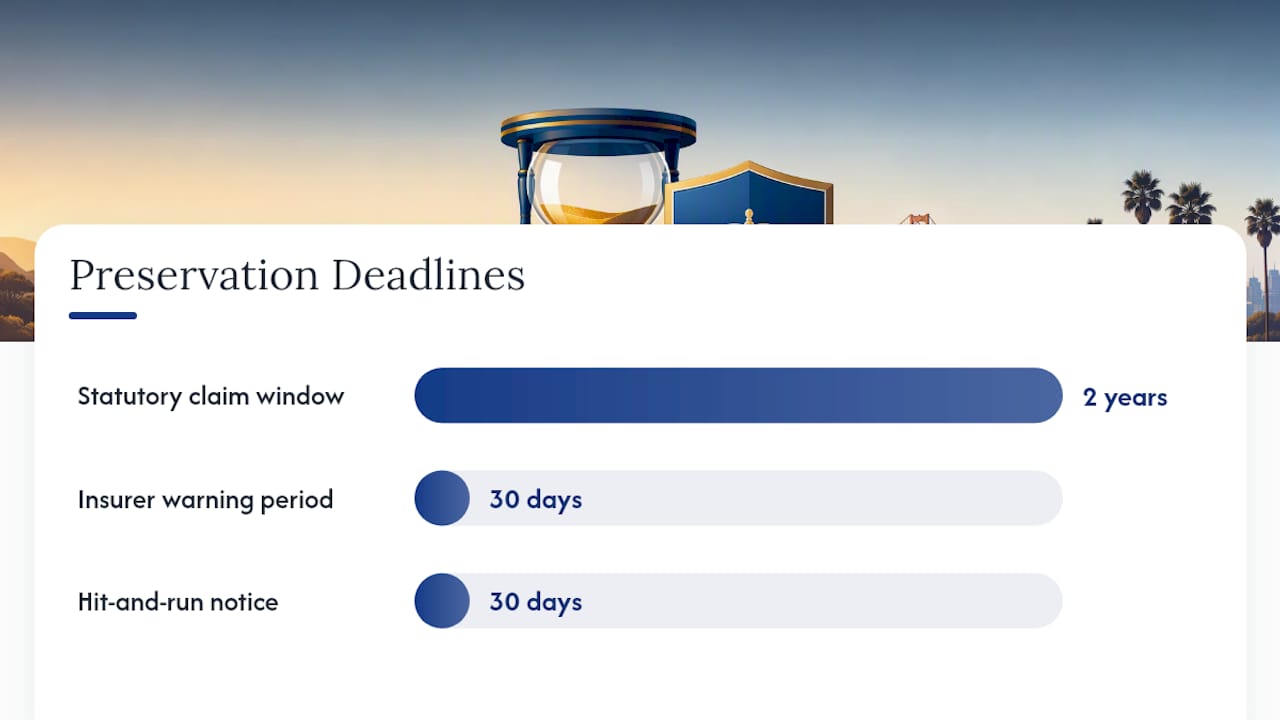
Under California Insurance Code §11580.2(i), you generally have two years from the date of the accident to take one of three specific actions:
- File a lawsuit against the uninsured motorist.
- Reach a written agreement with your insurer on the amount owed.
- Formally institute arbitration by written notice.
An adjuster telling you your claim is "still under review" does none of these things. If two years pass with nothing but ongoing conversation, you can lose your right to recover, even with a legitimate injury and clear liability.
Hit-and-run claims carry their own proof requirements under §11580.2(b), including evidence of actual physical contact between vehicles in most circumstances, a prompt police or CHP report, and written notice to your insurer, sometimes within 30 days depending on the specific coverage involved.
If you choose arbitration, send your demand by certified mail with return receipt requested, and keep that receipt permanently. Courts and insurers treat a missing return receipt as a real problem, since it's your primary proof that you gave proper written notice within the statutory window.
One protection working in your favor: your policy's notice provisions typically require the insurer to tell you about an approaching statute-of-limitations deadline at least 30 days before it expires. If they fail to give that notice, tolling rules may extend your window, though you shouldn't rely on that as your only safety net.
How the UM/UIM Claims Process Actually Unfolds
Once you've reported the claim, your insurer opens an investigation to verify the other driver truly had no insurance, or that their limits fall short of your damages. Expect them to ask for the police report, your medical records, wage documentation, and any evidence establishing the other driver's uninsured or underinsured status.
For UIM claims specifically, offsets come into play. Your insurer will typically deduct the at-fault driver's liability limits from what your UIM coverage would otherwise pay, so if your UIM limit is $100,000 and the other driver had $30,000 in coverage, you may be looking at up to $70,000 in additional recovery, not the full $100,000 stacked on top.
Carrier consent matters here more than most people realize. Settling with the at-fault driver's insurer before checking with your own carrier can jeopardize your UIM benefits and interfere with your insurer's subrogation rights, the right your insurer has to recover what they paid out from the at-fault party.
A few things to expect as the process moves forward:
- Most UM/UIM disputes head to mandatory arbitration rather than a jury trial, with the policy language and §11580.2(f) controlling how arbitrators get selected and what procedures apply.
- Arbitration panels are typically split, with each side naming an arbitrator and a neutral third arbitrator brought in when needed.
- The California Department of Insurance's mediation program exists mainly for vehicle physical-damage disputes, not bodily-injury liability fights.
- That mediation is voluntary and nonbinding, so either side can walk away if they don't like where it's heading.
Understanding these mechanics before you're in the middle of a dispute helps you recognize when your insurer's offer reflects a fair reading of the offsets, and when it doesn't. For more on how settlement timelines and offsets typically play out, see this breakdown of California car accident settlements and limits.
When Your Insurer Drags Its Feet: Filing with the CDI
If your insurer stalls, lowballs, or ignores your claim, the California Department of Insurance gives you a formal path to push back. You can file a Request for Assistance (RFA) that puts a regulatory spotlight on how your claim is being handled.
To file an RFA effectively, attach:
- Your policy declarations page.
- Your claim number and adjuster contact information.
- Copies of all correspondence with the insurer.
- Any supporting evidence, like the police report or medical documentation.
The Automobile Claims Mediation Program may also apply if your dispute involves vehicle physical damage exceeding certain thresholds in overall claim value and amount in dispute. It's voluntary and nonbinding for both sides.
Here's the part people miss: the CDI is a regulator, not a court, and it cannot extend your statutory two-year deadline under §11580.2. Filing an RFA does nothing to pause that clock. Take your preservation steps, filing suit, reaching a written agreement, or sending a certified arbitration demand, before or alongside any CDI complaint, never instead of it. If your claim is genuinely contested after filing with the CDI, that's usually the point where talking to counsel stops being optional. You can also read more on how statutory deadlines work in California car accident cases generally.
When It's Time to Call an Attorney
Some UM/UIM claims resolve cleanly with a fair offer and no drama. Others don't, and knowing the difference early saves you money and stress.
Consider talking to a lawyer if you're facing ongoing or serious medical treatment, if the insurer disputes fault or the other driver's uninsured status, if you've received a lowball offer that doesn't match your bills, or if the UIM offset math feels murky. Missed notice deadlines or an approaching two-year mark are also reasons to move fast rather than wait it out.
A personal-injury attorney typically calendars every statutory deadline immediately, drafts a proper arbitration demand if needed, and starts gathering medical records and wage documentation before your insurer can claim the delay is on you.
This is exactly where Legalleads fits into the picture. You describe your situation in plain English, the platform generates a professional case brief in under two minutes, and you get matched with California personal-injury attorneys who handle UM/UIM claims specifically.
Why Preservation Beats Negotiation Every Time
Most weak uninsured motorist claims aren't weak because the facts are bad. They're weak because someone missed a statutory step, let evidence go stale, or trusted an open adjuster file to protect them past the two-year mark. Negotiation tactics matter far less than people assume once a claim is already properly preserved. What actually determines outcomes is what happened in the first 72 hours and the first two years, not who argued harder in month fourteen.
The intake process is designed to reduce the time between the accident and attorney review, because that gap is where claims quietly die as explained in Why Insurance Companies Settle Class Actions. Get the police report. Notify the insurer. Preserve the records. Then get a professional read on your case before a deadline sneaks past you.
— Admin
Get Matched With California Personal-Injury Counsel
These services offer a faster starting point than calling law firms repeatedly. You describe what happened in plain English, the platform builds a case brief quickly, and you can get connected to qualified attorneys, often without forms or hold times.
If you're dealing with an uninsured motorist claim in California and you're unsure whether your two-year window is closing or whether your insurer's offer reflects what your UIM offset should actually pay, that's exactly the kind of situation worth a professional read. Many matched attorneys offer a free initial consultation, so there's little downside to finding out where you stand. Start your intake through the Personal Injury Attorney Matching page and get a case brief built around your actual accident, not a generic template.
This article is general information, not a substitute for advice from a qualified lawyer. Consult a qualified legal professional about your own circumstances before acting on anything here.
Sources
- California Insurance Code §11580.2
- Automobile Claims Mediation Program — California Department of Insurance
- California Department of Insurance — Request for Assistance (RFA) page
- Justia — California INS §11580.2 (arbitration and subrogation provisions)
FAQ
What happens if I get hit by an uninsured motorist in California?
Your own UM bodily-injury coverage, if you have it, pays for your medical bills, lost wages, and pain and suffering, since the at-fault driver has no liability insurance to cover you. You'll need to notify your insurer, get a police report, and follow the statutory preservation steps within two years to protect your right to recover.
What is the truth about uninsured motorist coverage in California?
Insurers must offer UM/UIM coverage on every policy, but many drivers unknowingly signed a written waiver rejecting or reducing it to save money. The only way to know for certain is to pull your declarations page and check for a signed rejection form on file with your insurer.
What is the statute of limitations for uninsured motorist claims in California?
You generally have two years from the accident date to file suit, reach a written agreement on the amount owed, or formally institute arbitration by written notice under §11580.2(i). An open claim file with your adjuster does not satisfy this requirement on its own.
What are the requirements for uninsured motorist coverage in California?
Insurers must offer UM/UIM bodily-injury coverage on every auto policy unless you sign a written waiver, per §11580.2. Common limits default to the state's financial-responsibility minimums, and hit-and-run claims carry added proof requirements including a timely police report and evidence of physical contact.
How much does it cost to use Legalleads to find a personal-injury attorney?
The intake and matching service through Legalleads is free for individuals seeking an attorney, since the platform's revenue comes from participating law firms rather than the person filing the claim. Consultation fees, if any, depend on the individual attorney you're matched with.