
Technology's role in legal access is to expand who can use the legal system, how fast they can use it, and what it costs them to do so. For decades, legal help was expensive, slow, and geographically limited. That is changing. 70% of consumers believe AI will make legal services easier to use, and 66% expect improved access overall. Those numbers reflect a real shift in how people think about getting legal help. Platforms like Legalleads are already putting that expectation into practice, connecting people to qualified attorneys in under 24 hours using plain-language technology.
What key technologies are driving the role of technology in legal access?
Several distinct tools are reshaping how people find, understand, and use legal services. Each one addresses a different barrier that has historically kept people away from the legal system.
AI-powered assistants and chatbots answer basic legal questions around the clock. They help people understand their rights, identify what type of attorney they need, and prepare for consultations. These tools do not replace lawyers, but they reduce the knowledge gap between a person with a legal problem and the professional who can solve it.

Document automation and plain-language tools are equally significant. Plain-language legal guidance combined with document automation significantly increases public access, as demonstrated by Ohio Legal Help's 2026 impact report. When legal forms are written in plain English and auto-populated with user data, people make fewer errors and complete processes faster.
Virtual courts and e-filing portals remove geography as a barrier. A person in rural Ohio no longer needs to drive three hours to file a motion. Digital portals let them submit documents, track case status, and receive court notices from home.
- AI chatbots for initial legal triage and rights education
- Document automation tools that generate court-ready forms
- E-filing systems and virtual hearing platforms
- Online legal aid portals with guided navigation
- AI tools used by nonprofits to assist community justice workers
Nonprofits are using AI in a particularly practical way. Frontline Q expands access to SNAP benefit assistance by equipping community justice workers with AI that delivers accurate, explainable legal guidance. The worker gets reliable answers fast, and the client gets help they could not otherwise access directly.
Pro Tip: When using an AI legal tool for the first time, test it with a simple question you already know the answer to. That tells you quickly whether the tool is accurate enough to trust with more complex issues.
How does technology improve access to justice and simplify legal processes?
Technology reduces three core barriers: cost, distance, and complexity. Each reduction makes the legal system more usable for more people.
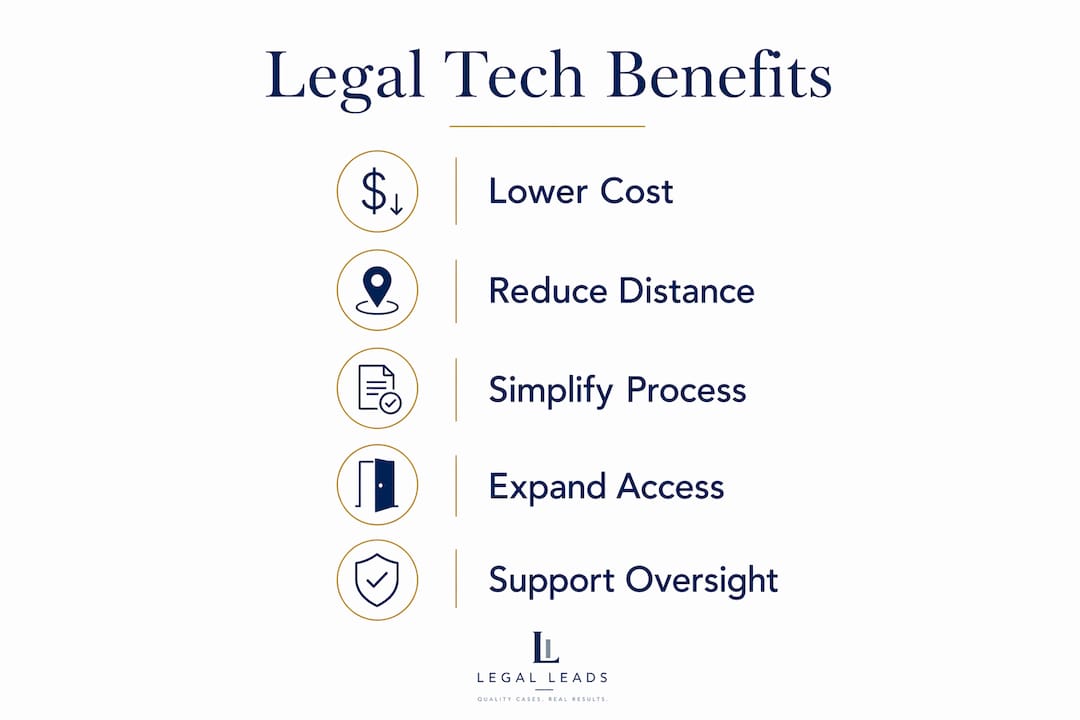
Cost drops when automation handles tasks that previously required billable hours. Document review, form preparation, and case research all take less time with AI assistance. That time savings translates directly into lower fees for clients or free services through legal aid organizations.
Distance shrinks through virtual legal services and digital platforms. Technology-driven innovations reduce procedural delays and geographic barriers, improving access especially for rural and disabled populations. A person with a mobility disability no longer needs to arrange transportation to a courthouse. A rural resident no longer loses a day of work to attend a brief hearing.
Complexity decreases when legal language becomes plain English. People who understand their situation make better decisions. They show up to hearings prepared. They file the right documents on time. That clarity also builds trust in the legal system itself.
Key practical benefits of access to justice technology include:
- Faster case processing through digital filing and automated scheduling
- Clearer record-keeping that clients can access and track themselves
- Reduced wait times for legal aid appointments through online intake
- Broader reach for legal aid organizations serving more people with fewer staff
Consumer sentiment supports these gains. The same Legal Services Board data showing 70% positive expectations signals that people are ready to use these tools. Readiness matters because technology only helps when people actually adopt it.
What challenges and limitations affect technology's role in legal access?
Technology does not solve legal access problems automatically. Three major barriers limit its reach: the digital divide, cybersecurity risks, and structural inequality between represented and unrepresented parties.
The digital divide is the most immediate obstacle. Lack of internet access, digital literacy gaps, and cybersecurity risks pose serious challenges that could deepen inequality if left unaddressed. A person without reliable broadband cannot use an e-filing portal. A person who has never used a smartphone cannot navigate an AI chatbot. Technology built for connected, digitally literate users excludes the people who most need legal help.
Cybersecurity is a separate concern. Legal matters involve sensitive personal data. Platforms that store case details, financial records, and identity documents become targets. Without strong data protection, the convenience of digital legal tools comes with real privacy risk. Readers exploring legal risk management for executives will recognize this tension between efficiency and data exposure.
The structural inequality problem is less visible but equally serious. AI tools are not universally available to pro se litigants, creating a structural disadvantage against represented parties. Law firms use sophisticated, tailored AI systems. A self-represented individual uses a general-purpose chatbot. That gap can affect case outcomes.
- Broadband access gaps in rural and low-income communities
- Low digital literacy among elderly and disadvantaged populations
- Data privacy risks from poorly secured legal platforms
- AI quality gaps between tools available to lawyers versus the public
Pro Tip: Before entering personal legal details into any online platform, check whether it uses end-to-end encryption and has a clear privacy policy. If neither is visible, find a different tool.
How is the legal industry adapting to incorporate technology responsibly?
The legal industry is not ignoring these challenges. Law firms, courts, and nonprofits are each adjusting how they work to get the benefits of technology without creating new problems.
Corporate legal departments are projected to double their investment in legal technology by 2028. That investment signals a permanent shift, not a trend. Law firms are hiring legal technologists alongside attorneys. Courts are building digital infrastructure. Nonprofits are partnering with AI developers to scale legal aid.
The most effective adaptation follows a hybrid model. AI handles research, document drafting, and intake. Attorneys handle judgment, strategy, and advocacy. That division keeps humans accountable while letting technology do what it does well: process information quickly and consistently.
Four principles guide responsible legal technology adoption:
- Accuracy verification. Every AI output requires human review before it affects a client's case.
- Training requirements. Attorneys and staff need ongoing education on the tools they use.
- Consumer safeguards. Platforms must disclose when AI is involved and provide clear redress options.
- Inclusive design. Tools must work for people with limited digital literacy, not just tech-comfortable users.
"Despite widespread AI access among lawyers, trust remains moderate, indicating a need for better training and oversight." The legal industry's challenge is not access to AI. It is building the judgment to use it well.
Human oversight remains crucial, with technology serving to support rather than replace legal work. That principle is not a limitation. It is the design standard that keeps legal technology trustworthy.
What practical steps can individuals take to use technology for legal help?
You can use technology to get better legal help right now. The key is knowing which tools are reliable and where their limits are.
Start with a legal situation assessment to clarify what kind of legal problem you actually have. Many people waste time and money consulting the wrong type of attorney because they misidentify their issue. AI-based self-help tools can help you frame your situation before you speak to anyone.
Practical steps for using digital tools for legal access:
- Use government-run legal aid portals first. They are free, accurate, and maintained by licensed professionals.
- Describe your situation in plain English on platforms that generate case briefs. This saves time in attorney consultations.
- Verify any AI-generated legal information against a second source before acting on it.
- Keep records of every digital interaction with legal platforms, including dates and document versions.
- Ask any online legal service whether a licensed attorney reviews its AI outputs.
For document-related tasks, a non-lawyer legal document review guide can help you understand what you can handle yourself and when you need professional review. That boundary matters. Technology can prepare you for legal help. It cannot substitute for it.
Pro Tip: If a legal platform does not tell you clearly whether a licensed attorney is involved in its service, treat its output as a starting point only. Never file a legal document based solely on AI output without attorney review.
Key Takeaways
Technology expands legal access by reducing cost, distance, and complexity, but human oversight and inclusive design remain the conditions that make it work equitably.
| Point | Details |
|---|---|
| Consumer expectations are high | 70% of consumers expect AI to make legal services easier, signaling strong demand for digital legal tools. |
| Plain language and automation work | Ohio Legal Help's 2026 report confirms that plain-language tools combined with document automation increase public access. |
| The digital divide is a real barrier | Lack of internet access and digital literacy gaps can deepen inequality if technology is not designed inclusively. |
| Structural asymmetry disadvantages self-represented individuals | Law firms use advanced AI unavailable to pro se litigants, creating unequal footing in legal proceedings. |
| Human oversight is non-negotiable | Technology supports legal work but cannot replace attorney judgment, accountability, or ethical responsibility. |
Why technology alone will not fix legal access
Technology has genuinely changed what is possible in legal access. I have watched platforms go from basic FAQ pages to AI systems that generate accurate case briefs in under two minutes. That is a real improvement. But the gap between what technology can do and who actually benefits from it is still wide.
The digital divide is not an abstract policy problem. It is a retired teacher in rural Mississippi who cannot file a housing complaint online because she does not have broadband. It is a recent immigrant who cannot navigate an English-language legal chatbot. Technology built without those people in mind does not expand access. It just moves the barrier.
A hybrid model combining AI tools with expanded court-based self-help centers is the most practical path forward. AI handles volume and speed. Human advocates handle nuance and trust. Neither works as well alone.
The legal industry's investment trend is encouraging. Doubling legal tech investment by 2028 means more tools, more competition, and eventually lower costs. But investment without inclusion standards produces better tools for people who already have access. The harder work is designing for the people who do not.
Technology is an enabler. The legal professionals and advocates who use it responsibly are still the ones delivering justice.
— Admin
Legalleads connects you with qualified attorneys, faster
Technology has made it easier to understand your legal situation. Getting connected to the right attorney still requires a reliable process.

Legalleads uses a technology platform that lets you describe your legal situation in plain English and receive a professional case brief in under two minutes. From there, you are matched with a qualified attorney within 24 hours. No calls, no complicated forms, and no guessing whether the attorney handles your type of case. Whether you need a personal injury attorney in Los Angeles or help with family law, Legalleads matches you to the right professional quickly. Find a lawyer through Legalleads and get matched today.
FAQ
What is the role of technology in legal access?
Technology improves legal access by reducing cost, removing geographic barriers, and simplifying legal processes through AI, document automation, and digital platforms. It makes legal help faster and more available to people who previously could not afford or reach it.
How does AI help people access legal services?
AI tools answer basic legal questions, generate plain-language document drafts, and help people identify the right type of attorney for their situation. Nonprofits also use AI to equip community justice workers with accurate legal guidance at scale.
What are the biggest barriers to legal technology access?
The digital divide, including gaps in internet access and digital literacy, is the primary barrier. Cybersecurity risks and the quality gap between AI tools available to law firms versus the general public also limit equitable access.
Can technology replace a lawyer?
Technology cannot replace a lawyer. Human oversight remains critical because attorneys provide judgment, accountability, and ethical responsibility that AI tools cannot replicate. Technology prepares and supports legal work; attorneys complete it.
How can I safely use online legal tools?
Use government-run legal aid portals and platforms that disclose attorney involvement in their AI outputs. Always verify AI-generated legal information against a second source, and never file a legal document based solely on AI output without professional review.