
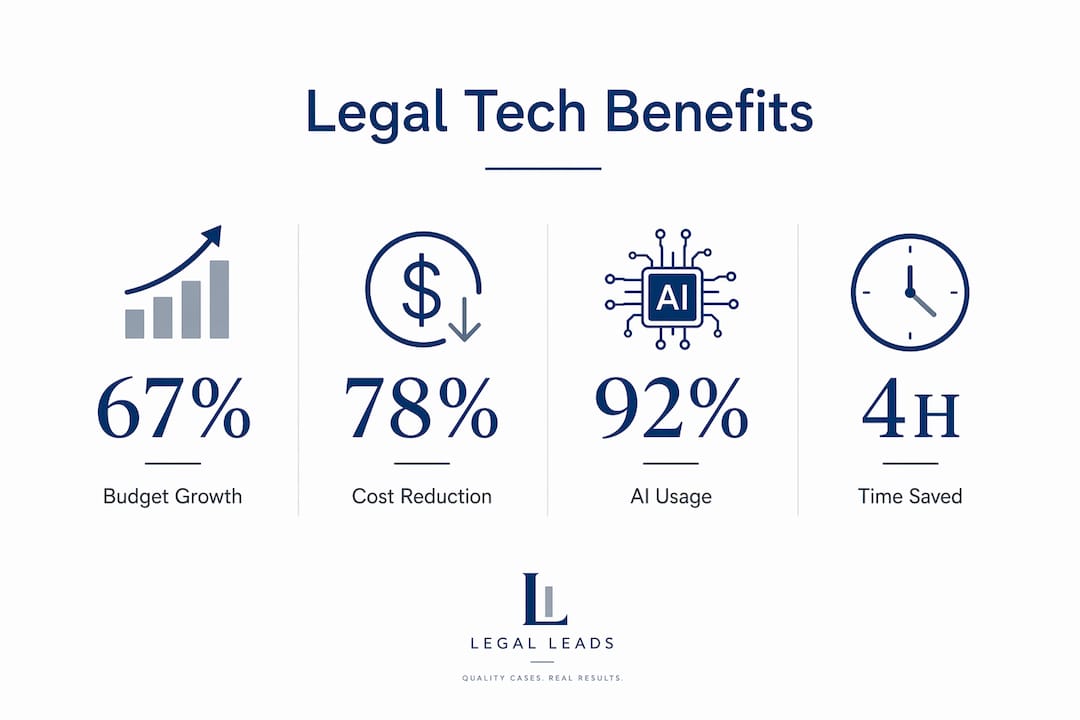
Legal technology is defined as the use of software, automation, and AI tools to manage, execute, and improve legal tasks within a business. The role of legal technology for businesses has shifted from a back-office convenience to a core operational function. 92% of legal professionals now use AI tools daily, saving nearly 10% of their weekly time on routine work. That number signals a structural change, not a trend. Legal tech now determines how fast a company can respond to risk, close contracts, and stay compliant.
What is the role of legal technology for businesses?
Legal technology covers a wide range of tools: contract management platforms, AI-assisted document review, matter management software, e-discovery systems, and cloud-based collaboration tools. The industry term for this field is "legal operations technology," though most business owners simply call it legal tech. Each category targets a specific friction point in how legal work gets done.
The primary value of legal tech is removing friction around human judgment. When a lawyer spends four hours reviewing a standard vendor agreement, that time is not spent on strategy or risk analysis. Automation handles the repetitive layer so attorneys focus on the decisions that actually require expertise. This is not a minor efficiency gain. It changes what a legal team can accomplish in a given week.
Legal departments boost AI spending at an average budget growth rate of 67% year over year. That level of investment reflects a clear return. Companies that adopt legal tech early gain a measurable advantage in contract cycle times, compliance readiness, and legal cost control. Those that wait face growing gaps in both speed and risk exposure.
What are the key benefits of legal technology for companies?
The benefits of legal technology fall into four clear categories: time savings, cost reduction, accuracy, and risk management.

Time savings are the most immediate impact. Automating contract approvals, deadline tracking, and document generation cuts hours from processes that previously required manual effort. Teams that save time on routine tasks redirect that capacity to higher-value work.
Cost reduction drives most adoption decisions. 78% of legal departments cite cost reduction as their top priority, and 66% are actively insourcing tasks they previously sent to outside counsel. That shift represents a fundamental change in how companies budget for legal services.
Accuracy and consistency improve when AI handles standardized processes. Human review introduces variation. AI-driven contract analysis applies the same rules every time, reducing errors in high-volume work like vendor agreements or employment contracts. You can read more about how document review works in practice.
Risk management gets stronger with contract lifecycle management and compliance monitoring tools. These platforms flag expiring agreements, track regulatory deadlines, and generate audit trails automatically.
Pro Tip: Before purchasing any legal tech tool, map your three highest-volume legal tasks. Buy the tool that addresses the biggest bottleneck first, not the most feature-rich platform.
How does legal technology transform legal departments into strategic partners?
Legal departments that use technology well stop functioning as cost centers and start functioning as business advisors. This shift is measurable. 96% of Chief Legal Officers agree that generative AI is now essential for proving their department's strategic value to leadership. That consensus reflects a real change in how legal teams operate.
"Legal departments are no longer just reviewing decisions after the fact. With the right technology, they participate in enterprise-wide AI governance and strategy from the start, shaping how the business adopts new tools and manages new risks." — Legal operations leaders, as reported by Law.com
Data analytics tools give legal teams the ability to report on contract performance, litigation exposure, and compliance status in real time. Executives get dashboards instead of memos. That shift changes the conversation from "what went wrong" to "what should we do next." Legal teams that understand business legal counsel in this broader context become genuine contributors to company strategy.
Legal departments now also play a central role in AI governance. As companies adopt AI tools across sales, HR, and operations, the legal team monitors regulatory changes, assesses liability, and sets internal policy. That function did not exist five years ago. Technology created it.
Pro Tip: Ask your legal team to present a quarterly risk dashboard to the executive team. If they cannot produce one, that gap is your first technology investment.
What are common challenges and best practices in adopting legal technology?
Adoption is harder than purchase. Most legal technology failures trace back to skipping workflow redesign and underestimating the cultural shift required.
84% of lawyers identify inconsistent processes as the primary cause of inefficiency, even when technology is already in place. That statistic reveals the core problem: tools do not fix broken workflows. They accelerate them, good or bad.
The best practices for successful adoption follow a clear sequence:
- Audit existing workflows before selecting any tool. Identify which processes are high-volume, high-friction, and rule-based. Those are your automation targets.
- Redesign the process first. Map the ideal workflow, then find the tool that supports it. Buying software and fitting your process around it produces fragmented results.
- Hire or train AI-literate personnel. Legal departments need people who understand both legal requirements and how AI systems work. Vendor reliance alone leads to gaps.
- Address compliance and cybersecurity readiness. Less than one-third of organizations are prepared for AI-related compliance and cybersecurity risks. That gap is the biggest operational risk in legal tech today. For a deeper look at managing this exposure, see legal risk management for executives.
- Measure outcomes, not activity. Track contract cycle time, legal spend per matter, and compliance incident rates. These metrics show whether technology is delivering real value.
| Challenge | Best Practice |
|---|---|
| Inconsistent processes | Standardize workflows before deploying any tool |
| Low AI literacy | Train staff or hire personnel with legal tech skills |
| Cybersecurity gaps | Conduct a security audit before cloud platform adoption |
| Vendor dependency | Build internal capabilities alongside vendor tools |
| Poor ROI measurement | Define success metrics before go-live |
Pro Tip: Run a 90-day pilot on one workflow before committing to an enterprise platform. Real usage data beats vendor demos every time.
What legal technology solutions are most impactful for businesses today?
The legal tech market organizes into several distinct categories, each addressing a different part of legal operations.
Contract lifecycle management is the fastest-growing segment in the legal tech market. CLM platforms centralize contract creation, approval routing, execution, and renewal tracking in one system. For companies managing hundreds of vendor, customer, or employment contracts, CLM eliminates the spreadsheet chaos that causes missed renewals and compliance failures.
Matter management software gives legal operations teams visibility into every active legal matter, associated costs, and assigned resources. Without it, legal departments operate reactively. With it, they can allocate resources based on actual workload data and report accurately on legal spend.
AI-assisted document review accelerates due diligence, litigation support, and regulatory filings. AI tools scan thousands of documents in hours, flagging relevant clauses and anomalies that would take a human team days to find. The key is targeting high-friction workflows for automation rather than applying AI broadly without a clear objective.
Cloud-based legal platforms now represent approximately two-thirds of the legal technology market. Cloud tools enable remote access, real-time collaboration, and secure document sharing across internal teams and outside counsel. That market share reflects how central cloud infrastructure has become to legal operations.
- CLM platforms: best for companies with high contract volume
- Matter management tools: best for in-house teams tracking multiple active matters
- AI document review: best for due diligence, M&A, and litigation-heavy operations
- Cloud collaboration platforms: best for distributed teams or hybrid legal departments
- Compliance monitoring tools: best for regulated industries with frequent regulatory updates
The right adoption strategy starts with business objectives, not technology features. Companies that build legal infrastructure around their specific operational needs outperform those that buy platforms based on market popularity.
Key Takeaways
Legal technology delivers measurable business value only when companies pair the right tools with redesigned workflows, trained personnel, and clear performance metrics.
| Point | Details |
|---|---|
| Automation saves real time | 92% of legal professionals use AI daily, saving nearly 10% of weekly time on routine tasks. |
| Cost reduction drives adoption | 78% of legal departments prioritize cost reduction, with 66% insourcing previously outsourced work. |
| Strategic value is now measurable | 96% of CLOs say generative AI proves legal's strategic value through data-backed executive reporting. |
| Process gaps undermine technology | 84% of lawyers cite inconsistent processes as the top inefficiency cause, regardless of tools in use. |
| Cloud platforms dominate the market | Cloud-based legal solutions hold approximately two-thirds of the legal technology market in 2026. |
Why most businesses get legal technology wrong
The biggest mistake I see business owners make is treating legal technology as a purchasing decision rather than an operational one. They buy a contract management platform, assign it to one person in legal, and expect the savings to appear. They never do.
What actually works is starting with the process. Before any tool goes live, the workflow needs to be mapped, standardized, and agreed upon by everyone who touches it. Technology accelerates whatever process exists. If the process is broken, the tool makes the problem faster and more expensive.
The second mistake is underestimating the cultural shift. Legal teams are trained to be cautious. Asking them to trust an AI system with contract review or compliance monitoring requires leadership buy-in, clear governance, and time. You cannot mandate adoption and expect quality results.
The firms that get this right treat legal technology as infrastructure, not software. They build internal capabilities, measure outcomes quarterly, and treat their legal team as a strategic function. That mindset produces compounding returns. The firms that skip it spend money on tools that sit unused and wonder why their legal costs keep rising.
— Admin
Legalleads connects you with attorneys who understand your business
Business owners need legal professionals who work efficiently and understand how technology changes legal practice. Legalleads connects you with qualified attorneys across practice areas, without the phone calls, complicated intake forms, or long waits.

Describe your legal situation in plain English and receive a professional case brief in under two minutes. Legalleads then matches you with a vetted attorney within 24 hours. Whether you need support with contracts, employment matters, or general business legal counsel, you can find a lawyer who fits your situation quickly. You can also browse attorneys by practice area to find the right match for your company's specific legal needs.
FAQ
What is legal technology in business?
Legal technology refers to software and AI tools that automate and manage legal tasks such as contract review, compliance tracking, and document management. It helps businesses reduce legal costs and improve the speed and accuracy of legal operations.
How does legal tech improve efficiency for companies?
Legal tech automates high-volume, rule-based tasks like contract approvals and deadline tracking, freeing attorneys to focus on complex decisions. Organizations using AI tools daily report saving nearly 10% of weekly time on routine legal work.
What is the biggest challenge in adopting legal technology?
The primary challenge is inconsistent processes, cited by 84% of legal professionals as the main cause of inefficiency even when technology is already in use. Successful adoption requires workflow redesign before tool deployment.
Which legal tech solution should a business prioritize first?
Contract lifecycle management is the fastest-growing legal tech segment and delivers the clearest ROI for companies with high contract volume. Start with the tool that addresses your highest-volume, highest-friction legal workflow.
Are most companies ready for AI-related legal risks?
Less than one-third of organizations are currently prepared for AI-related compliance, cybersecurity, and regulatory risks. Closing that gap requires a dedicated security and compliance audit before deploying any AI-powered legal platform.