
Legal risk management is defined as the systematic process of identifying, evaluating, and mitigating legal exposures that threaten a business's financial health, regulatory standing, and operational continuity. The role of legal risk management has expanded well beyond contract review and dispute resolution. Today, it sits at the center of enterprise governance, shaping decisions on structure, compliance, and growth. Frameworks like ISO 31000 establish the standard for integrating risk oversight across organizations, and General Counsels now lead on geopolitical uncertainty, cybersecurity, and AI integration alongside traditional legal duties. For business owners and executives, understanding this function is not optional. It is the foundation of sound governance.
How does legal risk management integrate with enterprise risk frameworks?
Legal risk management is most effective when it operates inside a broader Enterprise Risk Management (ERM) structure, not as a separate function. ERM provides the architecture: identify risks, analyze their likelihood and severity, evaluate their priority, treat them with controls, and review outcomes on a recurring cycle. Legal risk fits every stage of that cycle.
Cross-functional collaboration is the mechanism that makes this integration work. Legal risks routinely originate in IT systems, HR practices, and operational processes that legal teams never directly observe. A data breach starts in IT. An employment claim starts in HR. A contract dispute starts in procurement. Without structured communication across departments, legal teams respond to problems they never saw coming.

Legal professionals today also need hybrid skills that combine legal expertise with business and organizational competencies. This is not about lawyers becoming generalists. It is about legal teams understanding how business decisions create legal exposure, so they can advise before the exposure is locked in.
One practical tool for structuring this analysis is the 5x5 severity-by-likelihood matrix. It categorizes legal risks into four levels: Green (low), Yellow (medium), Orange (high), and Red (critical). Red risks, such as active litigation or government investigations, trigger mandatory escalation. This matrix gives executives a shared language for prioritizing legal risk alongside operational and financial risk.
| Risk level | Severity x likelihood | Example | Required action |
|---|---|---|---|
| Green | Low x Low | Minor contract ambiguity | Monitor and document |
| Yellow | Medium x Medium | Regulatory reporting gap | Assign owner, set deadline |
| Orange | High x Medium | Employment practice exposure | Immediate legal review |
| Red | High x High | Government investigation | Mandatory escalation |
Pro Tip: Run a cross-functional risk identification session quarterly. Invite IT, HR, operations, and legal to the same table. The risks that surface from that conversation are almost always the ones that would have blindsided you.
What are the key components of legal risk assessment?
A Legal Risk Assessment (LRA) is the structured process businesses use to surface legal exposures before they become disputes or regulatory actions. LRAs examine governance, contracts, operations, and compliance in a single review, revealing hidden liabilities that traditional financial audits miss entirely. Unmonitored legacy contracts and undocumented internal policies are common examples.
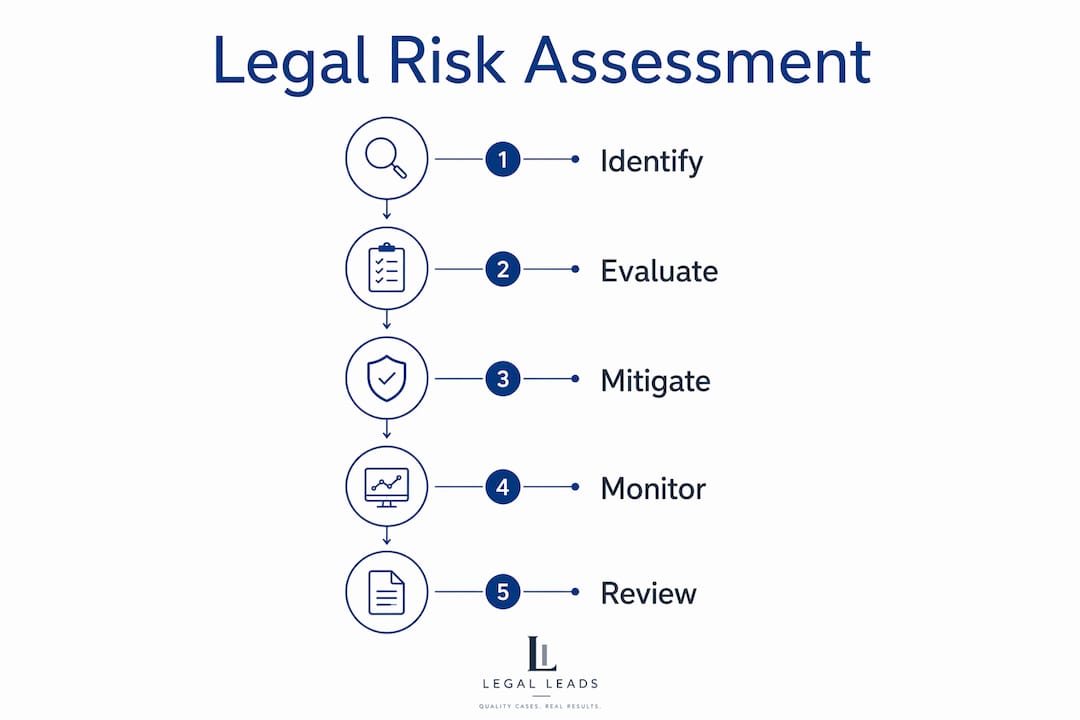
The LRA process follows a clear sequence:
- Risk identification. Map every area of the business where legal exposure exists: contracts, employment practices, intellectual property, data privacy, regulatory obligations, and third-party relationships.
- Categorization. Sort identified risks by type, such as compliance risk versus legal risk. Compliance risk and legal risk are distinct: compliance risk relates to following rules, while legal risk relates to defective transactions and adverse judgments. Each requires separate ownership.
- Prioritization. Apply a severity-by-likelihood framework to rank risks. Focus resources on Orange and Red categories first.
- Mitigation planning. Select a response strategy for each risk: avoidance (stop the activity), reduction (add controls), transfer (insurance or indemnification), or acceptance (document and monitor).
- Monitoring and review. Establish regular review cycles and trigger ad hoc reviews when major regulatory shifts occur.
Technology accelerates every phase of this process. AI-powered contract review and RegTech tools detect problematic contract clauses and monitor regulatory changes in real time. For businesses managing large contract portfolios or operating across multiple jurisdictions, these tools are not optional enhancements. They are the only practical way to maintain current risk visibility.
Pro Tip: Do not treat the LRA as a one-time project. Set a calendar trigger to revisit your risk register every six months, and immediately after any acquisition, restructuring, or entry into a new market.
Understanding document review basics also helps executives participate meaningfully in the LRA process, rather than delegating it entirely to legal teams.
How can businesses embed legal risk into strategic decisions?
Legal risk begins at the moment of structural decision-making, not at the drafting stage. By the time legal documents are created, the risk is already fixed and far less manageable. This is the most underappreciated fact in business legal governance.
Most executives engage legal counsel after a deal structure is set, a partnership is announced, or a new product is launched. That sequence is backward. The structural decisions, such as entity type, equity arrangements, vendor relationships, and market entry approach, determine the legal risk profile. Drafting only records what was already decided.
Embedding legal risk management into strategic decisions requires a shift in process:
- Bring legal counsel into planning conversations before term sheets or letters of intent are signed.
- Stress-test key assumptions with counsel. Ask what the legal exposure looks like if the deal terms change, if a partner defaults, or if a regulator challenges the structure.
- Treat legal input as a filter on optionality, not a final approval step. Early involvement preserves choices. Late involvement only documents them.
- Require a legal risk summary for any decision above a defined financial or operational threshold.
- Review governance documents, equity agreements, and key contracts annually, not only when disputes arise.
Involving legal counsel early in high-stakes decisions consistently produces better outcomes than post-transaction legal review. The cost of early counsel is always lower than the cost of unwinding a poorly structured deal.
What operational and compliance benefits come from managing legal risk?
Effective legal risk management produces measurable operational and compliance benefits that extend well beyond avoiding lawsuits. Businesses that build legal risk oversight into their governance routines report stronger regulatory relationships, fewer operational disruptions, and lower total legal expenditure over time.
The specific benefits include:
- Stronger compliance culture. When legal risk is reviewed regularly, compliance gaps surface before regulators find them. This shifts the organization from reactive to proactive on regulatory matters.
- Reduced dispute frequency. Clear contracts, documented policies, and trained employees generate fewer disputes. Prevention is consistently less expensive than litigation.
- Lower legal costs. Early issue detection reduces the volume and complexity of legal work required. Counsel spends time on prevention rather than crisis response.
- Improved investor and regulator confidence. Investors and regulators both assess governance quality. A documented legal risk program signals that leadership takes compliance seriously.
- Operational resilience. Proactive legal risk management includes crisis planning and policy documentation that keeps operations running when legal challenges arise.
Training is the often-overlooked component of this benefit set. Employees who understand basic legal risk, such as what constitutes a binding commitment, what data they can share, and when to escalate a vendor request, prevent a significant share of legal exposures before they reach the legal team. Understanding legal jargon in everyday decisions is a practical starting point for building that organizational awareness.
Key Takeaways
Effective legal risk management requires early legal involvement, cross-functional collaboration, structured assessments, and continuous monitoring to protect business value and compliance standing.
| Point | Details |
|---|---|
| Start before documents are drafted | Legal risk is fixed at the structural decision stage, not the drafting stage. |
| Use the 5x5 risk matrix | Categorize risks as Green, Yellow, Orange, or Red to prioritize resources and escalation. |
| Separate compliance and legal risk | Each requires distinct ownership: compliance risk and legal risk are not the same function. |
| Run regular LRAs | Legal Risk Assessments surface hidden liabilities that financial audits routinely miss. |
| Involve all departments | IT, HR, and operations generate legal risks that legal teams cannot identify alone. |
Legal risk is a judgment problem, not a paperwork problem
The framing that frustrates me most in conversations with business leaders is the idea that legal risk management is about having the right documents in place. Documents record decisions. They do not make them safer.
I have seen well-documented deals collapse because the structure was wrong from the start. The contracts were clean. The legal risk was not. The problem was a judgment call made before counsel was in the room, and no amount of careful drafting fixed it afterward.
The executives who manage legal risk well share one habit: they treat legal counsel as a thinking partner, not a production resource. They bring counsel in when they are still weighing options, not when they need signatures. That single shift changes the quality of every decision that follows.
The other misconception worth addressing is that legal risk management is a large-company function. It is not. Small and mid-sized businesses carry proportionally higher legal risk per decision because they have fewer resources to absorb a bad outcome. A single poorly structured partnership or an undocumented employment practice can be existential for a business with 20 employees. The scale of the risk program should match the scale of the business, but the discipline should not.
Build a governance routine that includes legal review at defined decision thresholds. Make it a standard part of how your organization operates, not a response to a crisis.
— Admin
How Legalleads connects businesses to qualified legal counsel
Managing legal risk requires access to the right attorney at the right moment. Legalleads connects business owners and executives to qualified attorneys in under 24 hours, without calls, complicated forms, or guesswork about who handles what.

You describe your legal situation in plain English. Legalleads generates a professional case brief in under two minutes and matches you with an attorney who fits your specific need. Whether you need counsel for a contract review, a compliance question, or a structural business decision, the platform gets you to the right expert before the risk becomes a dispute. Find a qualified attorney through Legalleads and put legal counsel where it belongs: at the front of your decision process, not the back.
FAQ
What is the role of legal risk management in a business?
Legal risk management identifies, evaluates, and mitigates legal exposures that could harm a business financially, operationally, or reputationally. It functions as a proactive governance discipline, not a reactive response to disputes.
How does legal risk differ from compliance risk?
Legal risk relates to defective transactions and adverse legal judgments, while compliance risk relates to failing to follow applicable rules and regulations. Each requires separate ownership, typically the General Counsel and the Chief Compliance Officer respectively.
When should a business conduct a Legal Risk Assessment?
A Legal Risk Assessment should run before major transactions, annually as a governance routine, and immediately after significant regulatory changes or business restructuring. LRAs surface hidden liabilities that standard financial audits do not catch.
What tools support legal risk assessment?
AI-powered contract review tools and RegTech platforms detect problematic clauses and monitor regulatory changes in real time. The 5x5 severity-by-likelihood matrix provides a structured framework for categorizing and prioritizing identified risks.
Why does early legal involvement matter in strategic decisions?
Legal risk is fixed at the structural decision stage, before any documents are drafted. Involving counsel early preserves options and improves outcomes. Engaging counsel only at the drafting stage records risk rather than reducing it.