
A legal advocate is defined as a non-attorney professional who supports individuals through legal processes by explaining procedures, connecting them to resources, and attending hearings on their behalf. The role of legal advocates explained clearly is this: they fill a critical gap for the millions of people who cannot afford or access formal legal representation. Legal advocates operate in civil, criminal, and administrative settings, and their work is governed by a firm boundary between providing legal information and giving legal advice. Understanding what advocates do, where their authority ends, and how they differ from licensed attorneys gives you a real advantage when facing any legal challenge.
What are the core functions of legal advocates?
Legal advocates provide legal information but cannot give legal advice tailored to an individual's specific situation or represent clients in full courtroom litigation. That single boundary defines everything about how they operate. Crossing it carries serious professional consequences for the advocate and real risks for the client.
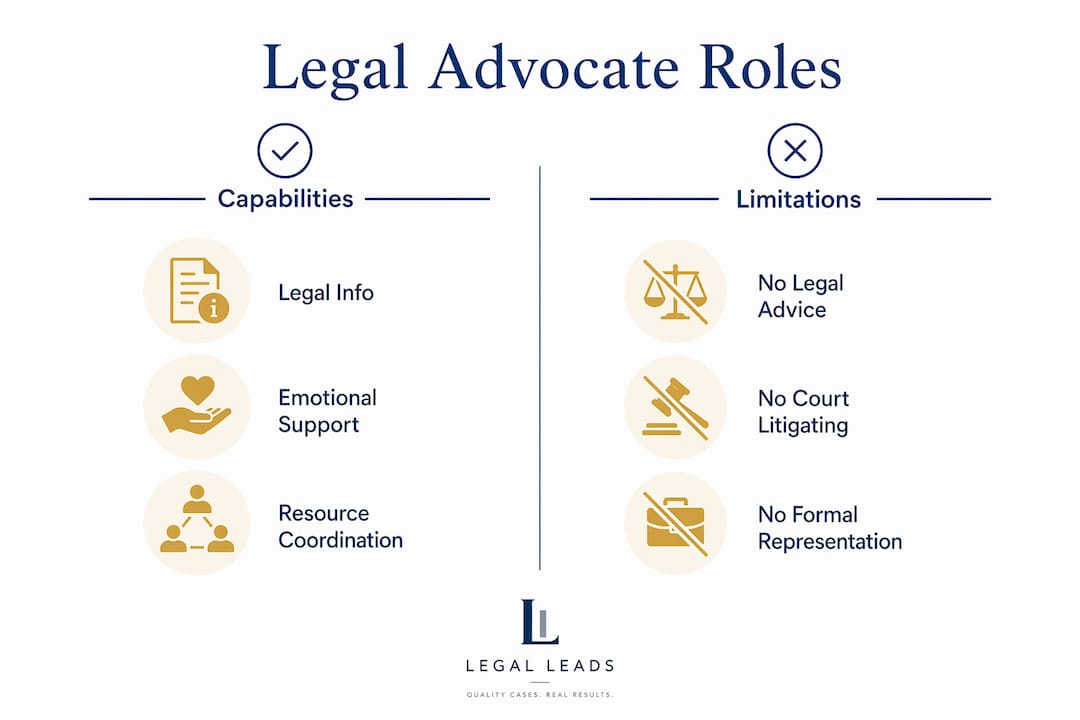
Within that boundary, advocates perform a wide range of practical functions. They explain legal documents in plain language, accompany clients to hearings, and connect individuals with social services, housing programs, or counseling referrals. Advocates often work in administrative settings such as housing disputes, benefit appeals, and school meetings, translating complex jargon into steps a client can actually take.
Core functions legal advocates perform include:
- Explaining court procedures and paperwork without interpreting how the law applies to a specific case
- Attending hearings, meetings, or administrative proceedings as a support presence
- Connecting clients with attorneys, social workers, or community organizations
- Providing emotional support throughout stressful legal processes
- Documenting client experiences and gathering information for attorneys to review
- Helping clients prepare questions before meeting with a lawyer
Pro Tip: Ask your advocate directly: "Is this legal information or legal advice?" If they are recommending a specific legal action for your situation, that crosses into advice territory, which requires a licensed attorney.
Most individuals confuse legal information with legal advice. This boundary distinction is critical for compliance and effective advocacy. Legal information describes how the law works generally. Legal advice tells you what to do in your specific case.
How do legal advocates differ from lawyers and licensed advocates?
The terminology here matters more than most people realize. All licensed advocates are lawyers, but not all lawyers are advocates in the formal sense, and legal advocates in the non-attorney sense are neither.

In jurisdictions like India, an "advocate" is a licensed legal professional authorized to represent clients in court after meeting education and bar exam requirements. They can litigate, cross-examine witnesses, and argue cases. That definition differs sharply from the American usage of "legal advocate," which typically refers to a trained but non-licensed support professional.
| Role | Licensing required | Can give legal advice | Can litigate in court |
|---|---|---|---|
| Legal advocate (non-attorney) | No | No | No |
| Lawyer | Yes (bar exam) | Yes | Depends on jurisdiction |
| Licensed advocate | Yes (bar exam + registration) | Yes | Yes |
The practical implication is clear. If you need someone to explain your court date paperwork and accompany you to a housing hearing, a legal advocate handles that well. If you need someone to argue your case before a judge, you need a licensed attorney. Understanding types of legal processes helps you identify which type of professional fits your situation.
Pro Tip: When searching for help, always ask whether the person you are speaking with is a licensed attorney or a legal advocate. The answer determines what kind of assistance they can legally provide.
Jurisdictional differences also matter. In the United States, the term "advocate" in everyday legal contexts almost always refers to a non-attorney support role. In the United Kingdom, India, and several other countries, "advocate" is a protected title for licensed litigators. Knowing which definition applies in your context prevents costly misunderstandings.
Why is legal advocacy important for individuals and the justice system?
Legal advocacy involves supporting individuals and institutional work to strengthen justice systems, advance the rule of law, eliminate bias, and promote human rights. The American Bar Association leads national initiatives in this space, including programs focused on justice reform and diversity in legal representation. That institutional dimension makes advocacy far more than a client service function.
For individuals, the importance is immediate and concrete. Millions of people face legal proceedings each year without any professional support. A legal advocate gives them a knowledgeable presence, reduces confusion, and prevents procedural errors that can derail a case before it begins.
"Advocates are the principal intermediaries between law and society, shaping how laws are interpreted and experienced by litigants through professional integrity and ethical conduct. Their duties include honest counseling, restraint from unnecessary litigation, and responsible dispute resolution."
LiveLaw, Rule of Law as Economic Infrastructure
The scope of advocacy has expanded beyond individual casework. Legal advocates and pro bono volunteers are increasingly engaging in "bearing witness," a practice that transforms legal services into social change activism by documenting systemic impacts, particularly in immigration cases. This approach drives accountability and systemic reform beyond individual cases.
Legal advocacy includes institutional efforts to advance policy reforms, promote diversity, and eliminate bias across the legal system. That means the importance of legal advocacy extends to every person who interacts with courts, government agencies, or administrative bodies, not just those with active cases.
What are the practical ways legal advocates help clients?
The most impactful work of legal advocates often occurs outside courtrooms. Advocates assist clients practically and emotionally in administrative hearings and social services coordination, helping them navigate complex bureaucratic systems that would otherwise be impenetrable without professional guidance.
A typical client interaction with a legal advocate follows a clear sequence:
- Initial intake: The advocate listens to the client's situation, identifies the relevant legal area, and explains what type of professional help is needed.
- Document review: The advocate reads through paperwork with the client, explaining what each form means in plain language without advising on legal strategy.
- Resource connection: The advocate identifies attorneys, legal aid organizations, or social services that match the client's needs and helps make referrals.
- Hearing preparation: The advocate helps the client prepare questions for their attorney and explains what to expect during the proceeding.
- Accompaniment: The advocate attends hearings or meetings as a support presence, taking notes and providing emotional grounding.
- Follow-up coordination: After a hearing, the advocate helps the client understand next steps and connects them with any additional services required.
The best outcomes arise when advocates and attorneys collaborate, each focusing on their distinct roles. Advocates address the client's full range of needs, while attorneys focus on courtroom strategy and legal argument. That division of labor produces better results than either professional working alone.
Pro Tip: If you are working with both an advocate and an attorney, ask them to communicate directly with each other. Advocates who share client notes with attorneys save time and reduce the chance of critical details being missed.
Common pitfalls to avoid include expecting your advocate to make legal decisions for you, or assuming they can represent you in court. Setting clear expectations at the start of the relationship prevents frustration and keeps the process moving efficiently. You can also explore attorney-client matching to understand how advocates and attorneys work together in structured referral systems.
Key Takeaways
Legal advocates are non-attorney professionals who provide legal information, emotional support, and resource coordination, filling a critical access gap for individuals who cannot afford full legal representation.
| Point | Details |
|---|---|
| Advocates provide information, not advice | Legal advocates explain processes and paperwork but cannot recommend specific legal actions. |
| Licensing defines the boundary | Only licensed attorneys and bar-registered advocates can litigate or give legal advice in court. |
| Most impact happens outside courts | Administrative hearings, benefit appeals, and social service referrals are where advocates add the most value. |
| Collaboration produces better outcomes | Advocates and attorneys working together serve clients more effectively than either working alone. |
| Advocacy drives systemic change | Beyond individual cases, legal advocacy supports policy reform, diversity, and rule of law initiatives. |
What I've learned about the real value of legal advocates
The conversation about legal advocates too often focuses on what they cannot do. That framing misses the point entirely.
Advocates act as guardians of the rule of law, ensuring honesty, prudence, and integrity in every client interaction. That is not a secondary role. For someone facing a housing eviction or a benefit denial with no attorney and no money, an advocate who shows up, explains the process, and makes a single well-placed referral can change the outcome of the entire case.
What I find most underappreciated is the emotional dimension. Legal proceedings are disorienting and frightening for people without legal training. An advocate who sits beside a client at a hearing, takes notes, and explains what just happened afterward provides something an attorney often cannot: sustained, human-level presence throughout the process.
The ethical dimension also deserves more attention. The rule of law is experienced by clients through daily legal interactions guided by advocates' integrity, honesty in risk assessment, and responsible choices. That means every advocate who operates with professionalism and within their proper scope is, in a real sense, strengthening the justice system itself.
The future of legal advocacy points toward greater institutional influence. As systemic reform movements grow and access to justice remains a documented national challenge, trained advocates will take on more formal roles in policy, documentation, and community legal education. The boundary between advocacy and law practice will remain firm. The importance of the work on the advocacy side of that line will only grow.
— Admin
Legalleads connects you with the right legal professional
Finding the right legal professional should not require hours of research or cold calls to law offices. Legalleads makes the process direct: describe your situation in plain English, receive a professional case brief in under two minutes, and connect with a qualified attorney within 24 hours.

Whether you need a family law attorney, support after a personal injury, or help with an employment dispute, Legalleads matches you with qualified legal professionals suited to your case. The platform removes the friction from finding legal help, so you spend less time searching and more time moving your case forward. Find a lawyer through Legalleads and get matched with the right professional for your situation today.
FAQ
What is a legal advocate?
A legal advocate is a non-attorney professional who supports individuals through legal processes by explaining procedures, attending hearings, and connecting clients with resources, without giving legal advice.
Can a legal advocate represent me in court?
No. Legal advocates cannot represent clients in full courtroom litigation. Only licensed attorneys and bar-registered advocates have the authority to litigate on your behalf.
What is the difference between a legal advocate and a lawyer?
A lawyer holds a law degree and bar license, can give legal advice, and can represent clients in court. A legal advocate provides information and support but operates without a license to practice law.
Where do legal advocates typically work?
Legal advocates work most often in administrative settings such as housing disputes, benefit appeals, domestic violence cases, and school meetings, where they provide practical and emotional support.
How do I know if I need a legal advocate or an attorney?
If you need help understanding paperwork, navigating a government agency, or finding legal resources, a legal advocate is appropriate. If you need someone to argue your case in court or advise you on legal strategy, you need a licensed attorney.