A case brief is defined as a concise, personal summary of a judicial opinion that distills the legally significant elements of a court decision into one page or less. The role of case briefs in law extends far beyond simple note-taking. These structured documents train law students and attorneys to read critically, identify legal issues, and apply rules to facts. Frameworks like IRAC (Issue, Rule, Application, Conclusion) and FIRAC give case briefs a standardized structure that law schools across the United States rely on. Whether you are a first-year law student preparing for a cold call or a practicing attorney cataloging precedent, understanding how to write and use case briefs is a foundational skill.
What are the essential components and frameworks for case briefs?
A well-structured case brief contains six core elements: the case name and citation, legally significant facts, procedural history, the legal issue, the applicable rule, the analysis, and the conclusion or holding. Each element serves a distinct purpose. The facts section captures only what the court found legally relevant, not every detail in the opinion. The procedural history explains how the case reached the court being reviewed.
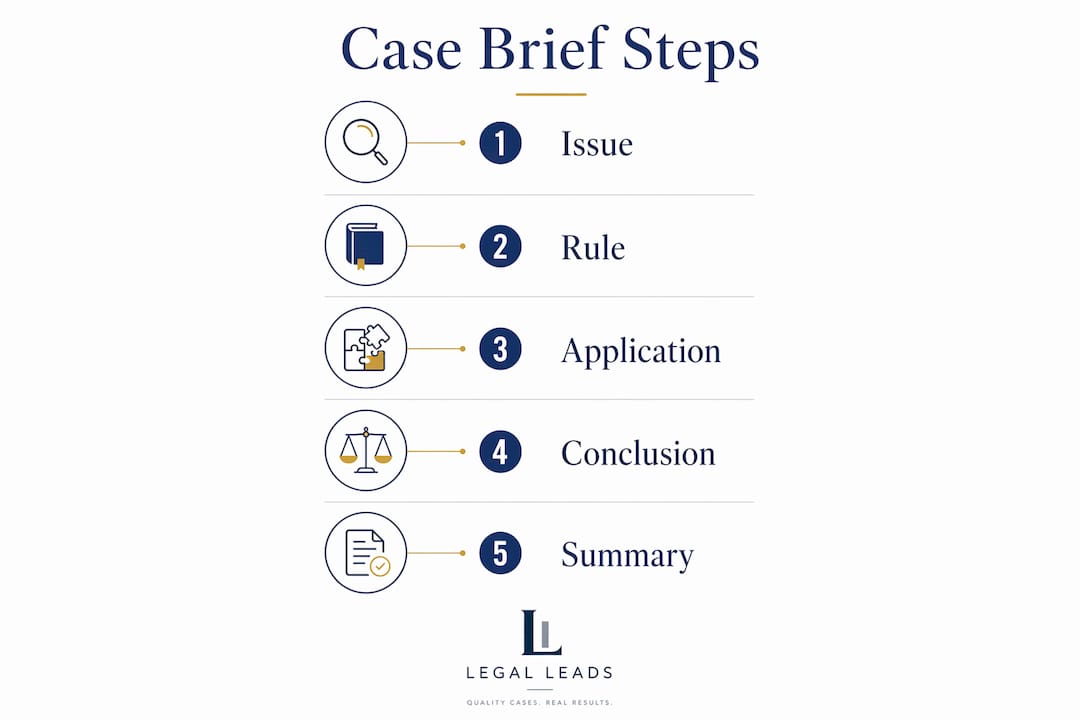
The IRAC framework is the dominant briefing format taught in American law schools. IRAC stands for Issue, Rule, Application, and Conclusion. The Application section is the longest and most critical part. This is where many students struggle most, because it requires explaining how the court applied the rule to the specific facts rather than simply restating the outcome.

Several IRAC variants exist, each with a slightly different emphasis:
| Framework | Structure | Best Used For |
|---|---|---|
| IRAC | Issue, Rule, Application, Conclusion | Standard case briefs and exams |
| FIRAC | Facts, Issue, Rule, Application, Conclusion | Briefs requiring detailed fact analysis |
| CRAC | Conclusion, Rule, Application, Conclusion | Predictive legal memos |
| CREAC | Conclusion, Rule, Explanation, Application, Conclusion | Complex analytical writing |
Pro Tip: Write the Application section in your own words before consulting any secondary sources. Paraphrasing forces you to confirm you understand the court's reasoning, not just its result.
How do case briefs differ from formal legal briefs?
Case briefs and formal legal briefs serve entirely different purposes, and confusing the two is a common early mistake. A case brief is a personal study document. A formal legal brief is a persuasive court filing submitted to a judge on behalf of a client. The audience, format requirements, and stakes are completely different.
Here is how the two documents compare across key dimensions:
- Purpose: Case briefs summarize existing opinions for learning. Legal briefs argue a position to persuade a court.
- Audience: Case briefs are written for yourself or your professor. Legal briefs are written for judges and opposing counsel.
- Format: Case briefs follow a flexible internal structure like IRAC. Legal briefs follow strict court rules on length, citation format, and section headings.
- Tone: Case briefs are neutral and analytical. Legal briefs are explicitly persuasive.
The skills developed through briefing overlap significantly with those needed for formal court filings. Identifying the issue, stating the rule, applying it to facts, and reaching a conclusion are foundational to both. A student who masters case briefs builds the analytical muscle that formal legal writing requires. Treating each document appropriately from the start prevents bad habits from forming in either direction. You can read more about the distinction in this business legal brief guide.
What is the evolving role of case briefs throughout law school and practice?
The way attorneys and students use case briefs changes significantly over time. First-year law students write full, detailed briefs for nearly every assigned case. This repetition builds the core skill of reading like a lawyer, which requires active engagement rather than passive reading or highlighting.
As students gain experience, their briefing habits shift. Experienced law students often move to book briefing, annotating directly in their casebooks rather than writing separate documents. This approach works once the foundational skills are already in place. Full written briefs remain valuable for doctrinally central cases, complex opinions, and any case likely to appear on an exam.
Practicing attorneys use case briefs differently than students do. Their primary use is cataloging precedent:
- Precedent tracking: Attorneys use briefs to catalog important cases efficiently, avoiding the need to re-read full opinions when preparing arguments.
- Quick reference: A well-written brief serves as a template for building legal arguments in new matters.
- Accident and injury cases: In personal injury practice, briefs on liability precedents allow attorneys to assess new fact patterns against established doctrine rapidly.
- Client communication: Briefs help attorneys explain the legal basis of a case to clients in plain terms.
Pro Tip: Keep a running brief file organized by legal doctrine. When a new case arises, you can cross-reference existing briefs instead of starting research from scratch.
How to write an effective case brief: tips and common pitfalls
Effective legal case brief creation starts with reading the full opinion before writing a single word. Students who skim first and brief second consistently miss the court's reasoning. The reasoning is the most important part of any brief.
Follow these steps to write a brief that actually builds your legal skills:
- Read the full opinion. Do not annotate or highlight on the first pass. Read to understand the story.
- Identify the legally significant facts. Exclude background details that did not affect the court's decision.
- Write the issue as a precise legal question. Frame it as: "Whether [legal standard] applies when [specific facts]."
- State the rule clearly. Include the source of the rule: statute, common law, or prior precedent.
- Write the Application section in your own words. Explain how the court connected the rule to the facts.
- State the holding concisely. One or two sentences. The holding is the court's answer to the issue, not a summary of the whole case.
- Edit for length. A brief exceeding one page often signals that non-essential details have crept in.
Three errors appear repeatedly in student briefs. First, copying text directly from the opinion instead of paraphrasing. Second, writing a facts section that reads like a narrative novel. Third, restating the final outcome in the analysis section instead of explaining the court's reasoning. All three errors signal passive reading rather than active legal analysis. Reviewing a legal case preparation checklist before you start can help you avoid these traps.
Pro Tip: After writing your brief, cover it and try to explain the case's reasoning aloud in two minutes. If you cannot, your Application section needs more work.
How do case briefs support exam preparation and legal analysis?
Case briefs are the most efficient study tool for law school exams. A brief reviewable in 60 seconds gives you everything you need to recall a case during a timed exam without re-reading the full opinion. That efficiency compounds across an entire semester of assigned cases.
Well-constructed briefs also train issue-spotting, which is the core skill tested on law school exams. When you encounter a new fact pattern on an exam, your brief collection becomes a mental index of rules and their triggering facts. Synthesizing multiple briefs across a doctrine reveals patterns that no single case shows alone.
| Study Use | How Case Briefs Help | Outcome |
|---|---|---|
| Cold calls | Instant recall of facts, issue, and holding | Confident class participation |
| Exam issue spotting | Pattern recognition across multiple briefs | Faster, more accurate analysis |
| Doctrinal synthesis | Comparing holdings across related cases | Deeper understanding of legal rules |
| Exam writing | Pre-built IRAC structure from briefing habit | Cleaner, faster exam answers |
Iterative editing and synthesis across multiple briefs reinforces understanding in a way that passive re-reading never achieves. Students who brief consistently throughout the semester outperform those who rely on commercial outlines alone. The brief is not just a study aid. It is proof that you have done the analytical work.
Key Takeaways
Case briefs are the single most effective tool for building legal reasoning skills, and their value grows with consistent, active use throughout law school and practice.
| Point | Details |
|---|---|
| Define before you write | A case brief summarizes only legally significant facts, issues, rules, and reasoning in one page or less. |
| IRAC is the standard | The IRAC framework structures most case briefs; the Application section is the hardest and most important part. |
| Briefs differ from court filings | Case briefs are personal study tools; formal legal briefs are persuasive court documents with strict format rules. |
| Briefing habits evolve | First-year students write full briefs; experienced students and attorneys shift to faster methods like book briefing. |
| Briefs power exam performance | A brief reviewable in 60 seconds enables fast recall and issue-spotting during timed law school exams. |
Why briefing is the habit that separates good lawyers from great ones
I have watched law students treat case briefs as a chore to complete before class. That framing costs them more than they realize. The brief is not the deliverable. The thinking you do while writing it is the deliverable.
What briefing actually trains is the ability to read a dense, complex document and extract what matters legally. That skill does not stay in the classroom. Every contract you review, every deposition you prepare for, and every argument you construct in practice draws on the same mental process you built by briefing cases at 11 PM in your first year.
The students I have seen struggle most on exams are almost always the ones who relied on pre-written briefs or commercial summaries. Using someone else's brief before reading the opinion is the equivalent of watching a workout video instead of exercising. You see the form but build none of the strength. Writing your own brief, even imperfectly, forces comprehension that no shortcut replicates.
My honest advice: keep briefing longer than your classmates do. Most students abandon full briefs by their second semester. The ones who keep writing them, even selectively, carry a structural thinking habit into practice that shows up in every document they produce.
— Admin
When your legal situation needs more than a brief
Case briefs build analytical skills for students and attorneys. When a real legal matter requires professional representation, the next step is connecting with a qualified attorney who knows your specific area of law.

Legalleads makes that connection fast and direct. Describe your situation in plain English on the platform, receive a professional case brief in under two minutes, and get matched with a qualified attorney within 24 hours. No calls, no complicated forms. Whether you need a personal injury attorney in Los Angeles or a family law specialist, Legalleads connects you to the right counsel without the usual friction. Find a lawyer through Legalleads and get the representation your case deserves.
FAQ
What is the main purpose of a case brief?
A case brief is a personal summary of a judicial opinion that distills the legally significant facts, issue, rule, analysis, and holding into one page or less. Its primary purpose is to build legal reasoning skills through active reading and analysis.
What does IRAC stand for in case briefing?
IRAC stands for Issue, Rule, Application, and Conclusion. It is the most widely used framework for structuring case briefs in American law schools, with the Application section being the most critical component.
How is a case brief different from a legal brief?
A case brief is an internal study tool summarizing a court opinion for personal use. A legal brief is a formal, persuasive document filed with a court on behalf of a client, subject to strict format and citation rules.
When do law students stop writing full case briefs?
Most students transition to book briefing or selective briefing after their first year, annotating directly in casebooks for speed. Full written briefs remain useful for complex or doctrinally central cases throughout law school.
Can practicing attorneys benefit from case briefs?
Practicing attorneys use case briefs to catalog precedent and build quick-reference libraries for legal arguments. This avoids re-reading full opinions and speeds up case preparation across matters with similar legal issues.