
Technology and AI are reshaping the role of technology in immigration law across three fronts simultaneously: automating routine adjudicative tasks at agencies like USCIS and EOIR, expanding enforcement surveillance through biometric and predictive systems at DHS, ICE, and CBP, and changing how attorneys and clients interact from intake through resolution. The net result is faster processing for standard benefit applications and more data-driven enforcement, paired with serious bias, transparency, and due-process risks that practitioners and policymakers cannot ignore. Primary technology areas now active in U.S. immigration practice include:
- Automated document processing and ID verification (Intelligent Document Processing, OCR, biometric matching)
- Case-management and intake platforms (deadline tracking, digital A-file assembly, client portals)
- Biometric and surveillance systems (facial recognition at ports of entry, GPS check-in apps, social-media screening)
- Predictive analytics and decision-support tools (caseload prioritization, risk scoring, verification confidence models)
Pro Tip: For immediate risk control, require human-in-the-loop checkpoints at every automated decision boundary and document the audit trail for any adverse outcome before it reaches an adjudicator.
Table of Contents
- How technology is being used across immigration workflows today
- Enforcement uses of technology and the constitutional risks they create
- How AI and automation change immigration practice and client outcomes
- A practical checklist for evaluating and adopting immigration tech
- How Legalleads speeds access to counsel: a practical example
- Regulation, oversight, and mitigation strategies across U.S. agencies
- Near-term trends that will reshape immigration practice
- Representative in-market tools practitioners use today
- How to evaluate and adopt immigration technology effectively
- How technology changes immigration timelines and costs
- Emerging AI capabilities for predictive case outcomes and risk assessment
- How technology affects client communication and engagement
- Data privacy and cybersecurity challenges in immigration technology
- Key Takeaways
- The efficiency-rights tradeoff deserves more honest attention
- Legalleads connects clients to immigration attorneys faster
- Useful sources
- FAQ
How technology is being used across immigration workflows today
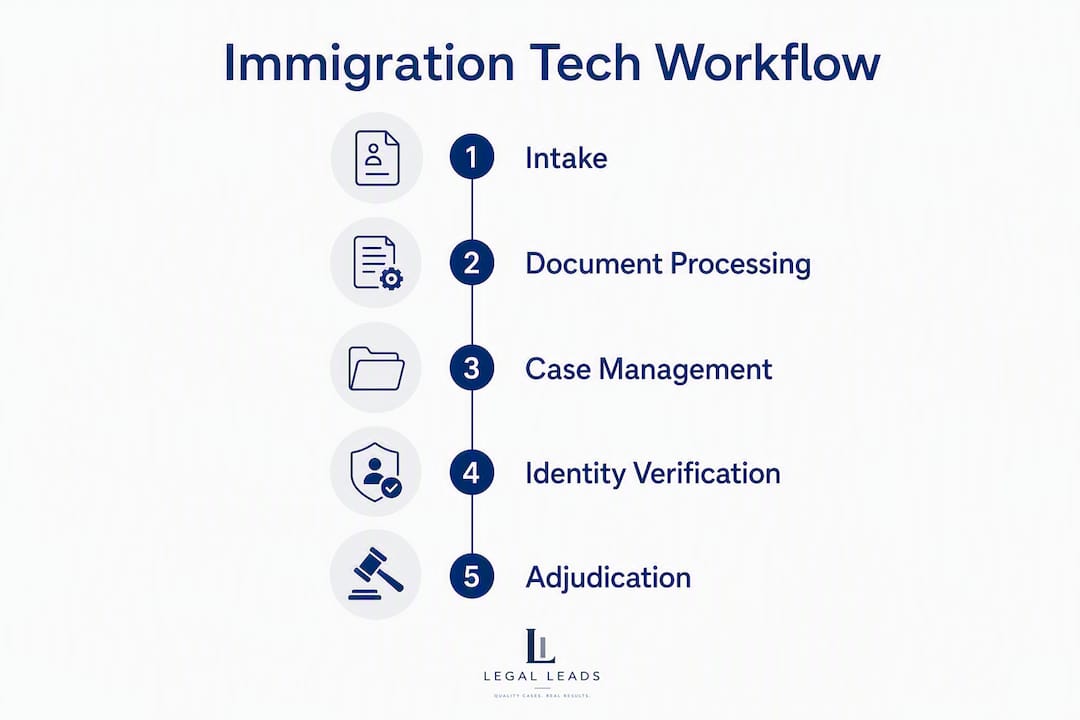
The application of digital tools spans every stage of the immigration process, from initial intake to final adjudication and enforcement monitoring.

Automated form assembly and Intelligent Document Processing. USCIS uses Intelligent Document Processing on certain forms, including the I-539, to identify and separate supporting documents such as passports, marriage certificates, and bank statements, then link them as structured records aligned with NARA standards. This reduces manual scanning time and lowers the error rate on document classification.
Digital intake and triage. Law firms and legal-aid organizations use intake platforms to collect client information in structured formats, auto-populate forms, and flag high-complexity cases for senior attorney review before a single billable hour is spent.
Case-management platforms. Enterprise-grade platforms track filing deadlines, generate automated reminders, consolidate digital A-files, and maintain audit logs. Their primary value is interoperability with agency data formats, not just internal organization.
Remote identity verification and biometrics. USCIS has issued requests for information on remote identity verification capable of handling up to 10 million transactions annually, requiring FIPS-validated encryption and FedRAMP-equivalent cloud security. This signals a near-term shift toward fully digital identity confirmation for benefit applications.
Translation and speech-to-text. Automated translation tools support multilingual intake and EOIR court management, reducing interpreter costs and wait times, though accuracy for low-resource languages remains inconsistent.

Predictive analytics for caseload prioritization. Agencies use ML-based scoring to rank cases by complexity or risk, directing limited adjudicator time toward cases that genuinely need human judgment.
| Technology Class | Typical Deployment Setting | Primary Practitioner Benefit |
|---|---|---|
| Intelligent Document Processing | USCIS intake, law firm document review | Faster classification, fewer manual errors |
| Digital intake and triage platforms | Law firms, legal-aid organizations | Structured data collection, early complexity flagging |
| Enterprise case-management platforms | Immigration law firms, agency case units | Deadline tracking, consolidated A-files, audit logs |
| Remote identity verification | USCIS benefit applications, ports of entry | Scalable, secure ID confirmation without in-person visits |
| Predictive analytics / ML scoring | Agency adjudication units, enforcement | Caseload prioritization, reduced manual review volume |
| Translation and speech-to-text | EOIR courts, multilingual intake | Lower interpreter costs, faster multilingual processing |
Enforcement uses of technology and the constitutional risks they create
DHS has reported nearly 200 AI use cases across its departments, with roughly 20 active deployments by ICE alone. Those deployments include facial recognition at ports of entry, social-media screening for visa applicants, GPS-based check-in applications for individuals on alternatives-to-detention programs, automated watchlist matching, and autonomous border surveillance through towers and drones.
The scale of automated verification is significant. E-Verify processes approximately 250,000 requests per day and SAVE processes approximately 70,000 requests per day, with ML-based Verification Match Models producing ranked confidence scores to reduce the volume of cases requiring manual review.
| Enforcement System | Agency | Scale / Scope | Key Risk |
|---|---|---|---|
| E-Verify (ML matching) | USCIS / DHS | ~250,000 requests/day | False positives affecting work authorization |
| SAVE (status verification) | USCIS | ~70,000 requests/day | Data lag causing incorrect benefit denials |
| Facial recognition | CBP / ICE | Ports of entry, detention | Racial bias, Fourth Amendment concerns |
| Social-media screening | DOS / DHS | Visa applicants | First Amendment chilling effects |
| GPS/photo check-in apps | ICE (ATD program) | Individuals on supervision | Scope creep, disproportionate monitoring |
The legal and constitutional concerns are concrete, not theoretical. Facial recognition models trained on non-representative datasets produce higher error rates for darker-skinned individuals, raising equal-protection and due-process claims. Social-media screening chills protected speech and association. Location-tracking apps raise Fourth Amendment questions about continuous warrantless surveillance. Scholarly analysis frames this shift as moving immigration governance from territorial management to granular, automated oversight of individuals, a change with significant civil-liberties implications.
Mitigation steps for agency counsel and policy stakeholders:
- Require algorithmic impact assessments before deploying any model that affects individual liberty or benefit eligibility.
- Commission independent third-party audits of training data, model outputs, and error-rate disparities by demographic group.
- Mandate explainability documentation so adjudicators can articulate the basis for any automated recommendation.
- Enforce data retention minimization policies to limit the scope of surveillance databases.
- Establish clear human-review gates for any automated decision that could result in detention, removal, or benefit denial.
How AI and automation change immigration practice and client outcomes
Automation reduces administrative time and error for routine filings, but it shifts firm value toward strategic legal judgment and client counseling. That shift is not optional; it is already happening.
A typical automated workflow moves from structured digital intake through automated document assembly, then to human attorney review, filing, and automated client status updates. The efficiency gain is real. Legal-tech platforms that automate visa and green-card paperwork, labor-compliance workflows, and intake triage allow attorneys to spend more time on complex cases and less on form population. Firms that submit structured, standardized documentation aligned with agency data models tend to see faster adjudication, because their filings require less manual review on the agency side.
The risks are equally concrete. Overreliance on templates produces errors in edge cases, particularly for complex asylum claims, removal defense, or cases involving mixed immigration status in a household. An attorney who approves an auto-assembled petition without reviewing the underlying facts faces real malpractice exposure. Automation also handles standard scenarios well and unusual ones poorly, which means the cases most likely to be harmed by unchecked automation are the ones with the highest stakes.
Operational bottlenecks for practitioners most often stem from poor digital interoperability and fragmented A-files, not from the absence of AI. A secure, API-connected case-management platform aligned with agency formats delivers more operational return than any consumer-facing AI tool. For detained and high-risk populations, digital access through tablets, remote video appearances, and secure A-file access materially improves representation rates.
AI adoption also reshapes workforce demand: automation reduces routine paralegal work while increasing demand for tech-literate staff who can manage platforms, audit outputs, and handle the complex cases that automation cannot. Firms that treat technology as a cost-cutting tool without investing in staff training tend to see quality problems within 12–18 months.
A practical checklist for evaluating and adopting immigration tech
Adopt a tool only when it reduces material risk or cost and the procurement includes enforceable guardrails covering data security, human review, and auditability. That is the decision threshold. Everything else is a feature conversation.
Vendor questions to ask before signing:
- What are the training data sources for any ML model, and can you provide documentation of data provenance?
- Does the system produce explainable outputs with audit logs accessible to the attorney of record?
- How is personally identifiable information (PII) encrypted at rest and in transit? Are FIPS-validated algorithms and FedRAMP-equivalent cloud environments supported?
- How frequently are models updated, and how are practitioners notified of changes that could affect output accuracy?
- Has the tool been independently evaluated for demographic bias or disparate impact?
- Does the platform support data export in standard formats, and does it provide API access for integration with agency systems?
- What is the incident response SLA for a data breach involving client immigration records?
Procurement checklist:
- Define a pilot scope with a representative sample dataset before full deployment.
- Test integration with A-file formats and agency submission portals.
- Require a staff training plan as a contract deliverable, not an afterthought.
- Include contract clauses for algorithmic accountability, liability allocation for automated errors, and audit rights.
Red flags that should end the conversation:
- Vendor refuses to disclose training data provenance.
- No human-in-the-loop option for decisions affecting individual cases.
- Pricing is tied to case outcomes rather than service delivery.
- The platform cannot operate in a controlled cloud environment that meets your firm's security requirements.
Document every procurement decision. If an automated tool contributes to a filing error or a missed deadline, the documentation trail is your first line of defense in a malpractice or bar complaint.
How Legalleads speeds access to counsel: a practical example
Legalleads demonstrates one concrete application of technology improving access to immigration counsel. A client describes their situation in plain English through the platform's intake interface. The system generates a professional case brief in under two minutes, which a matched attorney can review before the first consultation. The attorney-matching step connects the client to a qualified immigration attorney within 24 hours, without requiring phone calls or complex forms.
For high-risk cases, including detained individuals or those facing imminent removal proceedings, faster attorney contact is not a convenience; it is a material factor in case outcomes. Digital triage that flags case complexity early allows attorneys to prioritize their time and prepare more effectively before the initial consultation.
The platform's limitations are worth stating plainly. Legalleads speeds the connection and structures the intake, but it does not replace legal analysis. Complex asylum claims, removal defense, and cases involving prior orders of removal require attorney judgment that no intake platform substitutes for. The platform uses data minimization practices and secure transmission to protect client confidentiality during the intake process. Human review by a licensed attorney remains the required step before any legal strategy is formed.
For practitioners, the Legalleads intake and matching workflow addresses the first and most common bottleneck in immigration representation: the time between a client's need and their first substantive conversation with qualified counsel.
Regulation, oversight, and mitigation strategies across U.S. agencies
Regulation of AI in immigration is fragmented. Effective governance requires layered controls at the procurement, contract, audit, and operational levels, because no single federal statute currently governs biometric data collection, automated decision-making, or algorithmic accountability in immigration contexts.
USCIS's PAiTH program represents the most structured agency-level governance model currently in development: role-specific AI assistants running in a private USCIS cloud environment, designed to limit data exposure and maintain role-appropriate access. The DHS AI use-case inventory documents the breadth of deployments but does not impose binding performance or transparency standards on individual systems.
The absence of a comprehensive federal biometric privacy law means that constitutional litigation, state-level regulation, and contract language are currently the primary accountability mechanisms. Legal analysis consistently urges algorithmic impact assessments and transparency requirements as the minimum standard, noting that AI can buffer against inconsistent human decision-making when guardrails are properly designed.
Mitigation checklist for counsel and policymakers:
- Conduct algorithmic impact assessments before deployment and after any significant model update.
- Require third-party testing for demographic bias, with results disclosed to affected parties on request.
- Set data retention limits by category: biometric data, location data, and social-media data should have defined deletion schedules.
- Implement access controls that restrict database queries to authorized personnel with documented need.
- Build dispute-resolution workflows so individuals can challenge automated decisions with a clear escalation path to human review.
- Draft contract clauses covering model transparency, performance SLAs, data ownership, breach notification timelines, and audit rights. These should be treated as non-negotiable procurement terms, not optional add-ons.
Near-term trends that will reshape immigration practice
Several developments are likely to become operationally significant within the next two to three years.
- Continued civil-liberties pushback and state-level biometric regulation — Several states have enacted or are considering biometric privacy laws that will affect how vendors can deploy facial recognition and other biometric tools in those jurisdictions.
For practitioners, the practical implication is clear: invest in data interoperability, staff training, and legal oversight capabilities rather than headline consumer AI tools. Run small pilots focused on interoperability and auditability before committing to wholesale workflow replacement. The firms that will see the most durable efficiency gains are those that treat technology as infrastructure, not a shortcut.
Representative in-market tools practitioners use today
Several platforms have established meaningful adoption in U.S. immigration law practice. Each addresses a different part of the workflow.
INSZoom is a cloud-based immigration case-management platform used primarily by corporate immigration departments and law firms handling high-volume H-1B, L-1, and green-card caseloads. Its core value is deadline tracking, document storage, and client portal access within a single system. It integrates with HR platforms, which makes it practical for in-house teams managing employer-sponsored immigration at scale.
LawLogix (now part of Hyland) focuses on I-9 employment eligibility verification and H-1B case management. Its I-9 compliance module is widely used by HR teams that need audit-ready records and automated re-verification reminders. For firms with significant employer-client bases, LawLogix addresses a compliance gap that generic case-management tools do not.
Boundless targets the consumer end of the market, helping individuals navigate family-based green-card and citizenship applications with guided questionnaires and document checklists. It is not a law firm platform; it is a self-help tool that reduces errors on standard applications for users who cannot afford full attorney representation.
LegalPad focuses on immigration intake and document collection for law firms, using structured workflows to gather client information and supporting documents before the attorney engagement begins. It reduces the back-and-forth that typically adds days to the intake process.
These tools address distinct problems. INSZoom and LawLogix serve high-volume corporate and compliance workflows. Boundless serves self-represented applicants on standard cases. LegalPad addresses intake efficiency for law firms. No single platform covers all four functions, which is why many firms run two or more systems in parallel.
Pro Tip: Before selecting any platform, map your firm's actual bottlenecks first. A firm losing time to intake delays needs a different tool than one losing time to deadline management or I-9 compliance.
How to evaluate and adopt immigration technology effectively
The evaluation criteria that matter most are interoperability, security, and auditability, in that order. A tool that cannot exchange data with agency systems in standard formats will create more manual work than it eliminates. A tool that cannot demonstrate FIPS-compliant encryption is not appropriate for immigration data, which includes passport numbers, biometric identifiers, and immigration status information. A tool without audit logs is a liability in any malpractice or bar complaint scenario.
Practitioners see the largest return from platforms that enforce structured data collection compatible with agency systems, not from generic consumer-facing auto-fill tools. That distinction matters in procurement: ask vendors to demonstrate how their output formats align with USCIS submission requirements, not just how their interface looks.
The role of technology in legal access extends beyond efficiency. Tools that improve access for underserved populations, including detained individuals and those without English fluency, have a different value proposition than tools that reduce paralegal hours for corporate clients. Evaluate both dimensions when building a technology roadmap.
How technology changes immigration timelines and costs
Automation compresses timelines at the intake and document-assembly stages most reliably. A manual intake process that takes three to five days of back-and-forth can be reduced to same-day completion with a structured digital intake platform. Document assembly for standard petitions, including H-1B cap filings and family preference applications, can move from hours of paralegal time to minutes of automated population with attorney review.
The cost impact is real but unevenly distributed. Firms with high-volume, standardized caseloads see the clearest per-unit cost reductions. Firms with complex, fact-intensive caseloads, including asylum, removal defense, and VAWA cases, see smaller efficiency gains because those cases require substantial attorney judgment at every stage.
Processing time at the agency level is also affected. Submissions that mirror agency data models and arrive in structured, machine-readable formats require less manual review by adjudicators, which can reduce processing time for straightforward applications. USCIS's IDP deployment on the I-539 is a direct example: automated document classification reduces the time an officer spends sorting supporting materials before reviewing the substantive application.
The cost of technology itself is a real budget item. Enterprise case-management platforms carry licensing fees, implementation costs, and ongoing training expenses. Firms should model total cost of ownership over a three-year horizon, not just the monthly subscription rate, before committing.
Emerging AI capabilities for predictive case outcomes and risk assessment
Predictive analytics in immigration law currently operates at two levels: agency-side caseload prioritization and practitioner-side risk assessment. Both are developing rapidly.
On the agency side, ML models score incoming cases by complexity, completeness, and risk indicators to route them to appropriate adjudicators. USCIS's Verification Match Model, which produces ranked confidence scores for E-Verify and SAVE queries, is an operational example of this approach at scale.
On the practitioner side, emerging tools analyze historical adjudication data to estimate approval probabilities for specific petition types, officer assignments, and filing locations. These tools can help attorneys advise clients on realistic timelines and outcomes, but they carry a significant caveat: historical data reflects historical bias. A model trained on past adjudication patterns will encode the disparities present in those patterns, including geographic variation in approval rates and demographic disparities in enforcement.
Legal analysis notes that AI can act as a buffer against inconsistent human decision-making when algorithmic guardrails and transparency requirements are in place. The same analysis warns that without those guardrails, automated systems can amplify existing disparities at scale. Practitioners using predictive tools should treat outputs as one data point among several, not as a substitute for case-specific legal judgment.
How technology affects client communication and engagement
Client communication tools have changed the day-to-day experience of immigration representation more visibly than most back-office automation. Secure client portals allow clients to upload documents, check case status, and receive automated updates without calling the office. SMS and email notification systems reduce the anxiety of waiting for adjudication decisions by keeping clients informed at each stage.
For non-English-speaking clients, automated translation integrated into client portals reduces the barrier to participation in their own cases. Speech-to-text tools used during intake interviews can produce transcripts that attorneys review and correct, rather than requiring interpreters for every initial consultation.
Remote video consultation, now standard in many firms following the shift accelerated by the COVID-19 pandemic, has expanded access for clients in rural areas and those with transportation or work-schedule constraints. Virtual consultation tools have similarly changed how attorneys in other jurisdictions manage client relationships remotely, a pattern directly applicable to U.S. immigration practice.
The risk in client-facing technology is confidentiality. Client portals that store immigration status information, passport data, and case details are high-value targets for data breaches. Attorneys have an ethical obligation to use platforms with encryption standards appropriate for the sensitivity of the data involved.
Data privacy and cybersecurity challenges in immigration technology
Immigration data is among the most sensitive categories of personal information a law firm or agency handles. It includes biometric identifiers, national origin, immigration status, family relationships, and in asylum cases, detailed accounts of persecution. A breach affecting this data can have consequences that extend well beyond financial harm.
Law firms using cloud-based case-management platforms must verify that their vendors maintain encryption at rest and in transit, conduct regular penetration testing, and carry cyber liability insurance appropriate to the volume of sensitive data processed. FIPS 140-2 validated encryption is the baseline standard for any system handling federal immigration data; USCIS's own procurement requirements for remote identity verification systems specify FIPS validation and FedRAMP-equivalent cloud environments.
Data minimization is both a privacy best practice and a practical security measure. Collecting only the data necessary for the immediate legal task reduces the exposure in any breach. Retention schedules should be defined in advance: client records should not remain in active systems indefinitely after a matter closes.
Digital court filing modernization in other legal systems offers a useful reference point for how structured, secure e-filing can reduce paper handling while maintaining chain-of-custody integrity. U.S. immigration courts are moving in this direction, and practitioners who build secure digital workflows now will be better positioned as EOIR expands electronic filing requirements.
The cybersecurity obligation is not just contractual; it is ethical. Bar rules in most states require attorneys to take reasonable measures to protect client data, and "reasonable" is increasingly defined by reference to technical standards rather than general good intentions.
Key Takeaways
Technology and AI are producing measurable efficiency gains in routine immigration processing while simultaneously creating bias, transparency, and due-process risks that require active governance at every level of practice and policy.
| Point | Details |
|---|---|
| Automation speeds routine work | IDP, digital intake, and case-management platforms reduce processing time for standard filings, but complex cases still require full attorney judgment. |
| Enforcement scale is significant | E-Verify processes approximately 250,000 requests per day; DHS has nearly 200 AI use cases across departments, raising civil-liberties oversight demands. |
| Interoperability is the highest-ROI investment | Platforms aligned with agency data formats deliver more operational return than consumer AI tools; fragmented A-files remain the primary bottleneck. |
| Procurement guardrails are non-negotiable | Any adopted tool must include FIPS-compliant security, audit logs, human-review gates, and contract clauses for algorithmic accountability. |
| Legalleads speeds attorney access | Legalleads generates a case brief in under two minutes and connects clients to a qualified immigration attorney within 24 hours, reducing the time-to-counsel gap for urgent cases. |
The efficiency-rights tradeoff deserves more honest attention
The conversation about technology in immigration law tends to split into two camps: enthusiasts who lead with efficiency gains and critics who lead with surveillance risks. Both are right, and that is exactly the problem.
Automation is genuinely useful for routine benefit applications. There is no good argument for keeping a paralegal manually sorting passport copies when IDP does it faster and with fewer errors. The efficiency gains at the intake and document-assembly stages are real, and practitioners who ignore them are leaving time and money on the table.
But the same logic does not extend to enforcement and adjudication. When an automated system produces a recommendation that affects whether someone is detained, deported, or denied a benefit, the stakes are categorically different from sorting documents. The opacity of many deployed models, combined with the absence of a comprehensive federal framework governing algorithmic decision-making in immigration, means that the people most affected by these systems often have the least ability to challenge them.
The practical position for any responsible practitioner or policymaker is not to resist technology or to adopt it uncritically. It is to insist on the same standard of accountability for automated decisions that we expect from human ones: explainability, auditability, and a clear path to challenge. That standard is achievable. Most vendors who refuse to meet it are not refusing because it is technically impossible.
Legalleads connects clients to immigration attorneys faster
Finding a qualified immigration attorney quickly is one of the most concrete access-to-justice problems in U.S. law. Legalleads addresses it directly. Clients describe their situation in plain English, receive a professional case brief in under two minutes, and connect with a verified immigration attorney within 24 hours, without phone tag or complicated intake forms.

For practitioners, Legalleads handles the intake and triage steps that consume disproportionate administrative time, particularly for straightforward cases that need rapid attorney contact. The platform covers the checklist items that matter most at the front end of representation: structured intake, rapid case brief generation, and verified attorney matching. It does not replace legal analysis; it removes the delay between a client's need and their first substantive conversation with counsel.
For clients facing immigration issues in California, browse verified immigration attorneys or find a lawyer matched to your case through Legalleads today. Always confirm current immigration rules and case-specific strategy with a licensed immigration attorney.
Useful sources
The following sources informed this article and are recommended for further reading. Treat vendor marketing materials as promotional content and verify claims against primary agency sources.
U.S. agency primary sources:
- USCIS AI Use-Case Inventory (DHS) — documents PAiTH, IDP, E-Verify ML models, and remote identity verification requirements.
Policy and civil-liberties analysis:
- How Tech Powers Immigration Enforcement (Brookings) — documents DHS AI use-case breadth and ICE deployments.
- AI Risks and Safeguards in Immigration Adjudication (Rutgers Law Review) — legal analysis of bias, opacity, and algorithmic guardrails.
Practitioner and access-to-justice resources:
Workforce and economic context:
FAQ
What is the role of technology in immigration law?
Technology automates routine tasks like document assembly, intake, and identity verification while enabling enforcement agencies to use biometric screening, predictive analytics, and surveillance tools. The net effect is faster processing for standard cases and expanded enforcement capacity, paired with due-process and bias risks that require active oversight.
How is AI used in immigration applications?
AI supports immigration applications through Intelligent Document Processing (which classifies and sorts supporting documents), ML-based verification models like USCIS's E-Verify Verification Match Model, and automated intake platforms that structure client information before attorney review. USCIS is also developing role-specific AI assistants through its PAiTH program for internal staff use.
Can ICE stop you and ask for ID?
ICE agents generally need a judicial warrant to enter a private home, but in public spaces, they can approach and ask questions. Individuals are not required to answer questions about immigration status without an attorney present, though the legal specifics vary by circumstance. Consult a licensed immigration attorney for advice on your specific situation.
How has technology impacted the legal field overall?
Technology has shifted legal work toward higher-value tasks by automating document review, deadline tracking, and intake processes. In immigration law specifically, digital tools for immigration have improved access to counsel and reduced administrative costs, while also creating new compliance and malpractice risks tied to overreliance on automated outputs.
How does Legalleads use technology to connect clients with immigration attorneys?
Legalleads uses an AI-powered intake platform to generate a professional case brief in under two minutes from a plain-English client description, then matches the client to a verified immigration attorney within 24 hours. The platform handles intake and triage; all legal analysis and strategy remain with the licensed attorney.