
Legal counsel meaningfully reduces the risk of costly contractual mistakes by drafting, reviewing, and negotiating terms to align with your goals and California law. Whether you are signing a lease, settling a personal injury claim, or entering an employment agreement, an attorney's review is the difference between a contract that protects you and one that exposes you.
What counsel does at a glance:
- Drafts documents tailored to your specific goals and obligations
- Reviews and redlines the other party's terms to surface hidden risks
- Negotiates or advises on exit rights, dispute mechanisms, and liability limits
California courts enforce the clear written terms of a signed contract. Judges generally will not rewrite an agreement for fairness after the fact. Under Rule of Professional Conduct 2.1, attorneys are ethically required to give you candid, strategic advice, not just document preparation. Legalleads connects you with a qualified California attorney within 24 hours through a plain-English intake process that takes under two minutes.
Table of Contents
- What does legal counsel do at each contract stage?
- What are the real risks of signing without counsel?
- When should you hire counsel for a contract?
- What should you expect from counsel: deliverables, fees, and timelines?
- How does counsel conduct a business-centric review?
- How do you choose the right attorney for contract work?
- Key Takeaways
- Why early counsel matters more than most people realize
- Get matched with a California contract attorney today
- Useful sources
- FAQ
What does legal counsel do at each contract stage?
The role of legal counsel in contracts spans four distinct phases. Each phase carries different risks and deliverables.

Pre-signing review
Before you sign anything, counsel reads the full document with one question in mind: what does this obligate you to do, and what happens if something goes wrong?
- Identifies hidden duties, one-sided liability shifts, and auto-renewal traps
- Flags choice-of-law clauses that could pull a dispute into an unfavorable jurisdiction
- Reviews dispute resolution provisions (arbitration vs. litigation, venue, fee-shifting)
- Produces a redline or annotated memo explaining each flagged clause in plain language
Pro Tip: Request a plain-language risk memo alongside any redline. A good attorney explains what each flagged clause means in practice, not just that it exists. Legalleads-matched attorneys are expected to deliver exactly this.
Drafting
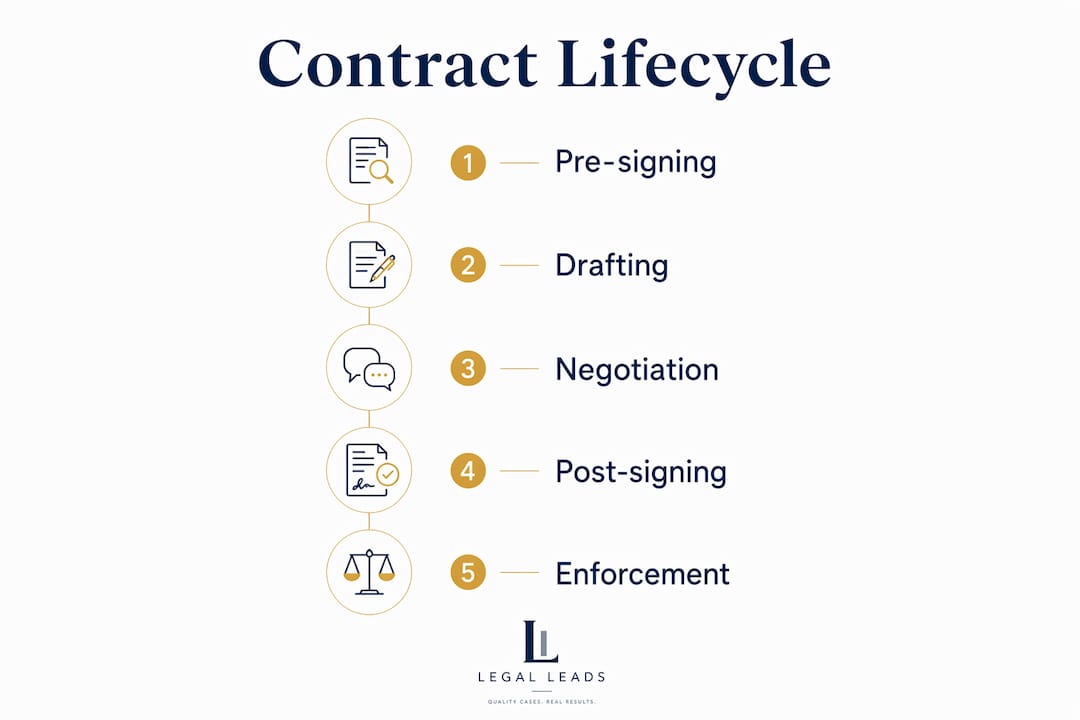
When you need a contract written from scratch, counsel translates business goals into enforceable clauses: scope of work, payment terms, deliverables, termination rights, limitation of liability, indemnities, and boilerplate. Boilerplate clauses, including governing law, arbitration, and assignment rights, determine dispute outcomes and must be customized to California rules, not copied from a generic template.
Negotiation
Counsel identifies your priorities, frames them against your best alternative to a negotiated agreement (BATNA), and proposes trade-offs. A tighter liability cap might cost you a slightly higher fee. A longer notice period might buy you more flexibility on termination. The attorney surfaces those trade-offs so you can decide, not discover them after signing.
Post-signing and enforcement
If a dispute arises, counsel sends demand letters, advises on settlement strategy, and identifies which remedies California law makes available. Early involvement also means the attorney already knows the contract, which cuts remediation time and cost significantly.
What are the real risks of signing without counsel?
The drafting party writes to protect its own interests and may bury risk in fine print. A second review by your own attorney is the standard safeguard. Without it, you face several concrete harms:
- Unintended binding obligations: Courts enforce clear written terms even when they look unfair in hindsight. You cannot claim you did not understand a clause you signed.
- Unenforceable protections: Vague indemnities or poorly drafted limitation-of-liability clauses may not hold up, leaving you exposed to the full cost of a claim.
- Operational traps: Auto-renewal clauses, assignment restrictions, and confidentiality terms can limit your choices for months or years.
- Missed California-specific rules: California has specific requirements around non-compete enforceability, wage and hour provisions in employment contracts, and consumer protection statutes. A contract drafted without California law in mind may be partially or fully unenforceable.
- Lost remedies: Statutes of limitation and contractual notice windows run while you wait. Missing a notice deadline can forfeit a remedy entirely.
Common scenario: A freelancer signs a contractor agreement without review. The scope-of-work clause is vague, the client withholds payment citing "incomplete deliverables," and the contract's dispute clause requires arbitration in another state. A 30-minute attorney review would have caught all three issues.
Attorneys who review legal loopholes clients commonly miss consistently find that limitation-of-liability and indemnity clauses carry the highest financial exposure for individuals.
When should you hire counsel for a contract?
Not every agreement needs a full attorney engagement. Use this checklist to decide.
Hire counsel when any of the following apply:
- The contract involves a dollar value or commitment that would cause real financial harm if it went wrong
- You are signing a personal guarantee, indemnity, or release of claims
- The agreement is long-term (over 12 months) or auto-renews
- It involves intellectual property, licensing, or confidential information
- It is a settlement agreement, family-law stipulation, or waiver of legal rights
- The other party drafted it and you have not had it reviewed
- It crosses state lines or involves parties in multiple jurisdictions
By contract type:
- Settlement agreements (personal injury, employment): always hire counsel. You are releasing legal rights permanently.
- Residential or commercial leases: counsel is worth the cost for any lease over 12 months or with personal-guarantee provisions.
- Freelance or contractor agreements: review is advisable when the scope, payment, or IP ownership is ambiguous.
- Business sale, franchise, or licensing deals: these agreements reliably justify counsel given the financial and operational stakes.
Clients who wait until a dispute occurs limit what their attorney can do. Early involvement enables preventative drafting; late involvement forces expensive damage control.
What should you expect from counsel: deliverables, fees, and timelines?
Common deliverables
- Annotated redline of the other party's draft
- Plain-language risk memo summarizing key concerns
- Suggested revised clauses or negotiation positions
- Demand or negotiation letters (if needed post-signing)
- Written engagement and fee agreement before work begins
Fee models
| Fee model | Best for | Typical use case |
|---|---|---|
| Flat fee | Short reviews (under 20 pages) | Lease review, freelance contract check |
| Hourly | Negotiation, complex drafting | Multi-party deals, employment agreements |
| Retainer | Ongoing contract work | Small-business owners with recurring agreements |
A short, targeted review often catches the most costly clauses and is priced to deliver net value. Many California attorneys offer fixed-fee reviews for standard agreements. Ask for a written fee estimate before work begins.
Typical timelines
- Short review (under 20 pages): 24–72 hours
- Drafting from scratch: 1–2 weeks depending on complexity
- Negotiation cycles: weeks to months, depending on the other party's responsiveness
Well-drafted contract templates amortize cost across multiple transactions. If you sign similar agreements regularly, investing in a reviewed template pays for itself quickly.
How does counsel conduct a business-centric review?
Effective counsel must understand your business goals and BATNA to negotiate terms that protect your interests beyond legal correctness. This means the attorney asks: what do you need from this deal, and what is your walk-away point?
From there, counsel surfaces trade-offs you may not have considered:
- Tighter liability limits in exchange for a higher contract price
- Longer termination notice periods in exchange for lower early-exit fees
- Broader IP ownership in exchange for reduced scope flexibility
For risk tolerance and BATNA frameworks, counsel aligns the contract language with what you can actually absorb if something goes wrong, not just what sounds favorable on paper.
Pro Tip: Use your attorney as the "bad cop" in negotiations. Counsel can push for necessary protections while you maintain the working relationship with the other party. This neutral advocacy tactic is common and effective, especially in long-term commercial or vendor agreements.
Settlement negotiations, including pharmacy lien reduction strategies, illustrate how counsel identifies leverage points and structures agreements to minimize financial exposure after a claim.
How do you choose the right attorney for contract work?
Selection checklist
- California bar admission and active standing
- Practice focus in transactional law (not primarily litigation)
- Experience with your specific contract type
- Clear, written fee structure provided before engagement
- Willingness to provide a plain-language summary of findings
Questions to ask in a first call
- What is your experience with this type of contract in California?
- What will you deliver and by when?
- How do you bill, and can I get a written estimate?
- Have you handled similar agreements for individuals (not just businesses)?
Trust signals table
| Signal | What to look for |
|---|---|
| Bar admission | Active California State Bar membership |
| Practice area | Transactional or contract law, not general practice |
| Written engagement | Fee agreement in writing before work starts |
| Jurisdictional knowledge | Familiarity with California-specific statutes |
| Client reviews | Documented positive outcomes for similar matters |
Red flags: evasive answers about fees, no written engagement agreement, no experience with California contract law, and inability to provide a clear timeline or deliverables list.
Preparing your documents in advance saves time and money. Guidance on how to document your legal situation for an attorney helps you arrive at the first call ready to move quickly.
Key Takeaways
Legal counsel reduces contract risk by drafting, reviewing, and negotiating terms aligned with your goals and California law, and early involvement consistently costs less than remediation after a dispute.
| Point | Details |
|---|---|
| Core roles of counsel | Drafting, review, redlining, negotiation, and enforcement advice across all contract stages. |
| When counsel is essential | High-value deals, personal guarantees, settlements, releases, and any agreement affecting your legal rights. |
| Fee and timeline expectations | Flat-fee reviews cover most short contracts in 24–72 hours; drafting takes 1–2 weeks. |
| California-specific rules matter | Non-compete limits, wage provisions, and consumer statutes require jurisdiction-specific review. |
| Legalleads matching | Legalleads connects you with a verified California contract attorney within 24 hours via a plain-English intake. |
Why early counsel matters more than most people realize
The conventional advice is to hire an attorney when a deal gets complicated. That framing is backwards. By the time a deal feels complicated, you have often already agreed to terms verbally, exchanged drafts, or created expectations the other party will hold you to.
The attorneys who deliver the most value are the ones brought in before positions harden. They shape the first draft, set the tone for negotiation, and build in exit rights while the other party is still motivated to close. Waiting until something goes wrong converts a strategic tool into a repair job, and repair is always more expensive.
Legalleads is built around this logic. The platform's intake process takes under two minutes, delivers a case brief immediately, and matches you with a verified California attorney within 24 hours. The goal is to remove the friction that causes people to delay getting counsel until it is too late.
Get matched with a California contract attorney today
Signing a contract without review is one of the most common and avoidable legal mistakes. Legalleads gives you a faster path to qualified counsel: describe your situation in plain English, receive a professional case brief in under two minutes, and get connected to a verified California attorney within 24 hours. No calls, no complicated forms.

Matched attorneys provide written fee estimates, clear timelines, and plain-language summaries of their findings. All attorneys in the Legalleads directory carry active California bar admission and relevant practice-area experience. Whether you need a personal injury settlement reviewed, a family-law agreement checked, or an employment contract negotiated, the matching process is the same: fast, clear, and free for individuals.
Find a California contract attorney through Legalleads now and get your case brief started.
Useful sources
- Optimizing legal counsel partnership with business teams for commercial contract negotiations — peer-reviewed analysis of attorney roles in commercial contract negotiations; supports the business-centric review and BATNA sections.
- Contracts Attorney Job Description — ACC — outlines core responsibilities of contract attorneys including drafting, review, and negotiation.
- Understanding the Crucial Role of Legal Counsel in Drafting Legal Documents — Ethiconic — covers drafting best practices, ambiguity risks, and dispute-resolution foresight.
- Risks of Entering a Contract With No Legal Advice — LegalVision UK — practical breakdown of risks individuals face without counsel; supports the risks section.
- Why Legal Advice Is Essential in Business Contract Drafting and Negotiation — KSW Lawyers — covers boilerplate clauses, indemnities, and the strategic value of early counsel involvement.
- Contract Lawyer: What They Do and When You Need One — Mayo Law — practitioner guide covering fee models, deliverables, and contract types that justify counsel.
- Exploring the Many Roles of the Contract Drafter — Contract Nerds — supports the BATNA, strategic advisor, and business-centric review material.
This article is general information, not legal advice. Consult a licensed California attorney for guidance specific to your situation and the current rules in your jurisdiction.
FAQ
What is the main role of legal counsel in contracts?
Counsel drafts, reviews, and negotiates contract terms to protect your interests and confirm the agreement is enforceable under applicable law, including California statutes.
When does a contract require attorney review?
Any agreement involving a personal guarantee, release of legal rights, settlement, long-term commitment, or significant financial exposure warrants review before signing.
How much does a contract attorney review cost in California?
Many California attorneys offer flat-fee reviews for standard agreements, typically completed within 24–72 hours. Hourly billing applies to negotiation and complex drafting work; always request a written estimate upfront.
What does a redline mean in contract review?
A redline is a tracked-changes version of the contract showing the attorney's suggested edits and deletions, usually accompanied by a plain-language memo explaining the reasoning behind each change.
How does Legalleads help with contract attorney matching?
Legalleads lets you describe your situation in plain English, generates a case brief in under two minutes, and connects you with a verified California attorney within 24 hours, with no forms or phone calls required.