If you need protection from someone in California, the type of restraining order you file depends on your relationship to that person and the danger involved. The main options are a Domestic Violence Restraining Order (DVRO), Civil Harassment order, Elder or Dependent Adult Abuse order, Workplace Violence order, and Gun Violence Restraining Order (GVRO). If you're in immediate danger, call 911. Police can request an Emergency Protective Order (EPO) on your behalf that night. If the danger isn't immediate but you need protection soon, file for a Temporary Restraining Order (TRO) using the correct court form and get help from your county's self-help center.
- In danger right now: Call 911. Officers can request an EPO for you.
- Need protection but not in crisis: File a TRO request with the correct form (DV-100 for domestic violence, CH-100 for civil harassment).
- Unsure which order fits: Your county superior court self-help center can point you to the right form at no cost for consultation.
Key Takeaways
Getting protection in California hinges on filing the right form for your situation and documenting specific incidents before your hearing date.
| Point | Details |
|---|---|
| Call 911 in a crisis | Immediate danger means police, not paperwork, come first, and officers can request an EPO on your behalf. |
| Match the order type | DVRO, civil harassment, elder abuse, workplace, and GVRO each require a different relationship or threat level. |
| Filing is free for most orders | Domestic Violence, Elder/Dependent Adult, and Gun Violence orders carry no filing fee statewide. |
| Details drive ex parte decisions | Judges often grant TROs based only on your written declaration, so specific dates and quotes matter. |
| Get legal help for contested cases | Custody, property, or firearm disputes benefit from attorney involvement, and Legalleads can match you with one within 24 hours. |
This article is general information, not a substitute for advice from a qualified lawyer. Consult a qualified legal professional about your own circumstances before acting on anything here.
Table of Contents
- Restraining Order California Types: Who Qualifies for Each
- What Can a Judge Actually Order You to Do?
- How Do You File for a Restraining Order in California?
- What's the Difference Between an EPO and a TRO?
- How Long Does a Restraining Order Last in California?
- What Happens If You Get Served With a Restraining Order?
- What Happens When Someone Violates a Restraining Order?
- Where to Get Immediate Help in California
- Does a Restraining Order Affect Immigration Status?
- Can a Restraining Order Affect Your Job or Housing?
- Can You Modify or End a Restraining Order Early?
- Who Actually Qualifies for a Restraining Order in California?
- What Happens at a Restraining Order Hearing?
- What Are Your Options for Legal Representation?
- Sources
- FAQ
Restraining Order California Types: Who Qualifies for Each
Not every conflict qualifies for the same order, and picking the wrong form slows everything down. California courts recognize several distinct categories, each tied to a specific relationship or threat.
- Domestic Violence (DVRO): For current or former spouses, dating partners, co-parents, or close relatives. Covers physical abuse, threats, harassment, and stalking.
- Civil Harassment: For people who aren't intimate partners or close family, like neighbors, coworkers, or an online stalker you've never met in person.
- Elder or Dependent Adult Abuse: Protects people 65 and older or dependent adults; a caregiver or family member can petition on their behalf.
- Workplace Violence: An employer can file to protect an employee from threats made at or connected to the job.
- Gun Violence Restraining Order (GVRO): Removes firearm access from someone who poses a danger to themselves or others, filed by law enforcement, family, or coworkers.
Filing under the wrong category is one of the most common reasons a case gets bounced back for correction, so match your situation to the definition before you file.
What Can a Judge Actually Order You to Do?
A restraining order isn't a single blanket protection. It's a set of specific court orders, and a judge tailors them to the situation.
- No contact and stay-away orders — bans calls, texts, and in-person contact, and sets a distance (commonly 100 yards) from your home, workplace, or school.
- Move-out orders — can force the restrained person out of a shared home, even if their name is on the lease.
- Child custody and support orders — judges can issue emergency custody or visitation terms, plus temporary child or spousal support.
- Firearm relinquishment — anyone named in a DVRO or GVRO must surrender firearms and ammunition to law enforcement or a licensed dealer.
- Property and account orders — a judge can restrain shared property or transfer control of a phone plan away from the restrained party.
There's no filing fee at all for Domestic Violence, Elder/Dependent Adult, or Gun Violence restraining orders in California, which removes a real barrier for petitioners who need protection immediately.
How Do You File for a Restraining Order in California?
Filing follows a defined sequence, and skipping a step usually means delay.
- Pick your form. DV-100 starts a domestic violence case; CH-100 starts a civil harassment case. The "Describe Abuse" section is the heart of the form because judges frequently decide TRO requests ex parte, based only on what you write.
- File at the right courthouse. File in the county where you or the restrained person lives, or where the abuse happened. Your county self-help center will confirm the correct courthouse and review your paperwork for free.
- Request the TRO. A judge reviews your written declaration, often the same day, and can grant temporary protection before any hearing takes place.
- Arrange service. Someone other than you (a sheriff, process server, or adult friend) must formally serve the restrained person and file proof of service with the court.
- Ask about a fee waiver. If a filing fee applies to your case type, request a fee waiver form if you can't afford it.
Pro Tip: Write your abuse description in chronological order with specific dates, times, and direct quotes. A vague account of "he's been controlling" carries far less weight than "On March 3, 2026, he blocked my car in the driveway and threatened to take my phone."
For readers navigating this process in the Inland Empire, family law resources in San Bernardino County can help with form completion and local filing questions.
What's the Difference Between an EPO and a TRO?
These two protections work on different timelines, and mixing them up creates confusion at the worst possible moment.
- Emergency Protective Order (EPO): Police request this directly from a judge after a 911 call, usually available around the clock. It typically lasts 5 to 7 days, just long enough to get you to court for a TRO.
- Temporary Restraining Order (TRO): You request this through the court, and a judge can issue it ex parte the same day you file. It stays in effect until your scheduled hearing, usually held within about three weeks.
- What to bring to the hearing: Your ID, any evidence (texts, photos, police reports), and witnesses if available. The judge decides at the hearing whether to extend the order for a longer period.
This staged system exists so you're never left unprotected between the 911 call and your actual court date. For a broader look at time-sensitive filings, see this guide to time-sensitive legal cases in California.
How Long Does a Restraining Order Last in California?
Duration depends entirely on which stage of the process you're in.
- TROs last only until your hearing date, typically two to three weeks after filing.
- EPOs last about 5 to 7 days, bridging the gap to a TRO hearing.
- Orders issued after a full hearing can last up to five years, and you can request a renewal before that expires, sometimes permanently in cases with an ongoing threat.
On fees: filing for Domestic Violence, Elder/Dependent Adult, and Gun Violence orders costs $0, no matter your income. Civil harassment fees vary by county, but low-income petitioners can request a waiver. That $0 baseline matters because it means cost should never be the reason someone delays filing for protection from a partner or family member.
What Happens If You Get Served With a Restraining Order?
Being served with a TRO means the order is legally binding the moment you receive it, even before your hearing.
- Follow it immediately. Violating a TRO before your hearing, even unintentionally, can result in arrest.
- Read every page. Forms like DV-109 and DV-110 (or CH-109/CH-110 for civil harassment) list your hearing date and exactly what's prohibited, down to specific addresses and distances.
- Start building your response now. Gather texts, emails, witness statements, or anything that contradicts the petitioner's claims.
- Get legal help for anything complicated. If custody, shared property, or firearms are involved, a family law attorney can materially change the outcome of a contested hearing.
Ignoring the paperwork because you disagree with it is the single most damaging mistake a restrained person can make.
What Happens When Someone Violates a Restraining Order?
Violating an active restraining order in California is a criminal matter, not just a civil one, and enforcement moves fast.
- Call police immediately for any violation. Officers can arrest the restrained person on the spot if the order is verifiable in the state database.
- Document everything. Screenshots, voicemails, and timestamped notes strengthen both criminal charges and any future contempt motion.
- Expect real penalties. Violations can lead to criminal contempt charges, fines, or jail time under California's penal code provisions, especially serious when firearms are involved.
Pro Tip: Keep a copy of your restraining order in your car, purse, and phone. Responding officers can act faster when you can show the order on the spot.
Where to Get Immediate Help in California
You don't have to navigate this alone, and several resources exist specifically for this situation.
- National Domestic Violence Hotline: Offers 24/7 safety planning and crisis support by phone or chat.
- County self-help centers: Every California superior court has one, and staff will review your forms for free before you file.
- Legal aid and victim-witness units: Many counties have advocates who accompany petitioners to court and connect them with legal aid attorneys.
- Language access: If English isn't your first language, ask the clerk's office about interpreter services. Language barriers shouldn't determine legal outcomes, and courts are required to provide assistance.
Does a Restraining Order Affect Immigration Status?
Filing for or receiving protection under a restraining order does not, by itself, jeopardize your immigration status. California courts process these cases as civil matters, separate from federal immigration enforcement, and court staff at self-help centers cannot ask about your immigration status as a condition of filing.
For immigrant survivors of domestic violence, a restraining order can actually open doors to additional protection. A U visa is available to victims of certain crimes, including domestic violence, who cooperate with law enforcement, and a documented restraining order often serves as key evidence in that petition. Similarly, the Violence Against Women Act (VAWA) allows certain immigrant spouses and children of abusive U.S. citizens or permanent residents to self-petition for legal status without the abuser's knowledge or consent.
Being the restrained person carries different considerations. A domestic violence restraining order or related conviction can affect immigration proceedings, particularly for green card applications, naturalization, or removal defense, since certain domestic violence offenses are treated as grounds for inadmissibility or deportability under federal law.
Because immigration consequences intersect with both criminal and family law, anyone worried about their status, whether filing or responding, benefits from consulting an attorney who understands both systems before a hearing. A single form filled out incorrectly, or a plea taken without understanding its immigration impact, can carry consequences that outlast the restraining order itself.
Can a Restraining Order Affect Your Job or Housing?
A restraining order can ripple into both your employment and your living situation, in ways that catch a lot of people off guard.
On the employment side, if you're the petitioner, a workplace violence restraining order can be filed by your employer to protect you from a coworker or outside threat, and many companies have policies supporting employees through this process without penalty. If you're the restrained person, some employers conduct background checks that surface civil court records, and certain jobs, particularly those requiring firearm possession like security or law enforcement, may become unavailable once a firearm relinquishment order is in place.
Housing gets complicated quickly, especially when the restrained person and petitioner share a lease. A move-out order can legally force someone out of a shared home even if their name is on the rental agreement, and landlords are generally required to cooperate with a valid court order. If you're the petitioner and need to break a lease early because of safety concerns, California law provides protections allowing domestic violence survivors to terminate a lease without the usual penalties, provided you give proper notice and documentation.
If you're the restrained person, a restraining order that requires you to vacate can leave you scrambling for housing on short notice, and landlords may ask about the order during future rental applications since eviction and civil court records are often searchable. These overlapping consequences are exactly why the "Describe Abuse" section and the specific orders you request matter well beyond the courtroom.
Can You Modify or End a Restraining Order Early?
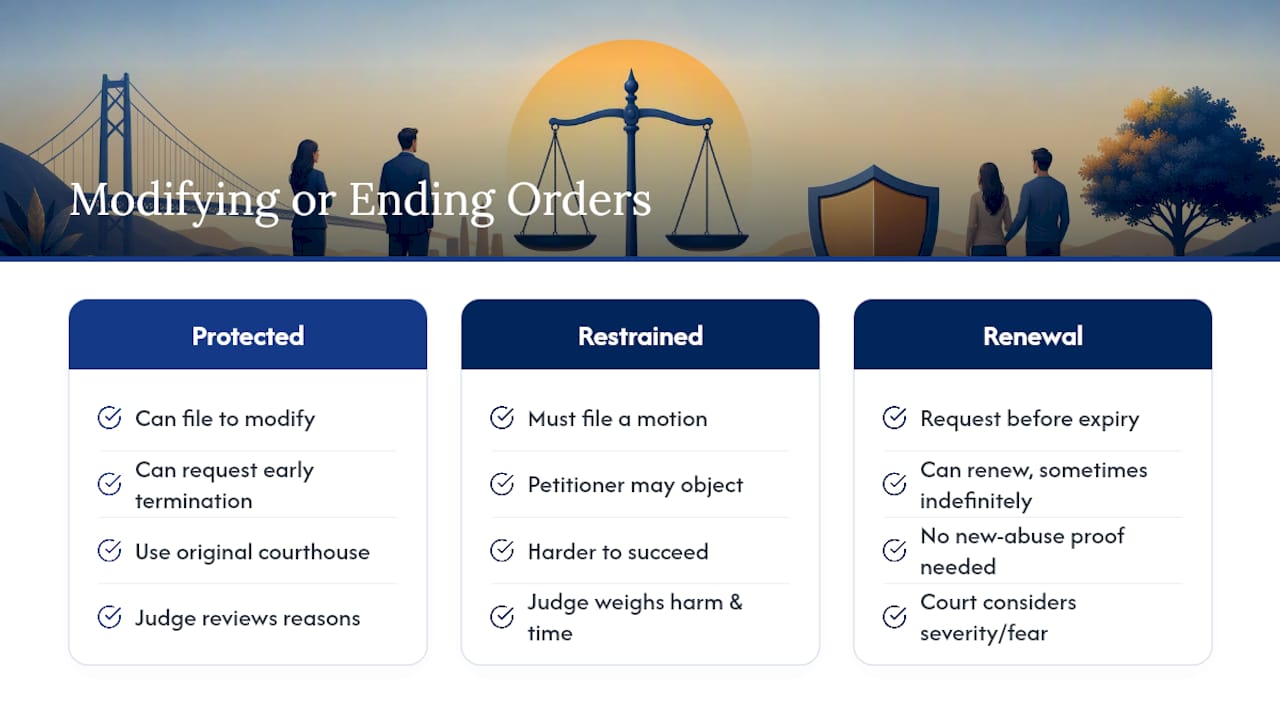
Restraining orders aren't locked in place for their full term. Either party can ask the court to change or terminate an order before it expires, though the process differs depending on who's asking.
If you're the protected person and circumstances change, you can file a request to modify the order's terms, shortening the stay-away distance, adjusting custody provisions, or removing a specific restriction, using the same courthouse that issued the original order. You can also request early termination if you no longer feel the order is necessary, though the judge will still want to understand why.
If you're the restrained person, requesting a modification or termination is harder, and for good reason. You'll need to file a motion, and the petitioner has the right to appear and object. Judges weigh factors like whether real harm occurred, how much time has passed, whether the restrained person completed any required counseling, and whether the petitioner still feels a genuine need for protection. A restrained person can't simply wait out an inconvenient order; the initial term (up to five years) stands unless a judge affirmatively changes it.
Renewal works differently than modification. Before an order expires, the protected person can request a renewal, sometimes indefinitely, without needing to prove new abuse occurred. Courts often renew based on the original incident's severity and any ongoing fear, particularly if the restrained person has a history of violating court orders. This is one area where legal representation pays off: contested modification and renewal hearings often turn on nuanced legal arguments about "reasonable fear," and a family law attorney knows how to frame that argument far more effectively than most petitioners or respondents can on their own.
Who Actually Qualifies for a Restraining Order in California?
Eligibility hinges on your relationship to the other person and the type of harm involved, and each order type has its own threshold.
For a Domestic Violence Restraining Order, you must have a qualifying relationship: current or former spouse, registered domestic partner, someone you're dating or used to date, a co-parent, or a close relative like a parent, child, or sibling. The harm can be physical abuse, threats, stalking, or a pattern of harassment; a single incident is often enough if it's serious.
A Civil Harassment order applies when there's no qualifying family or intimate relationship, covering neighbors, coworkers, extended family beyond the DVRO definition, or strangers engaging in stalking or repeated harassment. You generally need to show a "credible threat of violence" or a pattern of unwanted contact, not just a single unpleasant interaction.
Elder or Dependent Adult Abuse orders require the protected person to be 65 or older, or a dependent adult with mental or physical limitations that affect their ability to protect themselves. A family member, caregiver, or conservator can petition on their behalf if the elder can't file alone.
Workplace Violence orders can only be filed by an employer, not the employee directly, when a credible threat of violence exists in the workplace.
A Gun Violence Restraining Order has the broadest group of eligible petitioners: law enforcement, immediate family, current or former dating partners, or in some cases, employers and coworkers, when there's evidence the person poses a danger to themselves or others with a firearm.
Meeting the relationship or role requirement is only half the equation. You also need enough documented detail about the harm itself, which is why the forms matter as much as the underlying facts.
What Happens at a Restraining Order Hearing?
Your hearing is where a TRO either becomes a longer-term order or gets dismissed, and understanding the sequence removes a lot of the anxiety around it.
You'll arrive at the courthouse and check in, often at the family law or civil harassment window, then wait for your case to be called, sometimes alongside dozens of other cases scheduled the same morning. When your name is called, both you and the restrained person appear before the judge, though the restrained person may not show up at all, in which case the judge often proceeds and can grant the order based on your testimony and evidence alone.
If both parties appear, the judge reviews the written declarations already on file, then gives each side a chance to speak, present evidence, and question the other's account. This is where witnesses, text message screenshots, photos of injuries or damage, and police reports carry real weight. Judges are generally looking for consistency between your written TRO request and your testimony that day; contradictions can weaken your case even when the underlying facts are true.
After hearing both sides, the judge issues a ruling from the bench in most cases, either granting the restraining order (often for up to five years), denying it, or asking for additional information at a continued hearing. If the order is granted, the judge specifies exactly which protections apply, from stay-away distances to firearm relinquishment to custody terms, and that information gets entered into the statewide protective order database so any California law enforcement officer can verify it immediately.
Hearings involving contested custody, shared property, or conflicting testimony tend to run longer and benefit far more from legal representation than a straightforward case with no response filed by the other side.
What Are Your Options for Legal Representation?
You're never required to have an attorney to file for or defend against a restraining order in California, and plenty of straightforward cases proceed successfully without one. Court self-help centers exist precisely because the system is designed to be navigable pro se for many petitioners.
That said, certain situations shift the calculation. Cases involving contested child custody, shared property division, complex financial support orders, or immigration consequences are considerably harder to handle without legal training, and the stakes of getting it wrong are high. A family law attorney can spot procedural issues, frame testimony persuasively, and anticipate arguments the other side is likely to raise.
If cost is the barrier, legal aid organizations in most California counties provide free or low-cost representation for qualifying petitioners, and victim-witness units within the district attorney's office can offer additional support, particularly when a criminal case runs parallel to the civil restraining order. It's worth noting that a criminal protective order and a civil restraining order can coexist, and when they do, both the judge and the district attorney should be notified so the orders don't conflict.
For those who can afford private counsel but don't know where to start, matching services exist specifically to shorten that search, connecting you to attorneys who handle restraining order cases in your county within a day or two rather than weeks of cold calls.
A Realistic Take on What Actually Moves These Cases Forward
Most guides treat every restraining order case as equally simple to file alone, and that's not quite honest. A straightforward TRO with no custody or property disputes genuinely works fine through the self-help center. Once children, shared homes, or firearms enter the picture, the paperwork stops being the hard part; the strategy does. Document everything as it happens, not from memory later. Use the self-help center for the mechanics, but don't hesitate to bring in a lawyer the moment a case gets contested. Quick access to the right attorney often matters more than which form you technically filed first.
— Admin
How Legalleads Connects You to a California Attorney Fast
If your case involves contested custody, shared property, or a threat involving firearms, waiting weeks to find the right attorney can cost you real ground in your hearing. Legalleads is built for exactly this moment: describe your situation in plain English, and its intake technology generates a professional case brief in under two minutes, no phone tag, no long intake forms. That brief goes out to qualified California attorneys, and most people hear back within 24 hours.

This matters most when your restraining order case overlaps with family law, since custody and support orders issued during a DVRO hearing can shape your parenting arrangement for years. If your situation touches child custody, Legalleads' Los Angeles family law network can connect you with attorneys who handle both. Whether you're filing or responding, start with Legalleads' Find Lawyer page to get matched with a California attorney who already knows this process.
Sources
- Types of restraining orders | California Courts | Self Help Guide
- Restraining Orders | Superior Court of California | County of Orange
FAQ
What Qualifies for a Restraining Order in California?
You need a qualifying relationship (for domestic violence and elder abuse orders) or a credible threat/pattern of harassment (for civil harassment orders), along with documented incidents of abuse, threats, or stalking that a judge finds credible.
Is It Difficult to Get a Restraining Order in California?
Straightforward cases with detailed documentation and no response from the other side are often granted at the TRO stage the same day you file; contested cases involving custody or property disputes are considerably harder and benefit from legal representation.
What's the Longest You Can Put a Restraining Order on Someone?
A restraining order granted after a full court hearing can last up to five years, and the protected person can request a renewal before it expires.
How Much Does It Cost to Get a Restraining Order in California?
There's no filing fee for Domestic Violence, Elder/Dependent Adult, or Gun Violence restraining orders anywhere in California; civil harassment fees vary by county, but low-income petitioners can request a waiver.