
You can read and spot the risky parts of any contract using a short checklist, without a law degree. Most agreements share the same skeleton: who is bound, what they owe each other, how long it lasts, how it ends, and who pays if something goes wrong. Once you know where those pieces live, you can scan a 12-page agreement in minutes and know exactly what to question.
Here is the checklist to run before you sign anything:
- Who are the parties? Confirm full legal names, not nicknames or "the Company."
- What is the scope? The specific goods, services, or obligations promised, not vague summaries.
- What is the payment structure? Amount, due dates, late fees, and what triggers extra charges.
- How long does it run, and how does it renew? Fixed term, auto-renewal, or month-to-month.
- How do you get out? Termination rights, notice periods, and any penalty for leaving early.
- Who absorbs the risk? Liability caps, indemnity language, and insurance requirements.
- Who owns the work and the confidential information? Intellectual property and confidentiality terms.
- Is it properly signed? Names, dates, and authority to bind each party.
Run this checklist twice. The first pass, spend 60 to 90 seconds just locating each item and flagging anything missing. The second pass, read the actual language around each flagged item and ask whether it favors you, the other side, or neither. A legally enforceable agreement generally needs clear parties, a stated purpose, specific obligations, payment terms, and deadlines, and certain deals (real estate transfers, goods sales over $500, anything that can't be finished within a year) must be in writing under rules explained by Cornell Law School's Legal Information Institute. Two other places worth knowing: the American Bar Association publishes consumer-facing contract guidance, and the Uniform Commercial Code governs most goods transactions when a contract stays silent on a point.
Key Takeaways
Reading a contract in simple terms comes down to substituting defined terms into every clause and checking who carries the risk on payment, liability, and termination.
| Point | Details |
|---|---|
| Read definitions first | Defined terms quietly reshape every clause that uses them, so read this section before anything else. |
| Check the renewal window | Auto-renewal clauses often require 30 to 90 days notice to cancel, so calendar that date immediately. |
| Confirm liability is capped | An uncapped liability clause can expose you to damages far beyond the contract's value. |
| Document every negotiated change | Keep emails and track changes so verbal promises don't disappear before signing. |
| Get a lawyer when stakes are high | Legalleads matches you to an attorney within 24 hours when a contract needs real legal review. |
Where to Learn More and Verify These Rules
- Cornell Law School's Legal Information Institute explains the core legal requirements for an enforceable contract, including when a written agreement is mandatory.
- FindLaw's contracts basics guide breaks down when state common law versus the Uniform Commercial Code governs your agreement.
- Practical Law's contract review guidance walks through the risk-allocation clauses that matter most during review.
- Legalleads' non-lawyer document review guide offers a companion method for reviewing agreements without legal training.
- Legalleads' legal jargon mistakes guide catalogs specific wording errors that have cost real clients money.
This article is general information, not a substitute for advice from a qualified lawyer. Consult a qualified legal professional about your own circumstances before acting on anything here.
Table of Contents
- How to Read Legal Contracts in Simple Terms: A 5-Step Process
- What Do the Core Contract Clauses Actually Mean?
- What Contract Red Flags Should You Watch For, and How Do You Fix Them?
- What Belongs on a Contract Review Checklist?
- How Do You Request Changes and Sign a Contract Safely?
- When Should You Get a Lawyer to Review Your Contract?
- Sources
- FAQ
How to Read Legal Contracts in Simple Terms: A 5-Step Process
Reading a contract well is a sequence, not a single pass. Lawyers use a version of this method by habit. You can use it on purpose.
- Prepare before you read. Gather every email, proposal, quote, or earlier draft that led to this contract. You need something to check the final language against.
- Skim for structure. Read every heading, not every sentence. Note how many sections exist, where definitions sit, and where signatures go. This pass takes minutes, not hours.
- Read the definitions section word for word. This is the step almost everyone skips, and it's the one that changes meaning the most. A term like "Confidential Information" or "Services" gets defined once and then used dozens of times, so a narrow or broad definition quietly reshapes every clause that uses it.
- Analyze the core obligations with definitions substituted in. Go back through payment, scope, and termination clauses and mentally swap in the defined terms. A clause that says "Contractor will deliver the Deliverables" only makes sense once you know exactly what "Deliverables" means.
- Document open questions and decide. Write down anything unclear, anything that contradicts your earlier emails, and anything missing entirely. Missing terms are a frequent source of disputes, and relying on default state law to fill a gap creates real uncertainty, according to LegalClarity's contract training for non-lawyers.
Before you start step one, pull together:
- The original proposal, quote, or job posting
- Any email thread where terms were negotiated
- A prior version of the contract, if one exists
- Notes from any verbal conversation about price or scope
Pro Tip: Read the definitions section before anything else, and reread each operative clause once with the plain word and once with the full defined meaning swapped in. Lawyers read contracts this way for a reason: substituting definitions into clauses is essential to catching how a single defined term flips an obligation, according to attorney Rob Melton's guide to reading contracts like a lawyer.
What Do the Core Contract Clauses Actually Mean?
Every contract, whether it's an NDA, a service agreement, or a sales contract, is built from the same recurring parts. Once you can translate each one, the document stops feeling like a wall of text.
Parties and recitals. This section names who is bound and often states why the agreement exists. Watch for vague party names ("the Vendor" without a legal entity attached) since that makes enforcement harder later.
Definitions. These set the meaning of every capitalized term used later. A narrow definition of "Services" can quietly exclude work you assumed was included.
Scope of work. This spells out exactly what gets delivered. Commercially, a vague scope ("general marketing support") lets the other side do less than you expected and still claim compliance.
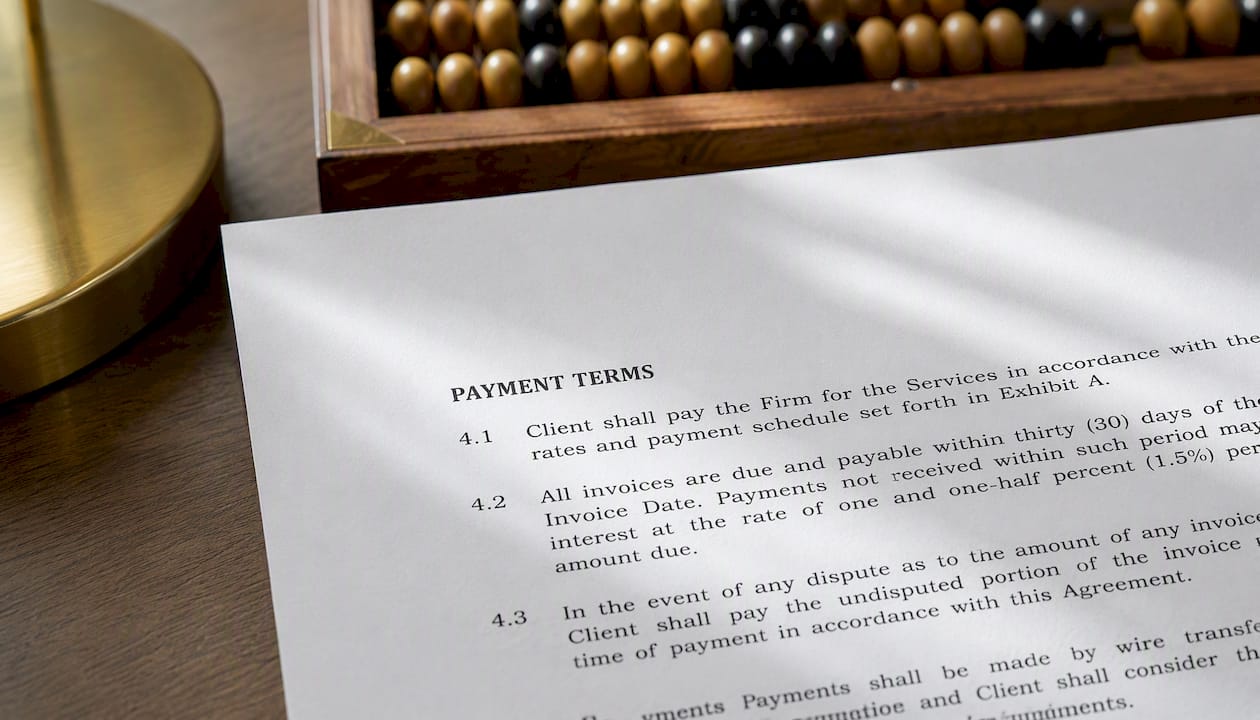
Payment terms. Amount, schedule, and what happens on late payment. Watch for automatic late fees or interest that compounds faster than a normal invoice grace period.
Term and renewal. How long the contract runs and whether it renews automatically. Missing an auto-renewal notice window can lock you into another full term you never intended.
Termination. The conditions under which either side can exit. A one-sided termination clause lets them leave any time, but requires you to prove "cause."
Indemnity. One party agrees to cover the other's losses from certain events. If this runs only one direction, you could be financially responsible for problems the other side caused.
Limitation of liability. A cap on how much either side can be forced to pay in damages. No cap at all means an unlimited claim; too low a cap can leave you covering catastrophic losses yourself.
Warranties and representations. Promises about quality, ownership, or legal status. These are the statements you can sue over if they turn out false.
Confidentiality. What information must stay private and for how long. Watch for a definition of "Confidential Information" so broad it covers things you wanted to talk about publicly.
Dispute resolution. How disagreements get resolved: litigation, mediation, or mandatory arbitration, and where. Mandatory arbitration in a distant state can make disputes expensive to pursue even when you're right.
Intellectual property. Who owns what gets created during the relationship. Freelance and consulting contracts often quietly assign all IP to the client, even side work.
Assignment. Whether either party can transfer the contract to someone else. A one-sided assignment right lets the other side sell your contract to a company you never agreed to work with.
Force majeure. Excuses performance during extraordinary events like natural disasters. Watch how narrowly it's written; some exclude pandemics or supply shortages entirely.
Boilerplate. Severability, entire agreement, and notice clauses sit at the end and rarely get read, but the entire agreement clause can erase every verbal promise made before signing.
Plain English: if anything goes wrong after delivery, you cover the contractor's legal costs, even for problems they caused. That's a one-sided risk shift worth flagging.
Plain English: "reasonable efforts" is not a firm deadline. It gives the contractor an easy excuse if the date slips, since "reasonable" is subjective and hard to enforce.
Effective contract review focuses squarely on these risk-allocation clauses because indemnity, liability caps, and termination rights determine your actual financial exposure far more than the marketing language surrounding them, according to Practical Law's contract review guidance. For a deeper breakdown of specific clause language and red-flag phrasing, Legalleads has compiled examples of legal clauses to watch.
| Clause | Plain-English meaning | Watch for |
|---|---|---|
| Indemnity | One side covers the other's losses | One-directional obligation |
| Limitation of liability | Caps how much either side can owe | No cap, or a cap too low to matter |
| Termination | How and when either side can exit | "For cause" required on one side only |
| Confidentiality | What must stay private, and for how long | Overly broad definitions with no time limit |
| Dispute resolution | How conflicts get resolved | Mandatory arbitration far from your location |
Pro Tip: Circle every "reasonable," "best efforts," "material," and "as needed" in the document. These qualifiers sound harmless but soften an obligation into something nearly unenforceable. "Shall deliver by March 1" is a promise. "Shall use best efforts to deliver by March 1" is closer to an intention.
What Contract Red Flags Should You Watch For, and How Do You Fix Them?
Some clauses cause more disputes than others. Auto-renewal traps, vague scope language, and one-sided indemnities rank among the most frequently disputed provisions in small-business contracts, according to LegalClarity's non-lawyer training. Here's how to spot them and what to say instead.
- Auto-renewal with a short notice window. Many agreements renew automatically unless you cancel 30 to 90 days before the term ends, and missing that window locks you into another full term, per LegalClarity. Ask for: "Please change the renewal notice period to 30 days before the current term ends, with written confirmation required from both parties."
- One-sided indemnity. If only you indemnify the other side, you're absorbing risk they created. Ask for: "Please make the indemnification mutual, limited to direct damages arising from each party's own breach."
- Uncapped liability. No liability limit means a single mistake could cost far more than the contract is worth. Ask for: "Please cap total liability at the fees paid under this agreement over the prior 12 months."
- Vague scope of work. Generic descriptions ("provide marketing services") leave room for disagreement about what's actually owed. Ask for: "Please attach an exhibit listing specific deliverables, quantities, and deadlines."
- Unilateral price increases. A clause letting one party raise fees without your consent turns a fixed-price deal into an open-ended one. Ask for: "Please require 60 days written notice and mutual agreement before any price change takes effect."
- Missing termination rights. If only the other side can terminate for convenience, you're stuck even if the relationship isn't working. Ask for: "Please add a mutual right to terminate for convenience with 30 days written notice."
- Data ownership gaps. Contracts that never say who owns data generated during the relationship invite disputes later. Ask for: "Please add a clause specifying that Client retains ownership of all data generated under this agreement."
When you can't push on everything, prioritize by value at risk. A vague scope clause on a $2,000 project matters less than an uncapped liability clause on a $200,000 contract. Rank each red flag by the dollar exposure it creates, then spend your negotiation leverage on the top two or three. Legalleads has documented more of these patterns in its rundown of legal loopholes clients miss.
What Belongs on a Contract Review Checklist?
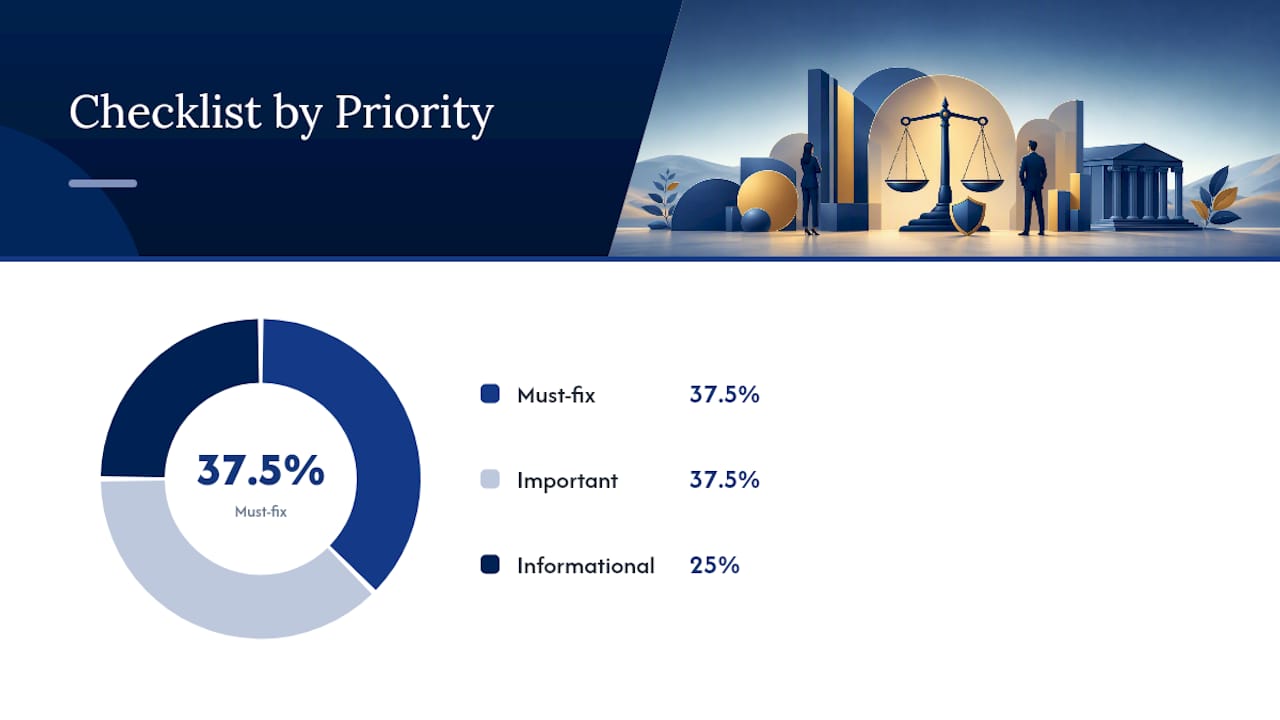
A printable checklist works best when it's sorted by urgency, not by the order clauses appear in the document. Copy this into a document you can mark up during negotiation.
| Priority | Item | What to check |
|---|---|---|
| Must-fix | Liability cap | Is there a dollar limit, and is it reasonable relative to the contract value? |
| Must-fix | Indemnity direction | Is it mutual, or does only one side cover the other? |
| Must-fix | Termination rights | Can both sides exit, and under what notice? |
| Important | Auto-renewal terms | What's the notice window, and is it calendared? |
| Important | Payment schedule | Are due dates, late fees, and triggers for extra charges clear? |
| Important | IP ownership | Is it explicit who owns work product after delivery? |
| Informational | Notice clause | Where must formal notices be sent, and by what method? |
| Informational | Governing law | Which state's law applies, and does that matter to you? |
Here's an annotated sample clause showing what that markup looks like in practice:
Original text: "Contractor retains all rights to pre-existing intellectual property, and Client shall own all deliverables created specifically under this Agreement, except that Contractor may use general knowledge, skills, and techniques gained during the engagement."
Annotated notes:
- "Pre-existing intellectual property" = anything Contractor built before this contract started. Reasonable, keep as is.
- "Client shall own all deliverables" = you get ownership of the finished work product. Good, this is standard and favorable.
- "General knowledge, skills, and techniques" = a carve-out letting the contractor reuse lessons learned, but not your actual materials. Watch that this phrase doesn't get stretched to cover reusable templates or code you paid for.
Copy the checklist table into a Word or Google Doc, use track changes for every edit you propose, and save a new version each time terms move. This is a generic template. When the dollar value is high or the other side pushes back hard, a lawyer should review the final draft before you sign. Legalleads outlines a similar structured approach in its legal document checklist for beginners.
How Do You Request Changes and Sign a Contract Safely?
Negotiating a contract is a paper trail exercise as much as a legal one. Follow these steps in order:
- Propose redlines directly in the document. Use Word's track changes or a PDF markup tool so every edit is visible and dated.
- Keep every negotiation email. If someone verbally agrees to a change, ask them to confirm it in writing before it disappears from memory.
- Compare versions before signing. Use a simple version-controlled file naming system (Contract_v1, Contract_v2_redlined) or a comparison tool to confirm the final draft matches what was actually agreed.
- Require written confirmation for verbal promises. If a salesperson tells you something isn't in the contract but "won't be enforced," get that in writing or assume it will be enforced exactly as written.
- Verify signer authority before you sign. Confirm the person signing on the other side actually has the authority to bind their company. For an LLC or corporation, that usually means an officer or authorized manager, not just any employee.
Pro Tip: Never sign until every disputed item is resolved in writing. A verbal "we'll fix that later" almost never survives past the signature, and once both parties sign, the entire agreement clause typically wipes out any prior promises not written into the final document.
After signing, keep the final signed contract, every negotiation email, and any side letters or amendments in one folder. If a dispute ever arises, this is the record that shows what both sides actually agreed to, not what either side remembers.
When Should You Get a Lawyer to Review Your Contract?
Not every contract needs an attorney, but certain triggers make legal review worth the cost. Get a lawyer involved when you see:
- Personal guarantees that put your own assets on the line
- Liability exposure that exceeds what you could comfortably absorb
- Intellectual property ownership questions, especially around work you created
- Unfamiliar governing law or a mandatory arbitration clause in a distant state
- High dollar stakes relative to your business or personal finances
- Indemnity language that's complex or clearly one-sided
Timelines vary by complexity. A quick flat-fee review of a short contract often turns around in 24 to 72 hours. Negotiated redlines on a more complex agreement typically take 3 to 14 days, depending on how many rounds of back-and-forth are needed. These are estimates, not guarantees, since every firm and every contract is different.
A lawyer's review typically delivers a risk memo identifying the biggest exposures, suggested redline language for the riskiest clauses, and a negotiation strategy for what to push on first, according to the CN Law Blog's guide to reading legal contracts. To speed the process, hand over the draft contract, your prior emails or proposals, and a short summary of what you're worried about before the first call. Legalleads explains more about what this process looks like in its guide to how attorney case review works, and in the role of legal counsel in contracts.
This article gives general information, not legal advice specific to your situation. Confirm current rules and get guidance tailored to your contract from a licensed attorney before signing anything with significant financial or legal consequences.
A note from Legalleads on what we actually see
Legalleads exists because finding the right attorney fast shouldn't require ten phone calls and three days of waiting.. Across the cases that come through the platform, the same handful of contract traps show up again and again: missed renewal windows, one-sided indemnity, and vague scope language that nobody caught until a dispute forced them to reread the document.. This guide reflects what actually trips people up, not just what looks good in a textbook, and it's built to hold up against the real contracts people bring to us every week.
If You Need Help Fast, Here's How Legalleads Connects You to a Lawyer
Legalleads is the fastest route to an attorney when a contract review can't wait for a referral or a week of phone tag. Describe your situation in plain English, and Legalleads generates a professional case brief in under two minutes, then matches you to a qualified attorney within 24 hours. No intake forms, no cold calls, no guessing whether the person on the other end handles your kind of case.
After you submit your situation, you'll typically hear back within a day with an attorney match suited to your issue, whether that's a service contract with a one-sided indemnity clause, a lease with a buried auto-renewal trap, or a business agreement where liability exposure feels too open-ended to sign as is. Include the contract type, the state where it applies, and what specifically concerns you, since more detail gets you a faster, more accurate match. Every submission stays private and only goes to verified attorneys reviewing cases in your practice area. If your contract touches a specific practice area, Legalleads also runs dedicated intake pages, including for personal injury cases and family law matters. Start by describing your contract issue on the find a lawyer page and get matched with someone who can give it a real look.
Sources
- Contract — Legal Information Institute (LII), Cornell Law School
- Practical Law - Contract review guidance (Thomson Reuters)
- How to read a contract like a lawyer (Rob Melton)
- How to read contracts: training for non-lawyers (LegalClarity)
- Contracts basics — FindLaw (Small Business section)
FAQ
How do you properly read a contract?
Skim it once for structure, then read the definitions section fully before analyzing payment, termination, and liability clauses with those definitions substituted in. This two-pass method catches most of what a quick single read misses.
Can you explain contract law in simple terms?
Contract law generally requires an offer, acceptance, and an exchange of value between parties who intend to be legally bound, with defaults filled in by state common law or the Uniform Commercial Code depending on whether goods or services are involved, per FindLaw.
What are the 5 elements of a legal contract?
A legally enforceable contract typically needs clearly identified parties, a stated purpose, specific obligations, defined payment terms, and set deadlines, according to Cornell Law School's Legal Information Institute.
Do I need a lawyer to read a simple contract?
Not always. A short, low-stakes agreement with clear terms is often fine to review yourself using a checklist, but personal guarantees, uncapped liability, or unfamiliar governing law are strong signals to get an attorney involved. Legalleads can match you to one within 24 hours through its find a lawyer page.
What's the biggest mistake people make when reading contracts?
Skimming a contract as if it's a standard form is the most common error, and attention to detail, not a law degree, is usually what prevents an expensive mistake, according to Momentum Lawyers.