
The fastest way to get matched with a qualified attorney is to use a verified online matching service that generates a professional case brief and connects you to vetted counsel within 24 hours. Legalleads does exactly that. You describe your situation in plain English, the platform produces a case brief in under two minutes, and a qualified attorney reaches out, no phone tag, no complicated forms.
Two trust anchors matter here: Legalleads operates a vetted attorney network, and the State Bar of California sets the standard every California attorney must follow, including the written fee agreement requirement covered below.
- Fastest path: Submit a plain-English intake on Legalleads and receive a match within 24 hours.
- What you get: A professional case brief generated in under two minutes.
- Who reviews it: Vetted, licensed attorneys matched by practice area and location.
- Next step: Start your intake now at Find a Lawyer.
Key Takeaways
Online attorney matching through Legalleads produces a professional case brief in under two minutes and connects first-time users to a vetted California attorney within 24 hours.
| Point | Details |
|---|---|
| Case brief speed | Legalleads generates a professional case brief from plain-English input in under 2 minutes. |
| Match timeline | A qualified, vetted attorney is matched and notified within 24 hours of intake submission. |
| Written fee agreement | The State Bar of California requires a written fee agreement before you officially hire any attorney. |
| Intake quality matters | Complete, detailed intake improves triage accuracy and reduces delays in attorney evaluation. |
| Legalleads coverage | The platform covers personal injury, family law, immigration, employment, and criminal defense in California. |
Table of Contents
- How does the Legalleads matching process work?
- What should you prepare before submitting your intake?
- What happens after you're matched with an attorney?
- How is your information protected and how are attorneys verified?
- How do you evaluate the attorney you're matched with?
- Real client examples: Maria and David
- When is a matching service not the right fit?
- What first-time users often underestimate about attorney matching
- Legalleads connects you to a qualified attorney fast
- Sources
- FAQ
How does the Legalleads matching process work?
The process moves in five clear steps. Understanding each one helps you know exactly where you stand at any moment.
- Submit your intake. You describe your legal situation in plain English. No legal jargon required.
- Case brief generated. The platform converts your intake into a professional case brief in under two minutes.
- Triage and conflict checks. The system routes your brief by practice area and California geography, then runs conflict-of-interest checks to confirm attorney availability and impartiality.
- Attorney match and notification. A qualified, vetted attorney is identified and notified with your case brief.
- Attorney contact. The matched attorney reaches out to you, typically within 24 hours of submission.
| Stage | Typical Time |
|---|---|
| Case brief generation | Under 2 minutes |
| Triage and conflict check | Same day |
| Attorney match and notification | Within 24 hours |
| Attorney initial contact | Within 24 hours of match |
For urgent matters, the platform prioritizes triage. If your situation involves an imminent deadline or emergency, note it explicitly in your intake so the system flags it for expedited handling.
Lawyer matching services reduce search time by curating attorneys based on case specifics, location, and practice area, which is precisely what the triage step accomplishes here.
What should you prepare before submitting your intake?
Thorough preparation directly improves triage accuracy. The more complete your intake, the faster an attorney can assess your case.
- Key dates: When the incident occurred, any deadlines, court dates, or statute of limitations concerns.
- Names and contact information: All parties involved, including witnesses.
- Contracts and agreements: Any signed documents relevant to the dispute.
- Official reports: Police reports, incident reports, or government filings.
- Photos and physical evidence: Images of injuries, property damage, or relevant conditions.
- Medical records: Diagnoses, treatment records, or bills if your case involves injury.
- Communications: Emails, texts, letters, or notices from the other party or any institution.
- Prior legal filings: Any court documents already filed in the matter.
Keep copies of everything you submit. Attorneys routinely find critical facts in items clients initially consider minor, so include anything that seems even remotely relevant. Detailed intake also prevents delays caused by back-and-forth requests for missing information.
Pro Tip: Review your intake communication before submitting. A clear, chronological account of events produces a stronger case brief and speeds attorney evaluation.
What happens after you're matched with an attorney?
After the match, the attorney will contact you to schedule an initial consultation. This typically happens by phone or video, though in-person meetings are available depending on the attorney and matter type.
The State Bar of California is direct on one requirement:
Before officially hiring an attorney, agree on and receive a written fee agreement that specifies the billing type and payment schedule. This is a standard protection for California clients and a requirement the State Bar recommends before any engagement begins.
At the first consultation, confirm these items in writing:
- Scope of representation: Exactly what the attorney will and will not handle.
- Billing type: Hourly, flat fee, or contingency, and what triggers each.
- Payment schedule: When payments are due and what retainer, if any, is required.
- Team members: Who on the attorney's team will handle day-to-day work on your case.
- Communication protocols: How quickly the attorney returns calls and preferred contact methods.
Keep copies of the signed fee agreement and all subsequent filings. Disputes about what was provided are far less common when both sides have identical records.
How is your information protected and how are attorneys verified?
Privacy and attorney quality are two separate concerns. Legalleads addresses both.
Privacy practices:
- Intake data is transmitted securely and shared only with vetted attorneys matched to your case.
- Attorney-client privilege attaches once you formally hire an attorney, protecting communications from that point forward.
- Your information is not distributed broadly; it goes to the specific attorney identified through triage.
Attorney verification steps:
- License checks confirm each attorney holds a current, valid California bar license.
- State Bar standing verification confirms no active disciplinary actions.
- Practice-area validation confirms the attorney handles cases in your specific legal category.
- Credential checks confirm relevant experience and geographic coverage.
The NYCLA Task Force on online legal matching services concluded that these platforms play a meaningful role in connecting clients and attorneys, and recommended that the organized bar formally recognize their role in closing the access gap.
Pro Tip: Avoid uploading sensitive financial account numbers, Social Security numbers, or passwords in your intake. Describe the facts of your situation; share sensitive documents directly with the attorney after you decide to hire.
How do you evaluate the attorney you're matched with?
A match is a starting point, not a final decision. Use the first consultation to assess fit.
Questions to ask:
- How many cases similar to mine have you handled, and what were the outcomes?
- What is your proposed strategy for my situation?
- What is the realistic timeline from engagement to resolution?
- Who specifically will work on my case day to day?
- What is your fee structure, and are there costs beyond the stated rate?
Red flags to watch for:
- Guarantees of specific outcomes. No attorney can promise a result.
- Vague or verbal-only fee language. Everything must be in writing per State Bar guidance.
- Slow response during the consultation itself. Poor responsiveness early predicts poor communication later.
- Refusal to provide a written engagement agreement.
If the match does not feel right, you can request a different one. The platform re-runs triage and conflict checks to identify an alternative attorney. A structured intake and triage process produces better attorney-client fit than open-ended searching, but fit still requires your active assessment.
Real client examples: Maria and David
Two brief examples illustrate how the matching process works for first-time users. These are anonymized accounts representing typical timelines and results, not guaranteed outcomes.
Maria submitted her intake after a car accident in Los Angeles. A personal injury attorney contacted her within 24 hours, reviewed her case brief, and scheduled a consultation the following day. She had a signed fee agreement and a clear next step within 48 hours of first using the platform.
David needed a family law attorney in Orange County. He described his situation in plain English, received a case brief confirmation, and was matched with a licensed family law attorney the same day. The attorney's first call covered scope, billing, and timeline, all in one conversation.
When is a matching service not the right fit?
Most first-time legal matters are well-suited to online matching. A few situations call for a different approach.
Limitations to know:
- Multi-district or multi-party litigation involving complex jurisdictional issues typically requires a specialized litigation firm with dedicated resources.
- Urgent felony arraignments or emergency criminal hearings may need immediate in-person counsel before a matching process can complete.
- Matters with existing conflicts of interest across the attorney network require direct outreach to a specialist firm.
- Cases requiring retained counsel on a long-term basis may benefit from a direct firm relationship rather than a matching service.
For urgent situations, review questions to ask in urgent legal situations before deciding on a route.
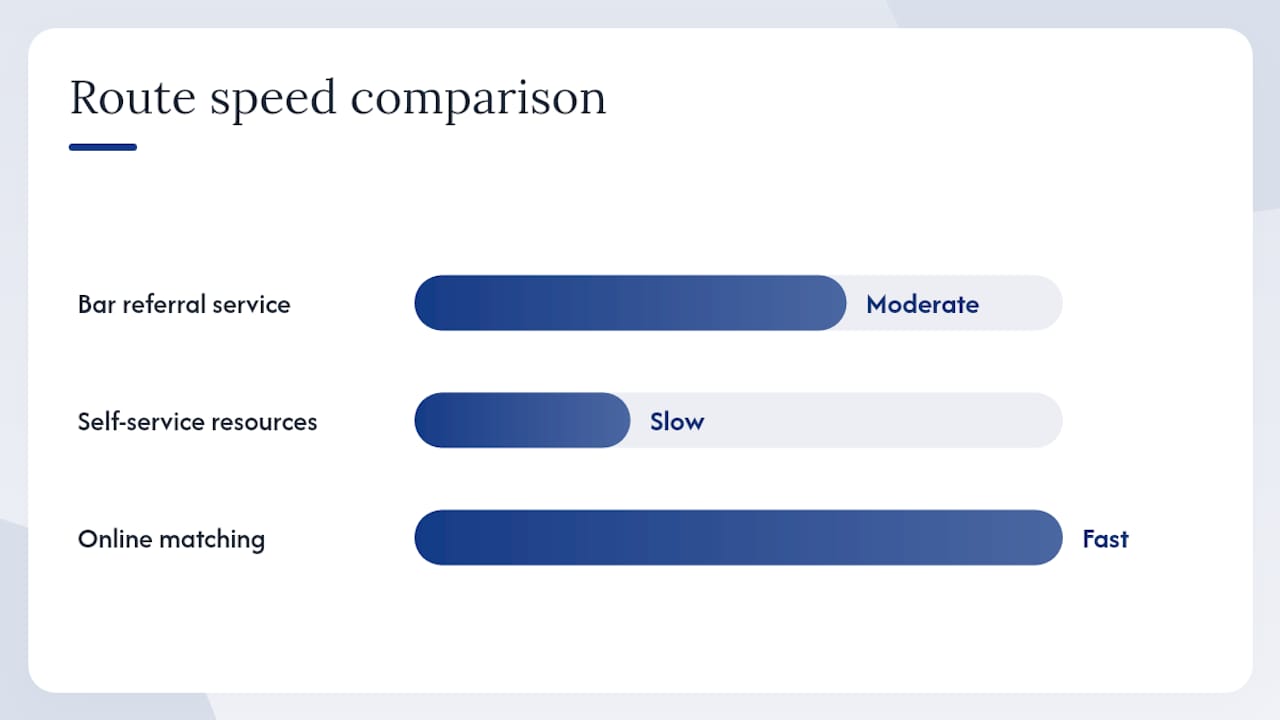
| Route | Speed | Convenience | Best Fit |
|---|---|---|---|
| Bar referral service | Moderate | Moderate | Screened referrals, low-cost initial consults |
| Self-service resources | Slow | Low | Research and background only |
| Online matching | Fast | High | First-time users needing a qualified attorney quickly |
Bar referral programs and online matching serve complementary roles. Bar referrals offer an unbiased screening function; matching platforms add speed and broader access.
What first-time users often underestimate about attorney matching
Most people approaching the legal system for the first time assume the hard part is finding an attorney. It usually is not. The hard part is arriving at that first consultation prepared enough for the attorney to act quickly. A complete intake, organized documents, and a clear account of events do more to accelerate your case than any other single factor.
Matching platforms get credit for speed, and the speed is real. But the quality of the match depends heavily on the quality of the intake. A vague description produces a generic brief. A detailed, chronological account produces a brief an attorney can act on immediately. That distinction changes how fast you move from match to strategy.
The platform limits are also worth stating plainly. For a routine personal injury claim, a family law matter, or an employment dispute, online matching is a direct, reliable path. For a federal criminal matter or a class action, it is a starting point at best.
Legalleads connects you to a qualified attorney fast
Legalleads is the direct route to qualified legal representation in California, without the delays of cold calls or directory searches.
- Submit a plain-English intake and receive a professional case brief in under two minutes.
- Get matched with a vetted, licensed California attorney within 24 hours.
- The platform covers personal injury, family law, immigration, employment, criminal defense, and more.
- Every match includes conflict-of-interest screening and State Bar license verification.
- Per State Bar of California guidance, your attorney will provide a written fee agreement before engagement begins.
Ready to get started? Find a lawyer through Legalleads and have a qualified attorney reviewing your case brief today.
Sources
- REPORT OF THE NYCLA TASK FORCE ON FOR-PROFIT, ONLINE LEGAL MATCHING SERVICES - New York County Lawyers Association
- Before Selecting an Attorney | The State Bar of California
- The Benefits of Using a Lawyer Matching Service - Web Lib
- How a Lawyer Matching Service Can Help You Find the Right Legal Representation - ORZ 360
This article is general information, not a substitute for advice from a qualified lawyer. Consult a qualified legal professional about your own circumstances before acting on anything here.
FAQ
How long does it take to get matched with an attorney through Legalleads?
Legalleads generates a case brief in under two minutes and matches you with a vetted attorney within 24 hours of intake submission.
What is a written fee agreement and why does it matter?
A written fee agreement specifies billing type and payment schedule before you hire an attorney. The State Bar of California recommends every client receive one before engagement begins.
What practice areas does Legalleads cover?
Legalleads covers personal injury, family law, immigration, employment, criminal defense, and other major practice areas in California.
Can I request a different attorney if the first match is not a good fit?
Yes. You can request a re-match, and the platform re-runs triage and conflict checks to identify an alternative attorney.
Is online matching right for every legal situation?
Online matching works well for most first-time legal matters, including personal injury and family law. Complex multi-district litigation or urgent felony arraignments may require direct outreach to a specialized firm or public defender.