California requires employers to give non-exempt employees a 30-minute unpaid meal break once a shift passes five hours, with a second 30-minute meal break after more than ten hours. Workers also get a paid 10-minute rest break for every four hours worked or major fraction of that time. Miss either one, and the employer owes one additional hour of pay at the employee's regular rate for each violation, per day.
That premium pay rule comes straight from Labor Code §512 and guidance published by the Division of Labor Standards Enforcement (DLSE). Employers can't just make a break available and call it done. They have to actually relieve the employee of all duty, according to the DLSE's own FAQ. If you're still answering calls, monitoring a register, or waiting for a manager's go-ahead, that's not a lawful break. It's paid work time.
Employees who get shorted a break have options: raise it with HR, file a wage claim with the Labor Commissioner, or bring in an employment attorney if the pattern is bigger than one missed lunch. The rest of this guide breaks down the timing rules, the narrow exceptions, and exactly what to do if your employer isn't following the law.
Key Takeaways
California's meal and rest break rules are non-negotiable statutory rights, and violations trigger one hour of premium pay per missed break, per day.
| Point | Details |
|---|---|
| Meal break timing | First 30-minute meal break is due before hour six; second before hour eleven on shifts over ten hours. |
| Rest break frequency | Paid 10-minute rest break for every four hours worked, meaning three breaks on a 12-hour shift. |
| Premium pay remedy | Employers owe one hour of regular pay per missed meal break and one per missed rest break, up to two per day. |
| Waivers are narrow | Mutual waivers and on-duty meal exceptions require written agreement and apply only under specific, limited conditions. |
| Filing window | Wage claims for break premiums generally carry a three-year statute of limitations. |
Table of Contents
- Meal Break Law California: Timing, Pay Status, and Shift Examples
- How Many Rest Breaks Do You Get in California?
- Can You Waive a Meal Break or Work Through It?
- What Happens When an Employer Violates Break Rules?
- Are There Exceptions for Certain Industries?
- If You Think Your Breaks Were Denied
- What I'd Tell Both Sides of This Fight
- Sources
- FAQ
Meal Break Law California: Timing, Pay Status, and Shift Examples
The meal break law california employers must follow hinges on two numbers: five hours and ten hours. Work past five hours in a day, and you're owed a 30-minute meal period before the start of your sixth hour. Work past ten hours, and a second 30-minute meal period is due before your eleventh hour begins. This isn't a suggestion or a best practice. It's the statutory floor set by Labor Code §512, and it applies to nearly every non-exempt hourly worker in the state.
Whether that break is paid depends entirely on whether you're relieved of duty. A meal period is unpaid only when the employee is completely free to leave the work site, free from any employer control, and free to use the time however they want. If an employer requires someone to stay on the premises, keep a radio on, or remain reachable, the "break" doesn't meet the legal standard and generally must be paid as regular work time.
How the thresholds play out across common shift lengths:
- 7-hour shift: One 30-minute meal break required, and it must start no later than the end of hour five.
- 10-hour shift: One meal break required by the start of hour six. A second meal break is not automatically triggered unless the shift is longer than 10 hours, since the second-meal trigger is "more than 10 hours," not exactly 10.
- 12-hour shift: Two meal breaks required. The first must begin before the end of hour five, and the second before the end of hour ten.
Here's how a scheduler might structure a 12-hour shift that starts at 6:00 AM to stay compliant:
- Employee clocks in at 6:00 AM.
- First meal break happens between 10:30 AM and 11:00 AM, well before the 11:00 AM deadline (end of hour five).
- Rest breaks are spaced through the morning and afternoon (covered in detail in the next section).
- Second meal break happens between 3:30 PM and 4:00 PM, ahead of the 4:00 PM deadline (end of hour ten).
- Employee clocks out at 6:00 PM.
Waiting until hour six to start that first meal, even by a few minutes, creates a violation and triggers the one-hour premium. This trips up a lot of employers who round schedules to the nearest half hour without checking the actual clock-in time.
A frequent scheduling mistake: stacking both meal breaks close together near the middle of a long shift because it's easier to staff. That satisfies the letter of the timing rule only if both breaks still land before their respective deadlines. Many employers instead build break windows directly into shift templates, flagging any clock-out for lunch that falls after the fifth or tenth hour as an automatic exception requiring manager review. That kind of proactive scheduling catches problems before they become in a wage claim.
How Many Rest Breaks Do You Get in California?
California entitles hourly employees to a paid 10-minute rest break for every four hours worked, or a major fraction thereof (more than half the four-hour period), which the DIR interprets accordingly. Unlike meal breaks, rest breaks are paid and count as hours worked, so they show up on your paycheck the same as any other 10 minutes on the clock.
The general guidance is that rest breaks should fall as close to the middle of each four-hour work segment as the schedule reasonably allows. That's not a rigid rule, but it reflects the underlying purpose of the break: giving employees a genuine pause roughly halfway through a stretch of work, not tacked onto the very start or end of a shift where it's practically useless.
Rest break entitlement by shift length:
- Under 3.5 hours: No rest break required.
- 8-hour shift: Two 10-minute rest breaks.
- 10-hour shift: Two 10-minute rest breaks.
- 12-hour shift: Three 10-minute rest breaks.
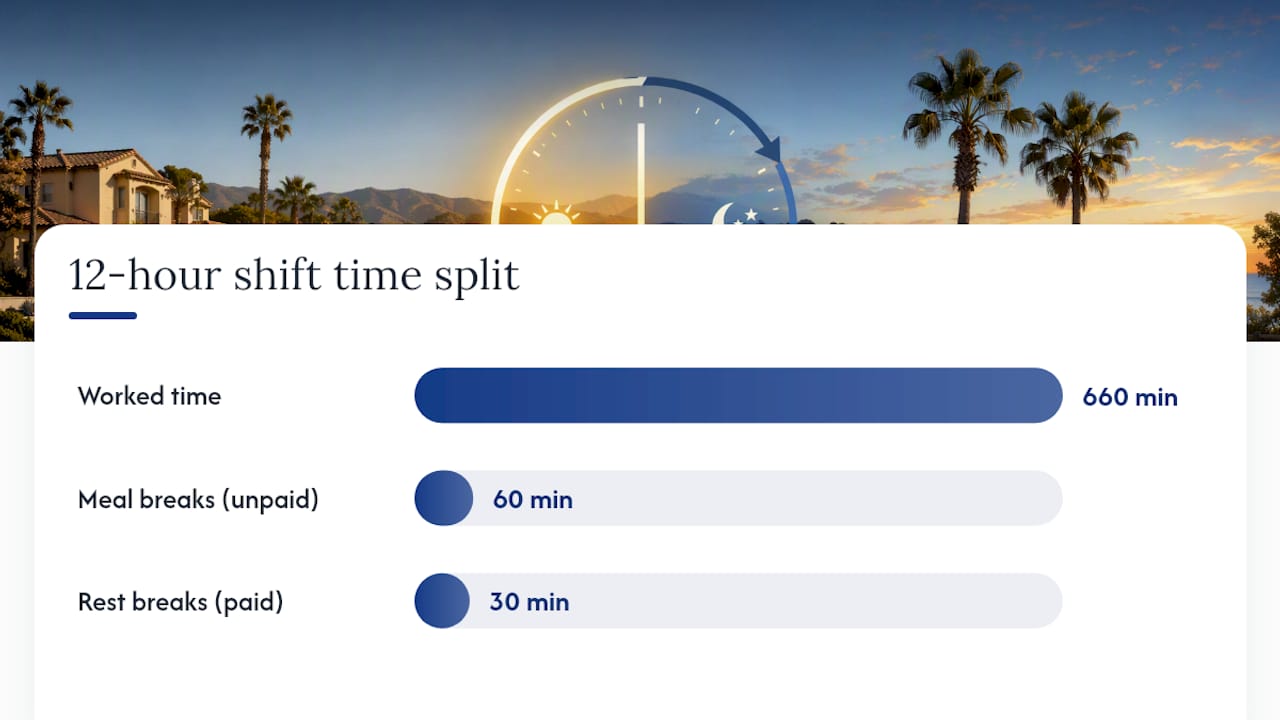
The 12-hour shift is where a lot of employees get shortchanged without realizing it. A 12-hour day breaks into three four-hour blocks, and DIR guidance confirms each block earns its own rest break. That's three separate 10-minute paid breaks, on top of the two unpaid meal periods discussed above. Combined, a 12-hour shift includes 30 minutes of rest break time plus 60 minutes of meal break time, meaning the employee is scheduled for 12 hours but only actively working for 11 hours across the two categories.
One detail that trips up both employers and employees: rest breaks and meal breaks are not interchangeable, and you can't combine two 10-minute rest breaks into a single 20-minute break, or attach a rest break to a meal period to create a 40-minute lunch. Each break type has to stand on its own, separated in time, because they serve different legal purposes and carry different pay treatment.
Can You Waive a Meal Break or Work Through It?
Yes, but only under narrow, specific conditions, and never as a blanket policy applied to every shift. California allows two distinct paths around a standard meal break: a mutual waiver, or the on-duty meal exception. Both require actual agreement, not just employer convenience.
Mutual waiver: If a shift is six hours or less, the employee and employer can mutually agree in writing to waive the first meal period entirely. For shifts over ten hours but under twelve, the second meal period can be waived, but only if the first meal period was actually taken. These waivers apply to specific circumstances defined in Labor Code §512, and practitioners note the exceptions are tightly constrained rather than a general opt-out tool employers can apply to any shift they like.
On-duty meal exception: This applies only when the nature of the work genuinely prevents the employee from being relieved of all duty, such as a sole worker at an isolated location where no one else can cover the post. The DLSE FAQ sets three requirements:
- The work must objectively make it impossible to relieve the employee of duty (not just inconvenient or costly to staff).
- Both parties must sign a written agreement authorizing the on-duty meal, and that meal period is then paid.
- The employee retains the right to revoke the agreement in writing at any time, reverting to a standard off-duty meal break.
Typical qualifying roles include a single security guard covering an isolated post overnight or a lone convenience store clerk with no relief staff available. What doesn't qualify: a restaurant that's simply short-staffed during a rush, or a warehouse that finds it operationally easier to keep one person on the floor.
Pro Tip: If your employer asks you to sign an on-duty meal agreement, read it before signing. It should explain your right to revoke in writing, and if it doesn't mention that right at all, that's a sign the agreement wasn't drafted to meet the DLSE's actual standard.
Invalid practices show up more often than most people expect. A manager who says "just eat at your desk if we're busy," a schedule with no real gap for a break, or a policy that quietly discourages clocking out for lunch all fall short of the legal standard, even if no one explicitly forbids the break. The DLSE has been clear that pressure and impractical scheduling amount to the same violation as an outright denial.
What Happens When an Employer Violates Break Rules?
A missed meal or rest break costs the employer one additional hour of pay at the employee's regular rate of pay for each workday the violation occurs, capped at two premium hours per day (one for meal violations, one for rest violations), according to DLSE guidance. That premium pay is a penalty, not overtime, so it doesn't factor into weekly overtime calculations even though it's calculated using the employee's regular hourly rate.
Wage claims involving break premiums generally fall under a three-year statute of limitations, and case law including the Murphy v. Kenneth Cole Productions line of decisions treats these payments as a wage rather than a penalty for limitations purposes, which is what extends the filing window from one year to three. That distinction matters because it means employees often have far more time than they assume to recover unpaid break premiums going back through their employment history.
If you believe your breaks were denied or shortened, here's the practical order of operations:
- Document everything as it happens. Note the date, the shift length, when the break occurred (or didn't), and who was present.
- Raise it with HR or a manager in writing. Email creates a timestamp and a paper trail that a verbal conversation doesn't.
- Request your timecards and schedules. California employers must retain these records, and you're entitled to copies.
- File a wage claim with the Labor Commissioner's office if the internal process doesn't resolve the issue or your employer retaliates.
- Consult an employment attorney if the violations are ongoing, affect multiple employees, or involve retaliation for raising the issue.
Strong evidence in these claims usually includes:
- Timecards showing clock-in and clock-out times, including any meal-period punches.
- Written schedules showing shift length and any planned break windows.
- Emails or texts referencing break denial, pressure to skip breaks, or manager instructions to stay on duty.
- Witness statements from coworkers who observed the same scheduling pattern.
Keeping your own copies of pay stubs and schedules as you go, rather than trying to reconstruct them months later, makes a real difference if a claim ever moves forward. A detailed record-keeping approach protects employers too, since accurate time records are often the deciding factor in whether a wage claim succeeds or gets dismissed.
Are There Exceptions for Certain Industries?
Yes. A handful of industries and arrangements operate under modified break rules, and it's worth checking the Industrial Welfare Commission (IWC) wage order that applies to your specific occupation before assuming the standard rules apply exactly as written.
Collective bargaining agreements (CBAs): A valid CBA can establish alternate meal and rest period provisions, including different premium pay remedies, as long as the agreement expressly provides for wages, hours, and working conditions and includes a regular hourly rate of at least the applicable minimum.
Motion picture industry: Wage Order 12 includes distinct meal period timing rules that reflect production schedules, differing from the general five-hour and ten-hour thresholds.
Alternative workweek schedules: Employees on a properly adopted four-day, ten-hour workweek still receive the same meal and rest break entitlements, just distributed across a longer single shift.
Agriculture: Agricultural workers are covered by Wage Order 14, which includes specific provisions for outdoor work and heat-related rest requirements layered on top of the standard break structure.
Healthcare workers: Certain healthcare employees can waive a second meal period on shifts over eight hours under specific conditions outlined in their applicable wage order, reflecting the operational realities of patient care.
If your job falls into one of these categories, the standard breakdown earlier in this guide is a starting point, not the final word.
If You Think Your Breaks Were Denied
Start by writing down what happened. Note the date, the shift, and whether you asked for the break and were told no, ignored, or pressured to skip it. Send a written request to HR asking them to address the pattern, and keep a copy of your paystubs and posted schedules going forward.
Escalate when the denial repeats, when it affects a whole team or shift, or when you're looking at damages beyond a simple premium payment.
- Ask HR for a written response and give them a reasonable window to fix the schedule.
- File with the Labor Commissioner if HR doesn't resolve it.
- Talk to an employment attorney if retaliation follows your complaint or the violations span months.
Legalleads takes a plain-English description of your situation and turns it into a professional case brief in under two minutes, then matches you with a qualified California employment attorney within 24 hours. No forms, no phone tag.
Pro Tip: Save your case brief details before you talk to anyone at work. A clear timeline makes it easier for an attorney to evaluate your claim quickly.
Start with Legalleads' attorney matching if you'd rather review options yourself, or browse attorney profiles directly.
What I'd Tell Both Sides of This Fight
Employers lose these cases more often from bad habits than bad intentions. A quarterly schedule audit checking actual clock times against the five- and ten-hour thresholds catches more violations than any policy memo. Train managers specifically on what "relieved of duty" means, because most violations trace back to a manager who didn't realize monitoring a phone during lunch converts it to paid work.
Employees: keep your own copies of schedules and paystubs as you go. Don't wait for a dispute to start reconstructing your history. If HR doesn't respond to a written request within a reasonable window, that silence is itself useful evidence.
Sources
Read the primary law directly at Labor Code §512, which sets the meal period thresholds, and Labor Code §512.1 for the current rest and meal period summary. The DLSE's Rest and Meal Periods guidance covers premium pay calculations, and the DLSE FAQ on meal periods addresses on-duty exceptions and employer obligations in detail. The DIR's small business guidance page offers a plain-language overview of both break types.
This article is general information, not a substitute for advice from a qualified lawyer. Consult a qualified legal professional about your own circumstances before acting on anything here.
- California Labor Code §512 — meal period rules
- Rest and Meal Periods — DLSE (Division of Labor Standards Enforcement) PDF
FAQ
Can I work 7 hours without a lunch break in California?
No. Any shift longer than five hours requires a 30-minute unpaid meal break, so a 7-hour shift must include one, typically starting before the end of hour five.
What changed in California's meal break law for 2026?
Nothing substantive changed. Labor Code §512.1 remains the controlling statute, and the five-hour and ten-hour thresholds are unchanged.
Is there a new California meal break law?
No new statute has replaced the existing framework. Employers and employees still follow Labor Code §512's original thresholds, waiver conditions, and premium pay remedy.
How many breaks do you get in California for a 12-hour shift?
A 12-hour shift includes two 30-minute unpaid meal breaks and three paid 10-minute rest breaks, for a combined 2 hours of break time during the day.
What happens if my employer denies my meal break?
Your employer owes one additional hour of pay at your regular rate for that workday, and you can document the incident and file a wage claim with the Labor Commissioner if it continues.