
Mass tort leads are inquiries from people who match a specific product or exposure, a qualifying injury, and the correct filing window for a live litigation. The number that matters is not cost-per-lead. It's cost-per-signed-case, paired with how deep the vendor's qualification process actually goes. Before you pay for a single lead, demand the vendor's screening criteria and consent records in writing.
TL;DR:
- Disqualification rates for mass tort leads typically range from 60 to 70 percent, requiring rapid screening and routing of only qualified claimants to closers.
- Vendors should provide clear, written definitions of exclusivity, qualification criteria, and payment tracking, especially the important cost-per-signed-case metric.
- Running a short pilot of two to four weeks allows testing qualification and sign rates; stable cost-per-signed-case as volume grows signals when to scale channels.
- Speedy intake processes with structured case briefs and immediate attorney matching significantly reduce claimant abandonment and improve conversion rates.
- Prioritize vendors who can accurately track signed case origin, offer detailed qualification criteria, and produce fast, organized case briefs to improve overall lead-to-case success.
Table of Contents
- Why Mass Tort Lead Buying Differs From Standard PI Lead Buying
- Channels, Budgets, and What Vendor Quotes Actually Mean
- Building an Intake Workflow That Actually Converts
- Vendor-Vetting Checklist Before You Sign a Contract
- Running a Pilot Before You Commit to Real Volume
- How Legalleads Approaches Fast, Qualified Case Matching
- Buy Leads, Build Your Own, or Both?
- Get Started With Legalleads
- Sources
- FAQ
Why Mass Tort Lead Buying Differs From Standard PI Lead Buying
A single-incident personal injury lead needs one thing confirmed: did an accident happen, and when. A mass tort lead needs three things to align at once: product or exposure history, a qualifying injury, and correct timing relative to the statute of limitations and litigation deadlines. That triple filter is why mass tort intake looks nothing like standard PI intake.
Firms that buy mass tort leads without adjusting their intake staffing get buried. Screening has to happen fast, and most inquiries won't survive it.
- Expect 60 to 70 percent total disqualification across the intake funnel. That is the norm, not a red flag.
- Disqualification happens in stages: initial contact, exposure confirmation, injury severity, filing timing, and prior representation checks.
- Your intake team needs to disqualify quickly and route the surviving claimants straight to a closer, not let them sit in a queue.
Build your staffing and budget math around that disqualification rate from day one, not after the first bad month.
Channels, Budgets, and What Vendor Quotes Actually Mean

Mass tort lead generation runs on a mix of paid search, social media, local service ads, SEO, and email, with mobile geofencing, CTV/TV, podcasts, and SMS layered in depending on the tort. Paid search tends to catch claimants actively researching their situation. CTV and podcasts reach people earlier, often before they've connected their symptoms to a specific product. Geofencing works well around medical facilities and pharmacies tied to a specific exposure.
When a vendor quotes you a price, ask which of three numbers it represents:
- Raw-response cost — what it costs to generate any inbound inquiry, qualified or not.
- Cost-per-qualified-lead — the cost after basic screening (exposure, injury, timing).
- Cost-per-signed-case — the actual economic figure, since it accounts for every disqualification along the way.
Pro Tip: If a vendor won't quote cost-per-signed-case, they're either not tracking it or don't want you to see it.
Reported blended figures for cost-per-signed-case range from roughly $68 to $15,000 depending on the tort and how mature the litigation is. Earlier-stage torts with less competition tend to run cheaper; saturated, high-profile torts push costs toward the top of that range.
Building an Intake Workflow That Actually Converts
A lead that isn't screened within hours is a lead your competitor signs first. The firms that convert well use a layered intake model instead of a single generic phone script.
- Fraud and bot filtering at the point of submission, before a human ever sees the inquiry.
- Scripted intake by a trained specialist who checks exposure, injury, and timing against the tort's known criteria.
- Identity and records verification, including HIPAA-compliant medical authorizations when injury documentation needs pulling.
- A dedicated retainer closer who handles borderline or hesitant claimants with e-signature retainer flows ready to go.
Your CRM needs pipeline stages built around each tort separately, since a mesothelioma case and a talc case screen against completely different criteria—learn how to handle family law intake step by step in NH to support your firm's operational intake best practices How to handle family law intake step by step in NH. Automated follow-up sequences catch claimants who stall mid-intake, and tracking lead sources through your practice management tools shows you which channel is actually producing signed matters, not just phone calls. Senior screeners should handle the borderline cases; junior intake staff can clear the obvious yeses and nos fast.
Vendor-Vetting Checklist Before You Sign a Contract
Every mass tort lead vendor will tell you their leads are exclusive and pre-qualified. Get it in writing before you believe it.
- Exclusive vs. shared: get a written definition of "exclusive," since some vendors sell the same lead to three firms and call it exclusive to each.
- Qualification depth: ask for the exact screening criteria used, whether a human conducted the interview, and what documentation (affidavits, medical authorizations) backs each qualified lead.
- Consent and TCPA provenance: confirm the opt-in records exist and are retrievable, not just claimed. Review California's attorney advertising rules if you're marketing to residents there.
- Replacement policy: get the exact terms for dead numbers, duplicates, and leads that fail your own screening within a set window.
- Delivery and reporting: decide between live transfer, CRM push, or batch delivery, and insist on reporting that traces leads to signed retainers, not just raw counts.
Running a Pilot Before You Commit to Real Volume
Don't sign a six-month contract on a vendor's word. Run a short pilot, watch the numbers, and let the data decide whether to scale.
- Structure the pilot as a 2 to 4 week ramp. Most vendors report first qualified leads arriving 3 to 5 days after onboarding.
- Track four numbers throughout: contact rate, qualification rate, signed rate, and cost-per-signed-case.
- If your qualification rate is dropping while volume climbs, tighten the vendor's screening criteria before adding more spend.
- If cost-per-signed-case stays stable as volume increases, that's your signal to scale the channel, not just the vendor.
Use signed-case attribution data to renegotiate terms or shift budget across channels. A vendor that can't tell you which channel produced your signed cases isn't giving you a real pilot, just a spend report.
How Legalleads Approaches Fast, Qualified Case Matching
Legalleads built its intake process around one problem: claimants abandon slow, confusing intake before a firm ever sees them. The platform generates a structured case brief in under two minutes from a plain-English description, then connects that claimant to a qualified attorney within 24 hours.
- Speed reduces decay. A claimant who waits days for a callback often signs with whoever responds first.
- Structured briefs cut intake friction. Attorneys receive organized case information upfront instead of a raw, unscreened inquiry.
- Warm claimants act faster. Firms can move quickly on a claimant who's already described their situation clearly, rather than starting intake from zero.
This model applies most directly to Legalleads' matching services in personal injury and related practice areas, where fast, organized intake has the most impact on conversion.
Buy Leads, Build Your Own, or Both?
Buy when you need docket position fast and can't wait months to build a pipeline. Build in-house when exclusivity and long-term data ownership matter more than speed. Most firms do best running both: pilot a bought channel on one tort, track sign-rate against cost-per-signed-case, then reinvest only in what actually compounds.
— Admin
Get Started With Legalleads
Some lead platforms give firms a faster path to signed cases than the vendor RFP cycle most mass tort buyers go through. Some platforms generate structured case briefs quickly and offer attorney matching within a short time frame, without a long sales process standing between you and your first claimant.
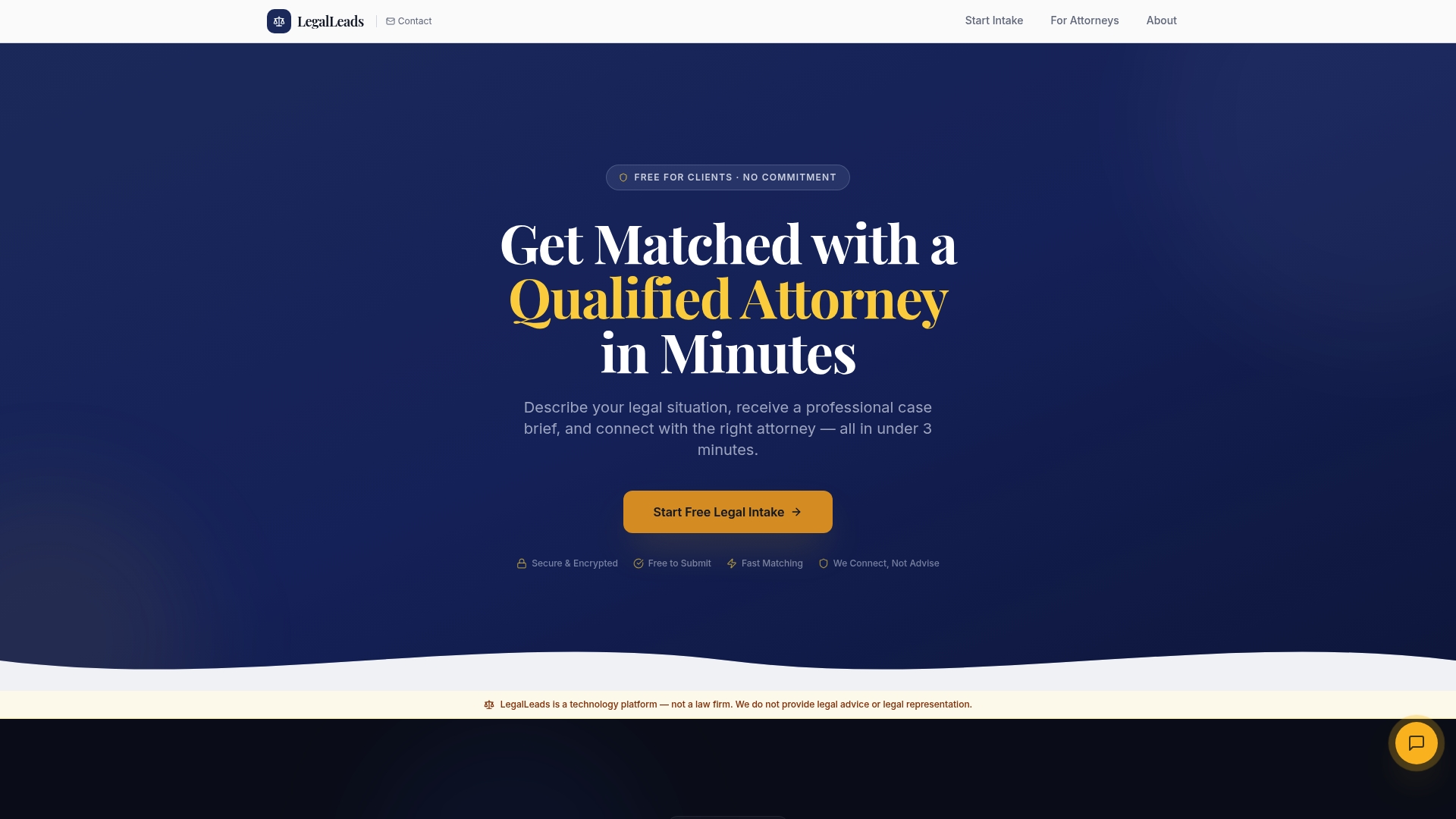
Before onboarding, ask for a sample case brief, the exact intake fields captured, and the reporting format you'll receive on signed matters. Firms that want a fuller acquisition engine, not just leads, can look at the All-In-One PR Package, which runs at $3,500 per month and bundles PR, website work, and content management alongside case matching. If personal injury is your focus, start with Personal Injury Attorney Matching and request a walkthrough of the intake flow before your next docket deadline.
Sources
Review HIPAA guidance, PCI security standards, and Clio's mass tort intake overview for compliance and benchmark detail.
This article is general information, not a substitute for advice from a qualified lawyer. Consult a qualified legal professional about your own circumstances before acting on anything here.
- How to Work Mass Tort Leads: First Contact to Signed Retainer (2026) — HowToWorkLeads
- Mass Tort Cost Per Signed Case (2026) — MTAA
- HIPAA | HHS
FAQ
What Are Examples of Mass Torts?
Common mass tort categories include pharmaceutical injury claims, defective medical devices, environmental or chemical exposure, and consumer products linked to a specific injury pattern, such as talc-related cancer claims or hernia mesh complications.
How Much Do Mass Tort Lawyers Charge?
Most mass tort attorneys work on contingency, typically taking a percentage of any settlement or verdict, so claimants generally pay nothing upfront. The exact percentage varies by firm and by tort, and firms should confirm fee structures during the retainer stage.
What Is a Mass Tort?
A mass tort is a civil action where multiple individuals file separate claims against the same defendant for similar injuries caused by the same product, drug, or exposure, rather than joining a single class action.
How Long Does a Mass Tort Lawsuit Take?
Timelines vary widely by tort and court, but most mass tort litigation runs multiple years from filing to settlement or verdict, since cases often consolidate into multidistrict litigation before individual claims resolve.
What Should I Look for When Buying Mass Tort Leads?
Prioritize cost-per-signed-case over cost-per-lead, and confirm the vendor's qualification criteria, consent provenance, and replacement policy in writing. Platforms like Legalleads that generate structured case briefs and fast attorney matches reduce the intake friction that causes qualified claimants to disappear before signing.