
Legal jargon mistakes costing clients money are defined as errors that occur when clients misunderstand, misuse, or overlook specialized legal language in contracts, filings, and agreements. These mistakes are not rare edge cases. UK businesses alone lose £2.3 billion annually from legal misunderstandings, including contract disputes and professional negligence claims. That figure reflects a global pattern: the gap between legalese and plain English creates real financial damage. The industry term for this category of risk is "legal language ambiguity," and understanding it is the first step toward protecting your money.
1. Legal jargon mistakes costing clients money: the most common types
The most damaging legal language errors fall into predictable categories. Recognizing them before you sign anything is far cheaper than fixing them afterward.
Contract misinterpretation from ambiguous terms

Ambiguous contract language is the leading source of costly legal misunderstandings. Terms like "reasonable," "material," and "best efforts" carry specific legal meanings that differ from everyday usage. Misapplying everyday meanings to legal terms weakens cases and triggers disputes, according to legal literacy expert Adam Garcia. A client who reads "best efforts" as a casual promise may be shocked to learn a court treats it as a near-absolute obligation.
Misreading modal verbs: shall, may, must
Modal verbs are not interchangeable in legal documents. "Shall" creates a mandatory obligation. "May" grants permission. "Must" sets a condition. Swapping these in your reading of a contract can flip your understanding of who owes what to whom. This single category of mistakes in legal language generates a disproportionate share of contract disputes.
Relying on AI tools or DIY templates
DIY contracts often lack crucial clauses that address real-world contingencies, creating liability gaps that only surface when something goes wrong. The risk compounds when clients use AI to interpret their obligations. A Delaware court ordered a $250 million reversal after AI-assisted legal decisions produced incorrect conclusions. Courts show no leniency when AI replaces qualified legal counsel.
Ignoring inconsistent terminology across documents
A single contract may use "agreement," "contract," and "arrangement" to describe the same thing. Courts can treat each as a distinct concept. That inconsistency creates ambiguity, and ambiguity creates litigation. Clients who do not flag these inconsistencies during review pay for them later.
Failing to demand defined terms
Legal documents use a "Definitions" section for a reason. Any term that appears in quotes or capital letters in a contract has a specific meaning that overrides its common usage. Clients who skip this section often misread their own rights and obligations.
Overlooking the specialized meaning of everyday words
Words like "execute," "consideration," "party," and "tender" mean something specific in law. Legalese can be exploited against clients who lack expert review, creating loopholes that opposing counsel will use. Legal consultants confirm that demand for clarity and consistent definitions is the primary defense against this risk.
Skipping professional review of translated documents
Legal translation errors carry their own financial weight. One mistranslated word reversed liability in a contract dispute and nearly cost the client millions. Professional review is not optional when documents cross language lines.
Pro Tip: Before signing any contract, read the Definitions section first. Every capitalized or quoted term in the document has a meaning that may differ entirely from what you expect.
2. How small language errors cause major financial consequences
Minor linguistic errors in legal documents are invisible until they are not. By the time they surface, the cost is rarely minor.
A misplaced comma in a patent claim invalidated the entire patent, costing millions in lost licensing revenue and triggering expensive litigation. That case illustrates a consistent pattern: small grammar ambiguities become catastrophic failures during the enforcement stage, not during drafting. The error looks harmless at signing and devastating in court.
Courts apply the "plain meaning rule" when contract language is unambiguous, and the "extrinsic evidence rule" when it is not. That distinction matters because ambiguous language invites testimony, depositions, and expert witnesses. Each of those adds cost. Clients who sign documents with unclear modifiers or vague scope clauses are effectively funding future litigation.
The table below summarizes common ambiguity types and their typical financial exposure.
| Ambiguity type | Example | Potential financial impact |
|---|---|---|
| Misplaced modifier | "Employees working remotely only" | Contract invalidation, lost revenue |
| Vague scope clause | "Related services as needed" | Unlimited obligation, cost overruns |
| Inconsistent defined terms | "Agreement" vs. "Contract" used interchangeably | Disputed obligations, litigation costs |
| Missing comma or punctuation | Patent claim with ambiguous phrase | Millions in lost licensing fees |
| Ambiguous modal verb | "Shall" read as "may" | Breach of contract claims |
Pro Tip: Ask your attorney to flag every modifier and every defined term in a contract before you sign. A one-hour review costs far less than a single day of litigation.
3. What role professional legal translation plays in preventing costly errors
Legal translation is not word conversion. It is specialized risk management that requires legal knowledge, terminology consistency, and document-level review. General translators who lack legal training produce documents that read correctly but function incorrectly under the law.
The financial stakes are asymmetric. Professional legal translation costs typically range from £500 to £2,000 per document. A single translation error, by contrast, can reverse liability and expose a client to damages in the millions. Translator liability is capped by contract. Client liability is not.
Common translation errors that generate financial exposure include:
- Translating "shall" as a future tense rather than a mandatory obligation
- Using a general term where a jurisdiction-specific legal term is required
- Failing to carry defined terms consistently across a multi-document transaction
- Translating a limitation of liability clause in a way that expands rather than caps exposure
- Using machine translation for clauses that contain legal terms of art
Best practices for clients commissioning legal translations include building a glossary of defined terms before translation begins, requiring the translator to hold legal credentials in the target jurisdiction, and having a qualified attorney review the final document before execution. Machine translation tools are acceptable for general comprehension. They are not acceptable as the final version of any binding document.
4. How clients can protect themselves from costly language errors
The most effective protection against the impact of legalese on clients is qualified legal counsel. Every other strategy is secondary. That said, clients who understand what to look for ask better questions and catch more errors before they become expensive.
Here is a practical checklist for reviewing any legal document:
- Read the Definitions section first. Every capitalized term has a specific meaning. Do not assume it matches common usage.
- Flag every modal verb. Identify whether each obligation is mandatory ("shall," "must") or permissive ("may"). Confirm your reading with your attorney.
- Check for terminology consistency. If the same concept appears under different names, ask your attorney to clarify whether the difference is intentional.
- Ask for plain-language summaries. A qualified attorney can explain what each clause means in plain English. If they cannot, that is a problem.
- Do not sign under time pressure. Urgency is a negotiating tactic. A contract that cannot wait for a one-hour review is a contract worth examining closely.
- Never rely solely on AI or DIY templates. Non-lawyer document review carries real risks, and courts do not accept "the template said so" as a defense.
- Request professional review of any translated document. The cost of review is fixed. The cost of a translation error is not.
Understanding why legal terms matter for your rights is not just academic. It directly determines what you can enforce and what you cannot.
Key Takeaways
Legal jargon mistakes cause direct financial harm when clients misread defined terms, rely on AI tools, or skip professional review of contracts and translations.
| Point | Details |
|---|---|
| Defined terms control meaning | Always read the Definitions section before any other part of a contract. |
| Modal verbs create obligations | "Shall" and "may" are not interchangeable; misreading them creates breach of contract exposure. |
| AI tools carry court risk | A Delaware court ordered a $250 million reversal after AI-assisted legal decisions proved incorrect. |
| Translation errors are expensive | Professional translation costs £500–£2,000; a single error can expose clients to millions in liability. |
| Small grammar errors compound | A misplaced comma invalidated a patent and triggered millions in lost licensing revenue and litigation. |
Why legal jargon keeps winning against clients
The pattern I see most often is not ignorance. It is confidence. Clients read a contract, recognize most of the words, and assume they understand the document. That assumption is where the money goes.
Legalese is not designed to confuse. It evolved to be precise. The problem is that precision in legal language depends on a shared vocabulary that most clients do not have. When a contract says "time is of the essence," that phrase triggers specific legal consequences that have nothing to do with urgency in the casual sense. When a client reads "indemnify and hold harmless" as a polite formality, they may be agreeing to cover the other party's legal fees in any future dispute.
The gap between what clients read and what documents say is not a failure of intelligence. It is a failure of access. Clients who communicate their legal problem clearly to a qualified attorney close that gap fast. The ones who do not often find out what they missed in a courtroom.
The good news is that legal literacy is not a prerequisite for protection. You do not need to become a lawyer. You need to know which questions to ask and who to ask them to. That is a much smaller lift, and it pays for itself every time.
— Admin
How Legalleads connects you with attorneys who speak plainly
Misreading one clause or missing one defined term can cost more than years of legal fees. The solution is not to read more carefully. It is to have the right attorney read it with you.
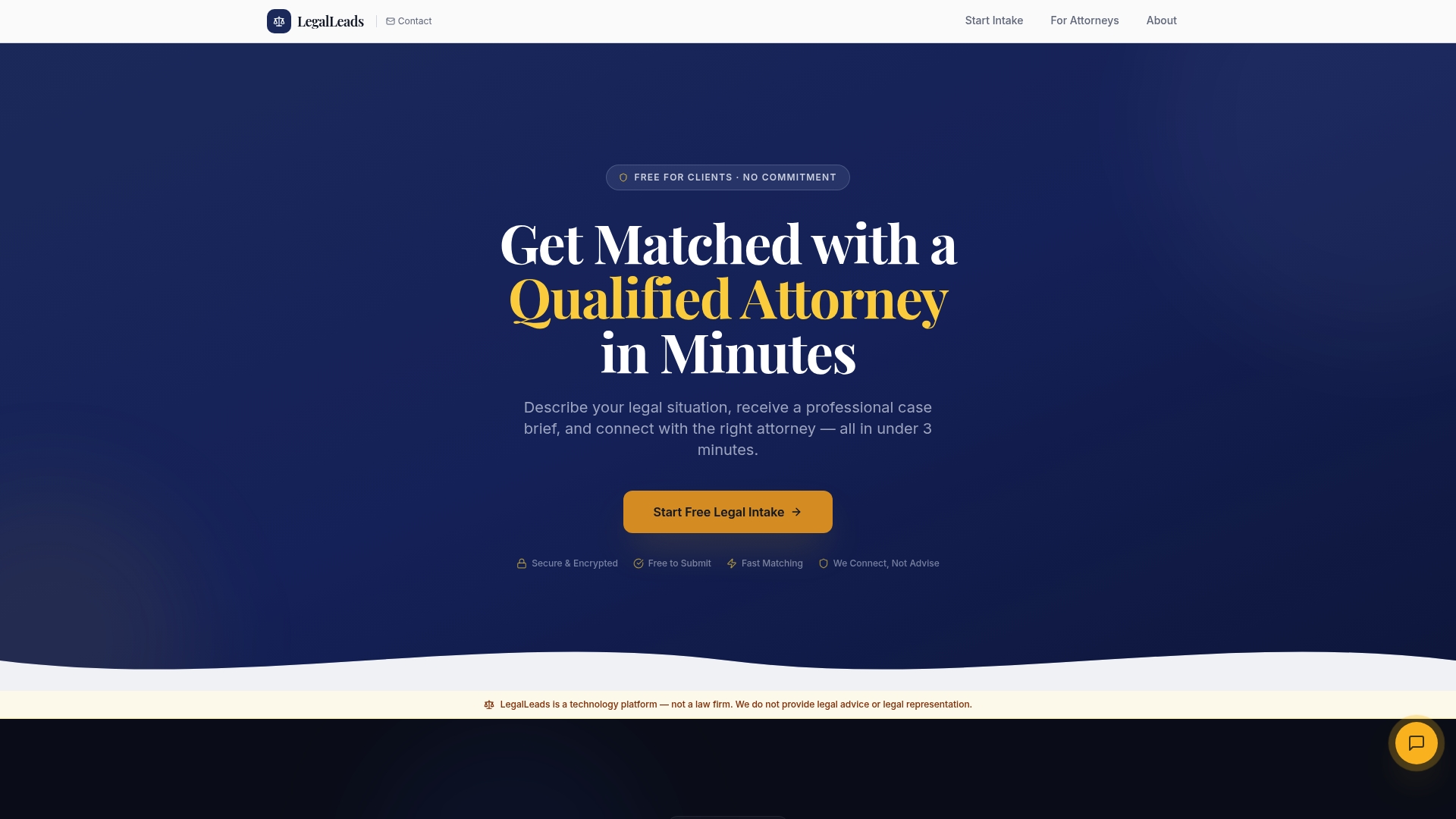
Legalleads connects clients with qualified attorneys in under 24 hours, without forms or phone calls. You describe your situation in plain English, and Legalleads generates a professional case brief in under two minutes. From there, a matched attorney reviews your documents, explains what they actually mean, and flags the terms that could cost you money. Whether you need a family law attorney or a personal injury specialist, Legalleads matches you to the right expert fast. Find a lawyer who will read the fine print with you before it becomes a problem.
FAQ
What are the most common legal jargon mistakes clients make?
The most common mistakes include misreading modal verbs like "shall" and "may," skipping the Definitions section, and assuming everyday words carry their everyday meanings. Each error can shift obligations or void protections entirely.
How much money can a legal language error actually cost?
A single grammatical ambiguity in a patent claim cost millions in lost licensing revenue and litigation fees. UK businesses collectively lose £2.3 billion annually from legal misunderstandings, including contract disputes.
Is it safe to use AI to review legal documents?
AI tools carry significant risk for legal interpretation. A Delaware court ordered a $250 million reversal after AI-assisted legal decisions produced incorrect conclusions, and courts apply no leniency for AI errors.
Why is professional legal translation worth the cost?
Professional legal translation costs £500–£2,000 per document. A single translation error can reverse liability and expose a client to damages far exceeding that amount, while translator liability remains capped.
What should I do before signing any legal document?
Read the Definitions section first, flag every modal verb, check for inconsistent terminology, and ask your attorney for a plain-language summary of each clause before you sign.