
A legal case summary is a concise, attorney-ready intake brief, typically 300 to 500 words, that states the key facts, exact dates, opposing-party names, and desired outcome in plain English. It is not a judicial case brief or court opinion summary. Write it now, attach your supporting documents, and send it before you contact a firm.
TL;DR:
- Providing exact dates and full legal names allows attorneys to quickly verify the viability of your case through conflict-of-interest and statute-of-limitations checks.
- Summaries should prioritize clear, chronological facts over emotional narratives to facilitate faster review and response by legal firms.
- Attaching filenames by content, not default device names, helps streamline document review and ensures relevant information is easily accessible.
- Submitting sensitive information requires secure methods, such as encrypted PDFs or secure upload links, to protect your privacy during the intake process.
- A concise, structured summary typically involves only 10 to 20 key fields, significantly reducing delays caused by incomplete or vague case descriptions.
Table of Contents
- What Facts Should a Legal Case Summary Include?
- How Do You Structure a Legal Case Summary?
- What Do Attorneys Actually Do With Your Summary?
- How Do You Submit a Legal Case Summary Securely?
- Example: A Ready-to-Send 350-Word Case Summary
- Why Concise Intake Summaries Speed Up Legal Help
- Get a Professional Case Brief and an Attorney Match Fast
- Sources
- FAQ
What Facts Should a Legal Case Summary Include?
Attorneys triage new matters fast, often in minutes, so the order and completeness of your facts determines how quickly a firm can act. A structured summary that separates contact information, matter type, timeline, and documents lets an attorney enter a consultation already informed instead of spending the first ten minutes asking questions you could have answered upfront.
Cover these items, roughly in this order of priority:
- Contact and identification: your full legal name, date of birth, and the best way to reach you.
- Core incident facts: what happened, where it happened, and exact dates. Vague references like "sometime last spring" force an attorney to guess whether your claim is even still within the statute of limitations, and those deadlines vary widely by state and matter type.
- Opposing parties: full legal names of every adverse party, plus any known counsel. Firms cannot run a conflict check on "the guy who hit my car."
- Status and steps already taken: medical treatment, police reports filed, prior legal filings, or insurance claims opened.
- Desired outcome and urgency: what resolution you want and whether a deadline is approaching.
- Supporting documents: police reports, photos, contracts, medical records, or correspondence you can attach.
Most practice areas need only 10 to 20 structured fields to qualify a case without overwhelming the person filling it out. If you find yourself writing paragraphs of backstory before naming the other party, you are burying the facts an attorney actually needs first.
How Do You Structure a Legal Case Summary?
A summary that wanders rarely gets read twice. Follow a fixed order, keep it inside the 300 to 500 word range that most professional guides recommend for case summaries, and let the structure carry the weight instead of adjectives.
- Opening line: who you are and what kind of legal matter this is, in one sentence.
- Timeline of events: dates in bold, in chronological order, three to six sentences.
- Parties involved: your name, the opposing party's full legal name, and any counsel already involved.
- Actions taken so far: medical care, police reports, filings, prior attorney contact.
- Desired outcome and urgency: what you want and any deadline pressure.
- Attached documents: a short list naming each file.
Write the content pass first. Get every fact down without worrying about tone. Then do a second, concise pass: cut adjectives, cut arguments about who was at fault, and cut anything that reads like a diary entry rather than a chronology. Bold every date. List every attachment by name rather than burying them in a sentence. If you do not know a fact, write "date unknown" or "name unconfirmed" instead of guessing. Attorneys handle uncertainty far better than they handle inaccuracy discovered later.
Pro Tip: Name your attached files by content, not by phone camera default. "Police_Report_03-14-2026.pdf" gets opened before "IMG_4821.pdf" does.
What Do Attorneys Actually Do With Your Summary?
Your summary does not go straight to a strategy session. It goes through a screening process first, and understanding that process explains why certain details are non-negotiable.
- Conflict-of-interest screening. Every name you provide, yours and the opposing party's, gets run through a conflict database. This is an ethics obligation under rules like ABA Model Rule 1.7 and 1.9, and most firms complete it within one to three business days. Missing or informal names slow this step down or block it entirely.
- Statute-of-limitations screening. Exact dates let an attorney immediately assess whether your claim is still viable, rather than flagging it for a follow-up call just to pin down a timeline.
- Outcome after review. You will typically hear one of three things: cleared for a scheduled consultation, declined with a non-engagement letter, or referred to another attorney better suited to your matter.
Submitting a summary is a screening step, not a retainer. In most cases, it does not create an attorney-client relationship on its own. That relationship forms only after a firm agrees to represent you, usually in writing.
How Do You Submit a Legal Case Summary Securely?
Your summary often contains medical details, financial information, or a Social Security number. Treat it that way. Use an HTTPS-secured intake portal, a secure upload link, or an encrypted PDF rather than pasting sensitive details into a plain email. Digital intake channels reduce entry errors and speed up firm response precisely because the data flows directly into a firm's case management system instead of sitting in an inbox.
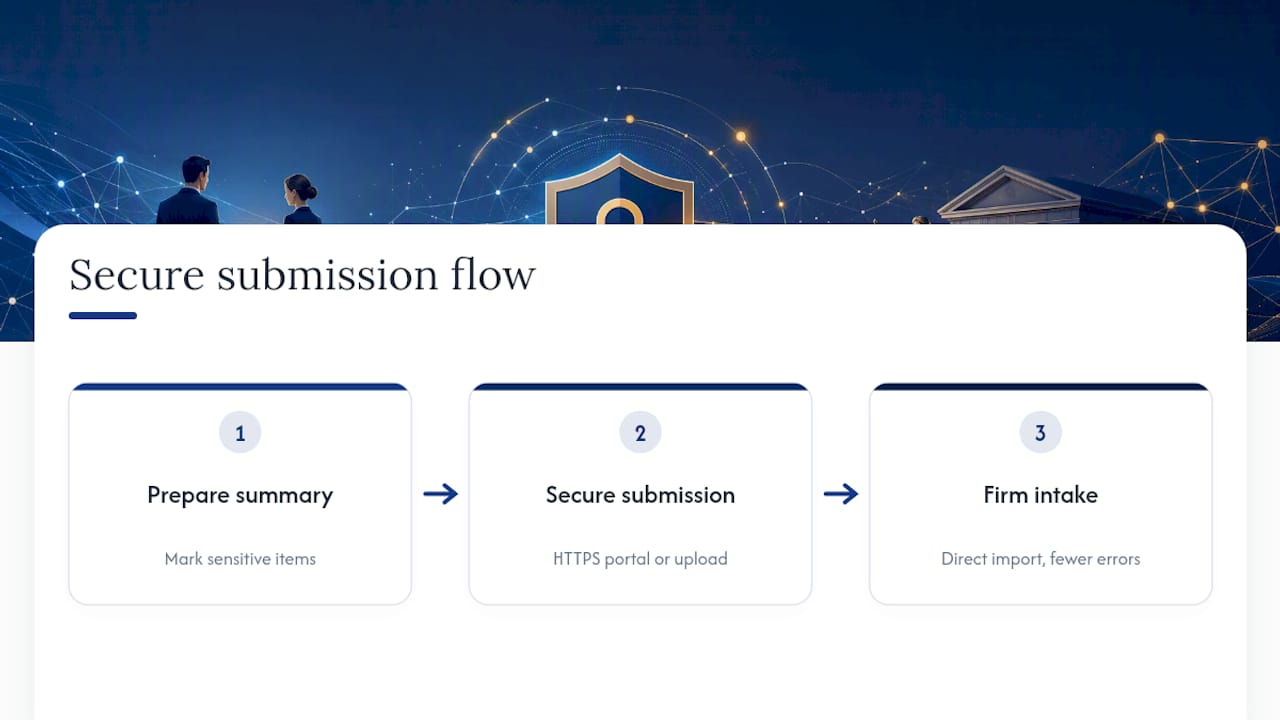
Mark anything sensitive clearly and ask for a secure upload option if a firm's website does not obviously offer one. If a firm declines to take your case, reputable practices will return or destroy your documents rather than retain them indefinitely. Before you submit anything, skim the firm's privacy or consent language. It usually spells out exactly how "prospective client" information gets handled, and that single paragraph tells you more about a firm's practices than any marketing page will.
Example: A Ready-to-Send 350-Word Case Summary
Here is an editable template. Replace the bracketed sections with your own facts and keep the structure intact.
Legal Case Summary: [Your Full Name]
Matter type: Personal injury, motor vehicle collision
Summary: On March 14, 2026, I was rear-ended at a red light on 4th Street by a vehicle driven by [Opposing Party Full Legal Name]. Police responded and filed report #[number]. I was treated at [hospital/clinic name] for whiplash and a fractured wrist the same day, and I have attended six follow-up appointments since.
Opposing party: [Full legal name], insured by [insurance company, if known]. No attorney has contacted me on their behalf as of this writing.
Steps taken: Filed a claim with my insurer on March 16, 2026. Opposing insurer has offered $[amount or "no offer yet"]. I have not signed any release.
Desired outcome: Full compensation for medical costs and lost wages. No pending deadline that I am aware of, but I want to move quickly given the accident date.
Attached documents:
- Police_Report_03-14-2026.pdf
- Medical_Records_MercyHospital.pdf
- Photos_Vehicle_Damage.zip
- Insurance_Correspondence.pdf
Unconfirmed: exact name of opposing driver's insurance adjuster.
Notice the pattern: bold dates, full legal names, a clean attachments list, and an honest flag on what you do not yet know. A summary built this way is exactly what platforms like LegalLeads are built to generate automatically from a plain-English description, cutting the drafting step down from an evening to about two minutes.
Why Concise Intake Summaries Speed Up Legal Help
The biggest mistake I see in intake material is people writing to persuade rather than to inform. A summary is not where you argue your case. It is a handoff document, and the shorter, dated chronology wins every time over the emotional narrative. Clear summaries with exact dates and full names move faster through conflict checks and get answered sooner, which is the entire point.
— Admin
Get a Professional Case Brief and an Attorney Match Fast
Writing a tight, conflict-ready summary from scratch takes real effort, especially while you're dealing with the underlying legal problem. Some platforms shorten that step: describe your situation in plain English, and the platform generates a formatted, professional case brief quickly, then connects you to a qualified attorney.

That speed matters because a properly formatted brief with conflict-ready names and dates is exactly what gets a faster response from a firm, compared to a summary an attorney's staff has to reformat before they can even screen it. If your situation involves a family law matter in Los Angeles, an employment dispute, or another practice area entirely, the intake works the same way. Start your intake now through the Find Lawyer page, attach your documents, and let the matching process do the rest. There are no long forms and no calls required to get started.
Sources
- Law Firm Intake Best Practices for More Cases | VerdictIQ
- How to Fill Out and Submit a New Matter Intake Form - LegalClarity
- What Is a Client Intake Form? A Guide for Law Firms | LegalStaffNow
- How Legal Professionals Can Write More Concise Case Summaries | LawFuel
This article is general information, not a substitute for advice from a qualified lawyer. Consult a qualified legal professional about your own circumstances before acting on anything here.
FAQ
How Long Should a Legal Case Summary Be?
Aim for 300 to 500 words. That range is long enough to cover the key facts and short enough that an attorney reads it in full rather than skimming.
Does Submitting a Case Summary Create an Attorney-Client Relationship?
No. Submitting a summary is typically a screening step for conflict checks and case fit, and the attorney-client relationship only forms once a firm formally agrees to represent you.
Why Do I Need to Include the Opposing Party's Full Legal Name?
Firms are required to run conflict-of-interest checks on every named party before they can review your matter, and an informal name or nickname can stall that process.
What Happens if I Don't Know an Exact Date?
Write "date unknown" rather than guessing. Vague timelines make it harder for an attorney to assess whether your claim still falls within the statute of limitations, since those deadlines vary by state and case type.
Can Legalleads Write My Case Summary for Me?
Yes. Legalleads generates a formatted, professional case brief from a plain-English description of your situation in under two minutes through its Find Lawyer intake.