
Law firm PR builds credibility through earned media and protects reputation during high-stakes matters, but it only works when it maps to business goals instead of running as a side project. Start by aligning PR efforts with your firm's business development priorities and naming one or two attorneys as designated spokespeople. From there, this guide covers core services, 2026 planning, measurement, attorney media prep, digital integration, and where a platform like Legalleads fits into the picture.
TL;DR:
- Effective law firm PR must be aligned with business goals and prioritized through strategic themes connected to specific practice areas.
- Media relations, litigation PR, crisis communications, and thought leadership are core services that depend on strong reporter relationships and rapid response protocols.
- Building a PR plan for 2026 involves mapping practice priorities, creating a proactive editorial calendar, and resource planning, with a focus on measurable impact metrics like referral leads and backlinks.
- Attorneys need targeted media training and messaging discipline to handle interviews ethically and confidently, especially within tight confidentiality constraints.
- Platforms like Legalleads offer automation and fast lead generation solutions, supporting small and midsize firms with affordable, scalable PR and marketing integration.
Table of Contents
- What Is Law Firm PR and Why Does It Matter?
- Core Law Firm PR Services Explained
- How Do You Build a Law Firm PR Plan for 2026?
- What KPIs Actually Show PR's Business Impact?
- Preparing Attorneys for Media Interviews
- Turning PR Into SEO and Digital Visibility
- Examples of Successful Law Firm PR Campaigns
- The Ethical Minefield: Confidentiality and Privilege in Legal PR
- How Should Firms Handle Negative Publicity?
- Customizing PR by Practice Area and Firm Size
- Agency, In-House, or Platform: A Publisher's View
- How Legalleads Supports Law Firm PR and Lead Generation
- Sources
- FAQ
What Is Law Firm PR and Why Does It Matter?
Law firm PR is the practice of earning third-party media coverage and managing public narrative around a firm's attorneys, cases, and expertise. It differs from advertising in one key way: you don't buy the placement, you earn it through relevance, timing, and credibility. That distinction shapes everything about how a firm PR program should run.
The core components break down into four buckets:
- Media relations — pitching journalists, distributing press releases, placing op-eds, and building reporter relationships over time
- Litigation PR — shaping public narrative around active cases without compromising legal strategy
- Crisis communications — managing the firm's own reputational exposure when something goes wrong
- Thought leadership — bylines, white papers, podcasts, and speaking engagements that establish attorneys as go-to sources
These components typically fall under a comprehensive law firm public relations program, according to Clio's guide to the field, which also flags media training and reputation management as standing services within that scope.
Why it matters comes down to five business outcomes: credibility with prospective clients, referral growth from other attorneys who see the coverage, SEO value from earned backlinks, access to higher-value matters that come through reputation rather than ad spend, and recruiting leverage when top candidates see a firm's name in trade press.
Pro Tip: A single strong media placement often outperforms months of paid search spend for attorney recruiting, because candidates read it as third-party validation rather than marketing.
Advertising guarantees placement; PR earns trust. If your firm needs immediate lead volume, paid channels move faster. If your firm needs to be seen as the authority in a practice area, PR is the tool that gets you there, and earned coverage strengthens SEO and referral pathways in ways that drive higher-value matters over time.
Core Law Firm PR Services Explained
Every legal public relations firm operates around five recognizable service categories, whether the work happens in-house, through an agency, or on a platform.
Media relations covers the daily blocking and tackling: identifying reporters who cover your practice areas, pitching timely stories, writing press releases that actually get opened, and placing op-eds under an attorney's byline. The relationships matter more than the volume. A firm with three strong reporter contacts in trade press will outperform a firm blasting fifty generic pitches a month.
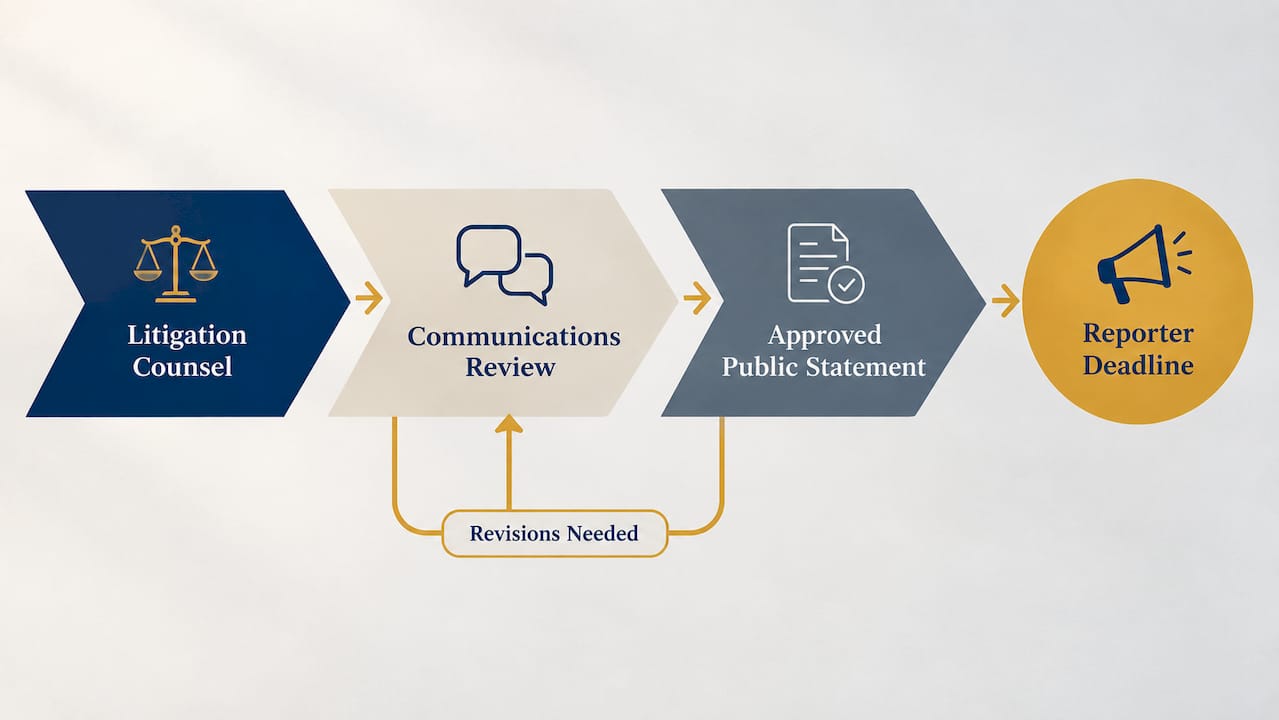
Litigation PR is a distinct discipline because it requires constant coordination between communications staff and litigation counsel. The goal is narrative alignment, not spin: making sure public statements support the legal strategy rather than undercutting it. Rapid response matters here. A case can break in the news cycle before counsel has even finalized a filing, and firms without a pre-approved statement process lose control of the story fast.
Crisis communications protects the firm itself, not just its clients. That means having an approval chain in place before a crisis hits, along with pre-drafted holding statements and a clear internal communications plan so employees aren't hearing about a firm scandal on Twitter before leadership tells them directly. Best-practice guidance consistently calls for a designated crisis team and audited workflows built well before a crisis, not during one.
Thought leadership turns attorney expertise into visible content: bylined articles, white papers, podcast appearances, and conference panels. This is often the easiest entry point for smaller firms because it requires expertise more than budget.
Media training ties all of it together. Attorneys who can write a sharp legal brief often freeze on camera or ramble past the sound bite a reporter needs. Format-specific preparation, including mock interviews for broadcast and message discipline for print, is what separates confident spokespeople from liability risks. Agency service pages across the industry consistently list these same five categories as the standard scope of legal PR work.
How Do You Build a Law Firm PR Plan for 2026?
A 2026 PR plan starts with firmwide strategy, not a media wish list. Law.com's planning guidance is blunt on this point: firms should enter the year with a plan that identifies priorities, names spokespeople, and maps a calendar of expected developments before anything gets pitched to a reporter.
Here's a practical sequence for building that plan:
- Map PR themes to firmwide priorities. If the firm wants to grow its healthcare litigation practice, PR should focus there first, not spread thin across every practice group.
- Coordinate with business development and practice leaders. They know which cases are moving toward resolution, which attorneys are hungry for visibility, and which relationships are worth nurturing through a joint byline or panel invite.
- Build an editorial and response calendar. Anticipate litigation milestones, regulatory deadlines, and industry events months ahead so pitches go out proactively instead of reactively.
- Decide how to resource the work. In-house staff, an agency retainer, or a platform subscription each carry different cost and speed tradeoffs, covered in more detail later in this guide.
- Plan for repurposing. Every placement, byline, or panel talk should generate at least two more assets: a social clip, a newsletter mention, or a BD leave-behind.
That calendar-first approach isn't just organizational hygiene. A quarterly "opportunity calendar" that lists anticipated case milestones, regulatory dates, and speaking slots lets a firm pre-draft statements and lock in spokesperson availability, so when a reporter calls, someone is actually ready to talk instead of scrambling for approval.
Tying PR planning directly to business development and cross-selling goals is what separates programs that generate measurable outcomes from programs that generate clippings nobody reads, a point Law.com's 2026 planning piece makes directly.
Pro Tip: Build your editorial calendar around known regulatory deadlines first. Reactive pitches compete with every other firm chasing the same news cycle; proactive pitches tied to a predictable date get a reporter's attention weeks in advance.
What KPIs Actually Show PR's Business Impact?
Output metrics count activity. Impact metrics prove value. A firm that reports "12 press mentions this quarter" has told leadership nothing about whether those mentions moved a single matter forward. The KPI set that actually justifies budget looks different.
Five metrics worth tracking:
- Earned media quality score — weighting placements by outlet authority and relevance to target practice areas, not raw count
- Referral leads tied to coverage — tracking intake sources back to specific placements or spokesperson appearances
- Backlink authority — measuring the domain strength of sites linking back to the firm after coverage runs
- Share of voice — how often your firm's attorneys get quoted versus competitors in the same vertical
- Sentiment trend — whether coverage skews favorable, neutral, or negative over time
Earned media's SEO value is well documented: placements generate backlinks that strengthen a firm's organic search authority and referral pathways, which compounds over months rather than showing up in a single quarterly report.
Reporting cadence matters as much as the metrics themselves. A monthly highlights summary keeps practice leaders informed without overwhelming their inbox. A quarterly business-impact report, built for BD and firm leadership, should connect coverage directly to pipeline: new inquiries, referral partner engagement, and any measurable shift in search rankings for target terms.
Set benchmarks against your firm's own baseline in the first two quarters, then adjust targets once you know what a realistic placement rate looks like for your practice areas. A boutique immigration firm and an Am Law 100 litigation group will never share the same benchmark, and pretending otherwise sets everyone up to miss.
Preparing Attorneys for Media Interviews
Attorneys are trained to argue a case, not to give a twenty-second sound bite, so media prep has to close that gap directly. Broadcast interviews demand short, quotable answers. Podcasts allow more nuance and storytelling. Print interviews give room to clarify a point after the fact; social clips give none.
- Run mock interviews specific to the format. A broadcast mock should feel rushed and adversarial; a podcast mock should feel conversational.
- Set ethics and privilege guardrails before the interview, not during it. Coordinate messaging with counsel so a spokesperson never improvises around a privileged detail under pressure. Everyday PR practice for lawyers depends on this kind of message discipline and ethics compliance as a baseline, not an afterthought.
- Use a pre-interview checklist. Confirm topic scope, reporter's angle, and any off-limits subjects in writing beforehand.
- Know when to decline. Any question touching active litigation strategy or client confidentiality gets referred to counsel or the PR lead, no exceptions.
Pro Tip: Give every spokesperson three core messages before any interview, no matter the format. Reporters remember repetition, and an attorney who drifts off-message usually does it because no one gave them a script to return to.
Turning PR Into SEO and Digital Visibility
A press mention that lives only in a reporter's archive is a wasted asset. The real value comes from what happens after the placement runs.
- Convert coverage into backlinks and owned content. Republish the core argument as a firm blog post, and link back to the original placement.
- Clip video and audio interviews for social distribution, especially LinkedIn, where attorney visibility drives referral relationships.
- Pitch niche newsletters and podcasts, not just major outlets. A trade newsletter with 8,000 subscribers in your exact practice area often converts better than a general business outlet with ten times the readership.
- Feed placements into BD outreach materials so business development teams can reference recent coverage in pitches to referral sources.
Owned media like blogs and podcasts should function as source material for the next pitch, not a side project. That's the sequence: place the story, repurpose the thought leadership content across owned channels, then measure the combined lift in referral traffic and search visibility rather than treating each channel in isolation. Earned coverage that generates backlinks also strengthens the technical groundwork covered in a law firm SEO checklist, since domain authority gains from press mentions compound with on-site optimization.
Examples of Successful Law Firm PR Campaigns
The pattern behind the strongest law firm PR campaigns usually traces back to a specific, timely hook rather than a generic press release. A firm that gets ahead of a regulatory change with a bylined explainer, published the week the rule takes effect, tends to land more coverage than a firm pitching the same expertise six months later with no news peg attached.
Litigation PR success stories share a similar shape: firms that pre-drafted statements before a high-profile filing, coordinated tightly with litigation counsel on what could be said publicly, and had a spokesperson ready the moment a reporter called. The firms that get burned in litigation PR are almost always the ones improvising a response after the story already broke.
Thought leadership campaigns that compound over time follow a repurposing loop. An attorney writes one strong byline on an emerging employment law issue, that piece gets pitched to a podcast, the podcast appearance gets clipped for LinkedIn, and the clip gets referenced in a BD pitch deck six months later. None of that requires a massive budget. It requires discipline about turning one placement into three or four assets instead of letting it die in an outlet's archive.
Crisis communications successes are harder to see publicly by design. The firms that handle a partner departure, a malpractice allegation, or a data breach well are the ones you rarely hear about, because the story never metastasized into a news cycle. That's the actual measure of success in crisis PR: the absence of a bigger story, not the presence of a good one.
The Ethical Minefield: Confidentiality and Privilege in Legal PR
Law firm PR carries a risk that most other industries never have to manage: attorney client privilege and confidentiality obligations don't pause because a reporter is on the phone. Every statement, every quote, and every background comment has to clear an ethics filter before it goes out, and that filter has to be faster than a reporter's deadline.
The biggest challenge is coordination speed. Litigation counsel often wants to say nothing publicly, while the PR function wants to shape the narrative before opposing counsel or the media does it first. Resolving that tension requires a pre-agreed approval chain, not an argument conducted in real time while a reporter waits for comment.
Confidentiality issues extend beyond active cases. A thought leadership piece that references a past matter, even in generalized terms, can drift into confidentiality territory if it's specific enough for someone to identify the client. Attorneys writing bylines need the same ethics review a litigation statement gets, even when the topic feels abstract.
Ethics rules also constrain how firms can characterize outcomes. A press release touting a settlement in aggressive marketing language can trigger bar complaints in jurisdictions with strict attorney advertising rules. Everyday legal PR practice depends on treating ethics compliance as a starting constraint, not a final check before publishing.
How Should Firms Handle Negative Publicity?
Negative publicity hits law firms differently than most businesses, because the firm's entire value proposition rests on trust and judgment. A product company can survive a bad review cycle. A law firm facing public scrutiny over an ethics complaint, a high-profile loss, or an internal scandal is fighting a reputational battle that touches the core reason clients hire attorneys in the first place.
The first rule is speed with restraint. Firms that stay silent for days while a story builds momentum lose control of the narrative to whoever is talking, whether that's opposing counsel, a disgruntled former client, or a reporter working from incomplete information. A brief, factual holding statement within hours, even one that simply confirms the firm is aware and reviewing the matter, buys time without conceding anything.
The second rule is internal alignment before external statements. Nothing damages a firm's credibility faster than a partner contradicting the official statement in a separate interview. That means the crisis approval chain built during 2026 planning needs to actually get used the moment a story breaks, not revised on the fly.
The third rule is knowing what not to say. Legal ethics obligations often limit what a firm can disclose about a client matter, even when staying quiet looks evasive to outside observers. A well-prepared spokesperson can acknowledge that limitation directly, explaining that professional obligations prevent comment on specifics, rather than dodging the question in a way that reads as guilt.
Recovery after a negative cycle depends on the thought leadership and earned media groundwork built beforehand. A firm with an existing reputation for expertise recovers faster than one with no public track record to fall back on.
Customizing PR by Practice Area and Firm Size
A personal injury firm and a white-collar defense practice need almost opposite PR strategies, even though both fall under "litigation PR" on paper. Personal injury PR often benefits from visible case outcomes and consumer-facing storytelling, since the audience is potential clients researching who to hire after an accident. White-collar defense PR runs the opposite direction, favoring discretion, measured statements, and thought leadership aimed at referral sources and other attorneys rather than the general public.
Family law PR tends to work best through empathetic thought leadership: articles on custody trends, mediation approaches, and practical guidance that builds trust with a hurting audience rather than press releases touting specific case wins. Immigration law PR often benefits from rapid-response commentary tied to policy changes, since that practice area moves in step with regulatory news cycles more than almost any other.
Firm size changes the resourcing question more than the strategy itself. A solo practitioner or small firm rarely has bandwidth for a dedicated PR hire, which makes niche marketing focus essential: pick one or two practice areas to build visibility around rather than spreading thin. A midsize regional firm can usually support a part-time in-house coordinator paired with agency support for crisis moments. Am Law 200 firms typically run dedicated communications teams that treat PR as a full department, with litigation PR specialists working alongside media relations and digital teams.
The mistake firms of every size make is copying a strategy built for a different scale. A boutique firm trying to run a national media relations campaign built for an Am Law 100 budget will burn resources chasing outlets that were never realistic targets in the first place.
Agency, In-House, or Platform: A Publisher's View
The right resourcing model depends on case profile, speed-to-response needs, and whether the goal is national visibility or local market presence. Agencies bring national media relationships and deep litigation PR expertise, which matters most for firms handling high-profile or multi-jurisdiction matters. In-house teams offer better cost control and can sustain long-term content programs without retainer fees eating the budget every month.
Platforms fill a different gap: speed and consistency. Legalleads pairs an AI-driven intake process with attorney matching within 24 hours, giving firms a steady lead pipeline without building an internal media operation from scratch. For firms without spare bandwidth for a full PR function, that combination of automation and consistent visibility often closes the gap faster than a slow agency search or an unfilled in-house role.
— Admin
How Legalleads Supports Law Firm PR and Lead Generation
Legalleads is the alternative to hiring a full communications team when a firm needs visibility and qualified leads without building an in-house PR department from zero. The platform's structured, AI-assisted intake generates a professional case brief in under two minutes and connects that inquiry to a qualified attorney within 24 hours, giving firms consistent visibility across personal injury, family law, immigration, criminal defense, and employment law without the overhead of a traditional retainer.

For firms that want PR support bundled with lead generation, the All-In-One PR Package combines media outreach, website creation, and content management into a single monthly subscription. Current pricing details are available on the package page. That model fits solo practitioners and small to midsize firms best: teams with strong casework but no dedicated marketing staff to run media pitches, manage a content calendar, and monitor practice-area visibility all at once.
Firms focused on a specific practice area can also start narrower. Review the Personal Injury Attorney Matching page or the Family Law Attorney Matching page to see how the intake and matching process works for that specialty. The next step is straightforward: request details on the All-In-One PR Package directly through the package page to see how it fits your firm's current marketing gaps.
Sources
This guide draws on planning frameworks from Law.com's 2026 PR planning article, Clio's comprehensive law firm PR guide, Software Advice's guide to PR for lawyers, and Inside Advantage PR's 2026 law firm PR guide. Each source informed the service breakdowns, planning framework, and measurement guidance covered above.
- Is your 2026 public relations plan ready to go? — The Legal Intelligencer
- A Comprehensive Guide to Law Firm Public Relations — Clio
- The Complete Guide to Law Firm PR (2026) — Inside Advantage PR
FAQ
What Are the Big Four PR Firms?
The "Big Four" typically refers to Edelman, Weber Shandwick, BCW, and FleishmanHillard, all global communications agencies. None specialize exclusively in legal PR, which is why most law firms work with legal-focused boutique agencies, in-house teams, or platforms like Legalleads instead.
Do PR Professionals Get Paid Well?
PR salaries vary widely by seniority and specialization, with legal PR specialists often commanding higher rates than general consumer PR roles due to the ethics and litigation expertise required. Agency retainers and in-house salaries both reflect that added complexity compared to standard corporate communications work.
What Does a PR Lawyer Do?
A "PR lawyer" isn't a formal legal role. It usually describes an attorney who advises on the legal risk of public statements, such as defamation exposure or attorney advertising rule compliance, working alongside a firm's communications staff rather than replacing them.
What Does a Law Firm PR Firm Actually Do?
A legal public relations firm manages media relations, litigation communications, crisis response, and thought leadership placement on behalf of attorneys and firms, as outlined in Clio's guide to the field. Some firms also offer media training and integrated marketing support, which is the model Legalleads uses in its All-In-One PR Package.
How Much Does the Legalleads PR Package Cost?
The All-In-One PR Package includes PR support, website creation, and content management, according to the package page.