
Prioritize a measured, multi-channel acquisition system plus a conversion-first intake engine. That combination, not any single tactic, produces predictable signed retainers. Pick channels that match your practice area and capacity, then build an intake process fast enough to catch the leads you're already paying for. Track lead-to-retainer performance, and evaluate a direct solution like Legalleads against whatever you're running now.
TL;DR:
- Local SEO, Google Business Profiles, and review volume are crucial for capturing consumer legal searches in local maps, especially for urgent practice areas like personal injury.
- Immediate response time within minutes significantly increases lead-to-signature conversion rates, making fast intake systems essential for better ROI.
- Using cost per signed retainer as a primary metric directs marketing spend toward channels that generate profitable, long-term clients rather than mere lead volume.
- Prioritizing long-term channels like SEO, content, and PR alongside immediate tactics ensures sustained visibility and lead quality over time.
- Legalleads offers a fast and pre-qualified intake process that reduces lead drop-off, improving efficiency and increasing signed retainers without forms or phone tag.
Table of Contents
- What Lead-Generation Methods Actually Work for Law Firms
- Which Lead Channels Deserve Your Budget First?
- How Do You Build an Intake System That Converts?
- How Do You Measure ROI on Law Firm Marketing?
- How Should You Split Your Marketing Budget by Practice Area?
- What Does the Research Say About Intake Speed and Conversion?
- What Are the Compliance Rules for Legal Marketing?
- Where Vendor Promises Meet Firm Reality
- Start Fixing Intake With Legalleads
- Sources
- FAQ
What Lead-Generation Methods Actually Work for Law Firms
Law firm lead generation breaks into two jobs: getting the phone to ring, and answering it fast enough to matter. Most firms overinvest in the first job and underinvest in the second. That imbalance is why so many marketing budgets produce case volume that never turns into signed retainers.
Legal practice lead generation runs through several channels, and each one behaves differently depending on your timeline and practice area.
- Local SEO and Google Business Profile. A fully optimized profile with a steady stream of reviews captures an outsized share of clicks in the Google Map Pack, which is where most consumer legal searches end.
- Content and authority building. Blog posts, practice-area pages, and FAQ content build organic visibility over months, not days, but they compound.
- PPC and Google Local Services Ads. These produce leads almost immediately, though legal keyword costs per click rank among the highest of any industry.
- Pay-per-lead services. You buy leads directly, often pre-qualified by intent, but quality varies wildly by vendor.
- Legal directories. Listings on established directories still generate steady, if unspectacular, volume for many consumer practices.
- Referrals and PR. Referrals remain a major source of new matters, though clients increasingly verify a referred attorney online before calling.
- Email nurture. Sequences that stay in front of past leads and referral sources convert cold contacts into calls months later.
- Social and LinkedIn. Far more useful for B2B-facing practices such as business, employment, or immigration law than for consumer injury or family law.
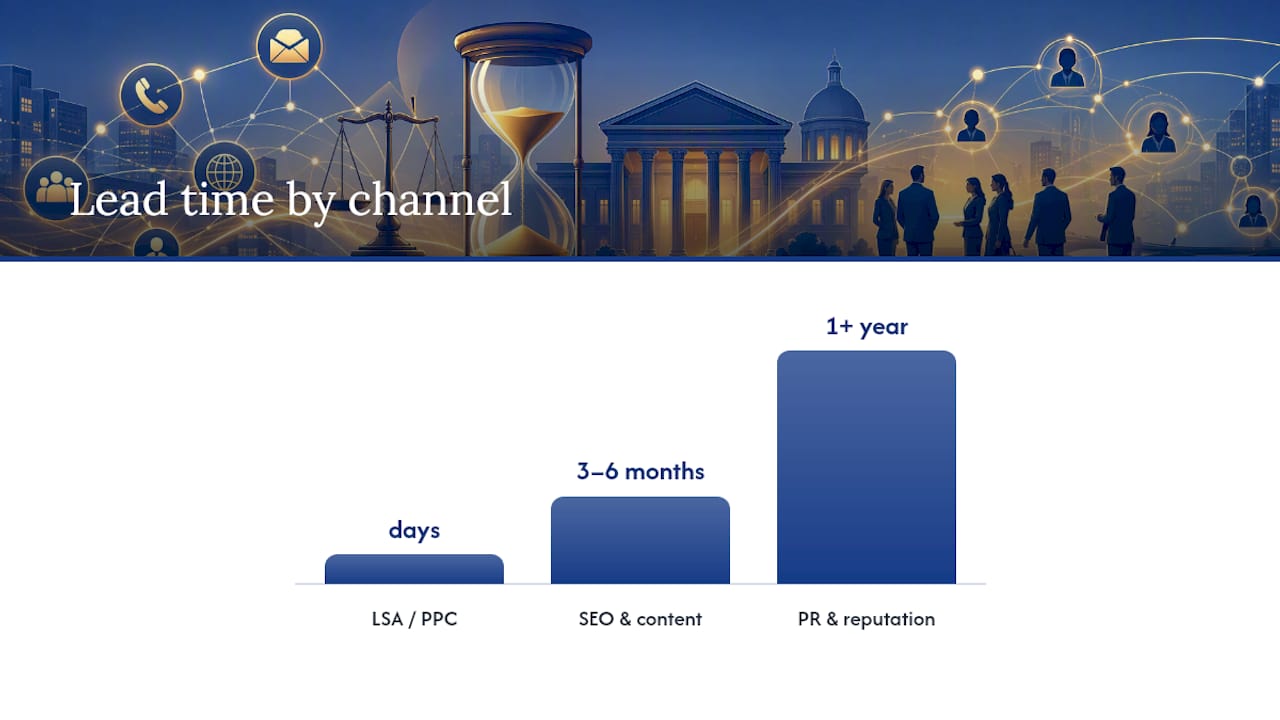
Timelines vary sharply. LSAs and tightly targeted PPC can generate calls within days. SEO and content typically need three to six months to gain traction. PR and reputation building are long plays that pay off over a year or more but tend to raise lead quality across every other channel once established.
Practice area changes the calculus. Consumer-facing work like personal injury and family law responds best to local SEO, LSAs, and review volume, because clients are searching in a moment of urgency. B2B-adjacent practices like employment or business litigation lean more on thought leadership and referrals, since those buyers research longer and value credibility signals over speed.
Which Lead Channels Deserve Your Budget First?
Every channel has a checklist attached to it, and skipping steps is where firms waste money. Here's what actually needs attention for each one.
1. Local SEO and Google Business Profile. Claim and fully complete your profile, including service areas, attorney photos, and practice categories. Keep review velocity steady rather than front loaded. Match your firm name, address, and phone number exactly across every directory listing. Add schema markup to your site so search engines can parse attorney bios and practice pages correctly. Build location pages for every city or county you actually serve, not just your headquarters.
2. PPC and Local Services Ads. Build dedicated landing pages for each ad campaign instead of sending traffic to your homepage. Load a negative keyword list before launch to filter out job seekers, DIY researchers, and students. Install call tracking so you know which keyword or ad actually produced the call. Budget for legal PPC's notoriously high cost per click, and pace spend rather than front loading a month's budget into the first week.
3. Pay-per-lead services and directories. Ask any vendor how leads are qualified before they reach you, and request a sample of the actual qualification questions used. Push for a trial batch you can score for relevance before signing a longer contract. Understand your margin per lead type. A $150 lead that converts one in ten times pencils out very differently from a $60 lead that converts one in twenty-five.
4. Content and social. Map content to search intent rather than to what feels easy to write. A page answering "what happens after a car accident in a rental" earns more qualified traffic than a generic "personal injury FAQ." Short video answering common client questions performs well on search and increasingly gets surfaced in AI-generated answers, which makes it worth the production effort for firms competing on visibility.
5. Referrals and PR. Build a repeatable ask into your process. Every satisfied client and referring attorney should get a specific, low-friction way to send someone your way, not a vague "let us know if you hear of anyone." Track referral source at intake so you can measure which relationships actually produce signed matters, not just phone calls.
6. Email nurture. Segment by practice area and by where the contact sits in their decision. A lead who called and never booked needs a different sequence than one who downloaded a guide and went quiet. Connect the whole sequence to your CRM so nothing falls through when a lead finally responds three weeks later.
Pro Tip: Before adding a new channel, audit whether your current channels are actually being measured. Adding SEO on top of an unmeasured PPC account just doubles your blind spots.
How Do You Build an Intake System That Converts?
Marketing without a fast intake system is the most common way firms burn budget. Lead generation only works as a system when the acquisition engine and the conversion engine both function, and conversion depends almost entirely on speed and structure.
Start with capture. A lead who lands on your site at 9 p.m. shouldn't have to wait until 9 a.m. to hear back. Live chat, an AI-assisted intake form, or after-hours phone coverage all close that gap. The mechanism matters less than making sure something responds immediately.
Response speed changes outcomes dramatically. Firms that respond within minutes convert at materially higher rates than firms that call back hours later. A lead who submitted a form is usually still comparing three or four firms at that exact moment, and the first callback often wins the matter regardless of who has the better case results.
Once you've made contact, qualification determines whether the call is worth an attorney's time.
- Open with an empathy statement, not a script that sounds like a form being read aloud.
- Confirm jurisdiction, matter type, and urgency in the first ninety seconds.
- Explain exactly what happens next, including timeline and who will call.
- Escalate to an attorney only once the matter clears your firm's basic criteria, so lawyers aren't fielding calls that never had a chance of becoming a case.
Leads that don't book on the first contact need a follow-up sequence, not a single voicemail. Multi-touch outreach across call, text, and email over one to two weeks recovers a meaningful share of leads who were simply busy or comparing options. Assign ownership clearly. Front desk staff, a dedicated intake coordinator, or the attorney directly, but someone specific, or follow-up quietly stops happening.
Track three numbers weekly: average response time, booking rate from first contact, and consult-to-retainer rate. If any of those three is weak, fix intake before spending another dollar on new lead volume.
How Do You Measure ROI on Law Firm Marketing?
Cost per click tells you almost nothing useful. Cost per signed retainer tells you everything. Most profitable firms hold every channel and vendor accountable to signed-retainer economics rather than click volume or lead count.
Four numbers matter for legal practice lead generation measurement:
- Cost per consult. Total channel spend divided by consultations booked.
- Consult-to-retainer rate. The percentage of booked consultations that actually sign.
- Cost per signed retainer. Total spend divided by retainers, the number that should drive every budget decision.
- Client lifetime value. What a signed matter is actually worth, including referrals it generates down the line.
Attribution doesn't require an expensive stack. A workable version pairs call tracking with UTM tagging, a CRM field logging first touch, and a monthly reconciliation connecting signed cases back to their original channel. Even a spreadsheet run consistently for six months produces real signal.
A B2B employment practice often runs the opposite pattern: fewer consults, higher retainer values, and a longer sales cycle. Run any new channel as a small test first, let it reach a statistically meaningful sample of leads, and only scale the channels where the retainer math actually works.
How Should You Split Your Marketing Budget by Practice Area?
The right lead mix depends on who you serve and how urgently they buy. A personal injury firm and a business litigation boutique should not be running the same playbook.
Consumer-facing practices (personal injury, family law, criminal defense) do best leading with local SEO, Google Local Services Ads, and consistent review generation, since these clients search in a moment of urgency and choose fast.
B2B-adjacent practices (employment, business, immigration for corporate clients) lean harder on outbound outreach, LinkedIn presence, and PR, because these buyers research over weeks and weigh credibility over speed.
Niche or high-value practices (complex litigation, specialized tax, high-net-worth family law) often do better with targeted PR and selective, low-volume PPC rather than broad consumer channels that attract the wrong caller.
Budget timing matters as much as budget size. LSAs and PPC can start producing calls within days, which makes them the right first move if you need volume now. SEO, content, and PR are long-horizon investments that should run in parallel, not instead of the immediate channels.
Before signing with any agency or pay-per-lead vendor, ask these questions directly:
- What's your capacity, and how many other firms in my practice area and market are you already serving?
- Is lead exclusivity included, or are leads sold to multiple firms simultaneously?
- What attribution data will you provide, and how often?
- Can I run a small trial batch before committing to a longer contract?
Pro Tip: A vendor who can't answer the exclusivity question directly is telling you the answer. Get it in writing before you pay for a single lead.
What Does the Research Say About Intake Speed and Conversion?
The pattern across current legal marketing research is consistent: acquisition tactics only pay off when intake keeps pace. Firms with optimized Google Business Profiles and steady review volume capture a disproportionate share of the local Map Pack, and firms that respond to leads within minutes convert at rates competitors simply can't match once the callback slips past the first hour.
Legalleads was built around that exact gap. The platform takes a person's plain-English description of their legal situation and produces a professional case brief in under two minutes, then routes it to a qualified attorney in the verified directory within 24 hours. No forms, no phone tag.
The bottleneck in most firms isn't lead volume. It's the gap between when someone reaches out and when a qualified person actually responds. Closing that gap is worth more than almost any new marketing spend.
For firms feeding leads through Legalleads' intake workflow, the practical effect shows up in two places: more booked consultations from the same lead volume, and a higher share of those consultations that were pre-qualified before an attorney ever picked up the phone.
What Are the Compliance Rules for Legal Marketing?
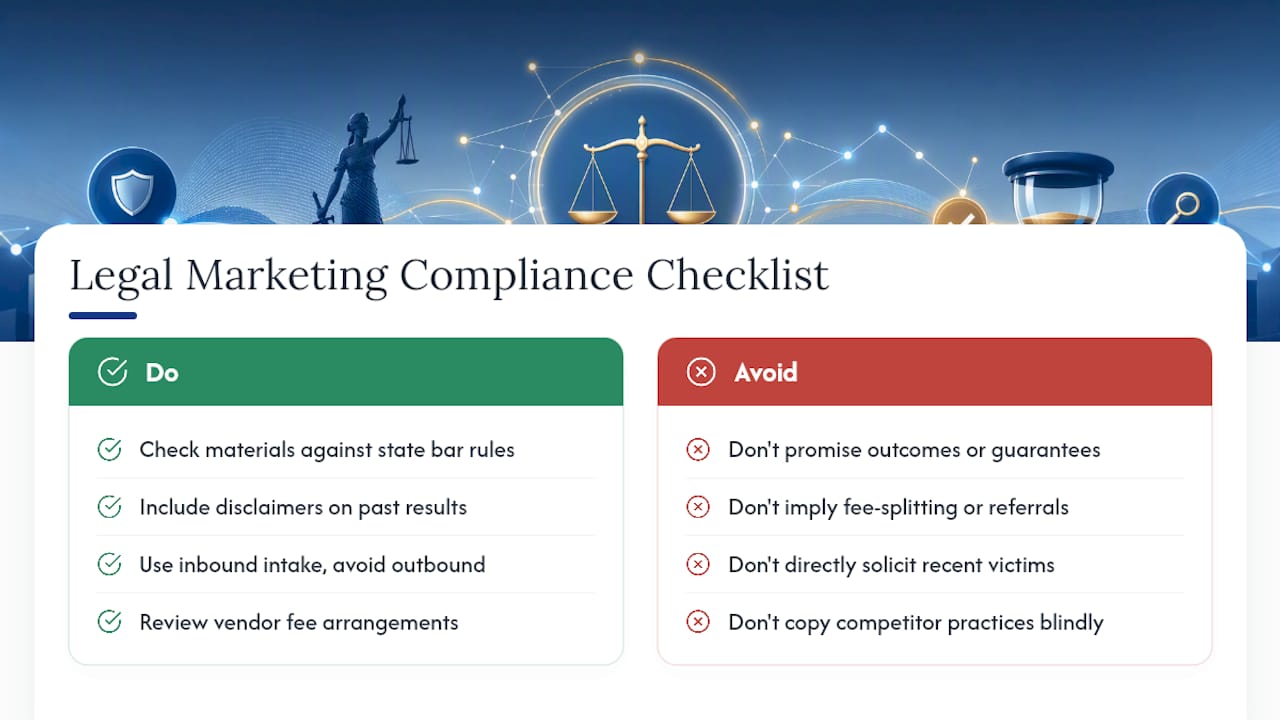
Law firm advertising isn't governed the same way as advertising in most other industries. State bar rules and the ABA Model Rules of Professional Conduct govern what attorneys can claim, how they can solicit clients, and how they must identify paid content. Rule 7.2 permits lawyer advertising broadly but restricts specific claims, requires certain disclosures, and prohibits misleading statements about outcomes or expertise. These rules vary by state, so a claim that's fine in one jurisdiction can trigger a bar complaint in another.
A few areas cause the most trouble in practice. Testimonials and case results need careful framing, since implying a guaranteed outcome is a common violation. Directory listings and pay-per-lead arrangements need review to confirm they don't cross into improper fee-splitting or referral arrangements under your state's rules. Content marketing that describes past case results should include appropriate disclaimers rather than presenting outcomes as predictive of future results.
Direct solicitation carries its own restrictions. Many states limit or prohibit direct contact with someone shortly after an accident or arrest, which is part of why intake systems built around inbound inquiries, rather than outbound solicitation, tend to carry less compliance risk.
None of this should discourage a firm from marketing aggressively. It should discourage marketing on autopilot. Before launching a new campaign, landing page, or vendor relationship, have someone check it against your state bar's advertising rules, not against what a competitor is already doing.
Where Vendor Promises Meet Firm Reality
Every vendor pitch sounds identical: guaranteed leads, instant rankings, exclusive territory. Ask for case-level attribution and a short trial before you commit past that. If a vendor can't show you which retained cases traced back to their leads, they're selling volume, not results.
Watch for three red flags: vague answers about attribution, promises of overnight ranking gains, and a package that looks identical regardless of your practice area or market. Legal marketing that ignores your specific competition and client urgency is a generic product wearing a legal label.
The most useful thing a busy owner can do this quarter isn't add a new channel. It's pick the one channel already producing leads, fix intake around it, and measure real conversion for 60 to 90 days before spending another dollar elsewhere.
— Admin
Start Fixing Intake With Legalleads
The intake gap costs firms more signed retainers than any weak marketing channel ever will. Legalleads closes that gap directly: a person describes their situation in plain English, gets a professional case brief in under two minutes, and gets matched to a qualified attorney within 24 hours, no forms, no phone tag, no lost leads sitting in a voicemail box.

For firms, that means qualified case leads arrive already briefed and pre-screened against your practice area, so your team spends time on consultations instead of chasing unqualified callers. A short pilot is the easiest way to see the difference. Track two numbers during the trial: how fast your team responds to a matched lead, and what share of those consultations turn into signed retainers. Compare that against whatever your current intake process produces today.
Visit the Find Lawyer page to see how the matching flow works, or explore a practice-specific landing page like personal injury lead matching in Los Angeles to see the model applied to a specific market. Start with one practice area, measure it for a full cycle, and expand once the numbers hold up.
Sources
- The State of Law Firm Marketing in 2026: What's Working, What Stopped, What's Coming | Forward Push
- Legal Client Acquisition: The Modern System for Law Firms in 2026
- 12 Law Firm Marketing Strategies That Actually Work (2026)
- The Legal Marketing Playbook: What Actually Drives Case Intake in 2026 | TMG Intelligence
FAQ
What Is the Fastest Way to Generate Law Firm Leads?
Google Local Services Ads and targeted PPC produce leads within days, faster than SEO or content, though they require dedicated landing pages and call tracking to avoid wasted spend.
How Fast Should a Law Firm Respond to a New Lead?
Within minutes whenever possible. Conversion rates drop sharply the longer a firm waits, and a same-hour callback often loses the matter to whichever firm called first.
What KPIs Matter Most for Law Firm Marketing?
Cost per signed retainer matters more than cost per click or cost per lead, since it's the only metric that reflects actual revenue rather than raw volume.
Are Referrals Still a Reliable Source of Legal Leads?
Yes, but referred clients increasingly research an attorney online before calling, so a firm's website, reviews, and content still influence whether a referral converts.
How Does Legalleads Help With Law Firm Lead Generation?
Legalleads generates an AI case brief from a client's plain-English description in under two minutes and matches qualified attorneys within 24 hours, addressing the intake speed gap that causes most lost leads.