
Law firm content marketing is the practice of publishing attorney-authored or attorney-reviewed content that attracts qualified prospects, builds topical authority, and converts readers into consultations. The single best first step: document a strategy before you write a word.
This week's immediate-action checklist:
- Pick one practice area with the highest case value and clearest search demand (personal injury, family law, or criminal defense are strong starting points).
- Draft a pillar outline: one 2,000+ word guide covering the core process, plus five cluster topics branching from it.
- Assign a named attorney reviewer and set a publish date within 30 days.
After execution, watch for three early signals: indexed page count in Google Search Console, organic impressions on target queries, and whether your firm's name appears in AI-generated answers on Perplexity or ChatGPT for your practice area.
Key Takeaways
A documented content strategy tied to signed-case KPIs, published consistently with attorney bylines and proper schema, is the most durable client acquisition system a U.S. law firm can build.
| Point | Details |
|---|---|
| Document the strategy first | Firms with documented blogging strategies capture disproportionately more organic traffic and inbound links than those without. |
| Pillar + cluster architecture | One 2,000+ word pillar supported by five or more cluster posts builds topical authority faster than random publishing. |
| E-E-A-T signals are required | Every piece needs an attorney byline linked to a full bio page with bar number, jurisdiction, and experience details. |
| Measure signed cases, not traffic | Set up UTM tracking, GA4 conversion events, and CRM source fields before publishing to attribute cases accurately. |
| Legalleads accelerates intake | Legalleads delivers pre-qualified, practice-area-matched case briefs to California attorneys through its AI-powered intake platform. |
Table of Contents
- What is law firm content marketing and why does it outperform ads?
- How to build a content strategy that drives signed cases
- How to find topics and do keyword research for law firms
- What content types work best for law firms?
- How do you optimize legal content for SEO and E-E-A-T?
- How do you build a sustainable editorial workflow?
- How should law firms distribute and repurpose content?
- How do you measure content marketing ROI for a law firm?
- How do you keep legal content current and compliant?
- What does content marketing success look like for a law firm?
- What are the U.S. legal advertising rules every firm must follow?
- What actually moves the needle in law firm content programs
- Legalleads gives law firms a faster path to qualified cases
- Sources
- FAQ
What is law firm content marketing and why does it outperform ads?
Law firm content marketing is a system of owned assets: blog posts, service pages, guides, and FAQ content that compounds in value over time. A paid ad stops generating leads the moment you stop paying. A well-structured pillar page on "how California personal injury claims work" can attract qualified traffic for years, earn backlinks, and appear in AI-generated answers without additional spend.
The distinction matters for case economics. Paid search in competitive legal markets can cost $50–$300 per click, with no guarantee the visitor is ready to hire. Content, by contrast, attracts prospects who are already researching their situation, which means they arrive warmer and convert at a higher rate per dollar spent over a 12–24 month horizon.
Research from the American Bar Association shows only a minority of law firms maintain a documented content strategy. Firms with consistent blogging programs and documented strategies capture a disproportionate share of organic traffic and inbound links, which translates directly to long-term organic lead generation. That gap is an opportunity for any firm willing to publish consistently.
Core benefits of a content-first approach:
- Topical authority: covering a practice area comprehensively signals expertise to both search engines and AI citation systems.
- Lower cost per signed case over time as organic traffic compounds.
- AI/GEO citation readiness: structured, answer-first content gets pulled into ChatGPT, Perplexity, and Google's AI Overviews.
- Trust-building before the first call, which shortens the sales cycle.
| Factor | Content marketing | Paid ads |
|---|---|---|
| Cost behavior | Fixed production cost; compounds over time | Ongoing spend required; stops when budget stops |
| Longevity | Months to years per asset | Active only while funded |
| Lead temperature | Research-stage; higher intent | Mixed; depends on targeting |
| Best use case | Authority building, long-term case flow | Immediate volume, new practice areas |
| E-E-A-T signal | High (attorney bylines, citations) | None |
Google's E-E-A-T framework (Experience, Expertise, Authoritativeness, Trustworthiness) weighs heavily in legal search results, which the search industry classifies as "Your Money or Your Life" content. Content signed by a licensed attorney with a detailed bio page consistently outranks anonymous or thin content on legal topics.
How to build a content strategy that drives signed cases
Strategy before content. Without documented goals tied to business outcomes, most law firm blogs drift into publishing whatever the managing partner finds interesting, which rarely matches what prospective clients search for.

Setting goals that connect to the intake pipeline
Start with three business KPIs and work backward to content targets:
- Signed cases per month from organic search — set a baseline from your CRM, then set a 6-month target.
- Consultation rate — what percentage of organic visitors book a call? Track this in GA4 with a goal event on your contact form.
- Cost per signed client from content — divide total content spend (production + distribution) by signed cases attributed to organic. Benchmark against your paid search cost per signed client.
From those KPIs, set content targets: how many pillar pages, how many cluster posts, and what publishing cadence produces enough indexed content to move the needle in your practice area.
Persona and buyer-journey mapping
Take one practice area and map it concretely. For a family law practice, the buyer journey looks like this:
- Awareness: "Do I have grounds for divorce in California?" The prospect is not ready to hire. They need process clarity and reassurance.
- Consideration: "How long does a contested divorce take in Los Angeles?" They are evaluating options and timelines. They want proof you understand their specific situation.
- Decision: "Best divorce attorney in Los Angeles for high-asset cases." They are ready to call. Your service page and attorney bios must convert.
Each stage needs different content. Awareness content builds traffic. Consideration content builds trust. Decision content converts.
Three-step prioritization checklist
Before picking topics, score each practice area on three dimensions:
- Case value — higher-value cases (wrongful death, truck accidents, complex immigration) justify more production investment.
- Search intent match — does your target client actually search for this? Validate with Google Search Console or a keyword tool.
- Production capacity — can your team produce and get attorney sign-off on one pillar per month? Start with one practice area and expand.
Effective law firm content aligns with buyer triggers and demonstrates proof through de-identified examples, checklists, and process clarity. That combination improves conversion quality, not just traffic volume.
How to find topics and do keyword research for law firms
Keyword research for law firms is not about finding the highest-volume terms. It is about finding queries where the searcher has a legal problem your firm can solve, and where you can realistically rank.
Topic-prioritization matrix
Score each potential topic on three axes before committing to production:
- Intent tier: Is this informational (awareness), navigational (brand), or transactional (decision)? Prioritize decision and consideration queries first.
- Case value: A query about truck accident settlements is worth more than a query about parking tickets.
- Keyword difficulty: Use Ahrefs, Semrush, or Moz to assess how competitive the SERP is. New sites should target difficulty scores below 30.
Tactical keyword research process
Step 1: Build a seed list. Start with your practice areas and add modifiers: "how to," "what happens if," "California law," "statute of limitations," "settlement," "attorney fees." For a personal injury practice, seeds include "car accident claim process California," "how long to settle personal injury case," and "what is a demand letter."
Step 2: Run a competitor gap analysis. Use Semrush's Keyword Gap or Ahrefs' Content Gap to find queries your competitors rank for that you do not. These are proven topics with existing demand.
Step 3: Validate SERP intent. Search the query yourself. If the top results are informational guides, write a guide. If they are service pages, build a service page. Matching the dominant format is a prerequisite for ranking.
Step 4: Select long-tail, decision-stage queries. These convert better and are easier to rank for. Examples for a car accident practice:
- "How much is my car accident settlement worth in California?"
- "What to do after a car accident in Los Angeles"
- "Can I sue if I was partially at fault in a California car accident?"
Sample article titles for a personal injury cluster:
- Pillar: "California Personal Injury Claims: The Complete Process Guide"
- Cluster 1: "How Long Does a Personal Injury Case Take in California?"
- Cluster 2: "What Damages Can You Recover After a Car Accident?"
- Cluster 3: "How to Document Injuries After an Accident"
- Cluster 4: "When to Hire a Personal Injury Attorney vs. Settling Alone"
Map each cluster article to a funnel stage and assign a CTA: awareness articles get a "download our checklist" CTA; decision articles get a "schedule a free consultation" CTA.
What content types work best for law firms?
Not every format serves every stage of the buyer journey. Matching format to intent is what separates content that converts from content that just gets read.
Production tips by format:
- Pillar pages need an attorney byline, a table of contents, internal links to cluster posts, and a schema markup block. Use headers that mirror common search queries.
- Service pages must include: practice area name in the H1, a clear description of what the firm does, who qualifies, what the process looks like, attorney bios with bar admission details, and a prominent contact form. Every criminal defense service page should address urgency directly, since those prospects often need help immediately.
- FAQ posts are the highest-leverage format for AI citation. Write each answer in 40–60 words, starting with a direct response to the question. Use FAQPage schema. A combined program of long-form pillar content plus short-form Q&A is recommended for success in 2026 to win both traditional rankings and AI/GEO citation surfaces.
- Video works best for explaining complex processes (how a deposition works, what happens at arraignment). Embed on the relevant service page and transcribe for SEO value.
Service page conversion checklist:
- Practice area keyword in H1 and first paragraph
- Clear statement of who the firm serves and where
- Step-by-step process overview (what happens after the client calls)
- Attorney bio with photo, bar number, and years of experience
- Social proof: case results (de-identified), client review count, bar ratings
- One primary CTA above the fold and one at the bottom
- FAQPage schema and LegalService schema
How do you optimize legal content for SEO and E-E-A-T?
SEO for law firms is not just about keywords. Google's quality raters score legal content on E-E-A-T, and a page without a credentialed author, verifiable credentials, and clear expertise signals will underperform regardless of keyword optimization.
On-page SEO checklist
- H1 contains the primary keyword and matches the searcher's query language.
- First paragraph answers the core question directly (BLUF structure).
- H2 and H3 subheads mirror related search queries.
- Internal links connect to relevant service pages and cluster posts.
- Meta title under 60 characters; meta description under 160 characters with a CTA.
- Images have descriptive alt text; file names are descriptive, not "IMG_1234.jpg."
- Page loads in under 3 seconds on mobile (test with Google PageSpeed Insights).
Author bio requirements for E-E-A-T
Every piece of legal content should carry a byline linked to a full attorney bio page. That bio page must include:
- Full name and state bar number
- Jurisdictions admitted to practice
- Law school and graduation year
- Years of experience in the relevant practice area
- Notable case outcomes (de-identified per ethics rules)
- Professional memberships (state bar sections, ABA, local bar associations)
- Headshot
Pro Tip: Link the author bio page from every article that attorney writes. Google's quality raters follow that link to verify credentials. A bio page that exists but is not linked from the content provides almost no E-E-A-T signal.
Schema markup to implement
- FAQPage schema: on any page with a Q&A section. Increases the chance of rich result display.
- LegalService schema: on every practice area service page. Include
name,description,areaServed,provider(the firm), andurl. - Person schema: on each attorney bio page. Include
name,jobTitle,alumniOf,memberOf, andurl.
Place schema in a <script type="application/ld+json"> block in the page <head>. Validate with Google's Rich Results Test before publishing.
Technical basics that commonly block law-firm SEO
- Crawlability: check robots.txt and XML sitemap in Google Search Console. Many law firm sites accidentally block crawlers on service pages.
- Duplicate content: practice area pages that are nearly identical across locations need unique content or canonical tags.
- Core Web Vitals: Largest Contentful Paint (LCP) above 2.5 seconds is a ranking signal. Most law firm sites fail this on mobile due to unoptimized hero images.
- HTTPS: every page must be served over HTTPS. Mixed-content warnings suppress rankings.
Immediate technical audit checklist:
- Submit XML sitemap to Google Search Console
- Crawl the site with Screaming Frog or Sitebulb to find broken links and redirect chains
- Run PageSpeed Insights on the top five service pages
- Check for duplicate title tags and missing meta descriptions
- Verify schema with Google's Rich Results Test
How do you build a sustainable editorial workflow?
Most law firm blogs fail because they treat blogging as an irregular task. The firms that win treat content as a system with defined roles, a repeatable brief template, and a calendar that does not depend on any one person's availability.
Content brief template
Every piece of content starts with a brief. The brief should include:
- Audience: who is this for, and what is their situation?
- Search intent: what does the reader want to know or do?
- Primary keyword and secondary keywords
- Required trust signals: attorney byline, bar citation, case result reference
- CTA: what should the reader do after reading?
- Internal links: which service pages and cluster posts to link
- Review checkpoints: attorney review deadline and SEO editor sign-off date
Role responsibilities
- Marketing owner: manages the content calendar, assigns briefs, tracks publishing deadlines, and reports KPIs monthly.
- Content writer: produces the first draft from the brief. Does not need to be an attorney but must follow the brief's accuracy requirements.
- Attorney reviewer: checks legal accuracy, removes any statements that could constitute legal advice to a specific person, and approves the byline. Target: 48-hour turnaround.
- SEO editor: checks on-page optimization, internal links, schema, and meta data before scheduling.
- Intake coordinator: ensures every published piece links to the correct intake form or consultation booking page.
Sample 90-day editorial calendar
Month 1 (foundation):
- Week 1: Publish practice area pillar (2,500 words, attorney byline, full schema)
- Week 2: Publish two FAQ cluster posts (400 words each)
- Week 3: Publish one process guide (1,500 words)
- Week 4: Publish one FAQ cluster post; distribute pillar via email and LinkedIn
Month 2 (expansion):
- Publish two cluster posts per week (alternating long-form and short FAQ)
- Add one video explainer embedded on the pillar page
- Begin outreach for one earned media placement (local bar publication or legal news site)
Month 3 (optimization):
- Audit Month 1 content: update any outdated statute references, add new FAQ sections based on Search Console queries
- Publish one case result summary (de-identified)
- Launch email nurture sequence tied to pillar content
Attorney review process rules:
- Send the draft with a clear deadline and a two-question checklist: (1) Is every legal statement accurate for the jurisdiction? (2) Does any statement constitute advice to a specific person?
- Use tracked changes so attorneys can approve or edit without rewriting from scratch.
- Cap review cycles at two rounds. If a third round is needed, schedule a 20-minute call to resolve remaining issues.
How should law firms distribute and repurpose content?
Publishing is not the finish line. A pillar page that sits unshared reaches only the people who find it through search. Distribution multiplies the return on every piece you produce.
Distribution priority order
- Email list: the highest-converting owned channel. Send a summary of every new pillar to your subscriber list with a link and a clear CTA. Segment by practice area interest when your list is large enough.
- Location pages: embed relevant content summaries on geo-targeted landing pages to strengthen local SEO signals.
- Attorney networks: share content through bar association newsletters, LinkedIn connections, and referral partner emails. Attorneys who refer cases are more likely to do so when they see your firm publishing authoritative content.
- PR and earned media: pitch pillar content as source material to local legal journalists or industry publications. A bylined article in a state bar journal earns a high-authority backlink and builds credibility.
- Social media: platform-specific user behavior persists. Choose platforms based on where your target clients spend time rather than where it is easiest to post. Facebook reaches older demographics; LinkedIn reaches business clients and referral sources; YouTube reaches people researching complex legal processes.
- Paid amplification: use paid social or Google Display to retarget visitors who read a pillar but did not convert. This is a low-cost way to stay visible during the consideration phase.
Repurposing workflow
One pillar page can generate six to eight additional assets without writing anything from scratch:
- Extract five key sections and turn each into a standalone email in a nurture sequence.
- Pull three statistics or process steps and create short-form social posts (one per week for three weeks).
- Record a 3-minute video summary of the pillar's main process. Embed it on the page and upload to YouTube.
- Convert the FAQ section into a downloadable PDF checklist for lead capture.
- Pitch one section as a guest post or bylined article to a local legal publication.
Sample 3-message email nurture sequence
Email 1 (Day 1 after opt-in): Deliver value. Subject: "What happens after you file a personal injury claim in California" Body: Summary of the process guide with a link to the full pillar. No CTA to hire yet.
Email 2 (Day 4): Build proof. Subject: "How we helped a client recover after a truck accident" Body: De-identified case summary showing timeline and outcome. Link to the case result page.
Email 3 (Day 8): Invite action. Subject: "Ready to talk about your case?" Body: Direct invitation to schedule a free consultation. Link to the intake form.
How do you measure content marketing ROI for a law firm?
Traffic is a vanity metric if it does not connect to signed cases. Build your measurement stack around business outcomes from day one.
KPI checklist mapped to business outcomes
- Signed cases from organic search: tracked in your CRM with a source field populated by UTM parameters.
- Consultation rate: organic sessions divided by consultation form submissions. Track as a GA4 conversion event.
- Assisted conversions: how many signed cases had organic content as a touchpoint, even if the last click was paid or direct. Use GA4's attribution reports.
- Citation share: how often does your firm appear in AI-generated answers for your target queries? Track manually or with a tool like BrightEdge or Semrush's AI Overview tracker.
- Cost per signed client: total content spend divided by signed cases attributed to content. Recalculate quarterly.
Attribution setup
- Add UTM parameters to every link in email, social, and PR placements (e.g.,
utm_source=email&utm_medium=nurture&utm_campaign=pi-pillar). - Configure GA4 conversion events for: form submission, phone call click, consultation booking.
- Map GA4 conversions to your CRM (Clio, Salesforce, or HubSpot) using a unique lead source field.
- Use a call tracking tool (CallRail or CallTrackingMetrics) to attribute phone calls to specific pages and campaigns.
Sample monthly budget ranges
| Spend level | Monthly budget | Expected outputs | Timeline to results |
|---|---|---|---|
| Entry | $1,500–$3,000 | 2 long-form posts, 4 FAQ posts, basic SEO | 6–9 months to organic traction |
| Mid | $3,000–$7,000 | 4 long-form posts, 8 FAQ posts, email, social | 4–6 months to measurable leads |
| Growth | $7,000–$15,000 | Full pillar + cluster, video, PR, paid amplification | 3–5 months to signed case attribution |
These ranges reflect U.S. market rates for legal content production, SEO management, and distribution. Results depend on domain authority, competition level, and practice area.
How do you keep legal content current and compliant?
Published content is not a set-and-forget asset. Statutes change, court procedures update, and a page that was accurate in 2024 may be misleading in 2026. A lightweight governance process prevents liability and protects rankings.
Content audit checklist
Run a quarterly audit on all published content. Flag any piece that meets one or more of these triggers:
- Published more than 18 months ago with no updates
- Organic traffic dropped more than 20% quarter-over-quarter
- References a statute, fee schedule, or court rule that has changed
- No longer ranks in the top 20 for its primary keyword
- Missing FAQPage or LegalService schema
- Conversion rate below 0.5% for a decision-stage page
Republish checklist
Before republishing an updated piece:
- Attorney reviews all legal statements for current accuracy in the target jurisdiction.
- Update any statute citations to the current code section.
- Check local court filing deadlines and fee schedules (these change frequently).
- Add new FAQ questions based on recent Search Console queries.
- Update the "last reviewed" date in the byline block.
- Re-submit the URL to Google Search Console for re-indexing.
Governance sign-off template
| Content type | Reviewer | Cadence |
|---|---|---|
| Pillar pages | Lead attorney + SEO editor | Every 12 months or on statute change |
| Service pages | Practice area attorney | Every 6 months |
| FAQ posts | Attorney reviewer | Every 12 months |
| Case result summaries | Managing partner | Before publication and on client status change |
What does content marketing success look like for a law firm?
Two realistic examples show what a well-run program produces and on what timeline.
Example 1: Personal injury firm, single-market focus A mid-size personal injury firm in Los Angeles published a pillar page on the California personal injury claims process, supported by eight cluster posts covering specific injury types and procedural questions. Within six months, the pillar ranked in the top five for three target queries. The firm attributed four signed cases directly to organic search in month seven, with an average case value that made the content investment pay back within the first quarter of attribution.
Example 2: Family law practice, multi-location A family law firm with offices in Los Angeles and San Bernardino built geo-targeted service pages for each location, each supported by a local process guide covering county-specific court procedures. They added a 5-email nurture sequence tied to a divorce process guide. The Los Angeles location's family law page moved from page three to page one for two high-intent queries within five months.
Realistic milestone timeline:
- Month 1–2: Content published, indexed, and appearing in Search Console impressions.
- Month 3–4: First page-two rankings on long-tail queries; email list begins generating consultation requests.
- Month 5–6: Page-one rankings on lower-difficulty queries; first organic-attributed signed cases.
- Month 9–12: Compounding effect visible; cost per signed client from content drops below paid search equivalent.
A note on attribution: early returns are often undercounted. A prospect may read your pillar in month two, call in month five, and be logged as a "direct" lead in your CRM if UTM tracking was not in place. Set up attribution infrastructure before you publish, not after.
What are the U.S. legal advertising rules every firm must follow?
Legal content marketing operates under state bar advertising rules, ABA Model Rules, and federal guidelines. Violations can result in bar complaints, fines, or mandatory disclaimers. Every piece of content your firm publishes is, in most states, considered attorney advertising.
Common advertising red flags to avoid:
- Claiming specific results ("We recovered $5 million for our client") without a disclaimer that past results do not guarantee future outcomes.
- Guarantees of any kind ("We will win your case," "You will get a settlement").
- Testimonials that include identifying client details without written consent.
- Statements that could be construed as legal advice to a specific reader ("You should sue your employer").
- Misleading comparisons to other firms ("We have the best track record in California").
- Failure to include required jurisdiction disclaimers when content is accessible outside your licensed states.
Disclaimer templates and placement:
Every practice area page and blog post should include a footer disclaimer. A standard template:
Place this disclaimer at the bottom of every page, in readable font size (not gray-on-gray). For pages that reference case results, add a second line: "Past results do not guarantee similar outcomes in future cases."
Recordkeeping: most states require law firms to retain copies of all advertising materials for one to three years. Store published content versions with publish dates in a shared drive or content management system.
Primary guidance sources:
- ABA Model Rules of Professional Conduct (Rules 7.1–7.5 govern advertising and solicitation)
- Your state bar's advertising rules (California, New York, Texas, and Florida have specific filing requirements)
- Legal Marketing Association Advocacy resources for professional standards guidance
The Legal Marketing Association provides member resources on ethical marketing practice, including guidance on advertising compliance and professional standards.
What actually moves the needle in law firm content programs
Most law firm content programs stall for the same reason: the firm publishes a handful of posts, sees no immediate spike in calls, and quietly stops. The mistake is treating content as a campaign rather than an infrastructure build. A pillar page is not a billboard. It is a foundation that earns compounding returns only after the cluster content, internal linking, and distribution layers are in place.
The firms that consistently generate cases from content share one habit: they measure signed cases, not page views. They set up call tracking and CRM source fields before the first post goes live. When month six arrives and organic leads start appearing, they can prove the ROI and justify expanding the program.
One non-obvious tactical note: the attorney review bottleneck kills more content programs than any other single factor. The fix is not to remove attorney review. It is to give attorneys a two-question checklist and a 48-hour deadline, and to send drafts in a format they can mark up in five minutes. That one process change typically cuts review time by more than half.
Pro Tip: Build a "content brief bank" of 20 pre-approved topics with outlines before you hire a writer. When a writer is available, the brief is ready. This eliminates the most common delay in legal content production: waiting for someone to decide what to write next.
Legalleads gives law firms a faster path to qualified cases
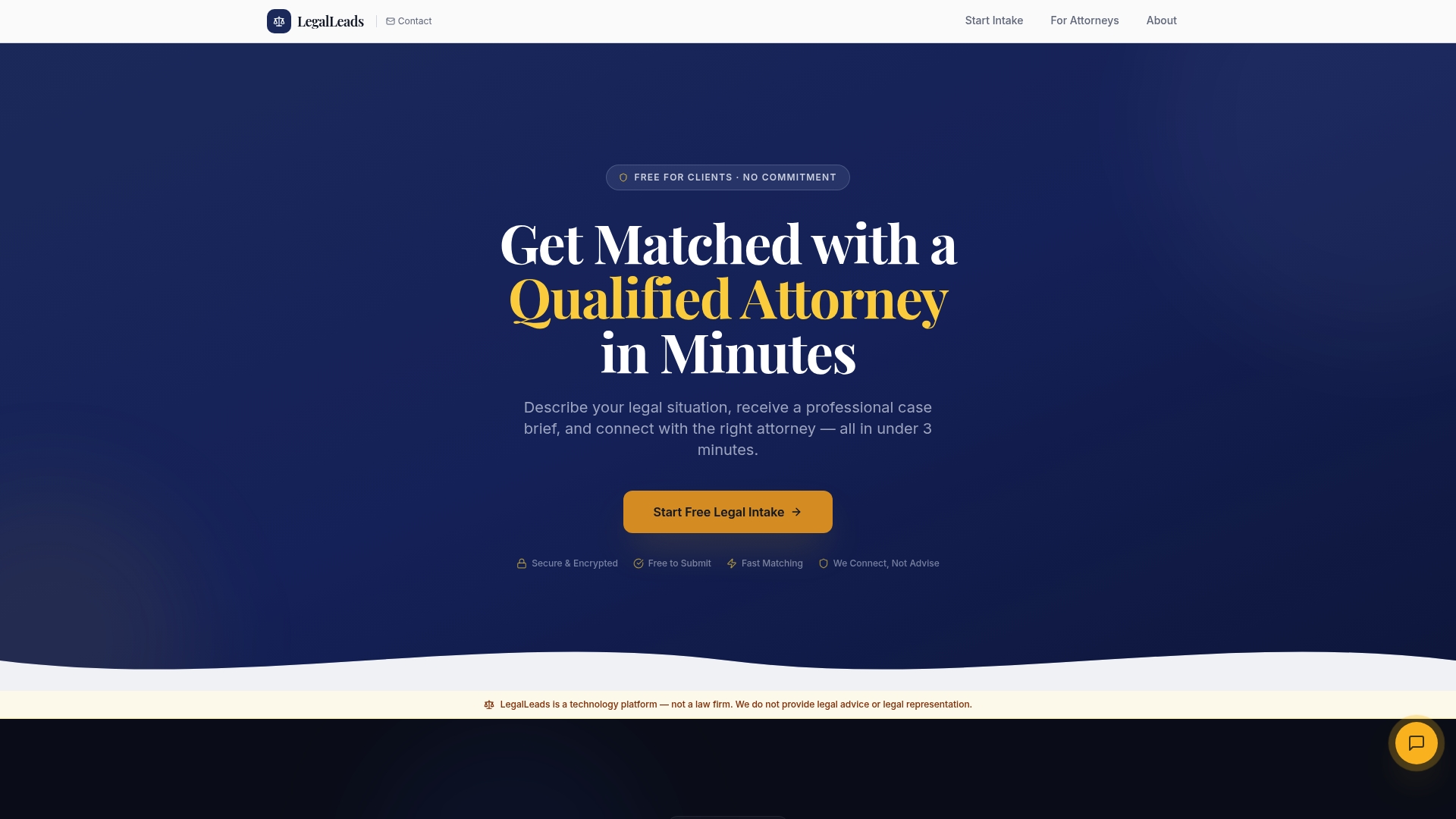
Law firms that want qualified case leads without building a full in-house marketing team have a direct option. Legalleads combines an AI-powered intake platform with a law firm marketing and lead generation package that covers PR, website creation, and content management. Attorneys on the platform receive case briefs generated in under two minutes from client-submitted descriptions, which means the leads arriving in your inbox are already pre-qualified and practice-area matched.
For firms in California covering personal injury, family law, immigration, employment, or criminal defense, Legalleads provides both the client-facing intake technology and the attorney-facing visibility tools in one package. No agency retainer, no long-term content contract to manage separately.

To see which case types are available in your market, browse active attorneys on the platform or go directly to the find a lawyer intake page to understand how the matching process works from the client side.
Sources
- Americanbar
- Law Firm Blog Strategy: Proven 2026 Guide
- Why Most Law Firm Blogs Fail (And the Strategic Framework That Fixes It) | My Legal Academy Knowledge Base
- Law firm content strategy: how to choose topics, show proof, and build thought leadership | Prose
- Pewresearch
FAQ
What is law firm content marketing?
Law firm content marketing is the practice of publishing attorney-reviewed content (blog posts, service pages, guides, and FAQs) to attract qualified prospects, build topical authority, and convert readers into consultations. It differs from advertising in that the assets compound in value over time rather than stopping when the budget stops.
What are the 3 C's of content marketing?
The 3 C's commonly referenced in content marketing are Content, Context, and Consistency: producing the right material, matched to where the buyer is in their decision process, and published on a reliable schedule. For law firms, consistency and context matter most because sporadic publishing rarely builds the topical authority needed to rank for competitive legal queries.
How much do law firms spend on SEO and content marketing?
Entry-level law firm content programs in the U.S. typically run $1,500–$3,000 per month for basic production and SEO. Mid-range programs with consistent pillar and cluster publishing run $3,000–$7,000 per month. Growth-level programs with video, PR, and paid amplification run $7,000–$15,000 per month. Results timelines range from three to nine months depending on domain authority and competition level.
What is a content marketing firm for law firms?
A legal content marketing firm is an agency or platform that produces, optimizes, and distributes attorney-reviewed content on behalf of law firms. Services typically include keyword research, content production, SEO, and distribution. Legalleads offers a law firm marketing package that includes content management alongside PR, website creation, and AI-powered case intake.
How long does it take for law firm content to generate leads?
Most law firm content programs show measurable organic traction within four to six months for lower-difficulty queries, with signed-case attribution typically appearing between months five and nine. High-competition markets (personal injury in Los Angeles, for example) may take nine to twelve months before content-attributed cases appear consistently.