
Attorney fees for immigration cases in the United States vary widely, from lower fees for straightforward naturalization filings to significantly higher fees for contested removal defense. That fee covers only the lawyer's work. USCIS filing fees, medical exams, and translations are billed separately, paid directly to the government or third-party providers. Before you sign anything, get a written, itemized estimate that splits attorney fees from government costs line by line.
TL;DR:
- Immigration lawyer fees range from a few hundred dollars for simple filings to over $8,000 for complex cases like full-service marriage green cards.
- Most routine cases, such as naturalization or DACA renewals, cost significantly less than contested removal or asylum cases, which can be highly variable.
- Attorney billing can be flat fee, hourly, or hybrid; flat fees work best for predictable, straightforward filings, while hourly billing suits unpredictable or contested cases.
- Government filing fees are paid separately and are updated periodically, so always verify current costs directly from USCIS before budgeting.
- Comparing written quotes through quick and organized intake platforms helps identify outliers and reduces time spent explaining your case multiple times.
Table of Contents
- How Much Does an Immigration Lawyer Cost by Case Type?
- Flat Fee, Hourly, or Hybrid: Which Pricing Model Fits Your Case?
- What's Included in Attorney Fees, and What Costs Extra?
- Why Do Immigration Lawyer Quotes Vary So Much?
- How to Reduce Immigration Legal Costs Without Cutting Corners
- What Should You Ask Before Hiring an Immigration Attorney?
- How LegalLeads Helps You Compare Attorney Fee Estimates Faster
- Get Matched With an Immigration Attorney and Compare Written Estimates
- Where to Verify Immigration Fees and Find Legal Help
- Sources
- FAQ
How Much Does an Immigration Lawyer Cost by Case Type?
The range in immigration attorney fees is wide because "immigration case" covers everything from a one-page form to a multi-year deportation fight. A lawyer filing a straightforward I-130 petition for a spouse spends a fraction of the hours required for an asylum case with a contested hearing. Fee ranges track that workload difference closely.
Here's what attorney fees commonly look like across the most requested case types, based on practitioner cost guides and market summaries:
- Naturalization (N-400): attorney fees generally range on the lower end for simple cases. USCIS filing fees for naturalization are separate and set by the agency.
- I-130 petition only (family relationship): attorney fees are generally moderate for petition-only filings.
- I-485 adjustment of status (green card) packages: attorney fees typically vary with complexity for combined I-130/I-485 filings.
- Marriage-based green card, full service: Attorney fees commonly land between roughly $1,500 and $8,000 depending on complexity, prior denials, or a fiancé visa route.
- Consular processing (green card via a U.S. embassy abroad): attorney fees often cover document review and interview prep, varying by case details.
- K-1 fiancé visa: $1,500 to $4,000 in attorney fees for the petition and consular follow-through.
- H-1B specialty occupation visa: attorney fees vary typically within a moderate range and are frequently paid by employers.
- PERM labor certification and EB green cards: multi-stage processes have correspondingly varied attorney fees based on complexity.
- Asylum applications: attorney fees vary widely depending on case complexity and appeal status.
- DACA renewal: $500 to $1,500, among the least expensive filings because the process is standardized.
- Removal defense (deportation proceedings): these complex cases incur significantly higher attorney fees reflecting unpredictable scope.
Quick fact: Removal defense and asylum cases carry the widest fee variations due to case complexity, history, and legal challenges.
Each of these ranges reflects hours of work, not arbitrary pricing. A naturalization filing usually needs one intake meeting, a document review, and a form submission. A removal case can mean months of evidence collection, multiple court appearances, and briefs. USCIS filing fees stack on top of every one of these ranges. Naturalization filing fees, for example, run in the low hundreds of dollars, while some employment-based petitions carry filing fees in the thousands. Because USCIS updates its fee schedule periodically, check the agency's current fee table before you finalize a budget.
Flat Fee, Hourly, or Hybrid: Which Pricing Model Fits Your Case?
Immigration attorneys bill in three main ways, and the model they use tells you a lot about how predictable your case is.
Flat fee means one price for a defined scope of work. It's common for routine, well-defined filings like naturalization, standard I-130 petitions, or uncontested adjustment of status. You know the number upfront, and it doesn't change unless your case scope changes (say, a Request for Evidence arrives, or a second applicant gets added).
Hourly billing charges for actual time spent, usually broken into increments. It shows up most often in unpredictable matters: removal defense, appeals, and cases with a criminal history or immigration violations where nobody can forecast how many hearings or filings will be needed. Legal-practice guides note that hourly billing is fairer to both sides when future work truly can't be scoped in advance.
Hybrid or retainer arrangements blend the two: a flat fee covers the base filing, with hourly rates kicking in for anything outside that scope, like a second RFE response or an appeal. This model is increasingly common for green card cases with borderline complexity.
A few practical checks before you agree to any pricing model:
- Ask what billing increment the firm uses. Some bill in six-minute units, others in fifteen or thirty. That detail matters if your case involves a lot of short emails or calls.
- Request itemized monthly statements if you're billed hourly, so you can see exactly what generated each charge.
- Confirm in writing what triggers an additional charge (an RFE, a second interview, a change in family composition) before it happens, not after.
Pro Tip: Ask specifically whether the flat fee includes a Request for Evidence response. Many firms cap included RFE work at a set number of hours and bill separately beyond that, which is one of the most common sources of "surprise" invoices.
What's Included in Attorney Fees, and What Costs Extra?
A flat-fee engagement typically includes the attorney's consultation, form preparation, evidence review and organization, and a first response to a Request for Evidence. Some firms cap that RFE work at a set number of hours; others include it without limit. Ask which applies to your quote.
What attorney fees almost never include:
- USCIS filing fees, paid directly to the government and separate from any attorney fee. Current figures are only accurate at uscis.gov, since the agency updates its fee schedule periodically.
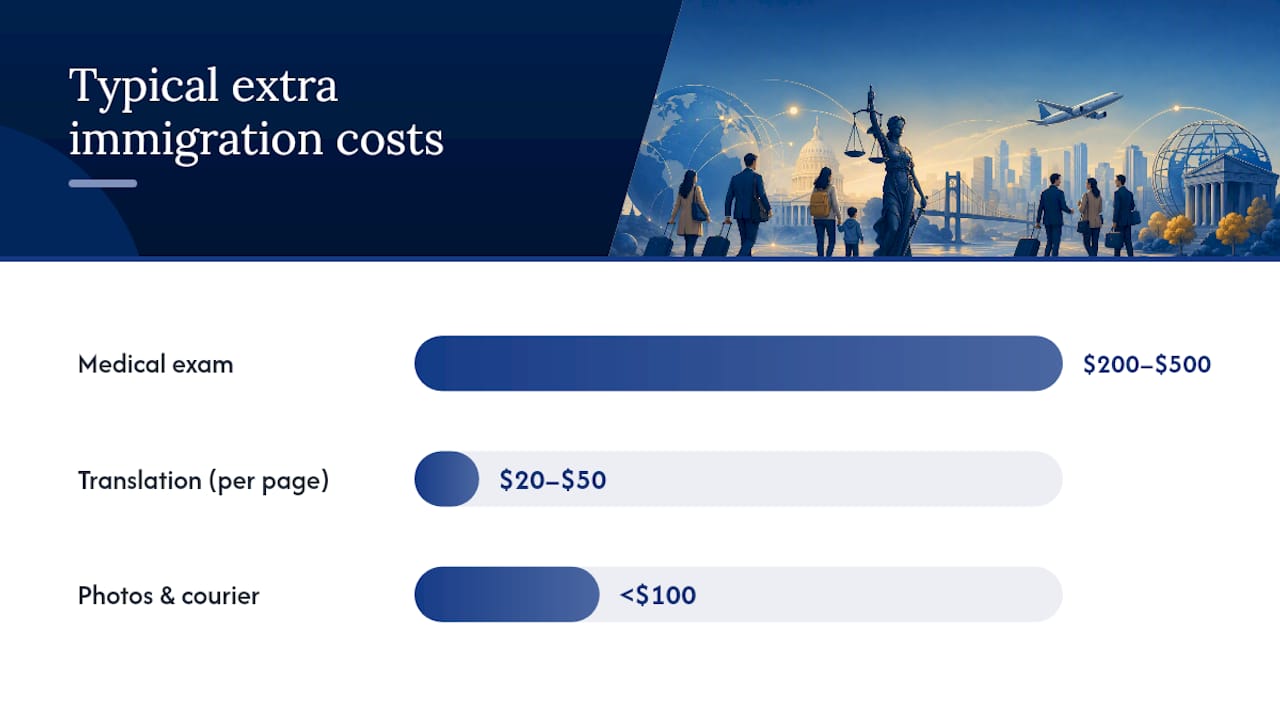
- Medical exams for green card applicants, generally $200 to $500 depending on the civil surgeon and location.
- Document translations, typically $20 to $50 per page for certified translations.
- Passport photos and courier or biometric appointment costs, usually under $100 combined.
- Premium processing, an optional USCIS service for certain petitions that speeds up adjudication for an additional government fee.
Fee-waiver fact: USCIS allows fee waivers for certain applicants who meet income thresholds tied to federal poverty guidelines, and fee reductions for select naturalization applicants. Not every form qualifies, and eligibility rules are specific, so check USCIS's fee-waiver guidance directly before assuming you qualify.
Ask for a cost breakdown that separates every one of these line items from the attorney's own fee. A quote that bundles "everything" into one number without itemizing government costs is harder to audit later, and it makes it nearly impossible to tell if you're being overcharged for the legal work itself.
Why Do Immigration Lawyer Quotes Vary So Much?
A quote that looks high isn't automatically a bad deal, and a quote that looks cheap isn't automatically a good one. A few factors legitimately move the price, and knowing them helps you separate justified cost from padding.
- Case complexity. A prior denial, a criminal record, a waiver requirement (like an I-601 unlawful presence waiver), or a mismatched immigration history all add attorney hours. These cases require more research, more documentation, and often more direct communication with USCIS or a court.
- Geographic market. Attorneys in major coastal metros like Los Angeles, San Francisco, or New York typically charge more than attorneys in smaller markets. Market analyses show coastal metros running 20% to 40% above mid-size market rates for comparable immigration work, reflecting higher overhead and demand.
- Attorney experience and firm size. A solo practitioner with a lean setup may charge less per case than a large firm with paralegal support and faster turnaround, but that lower price sometimes comes with less availability or slower response times. Neither model is inherently better; it depends on what your case needs.
- Scope creep. Adding a second applicant, a child, or a spouse to an existing filing increases cost, as does an appeal or a motion to reopen after a denial. Ask upfront how the firm prices additional applicants, since some quote per person and others quote per household.
If you're comparing quotes across regions, it helps to know what "normal" looks like locally. Readers in Southern California, for instance, can compare typical rates in Los Angeles, Orange County, or Riverside, where pricing can differ noticeably even within the same state.
How to Reduce Immigration Legal Costs Without Cutting Corners
Cost pressure is real, but the cheapest option on paper isn't always the cheapest option in practice. Here's how to lower your spend safely.
- Check legal-aid organizations and law-school immigration clinics first. Many operate on a sliding scale or offer services free for qualifying income levels. USCIS maintains a directory of accredited legal service providers to help you find a vetted option near you.
- Ask about staged flat fees or payment plans. Many firms will split a flat fee into installments tied to filing milestones rather than requiring the full amount upfront.
- Consider unbundled services for simple cases, where the attorney reviews your self-prepared paperwork rather than handling the fulfiling. This works best for straightforward cases, not contested ones.
- Avoid notarios and non-lawyer form-fillers, even though they're cheaper upfront. They aren't authorized to give legal advice, and a mistake on a form can trigger a denial or a years-long delay that costs far more to fix than the attorney fee would have.
Pro Tip: Gather your documents (birth certificates, marriage records, tax returns, prior immigration paperwork) and get certified translations done before your first consultation. Attorneys often bill for the time spent chasing down missing documents, so showing up organized can shave real hours off your final invoice.
What Should You Ask Before Hiring an Immigration Attorney?
A short consultation should answer enough questions to let you compare quotes on equal terms, not just on the bottom-line number.
Ask directly:
- What exactly is included in this flat fee, and what falls outside it?
- Who does the actual work: the attorney, a paralegal, or a mix?
- How often will I get invoices or updates, and in what format?
- What happens if I get a Request for Evidence or need to appeal? Is that priced separately?
- What's your refund policy if I need to end the engagement early?
Watch for these red flags:
- No written scope of work or engagement letter, only a verbal quote.
- Pressure to sign or pay immediately, especially same-day.
- A request for cash-only payment with no receipt.
- A fee that's dramatically below every other quote you've gotten, which sometimes signals a preparer who isn't actually a licensed attorney.
Trust signals work in the opposite direction: a written engagement agreement, an itemized invoice structure explained upfront, and an attorney who's reachable through a real office, not just a phone number with no address attached.
How LegalLeads Helps You Compare Attorney Fee Estimates Faster
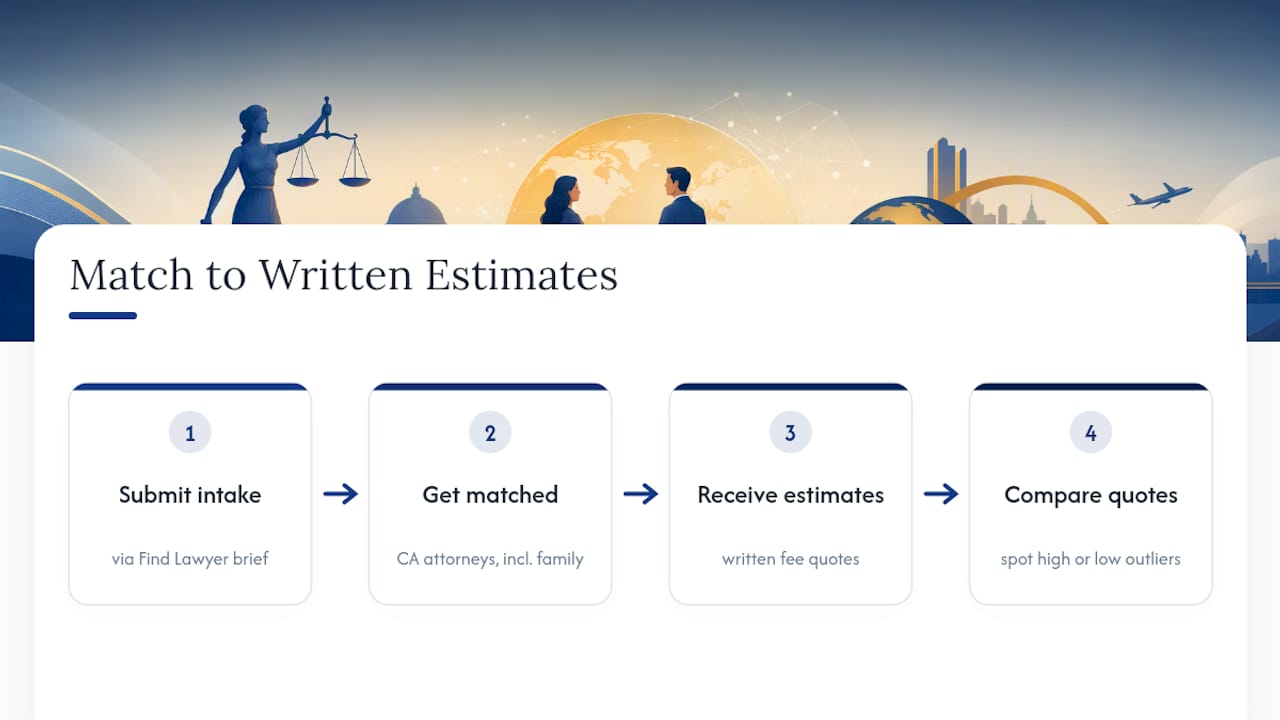
Getting to a written fee estimate usually means multiple calls, voicemails, and consultation scheduling before you know if a price is even reasonable. Some platforms shorten that step by letting you describe your situation in plain English, generating a case brief quickly, and connecting you to qualified attorneys within a short timeframe.
Faster matching means faster access to written estimates, which is what actually lets you compare quotes side by side. Instead of chasing five firms individually, you get responses lined up close together, while your case details are still fresh. That timing difference matters when you're trying to judge whether a quote is competitive.
Get Matched With an Immigration Attorney and Compare Written Estimates
Comparing immigration attorney fees usually means calling several firms, repeating your story each time, and waiting days for a callback. Some services allow you to submit a short intake describing your case and build a case brief you can share with matched attorneys, so you get written fee estimates without extensive back-and-forth calls across multiple offices.

That speed has a direct effect on budgeting: the faster you get multiple written estimates, the easier it is to spot a quote that's out of line, whether too high or suspiciously low. It also means less time explaining your situation over and over to different firms. If your case involves a family member, LegalLeads also matches family law cases in Los Angeles and other California regions for related legal needs that sometimes overlap with immigration matters, like custody or marriage documentation.
Start by submitting your case details through Find Lawyer and get matched with California attorneys ready to send a written estimate.
Where to Verify Immigration Fees and Find Legal Help
Filing fees change, so cross-check every number in this article against the source before you budget or file. USCIS's G-1055 fee schedule lists current government filing fees and fee-waiver eligibility rules directly from the agency. USCIS's legal services directory helps you locate accredited representatives and avoid scam preparers. For a broader view of billing structures and consultation practices, Law Cappital's overview of immigration attorney fee models covers how consultations and billing are typically structured, though its examples reflect a different market than the U.S.
This article is general information, not a substitute for advice from a qualified lawyer. Consult a qualified legal professional about your own circumstances before acting on anything here.
Sources
- USCIS — G-1055 and fee information
- AllLaw — Hiring an immigration lawyer: Is it worth the cost?
- CostSignals — Immigration lawyer cost guide (2026)
FAQ
How much do immigration lawyers charge in the USA?
Attorney fees vary widely, from lower fees for straightforward naturalization filings to significantly higher fees for contested removal defense, with most family and employment green card cases falling between $1,500 and $8,000.
Do immigration lawyers cost a lot?
Cost depends entirely on case type: routine filings like DACA renewals or naturalization cost a few hundred to a couple thousand dollars, while contested asylum or removal cases can run into the tens of thousands due to the hours of hearings and evidence work involved.
How can I get a free immigration lawyer in the US?
Nonprofit legal-aid organizations, law-school immigration clinics, and pro bono referral programs offer free or sliding-scale help for qualifying applicants; USCIS's find-legal-services directory is a reliable starting point to locate vetted providers.
How much is the US immigration fee?
Government filing fees vary by form and case type, from low hundreds of dollars for some filings to thousands for certain employment-based petitions, and they're always separate from attorney fees; current figures are listed at USCIS's official fee page.
Can I get matched with an immigration attorney quickly to compare fee quotes?
Yes. Platforms like LegalLeads generate a case brief from a short intake and connect you with qualified attorneys quickly, which helps you get written fee estimates to compare.