
If your situation involves a court deadline, risk of jail, or a financial loss over a few thousand dollars, you need an attorney. For routine paperwork with no opposing party and no strict deadline, court self-help resources or DIY forms are often enough. The legal situation assessment process comes down to three signals: urgency, stakes, and complexity.
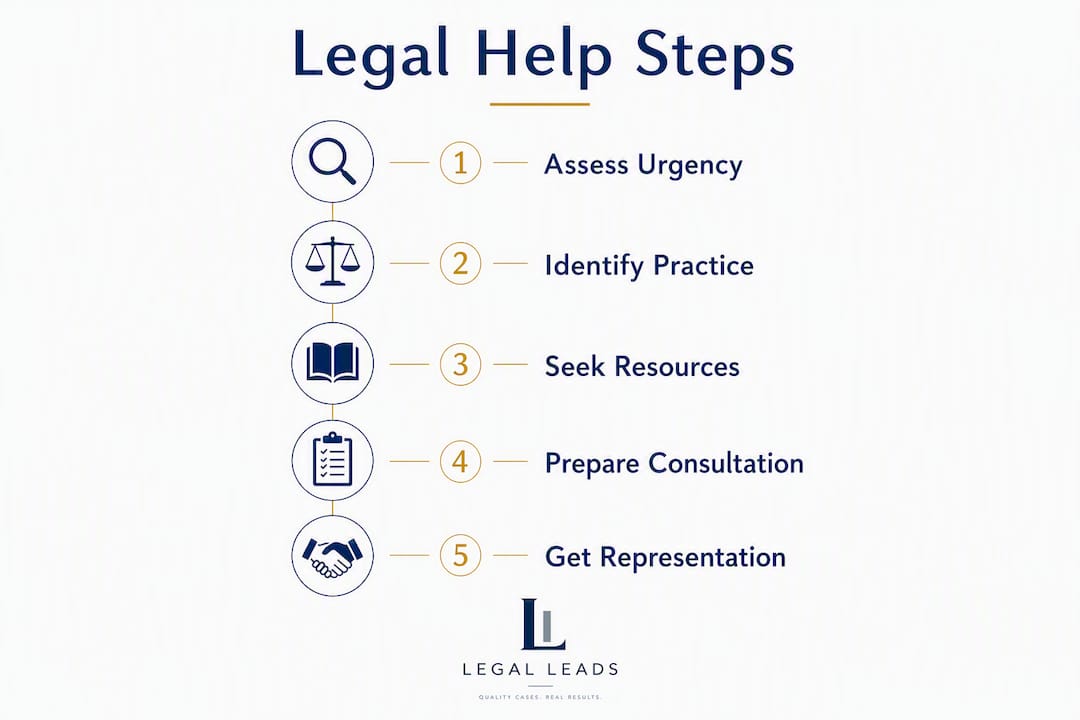
The American Bar Association, the Legal Services Corporation, and state court self-help programs all point to the same basic framework: match your problem to a practice area, check for deadlines, then pick the level of help that fits.
High-stakes example: You receive an eviction notice with a five-day response window. That is a court deadline with housing on the line. Call an attorney or contact legal aid today.
Low-stakes example: You want a simple name change with no contested parties. Most state courts offer a self-help packet and a checklist. You can likely handle it yourself.
Quick actions:
- Call or contact legal aid or an attorney if there is a court date, a summons, criminal charges, or custody at stake.
- Prepare your documents (contracts, notices, correspondence, photos) before any consultation.
- Use court self-help forms for uncontested, low-complexity matters with no imminent deadline.
Table of Contents
- When does your situation require an attorney?
- What practice area covers your legal issue?
- How to triage your legal situation step by step
- Where can you find free or low-cost legal help?
- How to prepare for your first attorney consultation
- When is self-help appropriate, and where does it fall short?
- Key Takeaways
- Why this guide exists
- Legalleads connects you to a verified attorney fast
- Useful sources
- FAQ
When does your situation require an attorney?
Some situations leave little room for delay. Attorneys evaluate new cases by looking at the same red flags you should check first.
High-risk signals that mean you need counsel now:
- You received a summons, complaint, or criminal charge.
- Jail or a criminal record is a possible outcome.
- A child custody or child safety dispute is active.
- You face eviction with a short response deadline.
- A contract dispute involves more than a few thousand dollars.
- You are dealing with a workplace discrimination or wrongful termination claim.
- A serious personal injury or medical situation involves insurance or liability.
Deadlines create urgency fast. Statutes of limitations vary by state and claim type, but many run as short as one year for personal injury or two years for contract disputes. Missing a filing deadline can permanently bar your claim, regardless of how strong it is. Check your state's specific rules before assuming you have time.
Medical-malpractice cases illustrate how quickly DIY becomes impossible: 28 states require an affidavit of merit at the time of filing, meaning you need an expert's signed statement before the case even opens.
When you probably don't need an attorney:
- Small claims court disputes under your state's dollar threshold (typically $10,000 or less).
- Simple traffic tickets with no license suspension risk.
- Uncontested name changes or uncontested divorces in states with streamlined forms.
For those lower-stakes matters, state court self-help centers provide free forms and instructions. They are not a substitute for legal advice, but they are a solid starting point.
Pro Tip: The American Bar Association recommends treating legal checkups like medical checkups, especially for business formation and estate planning. A short preventative consultation often costs far less than fixing a problem after it escalates.
What practice area covers your legal issue?
Matching your problem to the right specialty is the fastest way to determine legal needs and find qualified help. When you are unsure, a general practice attorney can triage your situation and refer you to the right specialist.

| Practice Area | Typical Problems | Likely Next Step |
|---|---|---|
| Family law | Divorce, custody, child support, adoption | Self-help forms (uncontested) or full representation (contested) |
| Criminal defense | Charges, DUI, probation violations, expungement | Attorney required in almost all cases |
| Landlord-tenant | Eviction, security deposit, habitability | Legal aid or limited-scope consult |
| Estate planning | Wills, trusts, probate | Limited-scope or full representation |
| Employment | Wrongful termination, discrimination, wage theft | Contingency attorney or agency complaint |
| Personal injury | Car accidents, slip and fall, medical malpractice | Contingency attorney |
| Immigration | Visa, green card, deportation defense | Attorney strongly recommended |
| Bankruptcy | Debt relief filing | Attorney or certified credit counselor |
| Business/contracts | Formation, disputes, breach of contract | Limited-scope or full representation |
| Consumer protection | Debt collection harassment, fraud | Nonprofit clinic or contingency attorney |
For criminal matters, the stakes are almost always high enough to require counsel. For family law, the right level of help depends on whether the other party contests anything. Types of legal processes like small claims, eviction, and probate each follow distinct procedural tracks, and knowing which track applies tells you a lot about what kind of help you need.
Criminal record issues, including expungement or annulment, often require a specialist. A criminal record annulment attorney can assess eligibility and handle the filing requirements that vary significantly by state.
How to triage your legal situation step by step
Legal triage ranks your issue by urgency, complexity, and stakes. Use this checklist before you contact anyone.
Triage score guide:
- 0 yes: — Self-help forms and court self-help centers are likely sufficient.
Pro Tip: Limited-scope (unbundled) representation is authorized in 41 states. Instead of hiring an attorney for the entire case, you pay for one specific task: a document review, a single court appearance, or a one-hour strategy session. This typically costs a few hundred dollars rather than a multi-thousand-dollar retainer, and it is a practical middle ground for moderate-complexity situations.
Where can you find free or low-cost legal help?
The right channel depends on your triage score and income. Free options exist for qualifying individuals; paid options scale from a few hundred dollars to full retainer arrangements.
Free and low-cost options:
- Court self-help centers: — Available in most state courthouses. They provide forms, instructions, and general information. They do not give legal advice.
Free legal services through pro bono programs, public defenders, and nonprofit clinics cover a wide range of issue types, though availability depends on your location and the nature of the case.
| Option | Typical Cost | Best For | Key Limit |
|---|---|---|---|
| Court self-help center | Free | Simple forms, procedural questions | No legal advice given |
| Legal aid / pro bono | Free (income-based) | Housing, family, consumer matters | Eligibility requirements apply |
| Law school clinic | Free | Immigration, housing, consumer | Limited issue areas |
| Limited-scope attorney | A few hundred dollars per task | Moderate complexity, specific tasks | Scope is narrow by design |
| Hourly attorney | Varies by market and specialty | Complex or contested matters | Can add up quickly |
| Contingency attorney | No upfront cost; percentage of recovery | Personal injury, employment claims | Only available when damages are likely |

State bar referral services, like the California State Bar's lawyer referral service, connect you with attorneys who offer reduced-fee initial consultations. That first paid consultation is often worth the cost because it clarifies whether you need full representation or can proceed with limited help.
Understanding the difference between a case manager and an attorney matters here too. A case manager vs. attorney comparison clarifies what each role can and cannot do, which helps you set realistic expectations when working with clinic or nonprofit programs.
How to prepare for your first attorney consultation
A well-prepared consultation saves time and money. Attorneys bill by the hour or evaluate cases quickly, so arriving organized makes the meeting more productive.
Documents to bring:
- Any papers you were served (summons, complaint, eviction notice, contract)
- Relevant correspondence (emails, letters, texts)
- Photos or physical evidence related to the incident
- Medical records or bills if injury is involved
- A written timeline of key events in chronological order
- Financial records if money or debt is at stake
Knowing how to document your legal status for an attorney before the meeting prevents back-and-forth and keeps the consultation focused on strategy rather than fact-gathering.
Questions to ask the attorney:
- Have you handled cases like mine before, and what were the outcomes?
- What is your fee structure: hourly, flat fee, or contingency?
- What is the likely timeline for my situation?
- What are my realistic options, and what do you recommend?
- What happens if I do nothing or handle this myself?
What not to say: Avoid speculating about facts you are not sure of. Do not volunteer information beyond what the attorney asks. Stick to what you know and what you can document. Attorney-client privilege protects what you share in a consultation, but speculation can complicate your case if it contradicts the facts later.
Pro Tip: Before the meeting, write a one-paragraph summary of your situation. Knowing how to communicate your legal problem clearly helps the attorney assess your case faster and gives you a cleaner record of the facts as you understand them.
When is self-help appropriate, and where does it fall short?
Self-help works well for a specific set of situations. Outside those situations, it carries real risk.
Commonly appropriate for self-help:
- Small claims court filings under your state's dollar limit.
- Uncontested name changes with no complications.
- Simple uncontested divorces in states that offer streamlined court packets.
- Responding to minor debt collection letters with a written dispute.
Red flags that should stop self-representation:
- The other party has an attorney.
- The case involves federal law, immigration status, or criminal charges.
- You are unsure which forms apply or how to complete them correctly.
- A procedural error could result in a default judgment against you.
Court self-help centers provide information and forms, not legal advice. Staff at these centers are prohibited from telling you which option is right for your case or reviewing your completed forms for accuracy. That distinction matters when a filing error could cost you the case.
Legal aid organizations rarely review self-drafted filings because non-lawyer staff cannot deliver legal advice without violating unauthorized practice of law rules. If you draft your own documents, a short attorney review is often the most cost-effective step you can take before filing.
Online forms and legal-tech tools can help you draft documents, but they cannot assess whether the document fits your specific facts or your state's procedural requirements. A form that looks complete can still be wrong for your situation.
Key Takeaways
Matching your legal issue to the right level of help, from self-help forms to full representation, depends on three factors: urgency, complexity, and what you stand to lose.
| Point | Details |
|---|---|
| Triage first | Check for deadlines, liberty risk, and financial exposure before deciding on any level of help. |
| Match the practice area | Use the practice area table to identify your issue type, then confirm with a general practitioner if unsure. |
| Use free resources | Court self-help centers, legal aid, and law school clinics are free starting points for qualifying individuals. |
| Limited-scope is a middle ground | Authorized in 41 states, limited-scope representation covers one task for a few hundred dollars instead of a full retainer. |
| Legalleads for fast matching | Legalleads generates a case brief from your plain-English description and connects you to a verified attorney within 24 hours. |
Why this guide exists
Legalleads built this resource because the hardest part of getting legal help is often not finding an attorney. It is knowing what kind of attorney you need and whether you need one at all. The platform uses AI to generate a professional case brief from a plain-English description of your situation in under two minutes, then connects you to a qualified attorney within 24 hours. No calls, no complicated intake forms.
This guide reflects the same approach: give you clear criteria, a repeatable triage process, and direct pointers to free and paid resources so you can act with confidence. For readers who want fast matching to a verified attorney in California, the platform's attorney directory is a direct next step.
Legalleads connects you to a verified attorney fast
Searching for an attorney on your own takes time you may not have, especially when a court deadline is close.

Legalleads shortens that process. Describe your situation in plain English, and the platform generates a professional case brief in under two minutes. A verified, qualified attorney contacts you within 24 hours. No phone tag, no complicated intake forms.
The platform covers personal injury, family law, immigration, employment, criminal defense, and other major practice areas in California. For family law matters specifically, family law attorneys in Los Angeles and Orange County are available through the directory.
To get matched now, visit Find a Lawyer on Legalleads and describe your situation. The process takes less than two minutes.
Useful sources
These resources provide free information, forms, and referral services for U.S. residents.
- Get free or low-cost legal help (California Courts): California's official self-help portal with forms, instructions, and links to local legal aid.
- California State Bar Lawyer Referral Service: Find a certified referral service in your county; many offer reduced-fee initial consultations.
- Maryland Courts Self-Help Center: Forms and procedural guides for Maryland residents handling civil matters without an attorney.
- Maryland Family Law Assistance: State-specific guidance on family law forms, custody, and support procedures.
- American Bar Association: When do I need a lawyer?: ABA guidance on common situations that warrant professional legal consultation.
- Legalleads Find a Lawyer: AI-assisted case brief and attorney matching for California residents needing fast, verified legal help.
| Resource | What You Find There |
|---|---|
| California Courts Self-Help | Free forms, instructions, and local legal aid links |
| California State Bar Referral | County referral services with reduced-fee consultations |
| Maryland Courts Self-Help | Civil procedure guides and court forms |
| ABA Public Education | Guidance on when and how to hire an attorney |
| Legalleads Find a Lawyer | Fast attorney matching via AI case brief |
FAQ
What counts as legal assistance?
Legal assistance includes any professional help with a legal matter: advice from a licensed attorney, representation in court, document drafting, or limited-scope consultations. Free resources like court self-help centers provide information and forms but are not considered legal advice.
What are the main types of law individuals typically need?
The four most common areas for individuals are family law (divorce, custody), criminal defense, housing and landlord-tenant disputes, and personal injury. Employment law and immigration are also frequent needs, depending on the situation.
What should I not tell my attorney?
Avoid speculating about facts you are uncertain of, and do not volunteer information beyond what the attorney asks. Stick to documented facts. Attorney-client privilege protects your consultation, but speculation that contradicts the record can complicate your case later.
How do I know which type of law applies to my situation?
Match your problem to the practice area table in this guide, then confirm with a general practice attorney if the issue spans more than one area. Legalleads can generate a case brief from your plain-English description and route it to the right specialist within 24 hours.
Can I handle my legal issue without an attorney?
For low-complexity, uncontested matters with no court deadlines, self-help forms from state court self-help centers are often sufficient. If the other party has an attorney, a deadline is imminent, or liberty or significant money is at stake, professional representation is the safer choice.
This article provides general information, not legal advice. Laws and procedures vary by state. Confirm current rules with your state court, a licensed attorney, or a qualified legal aid organization before taking action.