
Documenting legal status for an attorney means obtaining official proof of their licensing, standing, and disciplinary history from recognized authorities such as state bar associations and court registries. This process goes beyond a quick Google search. The two core documents you need are the Certificate of Good Standing and the Disciplinary History Report, both issued by official state or court bodies. Getting these right protects you from working with an attorney whose license is suspended, lapsed, or under investigation. Legalleads connects you with attorneys whose credentials you can verify through these exact official channels.
What documents are required to document legal status for an attorney?
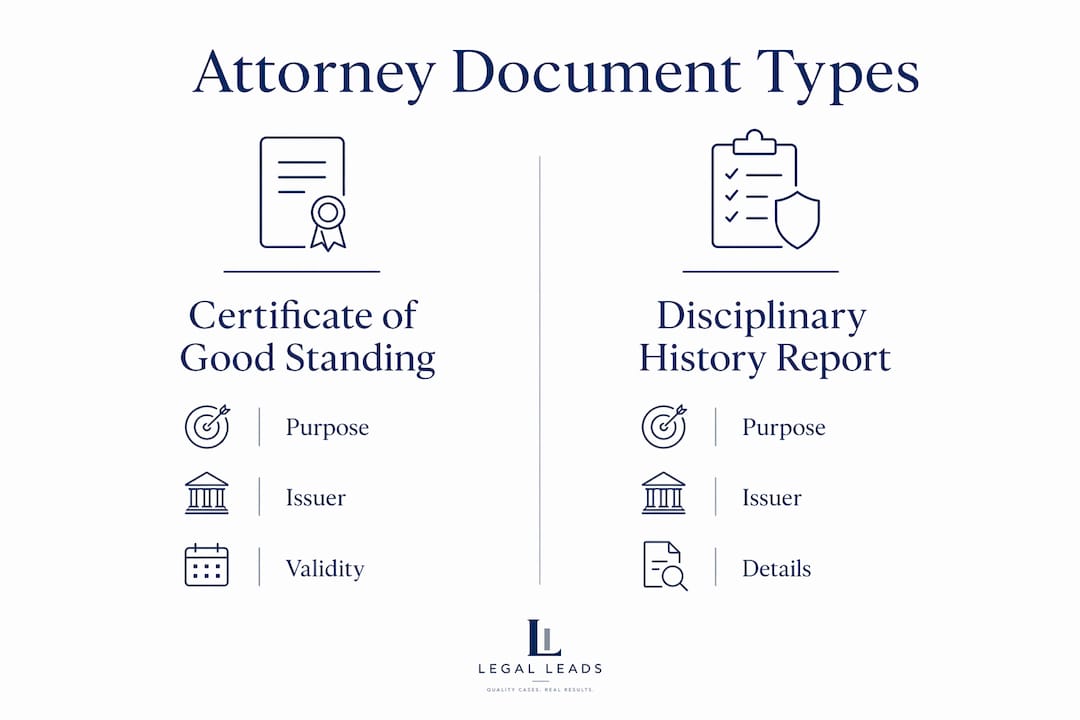
The Certificate of Good Standing is the primary document used to confirm an attorney's active license status. Issued by the state's highest court or bar association, it confirms that the attorney holds an active license and has no unresolved disciplinary issues. Courts, opposing counsel, and licensing boards commonly require this document when an attorney seeks admission to practice in a new jurisdiction.
The Disciplinary History Report is a separate document. It provides a record of any formal complaints, sanctions, or disciplinary actions taken against the attorney. Many people confuse the two, but they serve different purposes. The Certificate of Good Standing confirms current status. The Disciplinary History Report reveals the attorney's conduct record over time.

Key differences between the two documents
| Document | Purpose | Issued by | Typical validity |
|---|---|---|---|
| Certificate of Good Standing | Confirms active license and no unresolved discipline | State supreme court or bar association | 30–90 days |
| Disciplinary History Report | Lists past complaints, sanctions, and actions | State bar association | Varies by state |
Costs and procedures vary by state. New Jersey charges $20 per certificate with several delivery options, and most states now process requests through online portals. Before you order, confirm exactly which document the requesting entity requires. Ordering the wrong document can delay legal proceedings by weeks.
Pro Tip: Call the requesting court or agency directly to confirm the exact document name and format they accept before placing your order.
How do you verify an attorney's status through official registries?
State bar directories and supreme court registries are the only reliable sources for attorney license verification. Official state bar lookup tools provide up-to-date records of whether an attorney is active, inactive, suspended, or disbarred. Third-party directories may lag behind official records by days or weeks, making them unreliable for legal status verification.
Here is a step-by-step process for checking attorney credentials through official channels:
- Identify the correct state bar. Find the bar association for the state where the attorney is licensed to practice.
- Access the attorney lookup tool. Most state bars provide a free public search on their official website. Search by the attorney's full name or bar number.
- Read the status field carefully. Active means the attorney is currently authorized to practice. Inactive means they have voluntarily stepped back. Suspended means they cannot practice due to disciplinary action or noncompliance. Disbarred means their license has been permanently revoked.
- Check the discipline history tab. Many state bar directories include a link to any public discipline records directly on the attorney's profile page.
- Cross-reference with the court registry. For attorneys admitted to federal courts, check the relevant federal district court's attorney roster as a secondary confirmation.
- Document your findings. Take a screenshot or print the results with the date and time visible. This creates a record of the status at the time you checked.
For immigration-related matters, federal verification tools add another layer. Systems like SAVE and E-Verify are used for lawful status checks tied to immigration proceedings. A Tentative Nonconfirmation result in these systems does not mean denial. It signals a data mismatch that the individual can correct through the issuing agency's process.
Pro Tip: Always note the exact date and time when you run a status check. Attorney status can change overnight due to administrative actions, and a dated record protects you if a dispute arises later.
Common mistakes when verifying attorney legal status
Relying on an attorney's own claims is the most common mistake people make. An attorney's website or reputation does not confirm active status. Only official state bar registries provide accurate, real-time records. Always cross-reference any claim with the official registry before proceeding.
Several other mistakes appear repeatedly:
- Ordering the wrong certificate. Requesting a Certificate of Good Standing when the court requires a Disciplinary History Report, or vice versa, wastes time and money. Confirm the exact requirement before ordering.
- Ignoring administrative suspensions. Attorneys must meet annual compliance requirements such as paying dues and completing continuing legal education. Failure to meet these deadlines triggers an administrative suspension immediately. Work performed during a suspension is unauthorized and can carry serious legal consequences.
- Using outdated documents. A Certificate of Good Standing is a snapshot in time. It is typically valid for only 30 to 90 days because status can change quickly. A certificate issued three months ago may no longer reflect current standing.
- Ignoring data mismatches. Verification systems sometimes return errors due to name spelling differences or data entry mistakes. Do not treat a mismatch as a final result. Contact the issuing agency to correct the record before drawing conclusions.
"Bar admission verifies eligibility to practice law, not competence or specialization. Treat status verification as a baseline check, not an endorsement of quality."
Legal status is dynamic. Periodic verification is necessary for any ongoing legal matter, not just at the start of a case.
Step-by-step process to document an attorney's legal status
A structured approach prevents errors and saves time. Follow these steps to gather and confirm the documentation you need.
- Collect the attorney's identifying information. You need their full legal name, state of licensure, and bar number. The bar number speeds up searches and eliminates confusion with attorneys who share similar names.
- Determine which documents your case requires. Ask the court, agency, or opposing party exactly which certificates they need. Confirm the format, issuing authority, and acceptable age of the document.
- Request the certificate from the official source. Go directly to the state supreme court or bar association website. Use their online portal to order the Certificate of Good Standing or Disciplinary History Report. Pay the required fee and note the processing time.
- Run an online status check. While waiting for the official document, use the state bar's attorney lookup tool to confirm current status. This gives you a real-time snapshot before the certificate arrives.
- Confirm the document matches your jurisdiction's requirements. Some courts require certification by a specific official or a raised seal. Verify these formatting requirements before submitting.
- Store the documents with a clear date record. Save digital copies with the retrieval date in the file name. For ongoing matters, set a calendar reminder to re-verify status every 60 days.
Tracking attorney status over time
| Step | Action | Frequency |
|---|---|---|
| Initial verification | State bar lookup and certificate order | Before engagement |
| Document currency check | Confirm certificate is within 30–90 days | Before submission |
| Ongoing status monitoring | Re-run state bar lookup | Every 60 days |
| Compliance check | Confirm annual renewal and CLE completion | Annually |
Bar admission is the baseline for legal practice. Consumers must verify active standing and discipline history to assess whether an attorney is suitable for their specific legal matter.
Key takeaways
Accurate legal status documentation requires official certificates, real-time registry checks, and periodic re-verification throughout any ongoing legal matter.
| Point | Details |
|---|---|
| Use official sources only | State bar registries and court portals are the only reliable sources for attorney status. |
| Know your documents | The Certificate of Good Standing and Disciplinary History Report serve different purposes. |
| Check document currency | Certificates are valid for 30–90 days; outdated documents can delay proceedings. |
| Watch for administrative suspensions | Annual compliance failures trigger immediate suspension with no grace period. |
| Re-verify for ongoing matters | Set a 60-day reminder to re-check attorney status throughout active cases. |
Why I think most people verify attorneys the wrong way
People treat attorney verification as a one-time task. They check a name on a bar website before signing a retainer, then never look again. That approach misses the real risk.
Attorney status is not static. Legal status changes the moment an attorney misses a compliance deadline or receives a disciplinary action. A case that started with a fully licensed attorney can continue with a suspended one if you are not watching. The legal consequences of work performed during a suspension are serious and can affect your case outcome directly.
The other misunderstanding I see constantly is treating bar admission as a quality signal. Bar admission confirms eligibility to practice law. It does not confirm skill, experience, or specialization in your type of case. Verification tells you the attorney is authorized. It does not tell you they are the right attorney for your situation.
The practical fix is simple. Build verification into your process at the start, before any submission deadline, and every 60 days for active matters. Use the official state bar lookup tool, not the attorney's own website. Order a fresh certificate when one is required, not a photocopy of an old one. These habits take minutes and prevent problems that can take months to untangle.
— Admin
Legalleads makes finding a verified attorney faster
Knowing which documents to gather is only part of the process. Finding an attorney with confirmed credentials and the right practice area is where most people lose time.

Legalleads cuts that search down to under 24 hours. You describe your legal situation in plain English, and the platform generates a professional case brief in under two minutes. That brief goes to qualified attorneys in your area, and you receive a match without filling out complicated forms or making calls. You can browse verified attorneys by practice area and location, or go directly to find a lawyer matched to your specific case. Every attorney in the Legalleads directory can be cross-checked against official state bar records using the verification steps covered in this article.
FAQ
What is a Certificate of Good Standing for an attorney?
A Certificate of Good Standing is an official document issued by a state's highest court or bar association confirming that an attorney holds an active license with no unresolved disciplinary issues. It is typically valid for 30–90 days.
How do I check an attorney's credentials for free?
Use your state bar association's free public attorney lookup tool. Search by the attorney's full name or bar number to see their current status, including whether they are active, inactive, suspended, or disbarred.
What does attorney status "suspended" mean?
A suspended attorney cannot legally practice law. Work performed during a suspension is unauthorized and may carry serious legal consequences for both the attorney and the client.
How often should I verify an attorney's legal status?
Verify status before you engage an attorney, before any major court submission, and every 60 days for ongoing matters. Attorney status can change instantly due to missed compliance deadlines or disciplinary actions.
What is the difference between a Certificate of Good Standing and a Disciplinary History Report?
The Certificate of Good Standing confirms current active status. The Disciplinary History Report lists past complaints, sanctions, and formal actions. Courts and agencies may require either or both, so confirm the exact requirement before ordering.