
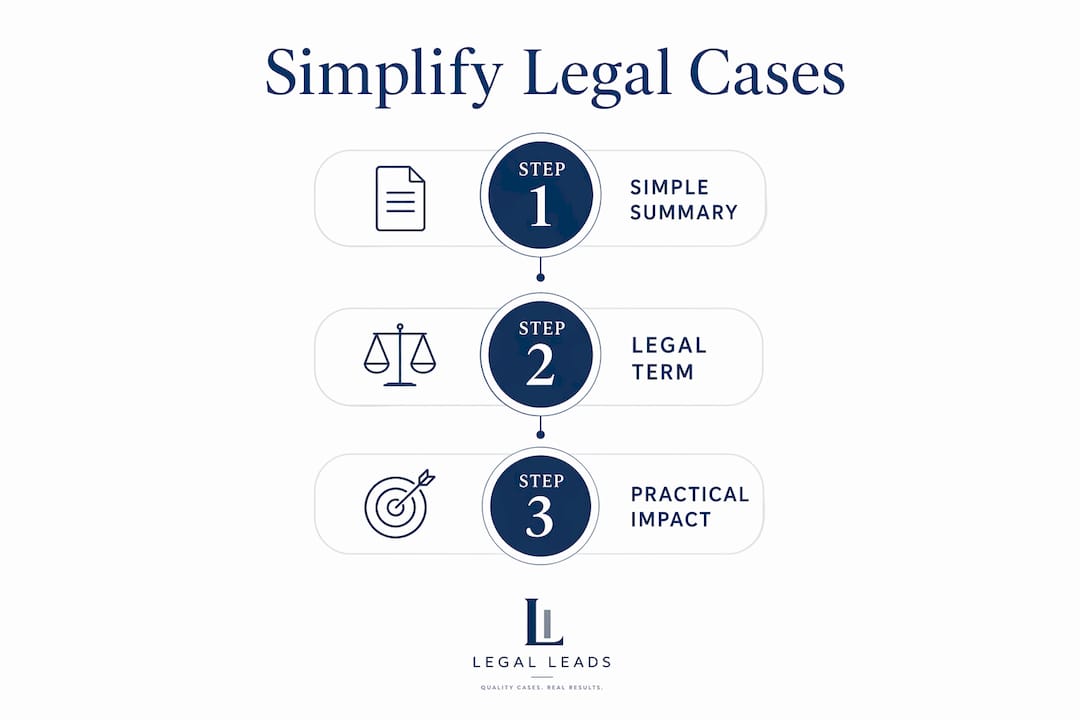
Attorneys explain cases simply by translating legal analysis into plain language that clients can understand and act on. The core method follows three levels: a simple summary, a legal explanation, and a practical consequence. Effective attorneys start with the client's real question, not with statutes or doctrines. They use storytelling, analogies, and structured logic to make legal concepts accessible.
Key elements of how attorneys clarify cases:
- Start with the client's concern. Identify the practical question first, whether it is risk, money, or a decision that needs to be made.
- Use the three-level method. Simple summary, then the legal term, then the practical consequence.
- Apply deductive logic. Present the rule, apply the facts, state the conclusion.
- Adapt to the audience. Match the depth and vocabulary to what the client already knows.
- Use analogies and plain language. Concrete comparisons make abstract law tangible.
Why lawyers must simplify complex legal information
Clients come to attorneys with practical problems, not legal questions. A client asks, "Can they sue me?" or "Do I have to pay?" The attorney must think through jurisdiction, liability, and evidence, but the client needs a clear answer, not a law school lecture.
Simplifying legal terms builds trust and supports better decisions. When clients understand their situation, they can give more useful information, follow legal strategy, and make informed choices. Confusion, by contrast, leads to missed deadlines, poor decisions, and damaged attorney-client relationships.
Legal concepts are inherently technical. Balancing precision and clarity is not optional. An explanation that is legally accurate but incomprehensible fails the client just as much as one that is clear but wrong.
Common techniques attorneys use to explain cases simply
The most reliable method is the three-level explanation: give a simple summary, introduce the legal concept, then explain the practical consequence. For example: "In simple terms, the court may not have power to hear this case. Legally, we call this jurisdiction. For you, this means we may be able to challenge the lawsuit before it moves forward."

Attorneys also use the deductive syllogism to structure legal arguments. State the rule, apply the facts, reach the conclusion. A well-built syllogism lets a reader grasp the core argument in under 90 seconds, according to Bryan Garner's widely cited standard in legal writing circles.
Additional techniques attorneys rely on:
- Begin with the client's decision. Does the client need to sign, settle, or respond? Start there.
- Avoid leading with procedural history. Jump to what matters for the client's situation.
- Use analogies. Comparing a contract clause to a lease agreement a client has signed before makes the concept concrete.
- Plain language tools. Resources like Legalpedia AI provide plain-English explanations of legal concepts to support client comprehension.
- Attorney case summaries. Short written summaries after meetings reinforce verbal explanations and give clients a reference.
Pro Tip: Pace your explanation, anticipate the client's objections, and keep a conversational tone. Bryan Garner describes expert legal explainers as people who write "clearly, simply and pleasantly to a small mixed audience of intelligent people."
Challenges lawyers face when explaining legal issues
The biggest obstacle is the gap between legal training and client knowledge. Attorneys are conditioned to think in categories, doctrines, and exceptions. Clients think in outcomes.

Acontextual statements are a common failure. Dropping a case name or legal principle without context leaves clients lost. Excessive procedural history is the opposite problem: too much buildup before the point arrives. Both extremes undermine comprehension.
Time pressure adds another layer. Attorneys often have limited time per client meeting, which pushes toward shortcuts that sacrifice clarity. Varying client learning styles compound this. Some clients want bullet points; others need a narrative. Distinguishing legal information from legal advice also sets a boundary: attorneys can educate clients on how the law works generally, but tailored counsel requires the formal attorney-client relationship.
What training helps attorneys communicate cases effectively
Clear legal communication is a skill, not a natural talent. It requires deliberate practice across several areas.
Legal writing training is the foundation. Programs grounded in plain language principles, such as those developed around Bryan Garner's work published in the ABA Journal, teach attorneys to cut procedural filler and lead with the point. The formula for explaining caselaw follows a clear pattern: state the legal principle, identify the case, describe what happened, then explain the result and the reason.
Audience awareness practice trains attorneys to read the room. Knowing when to simplify further, when to introduce a term, and when to stop talking is learned through client interaction and feedback.
Communication skills courses focused on plain language, active listening, and structured explanation help attorneys move away from jargon-heavy habits built in law school. Many bar associations offer continuing legal education credits for these programs.
Written summaries and follow-up notes reinforce verbal explanations. Attorneys who send a short written recap after a meeting give clients something to reference, which reduces follow-up confusion. For guidance on how attorney case review works, structured written communication is a consistent best practice.

Finding an attorney who communicates clearly makes a real difference. Legalleads connects you with qualified attorneys in under 24 hours. Describe your situation in plain English and receive a professional case brief in minutes. Find a lawyer who explains your case the way you need it explained.
Key Takeaways
Attorneys explain cases most effectively by starting with the client's practical concern and moving through a structured three-level explanation toward a clear, actionable conclusion.
| Point | Details |
|---|---|
| Start with the client's question | Begin with the practical concern, not the legal doctrine, to build relevance immediately. |
| Use the three-level method | Simple summary, legal explanation, and practical consequence give clients a clear path. |
| Apply deductive structure | The rule-facts-conclusion format lets readers grasp a legal argument in under 90 seconds. |
| Avoid acontextual statements | Dropping legal terms without context is a leading cause of client confusion. |
| Train continuously | Plain language writing skills and audience awareness require deliberate, ongoing practice. |
FAQ
What is the three-level explanation method attorneys use?
Attorneys give a simple summary first, then introduce the legal term, then explain the practical consequence for the client. This structure keeps explanations clear without sacrificing legal accuracy.
What is the 80/20 rule for lawyers?
The principle highlights that a small portion of a lawyer's efforts yields most results, emphasizing focus on the most consequential legal issues in a case rather than exhaustive procedural detail.
What should you not tell your attorney?
Avoid withholding facts, even ones that seem unfavorable. Attorneys need complete information to give accurate advice; incomplete facts lead to flawed strategy.
What is the hardest type of case to win in court?
Cases that rely heavily on circumstantial evidence or require proving intent, such as certain fraud or criminal conspiracy claims, tend to be among the most difficult to win because the burden of proof is high and facts are often disputed.
Can you say "yes sir" to a judge?
Yes. Addressing a judge respectfully as "Your Honor," "sir," or "ma'am" is appropriate courtroom conduct and reflects the formal respect the court expects from all participants.