
What factors do attorneys use to evaluate new cases?
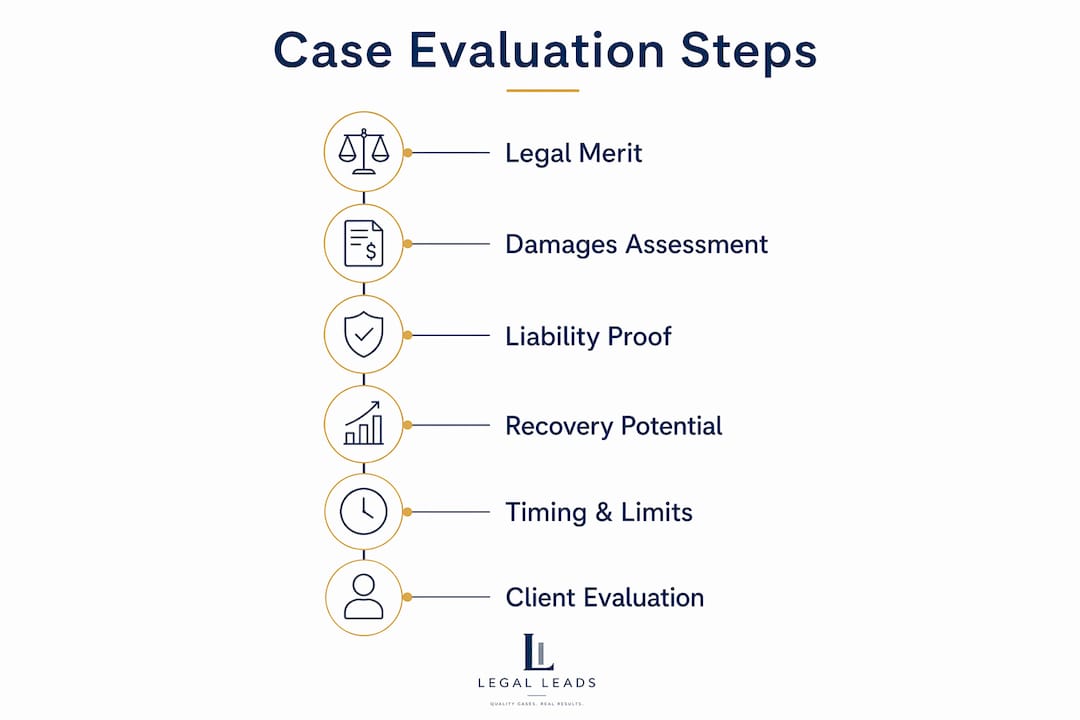
Attorneys evaluate new cases through five core factors: liability, damages, collectability, timing, and the client. All five must align before most attorneys will commit to representation. A legally strong claim can still be rejected if there is no realistic way to recover money. Understanding this framework helps you approach any consultation with clear expectations.
Key factors attorneys assess at intake:
- Liability: Can fault be established against the defendant?
- Damages: Are the injuries or losses significant enough to justify litigation costs?
- Collectability: Does the defendant have insurance or assets to pay a judgment?
- Timing: Is the claim still within the statute of limitations?
- The client: Is this person credible, cooperative, and workable as a client?
How attorneys evaluate the legal merit and viability of a case
Legal merit is the starting point of any attorney case assessment. Attorneys examine applicable statutes, relevant case law, and whether the facts support a recognized legal theory. A case without a clear legal basis rarely advances past the intake stage.

Attorneys also stress-test the case from the opposing side's perspective. They look for evidentiary gaps, jurisdictional risks, and defenses the other party is likely to raise. This early vetting shapes litigation readiness before any filing occurs.
Key legal merit considerations:
- Does the claim fit a recognized cause of action under applicable law?
- Are there binding precedents that support or undermine the theory?
- What is the complexity of the legal issues, and what resources will they require?
- Do ethical rules under the applicable Rules of Professional Conduct permit acceptance?
- Are there any conflicts of interest that would disqualify the attorney?
How attorneys assess damages and potential compensation
Damages drive case value. Without meaningful, documented harm, even a clear liability case may not justify the time and expense of litigation. Attorneys look at both economic losses (medical bills, lost wages, property damage) and non-economic losses (pain, suffering, loss of quality of life).
Well-documented injuries carry more weight. Medical records, treatment timelines, and expert opinions all strengthen the damages picture. A rule of thumb used by many plaintiff's attorneys is to expect litigation costs of roughly 10% of the estimated case value, which means low-value cases may not be financially viable to pursue.
Damages assessment components:
- Medical expenses: Past and projected future treatment costs
- Lost income: Wages lost and reduced earning capacity going forward
- Non-economic harm: Pain, suffering, emotional distress, and life impact
- Property damage: Repair or replacement costs where applicable
- Catastrophic injury cases: High desirability but require significant time and expense to prosecute
How attorneys determine liability and proof of fault
Liability is the central question in most civil cases. Attorneys need confidence that fault can be proven before they invest time and money. Some liability situations are straightforward, such as a rear-end collision. Others, like premises liability, require deeper analysis of comparative fault and the costs of proving negligence.

Attorneys look for a clear, concise client statement that confirms the defendant's negligence. They also consider what evidence exists and what it will cost to obtain more. Even with comparative fault on the client's side, a case can still hold value depending on the severity of damages.
Proof of fault elements attorneys examine:
- Physical evidence: photos, accident reports, surveillance footage
- Witness statements and their reliability
- Expert testimony requirements and associated costs
- Defendant's likely defenses and counterclaims
- Comparative fault percentage and its effect on recovery
Can you actually collect damages? Why recovery potential matters
Legal merit means little if there is no money to collect. Insurance policy limits are requested early in the intake process and heavily influence how much time and expense an attorney can justify investing. In an auto case with limited policy coverage, the ceiling on recovery is set from day one.
Attorneys also assess the defendant's personal assets when insurance coverage is low or absent. A judgment against a defendant with no assets or insurance is largely unenforceable. This is why collectability can override strong legal merit entirely.
Recovery potential checklist:
- What are the defendant's insurance policy limits?
- Does the client have underinsured motorist (UIM) coverage?
- Does the defendant have personal assets beyond insurance?
- Is the defendant a business entity with deeper financial resources?
- Would a low-collectability finding change the litigation strategy?
Timing and the statute of limitations
Every legal claim has a deadline. Once the statute of limitations expires, even a strong case cannot proceed. Attorneys check this deadline immediately at intake. A claim filed one day late is legally dead regardless of its merits.
Timing also affects strategy. Early consultation gives attorneys more options, including time to gather evidence before it disappears. For legal representation timelines and why they matter, deadlines shape outcomes in ways that cannot be undone after the fact.
Critical timing factors:
- Applicable statute of limitations by claim type and state
- Discovery rule exceptions (when the clock starts from discovery of harm)
- Tolling provisions for minors or incapacitated individuals
- Time-sensitive evidence preservation needs
- Filing deadlines for government entity claims, which are often much shorter
Client factors and ethical considerations in case acceptance
Attorneys evaluate the client as carefully as the facts. Client credibility, responsiveness, and cooperation are practical concerns that affect every stage of litigation. A difficult client relationship can derail an otherwise solid case.
Attorneys also conduct a preliminary assessment of jury perception. How a client presents, communicates, and handles pressure matters because juries ultimately decide many cases. Prior claims history, criminal background, and pre-existing medical conditions are all reviewed at intake. Undiscovered prior claims can surface at a critical moment during litigation and damage the case significantly.
Client evaluation factors:
- Credibility and likability as a potential witness
- Communication style and willingness to follow instructions
- Prior claims history and pre-existing medical conditions
- Criminal history and how it might affect jury perception
- Conflicts of interest checks required by professional conduct rules
Pro Tip: Instruct your attorney about every prior claim and medical condition upfront. Attorneys who discover these facts early can manage the narrative. Those who find out during litigation cannot.
Resources and practical next steps before your consultation
Preparation before a consultation directly affects how an attorney evaluates your case. Attorneys request specific documentation at intake, and arriving without it slows the process. For a structured approach, a legal case preparation checklist covers the key documents to organize before your first meeting.
What to gather before your consultation:
- Medical records and treatment summaries from the past five years
- Accident or incident reports (police, workplace, or property)
- Photographs of injuries, property damage, or the incident scene
- Insurance policy documents (yours and the defendant's if available)
- Witness names and contact information
- Any written communications related to the incident
Avoid posting about your case on social media. Attorneys routinely advise new clients to stop all social media activity related to the incident from the moment representation begins.
How attorneys treat initial case assessment as a business decision
The initial case assessment is more than a legal review. Within the initial weeks following intake, attorneys in complex litigation build a concise document outlining estimated costs, key risks, discovery needs, and litigation posture. This functions as a business plan for the case.
Front-end analysis before filing reduces the risk of committing firm resources to a case that cannot deliver a return. For contingency-fee attorneys, the intake period determines whether a case will require full litigation or is likely to settle early. Miscalculating that question wastes time, money, and firm reputation.
Pro Tip: Understand that your attorney's decision to accept your case is partly a financial calculation. The more organized and transparent you are at intake, the more accurately they can assess the case's potential and commit resources accordingly.
Case valuation resources and references
Attorneys use several tools and references to build a realistic case value estimate. Settlement databases, verdict reports, and jury verdict research services provide benchmarks for similar cases in the same jurisdiction. These references help attorneys set realistic expectations with clients and inform litigation strategy.
The Reuters Practical Law framework for case assessment emphasizes working backward from the likely outcome to estimate costs and exposure. Attorneys also consult medical cost databases, economic loss calculators, and expert networks to quantify damages accurately. For personal injury matters, understanding what your attorney needs to know about your claim helps build a more accurate valuation from the start.
What happens during the initial client consultation?
The first consultation is a structured intake interview. Attorneys ask the who, what, when, where, how, and why of the incident. They gather witness identities, photographs, and any available video. They also drill down on prior claims and medical history going back five years.
A face-to-face meeting is preferred when possible. Attorneys use checklists and questionnaires to ensure nothing is missed. The goal is to capture the full picture while the facts are fresh and the client's recollection is most reliable.
Fee arrangements and payment expectations
Most personal injury attorneys work on a contingency fee basis, meaning they collect a percentage of the recovery only if the case succeeds. This arrangement aligns the attorney's financial interest with the client's outcome. Contingency percentages typically vary by case type, complexity, and whether the matter settles or goes to trial.
Attorneys discuss fee structures at or before the close of the initial consultation. Clients should ask directly about the percentage, what litigation costs are deducted from the recovery, and who bears those costs if the case is lost. Understanding the fee arrangement upfront prevents misaligned expectations later.
Find the right attorney faster with Legalleads

Legalleads connects you with qualified attorneys in under 24 hours. Describe your legal situation in plain English, receive a professional case brief in under two minutes, and get matched without calls or complicated forms. Find a lawyer who fits your case today, or browse attorneys across multiple practice areas.
Key Takeaways
Attorneys evaluate new cases by weighing liability, damages, collectability, timing, and client suitability together, and a weakness in any one factor can lead to rejection even when the others are strong.
| Point | Details |
|---|---|
| Five-factor framework | Liability, damages, collectability, timing, and client fit must all align for case acceptance. |
| Collectability overrides merit | Strong legal claims are rejected when there is no realistic recovery source, such as insurance or assets. |
| Statute of limitations is absolute | Once the deadline expires, even a strong case cannot proceed legally. |
| Client credibility matters | Jury perception, prior claims history, and cooperation directly affect an attorney's acceptance decision. |
| Intake as a business plan | Attorneys build a cost and risk estimate within 30–60 days of intake to guide their resource commitment. |
FAQ
How do lawyers typically assess new cases?
Attorneys review five key factors: liability, damages, collectability, timing, and the client's credibility and cooperation. All five must support a viable case before most attorneys will agree to representation.
What is the 80/20 rule for lawyers?
The principle in legal practice generally refers to the idea that a small portion of cases generate the majority of a firm's revenue, which is why thorough front-end case evaluation helps attorneys focus resources on the strongest matters.
What are red flags for lawyers during case intake?
Red flags include undisclosed prior claims, inconsistent client statements, expired statutes of limitations, low or no insurance coverage, and a client who is unresponsive or unwilling to follow legal advice.
Does a strong legal claim guarantee an attorney will take the case?
No. Even a legally sound claim can be declined if damages are too low to justify litigation costs, if the defendant has no assets or insurance, or if the client relationship raises credibility concerns.