
AI-driven matching platforms are the fastest lawyer connection route available in the U.S. right now. Legalleads generates a professional case brief in a few minutes and typically connects clients to qualified attorneys within about a day, making it the recommended option for most individuals who need a lawyer quickly. For context, the Oregon State Bar's AI referral tool connects clients in about 3–4 minutes using automated guided intake, and the D.C. Bar's MyDCLawyer service delivers a personalized attorney list very quickly after a short intake. Traditional directories like Martindale-Hubbell are useful for discovery but depend on manual outreach, which adds days to the timeline.
Top picks at a glance:
- Fastest overall: AI-driven matching platforms (Legalleads) — case brief under two minutes, attorney connection within 24 hours
- Fastest for emergencies: State/local bar referral hotlines with live intake — same-day or next-business-hour contact in most jurisdictions
- Fastest free/public option: D.C. Bar's MyDCLawyer or equivalent state bar referral programs — near-instant shortlist at no cost to the client
Key Takeaways
AI-driven matching platforms are the fastest lawyer connection model available, with intake-to-first-contact measured in minutes to hours rather than days.
| Point | Details |
|---|---|
| Fastest overall model | AI platforms like Legalleads generate a case brief in under two minutes and connect clients within 24 hours. |
| Fastest free public option | Bar referral programs (e.g., D.C. Bar's MyDCLawyer) deliver a near-instant attorney list at no cost to the client. |
| Speed depends on jurisdiction | Cross-state matters and thin attorney networks extend timelines even on fast platforms. |
| Vetting still matters | Verify bar membership and check for discipline history before committing, even on a fast match. |
| Legalleads recommendation | Legalleads covers California across personal injury, family law, immigration, employment, and criminal defense with free individual intake. |
Table of Contents
- How this fastest lawyer connection services comparison measures speed
- At-a-glance comparison of lawyer connection models
- What do realistic timelines actually look like?
- How do you choose the fastest safe option when time is the priority?
- Why Legalleads is the recommended fast-match option
- When fastest should be your top priority — and when it shouldn't
- Legalleads connects you to a qualified attorney fast
- Sources
- FAQ
How this fastest lawyer connection services comparison measures speed
Speed in attorney matching means two distinct things. Time-to-first-contact is how long it takes to receive a name, a list, or a direct message from an attorney or referral coordinator. Time-to-initial-consult is how long until you sit down (in person or virtually) for a substantive legal conversation. These two metrics can differ by hours or days depending on the model.
Sources used here include vendor-published SLA claims, state bar program documentation, published platform intake workflows, and timed-response data where available. The Legal Options Hub comparison index provides a useful framework for evaluating service types across advice level, support model, jurisdiction sensitivity, and cost.
Key caveats that affect every timeline number:
- Jurisdictional licensing: An attorney licensed in California cannot represent you in a New York matter. Cross-state needs add time.
- Practice-area complexity: Emergency criminal defense moves faster than complex commercial litigation.
- Business hours: Many referral programs and law firms operate 9 AM–5 PM. AI platforms and some telelaw services run 24/7.
- Vetting level: Higher vetting (peer review, bar discipline checks) adds time before a match is confirmed.
- Paid prioritization: Some platforms offer faster placement for premium listings or paid intake tiers.
Apply these metrics to your own situation by identifying which caveat applies first. If you need a California personal injury attorney tonight, an AI platform with 24/7 intake beats a bar referral program that opens Monday morning.
At-a-glance comparison of lawyer connection models
The six major connection models differ sharply on speed, vetting, and cost. Attorney-client matching technology has widened the gap between automated platforms and manual methods over the past few years.
| Connection model | Time-to-first-contact | Time-to-initial-consult | How matches are made | Vetting level | Consumer cost | Availability | Best for |
|---|---|---|---|---|---|---|---|
| AI-driven matching platform | Minutes to hours | Same day to 24 hours | Algorithm + AI intake | Moderate (verified bar membership) | Free intake; attorney fees vary | 24/7 | Urgent matters, most practice areas |
| State/local bar referral | Minutes to 1 business day | 1–3 business days | Guided intake, manual or automated | High (bar-verified, discipline-checked) | Free or low fee | Business hours (some 24/7 hotlines) | Routine matters, free option seekers |
| Online directory/marketplace | Hours to days | 2–5 business days | Directory search, manual outreach | Low to moderate (self-reported profiles) | Free to browse; attorney fees vary | 24/7 browsing | Research, vetting by reputation |
| Virtual law firm/telelaw | Hours to 1 business day | Same day to 2 days | Platform intake, assigned attorney | Moderate to high | Subscription or per-matter fee | 24/7 intake | Remote clients, straightforward matters |
| Prepaid/legal plan | Hours to 1 business day | 1–2 business days | Plan network directory | Moderate | Monthly plan fee | Business hours | Ongoing legal needs, plan members |
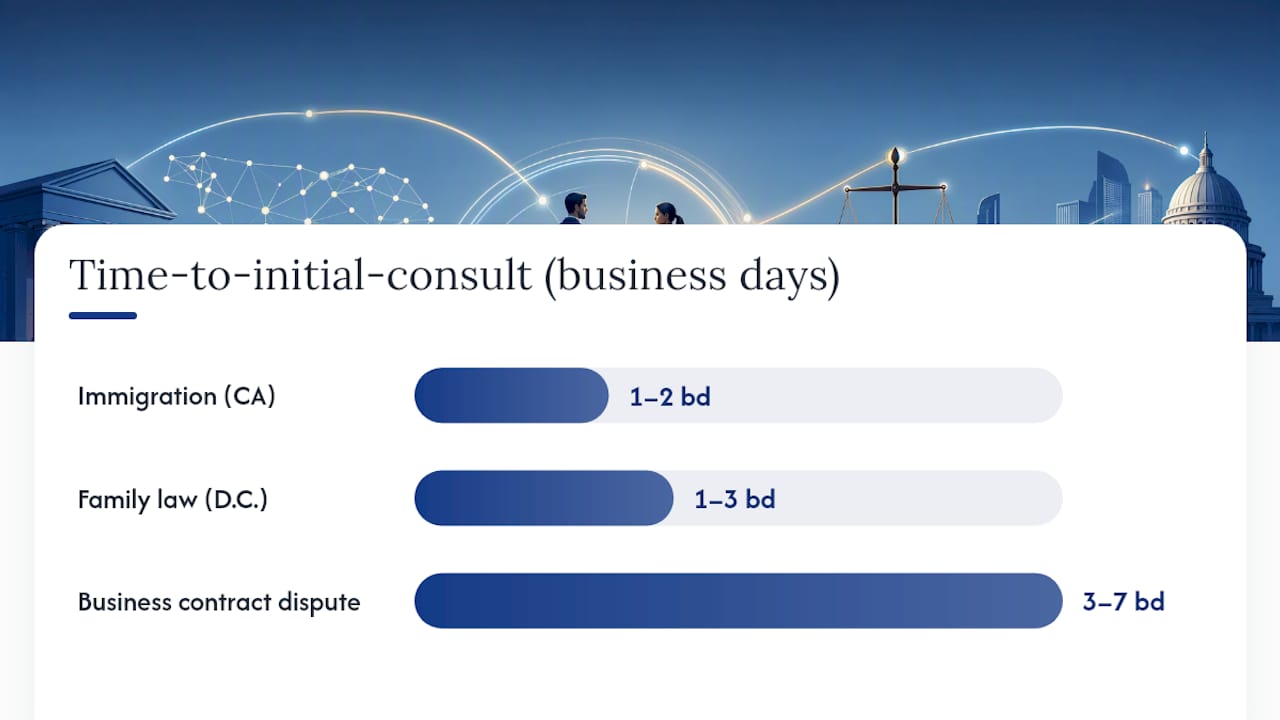
| Traditional law firm | 1–3 business days | 3–7 business days | Phone/email, manual intake | High (firm-specific screening) | Varies widely | Business hours | Complex litigation, high-stakes matters |
A few model-level notes worth keeping in mind:
- AI platforms trade some depth of vetting for speed. They verify bar membership but typically do not run the peer-review process that Best Lawyers rankings require.
- Directories like Martindale-Hubbell are strong discovery tools. Response speed, however, depends entirely on whether the attorney checks their inbox.
- Bar referral programs are the most trustworthy free option. The D.C. Bar's MyDCLawyer and similar services are designed to provide near-instant attorney lists filtered by practice area and geography.
- Leopard Solutions' Connection Reports map attorney-to-attorney relationships for business development. They are not designed for consumer rapid-match needs.
What do realistic timelines actually look like?
Concrete examples clarify what "fast" means across different practice areas.
| Scenario | Model used | Time-to-first-contact | Time-to-initial-consult |
|---|---|---|---|
| Personal injury (car accident, California) | AI matching platform | Under 24 hours | Same day or next day |
| Family law (divorce filing, D.C.) | Bar referral (MyDCLawyer) | Near-instant list | 1–3 business days |
| Emergency criminal defense (arrest, weeknight) | Bar hotline or AI platform | Minutes to 1 hour | Same night or next morning |
| Business contract dispute (non-urgent) | Online directory | 1–3 days | 3–7 business days |
| Immigration matter (California) | AI matching platform | Under 24 hours | 1–2 business days |
The Oregon State Bar's AI tool demonstrates what automation does to intake: 3–4 minutes to a match versus the 20–40 minutes a phone-based intake typically takes. That compression comes from replacing open-ended questions with structured guided prompts that feed directly into a matching algorithm.
The D.C. Bar's MyDCLawyer service shows the public-sector version of the same principle. A few intake questions produce a personalized, practice-area-filtered list almost immediately. The list is free. The trade-off is geographic scope: it covers D.C. matters only.
Practice-area variation matters. Emergency criminal defense has the shortest acceptable time-to-first-contact of any category because arraignment deadlines are measured in hours. Personal injury and family law allow slightly more time but still reward fast intake. Complex commercial litigation, by contrast, rarely benefits from a same-day match because the vetting requirements outweigh the speed advantage.
Jurisdictional licensing limits are the most common reason a fast match still takes longer than expected. An AI platform can generate a case brief in minutes, but if your matter requires a licensed attorney in a state where the platform's network is thin, the connection window stretches. Legalleads currently covers California, including personal injury, family law, immigration, employment, and criminal defense.
For accident and personal injury cases specifically, speed at intake directly affects case outcomes because evidence preservation and statute-of-limitations windows open immediately after an incident.
How do you choose the fastest safe option when time is the priority?
Speed without fit is not useful. A fast match to the wrong attorney costs more time than a slightly slower match to the right one. Work through these criteria in order:
- Intake speed: Does the service accept intake 24/7, or only during business hours? AI platforms and some telelaw services accept intake at any hour.
- Vetting level: Does the service verify bar membership and check for discipline history? Faster services should still confirm active licensure at minimum.
- SLA or response window: Does the platform publish a specific time-to-first-contact commitment? Vague language like "we'll get back to you soon" is a red flag.
- Jurisdictional coverage: Is the service licensed to match attorneys in your state for your specific matter?
- Hours of operation: A 24/7 intake form means nothing if the matching team reviews submissions only on weekdays.
Questions to ask any service before submitting your case:
- What is your typical time-to-first-contact after intake?
- Do you verify bar membership and check discipline records?
- Is there a cost for the initial consultation?
- Can you match attorneys licensed in my state for this practice area?
- What happens if the first match is not a fit?
Red flags that suggest slowing down is the right call:
- No verifiable licensing information on the attorney profile
- No stated response window or SLA
- No option for an initial consultation before committing
- Pressure to sign a retainer before speaking with the attorney
- No clear geographic or practice-area scope
The Legal Options Hub framework identifies jurisdiction sensitivity as one of the key axes for evaluating online legal services. A service that scores well on speed but poorly on jurisdiction sensitivity is a poor fit for any matter where state-specific law is central.
When to accept a quick referral: routine matters with clear facts, time-sensitive filings, and situations where any licensed attorney in the practice area can help. When to slow down: complex litigation, high-asset transactions, matters involving multiple jurisdictions, or any situation where the attorney's specific track record is material to the outcome. For business emergencies, the calculus shifts back toward speed because delay has a direct financial cost.
Why Legalleads is the recommended fast-match option
Legalleads is built around a three-step intake workflow designed to minimize the time between describing a legal problem and speaking with a qualified attorney.
How the workflow runs:
- Step 1 — Plain-English intake: Describe your situation in plain English through the platform. No forms, no phone calls.
- Step 2 — AI case brief: The platform generates a professional case brief in a few minutes (brand claim).
- Step 3 — Attorney connection: Qualified attorneys in the matching network review the brief and respond. Legalleads states clients are typically connected within 24 hours.
The platform covers personal injury, family law, immigration, employment, criminal defense, and other major practice areas in California. Intake is free for individuals. Attorneys in the network are verified for active bar membership.
TopCounsel's documentation illustrates the broader principle: combining AI intake with peer-backed or verified attorney data surfaces qualified matches faster than manual directory searches. Legalleads applies the same logic at the consumer level, replacing the phone-tag cycle with a structured brief that attorneys can evaluate before responding.
Pro Tip: Provide specific, concrete facts during intake — the date of the incident, the practice area, and the outcome you need. A precise brief reaches attorneys faster and generates more relevant responses than a vague description.
For personal injury cases in Los Angeles or family law matters, the platform's California network is the most direct path to a qualified match.
When fastest should be your top priority — and when it shouldn't
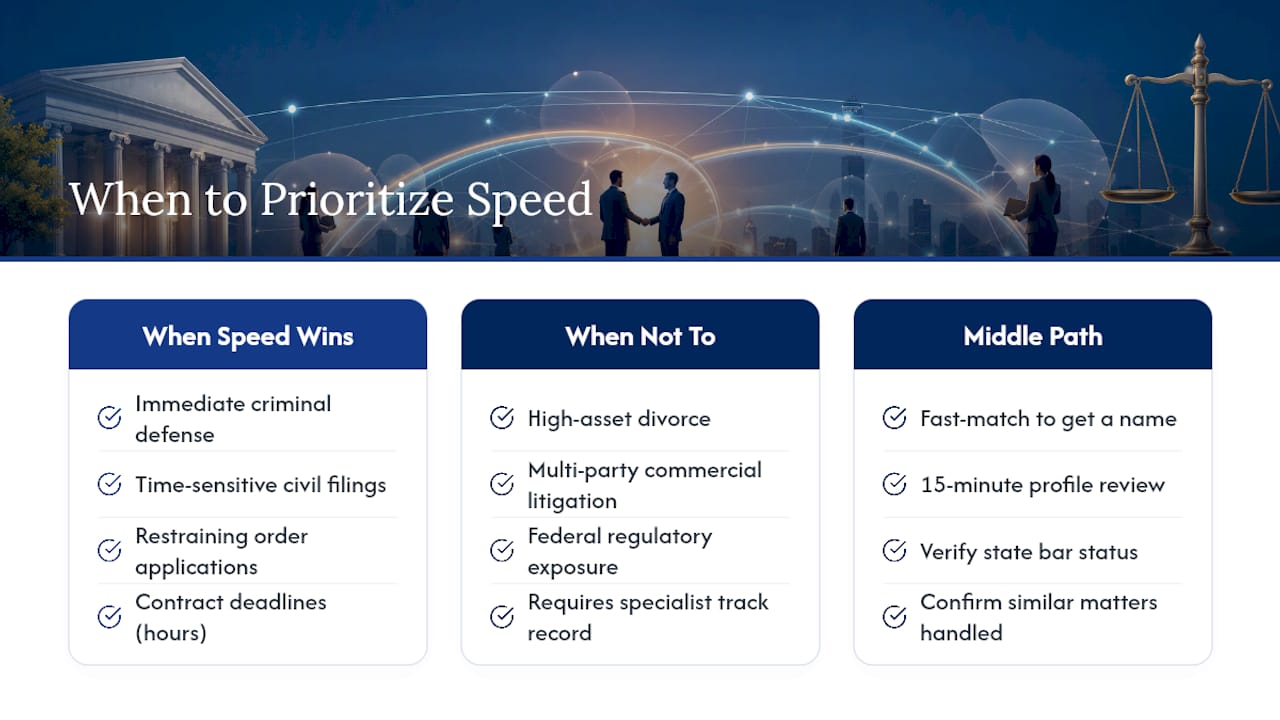
Speed is the right selection driver in a specific set of circumstances. Immediate criminal defense is the clearest case: arraignment windows are short, and any delay in retaining counsel has direct procedural consequences. Time-sensitive civil filings, restraining order applications, and business emergencies where a contract deadline is hours away all belong in the same category. For these situations, an AI matching platform or a 24/7 bar referral hotline is the correct first move.
The calculus changes for complex matters. High-asset divorce, multi-party commercial litigation, and cases involving federal regulatory exposure require an attorney whose specific experience and track record are material to the outcome. Rushing that selection to save 48 hours is rarely worth it. The right approach is a fast initial contact to preserve your options, followed by a deliberate vetting step before signing anything.
One practical middle path: use a fast-match service to get a name quickly, then spend 15 minutes on that attorney's profile. Check their bar status on your state bar's public directory, confirm they have handled similar matters, and ask one direct question about their experience in your specific practice area. That combination, fast intake plus a minimal verification step, captures most of the speed benefit while reducing the main risk of a purely algorithmic match.
Legalleads connects you to a qualified attorney fast
Legalleads is built for exactly this situation: you need a qualified attorney quickly, without spending hours on hold or filling out complicated forms. The intake takes minutes. The case brief is ready in under two minutes. Most clients are connected to a matched attorney within 24 hours.
Getting started is straightforward. Describe your legal situation in plain English at the Legalleads intake page. The platform generates your case brief automatically and routes it to verified attorneys in your practice area. Intake is free for individuals. For personal injury matters in California, the Los Angeles personal injury page connects you directly to attorneys in that network. To start a match across any practice area, visit Find a Lawyer on Legalleads and submit your case now.
Sources
External references cited:
- Oregon State Bar -- Legal Referral
- DC Bar - Hiring a Lawyer
- 2026 Online Legal Services Comparison Index | Legal Options Hub
- Connection Report | Leopard Solutions
- Best Lawyers
- TopCounsel Documentation | The L Suite
Related reads on the Legalleads blog:
This article is general information, not a substitute for advice from a qualified lawyer. Consult a qualified legal professional about your own circumstances before acting on anything here.
FAQ
What is the fastest way to find a lawyer in the U.S.?
AI-driven matching platforms are currently the fastest route, with some services generating a case brief and routing it to attorneys in minutes. Bar referral programs like the D.C. Bar's MyDCLawyer service offer near-instant shortlist (quickly)s for free.
Are prepaid legal plans worth it for fast attorney access?
Prepaid legal plans typically provide first contact within hours to one business day through a plan network directory, which is faster than a traditional law firm but slower than AI platforms. They work best for individuals with ongoing or predictable legal needs rather than one-time emergencies.
How do I know if a fast-match attorney is actually qualified?
Check active bar membership through your state bar's public directory and ask the service whether it screens for discipline history. Peer-reviewed rankings from sources like Best Lawyers add a deeper vetting layer but are not required for routine matters.
Is $400 an hour a lot for a lawyer?
It depends on the practice area and market. In major U.S. cities, attorney hourly rates vary widely; fast-match platforms connect you to attorneys whose rates vary, and the intake itself is typically free for individuals.
Does Legalleads work outside California?
Legalleads currently focuses on California, covering personal injury, family law, immigration, employment, and criminal defense. For matters outside California, a state bar referral program in the relevant jurisdiction is the recommended free alternative.