
A first-offense DUI in California typically brings informal probation, mandatory DUI classes, and fines that land near $2,000 after assessments. Jail time is possible but not the norm. The one deadline that overrides everything else: you have 10 calendar days after arrest to request a DMV hearing, or your license gets suspended automatically. If injuries, prior convictions, or a chemical test refusal are involved, the penalties escalate fast, sometimes into felony territory.
TL;DR:
- DUI penalties in California increase sharply after the second offense, with third and fourth offenses often resulting in jail time or license revocation.
- A felony charge is possible if the DUI causes injury, with potential state prison sentences and long-lasting consequences like license loss and employment issues.
- The 10-day window to request a DMV hearing is critical; missing it results in an automatic license suspension regardless of the criminal case outcome.
- Enhancements like high BAC, refusal, child passengers, or excessive speed significantly raise jail time and program lengths when combined.
- Acting quickly with legal help within the first week after arrest can determine whether you negotiate a plea to a lesser charge or fight for more favorable outcomes.
Table of Contents
- First, Second, Third, and Fourth DUI Penalties in California
- When a DUI Becomes a Felony: Injury and Death Cases
- Enhancements That Add Jail Time and Longer Programs
- DMV Hearings vs. Criminal Court: Two Separate Fights
- Ignition Interlock Devices and Restricted License Options
- What a DUI Actually Costs: Fines, Fees, and Insurance
- Fighting a DUI: Defenses, Plea Deals, and Wet Reckless
- Probation, Alternatives to Jail, and Clearing Your Record
- Your First 90 Days: A Timeline You Can't Afford to Miss
- Why Speed Matters More Than People Think in DUI Cases
- Get Matched to a DUI Defense Attorney Today
- Sources
- FAQ
First, Second, Third, and Fourth DUI Penalties in California
California scales DUI penalties by how many convictions you've had in the past 10 years, and the jump between each offense level is steep. This look-back window matters more than most people realize: a "wet reckless" plea from six years ago still counts, and so does an out-of-state DUI conviction.
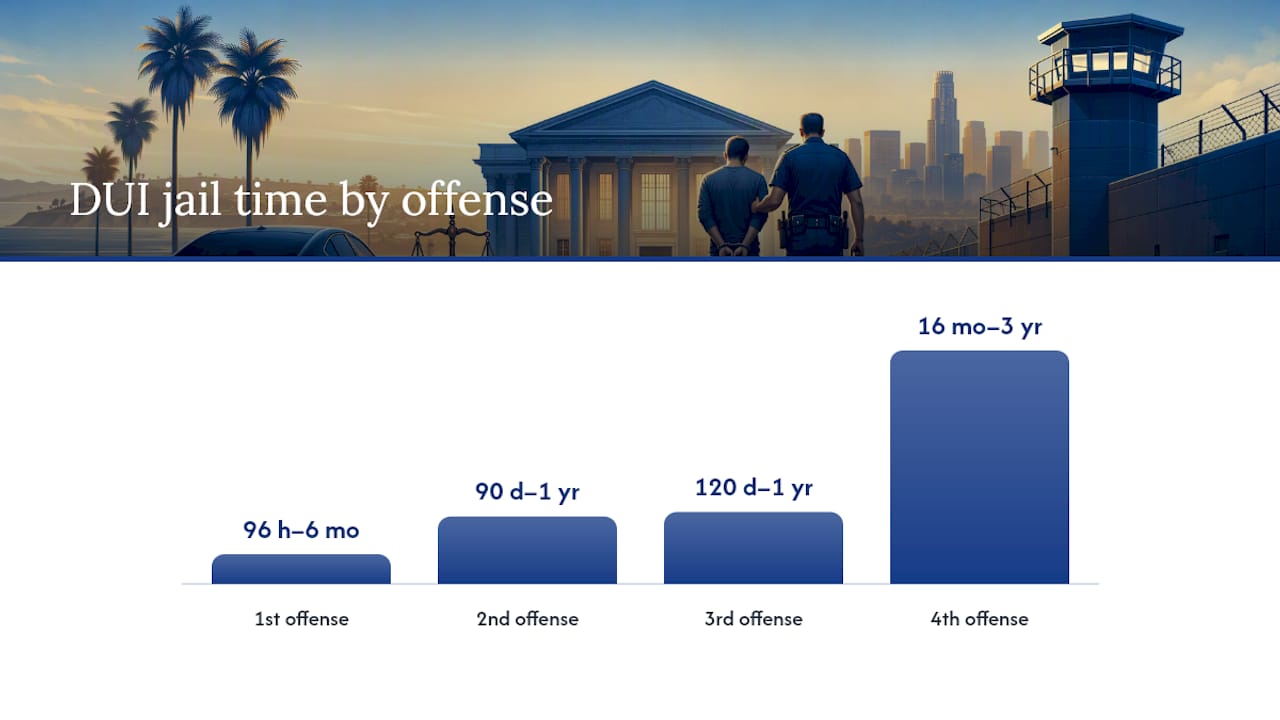
For a first offense under Vehicle Code 23152, you're looking at 96 hours to 6 months in county jail, a base fine of $390 to $1,000, and 3 to 5 years of informal probation. In practice, most first-timers walk away with probation and a program requirement rather than actual custody. Judges frequently substitute electronic monitoring or work release for jail, especially when there's no accident and no prior record.
A second DUI within 10 years changes the calculus. The penalty structure jumps to 90 days to 1 year in county jail, with a mandatory minimum of 96 hours. The fine range stays similar, but the DUI program lengthens to either 18 or 30 months, and a 12-month ignition interlock device requirement becomes standard. DMV data shows repeat offenders serve actual jail time far more often than first-timers.
Third and fourth offenses within that same 10-year window move into more serious territory:
- Third offense: 120 days to 1 year in county jail, fines up to $1,000 plus assessments, a 30-month DUI program, and license revocation for 3 years.
- Fourth offense: Often charged as a felony, with 16 months to 3 years in state prison exposure and enhanced fines depending on the exact circumstances.
- Prior convictions counted: Wet reckless pleas, out-of-state DUIs, and even some juvenile DUI adjudications can count toward the 10-year look-back.
- County variance: Some counties, particularly in Southern California, prosecute repeat offenses more aggressively than others, so outcomes for the same facts can differ by jurisdiction.
The classification shift from misdemeanor to felony at the fourth offense is the single biggest cliff in the entire penalty structure. Once you're there, you're not negotiating with a city prosecutor anymore. You're facing a state prison sentence.
When a DUI Becomes a Felony: Injury and Death Cases
A DUI that causes injury to another person is charged under Vehicle Code 23153, and prosecutors have discretion to file it as either a misdemeanor or a felony depending on the severity of the injury and the driver's record. This is where DUI law stops looking like a traffic case and starts looking like a criminal case with real prison exposure.
Felony injury DUIs can carry state prison time, fines up to $10,000, and additional enhancements depending on how the injury occurred and whether prior convictions exist. Fourth-time offenders within the 10-year window face 16 months to 3 years in state prison, and that range climbs further when a great bodily injury enhancement applies.
Key distinctions that shape how these cases get charged:
- Great bodily injury enhancement: Adds separate prison time on top of the underlying DUI sentence when the victim suffers significant physical harm.
- Multiple victims: Prosecutors can file separate counts for each injured person, multiplying total exposure.
- Misdemeanor vs. felony injury DUI: A misdemeanor injury DUI stays in county jail territory; a felony version, or a case that escalates to vehicular manslaughter after a fatality, moves to state prison.
- Restitution: Courts routinely order defendants to pay victims' medical bills, lost wages, and property damage, separate from any fine.
Beyond the sentence itself, a felony DUI conviction follows you. Professional licenses can be suspended or revoked, background checks flag the felony for years, and some employers simply won't hire someone with a felony record on file. If injuries are involved, restitution and civil liability for the victim's damages compound the financial hit, an issue closely tied to premises and personal injury liability law more broadly.
Enhancements That Add Jail Time and Longer Programs
Certain aggravating facts trigger mandatory add-ons to the base DUI sentence, and these stack on top of whatever penalty range applies to your offense number. A first-time DUI with two enhancements can end up looking like a second offense in terms of actual consequences.
- High BAC (0.15% or above): Extends the mandatory DUI program from 3 months to 9 months for first offenders and can influence jail-time recommendations at sentencing.
- Chemical test refusal: Triggers its own administrative license suspension separate from the DUI charge itself, and prosecutors often treat refusal as an aggravating factor in plea negotiations.
- Child passenger enhancement: Under Vehicle Code 23572, having a passenger under 14 in the vehicle adds mandatory additional jail time on top of the base sentence.
- Excessive speed: Driving 30+ mph over the limit on a highway, or 20+ mph over on a surface street, while under the influence, adds its own enhancement under the same statutory scheme.
These enhancements compound with prior convictions rather than replacing them. A second-offense DUI with a high BAC reading and a refusal on top of it isn't treated as a second offense with one issue. It's treated as a second offense with two separate aggravating factors, each pushing sentencing recommendations higher and shrinking your attorney's room to negotiate a favorable plea.
DMV Hearings vs. Criminal Court: Two Separate Fights
Here's what catches a lot of people off guard: your DUI arrest triggers two completely separate legal processes that run on different tracks with different rules. One is the criminal case in court. The other is an administrative license suspension run entirely by the DMV, and it moves on its own clock regardless of what happens in your criminal case.
The DMV's administrative per se suspension typically kicks in about 30 days after your arrest unless you request a hearing within 10 calendar days. Miss that window, and the suspension happens automatically, no hearing, no negotiation. Request the hearing in time, and the suspension is paused until a hearing officer makes a decision.
Winning your criminal case does not automatically undo a DMV suspension. These are separate proceedings with separate standards of proof, and a not-guilty verdict or dismissed charge in court has no automatic effect on the administrative side. You have to fight both.
Practical steps for handling both tracks:
- Call the DMV's Driver Safety Office or submit a hearing request in writing within 10 days of arrest.
- Gather your citation, temporary license, and arrest paperwork immediately since you'll need them for both proceedings.
- Coordinate with an attorney early. Defense lawyers often handle the DMV hearing and criminal defense together, using DMV hearing testimony as an early look at the arresting officer's evidence.
- Track both deadlines separately. Court dates and the DMV hearing rarely align on the same calendar.
Pro Tip: Request the DMV hearing the same day you hire an attorney, even before your first court date. It's the one deadline that can't be extended for "still finding a lawyer."
Ignition Interlock Devices and Restricted License Options
An ignition interlock device, a breathalyzer wired into your car's ignition, has become the standard path back to legal driving after most California DUI convictions. Rather than sitting out a full suspension, many drivers install an IID and get a restricted license that lets them drive to work, school, and DUI program appointments.
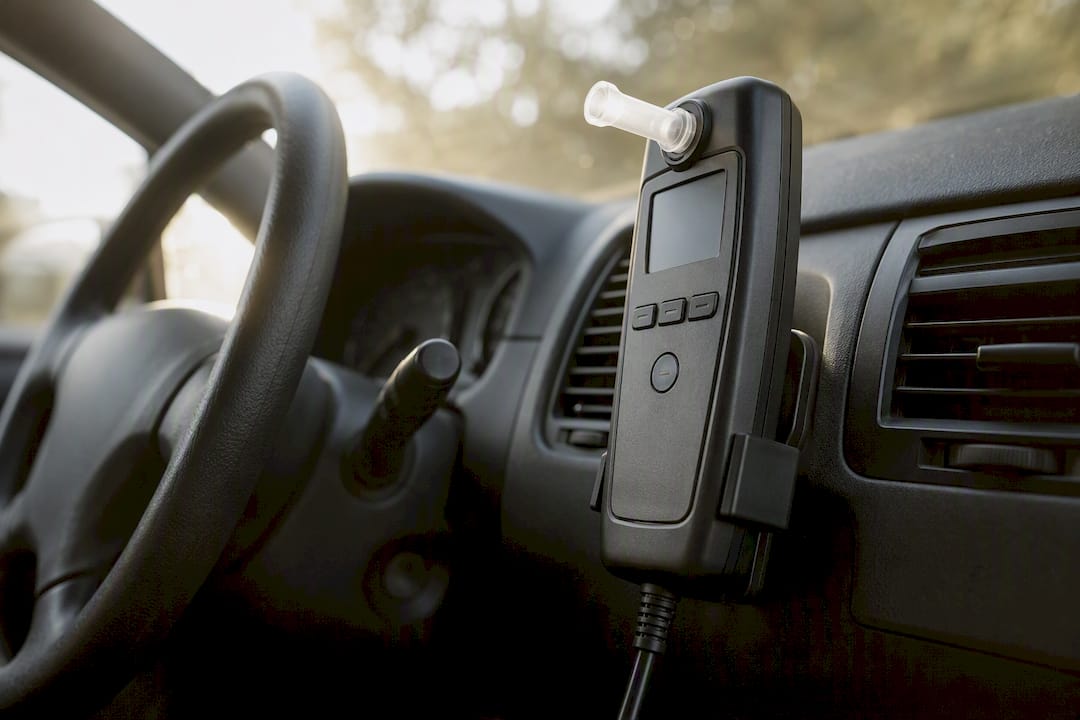
For a first offense, IID requirements vary by county and case specifics, though many first-time cases now default to some IID period as the standard route to keep driving. Second offenses carry a more consistent 12-month IID requirement. The device requires periodic recalibration, typically every 60 days, at a licensed service center, and skipping a calibration appointment can trigger a violation report to the DMV.
What to budget for:
- Installation typically runs a few hundred dollars, paid out of pocket by the driver, not the court or DMV.
- Monthly rental and monitoring fees continue for the entire mandatory period.
- Calibration visits are mandatory and missed appointments can extend your restriction period or trigger additional consequences.
- Courts and the DMV can both impose IID requirements, sometimes independently of each other, so check both orders carefully.
The tradeoff is straightforward: an IID costs money and requires discipline, but it beats a hard suspension with no driving privileges at all.
What a DUI Actually Costs: Fines, Fees, and Insurance
The statutory fine range you'll read about, $390 to $1,000 for a first offense, is almost never what you actually pay. Mandatory state and county penalty assessments stack on top of the base fine, and those assessments typically push the real court-ordered cost to roughly $2,000 to $3,000 for a standard first-time DUI.
That figure doesn't include everything else. Here's a realistic breakdown for a typical first offense:
The long-term expense most people underestimate is insurance. A DUI conviction typically requires an SR-22 filing, and premium increases from a single conviction commonly push total costs into the $5,000 to $15,000 range once you account for several years of elevated rates. That single number often exceeds every court fine and program fee combined.
Fighting a DUI: Defenses, Plea Deals, and Wet Reckless
Not every DUI arrest holds up under scrutiny, and the specific facts of the stop matter enormously. Common defense strategies challenge whether the initial traffic stop was legally justified, whether field sobriety tests were administered correctly, and whether breath or blood testing equipment was properly calibrated and maintained.
A negotiated plea to "wet reckless" under Vehicle Code 23103.5 is one of the most common outcomes for first-offense cases with borderline evidence. It typically carries up to 90 days in jail exposure and a shorter education program than a full DUI conviction, and it can preserve driving privileges more easily. The catch: it still counts as a prior DUI-related conviction if you're arrested again within 10 years, so it's a real tactical tradeoff, not a free pass.
Other reductions can matter just as much for your license. A charge reduced from a second offense to a first offense, for instance, can shrink your DUI program from 18 or 30 months down to 3, and reduce your IID requirement significantly.
- Preserve evidence early: dashcam footage, witness contact information, and your own memory of the stop fade fast.
- Request the DMV hearing regardless of whether you plan to fight the criminal charge.
- Contact a defense attorney before your arraignment date, not after.
Pro Tip: Ask any attorney you're considering how often they negotiate wet reckless pleas for clients with your specific BAC range. It's a fast way to gauge real experience versus a generic pitch.
Probation, Alternatives to Jail, and Clearing Your Record
Most DUI convictions come with 3 to 5 years of informal probation, and the conditions attached are more restrictive than people expect. Standard terms typically include no additional violations of law, completion of the DUI program, compliance with any IID order, and periodic check-ins depending on the county.
Courts increasingly favor alternatives to straight jail time, particularly for first and second offenses without aggravating facts:
- Work release programs let defendants serve custody time while still reporting to their job.
- Electronic monitoring (ankle bracelets or home confinement) substitutes for physical jail in many counties.
- Community service sometimes replaces a portion of jail time, especially for first offenders.
Once probation and program requirements are complete, expungement under Penal Code 1203.4 becomes an option worth pursuing. It doesn't erase the conviction from every record, DMV and certain licensing boards can still see it, but it does change how the conviction shows up on most background checks, which matters enormously for employment. If your DUI intersects with substance abuse treatment, it's worth understanding how rehab programs interact with disability protections under California law, since treatment participation can sometimes factor into both sentencing and workplace accommodation decisions.
Your First 90 Days: A Timeline You Can't Afford to Miss
The choices you make in the first 10 days after a DUI arrest shape everything that follows, sometimes irreversibly.
- Days 0 to 10: Request your DMV hearing before this window closes. Gather your citation, temporary license, and any arrest paperwork. Contact a defense attorney immediately, ideally before day 5, so they have time to prepare a hearing request.
- Days 10 to 30: Attend your arraignment, where you enter an initial plea. Your attorney should begin requesting discovery, including police reports, breath or blood test calibration records, and dashcam footage.
- Days 30 to 90: Plea negotiations typically happen during this window. If an IID is required, start researching installation options now since courts often set tight deadlines for compliance once a plea or verdict is entered.
Missing the 10-day DMV window is the single most avoidable mistake in this entire process. It converts an administrative process you could have contested into an automatic suspension with no hearing at all. Prosecutors, for context, generally have up to one year to file most misdemeanor DUI charges and up to three years for felony versions, so the DMV clock is almost always the tightest deadline you're facing.
Why Speed Matters More Than People Think in DUI Cases
Most people treat a DUI arrest like they have weeks to figure out their next move. They don't. Between the 10-day DMV deadline and the practical reality that early attorney involvement changes what evidence gets preserved, the first week after an arrest is often more consequential than anything that happens at trial.
What gets underestimated: the difference between an attorney who reviews your case brief on day 2 versus day 12 is often the difference between a wet reckless negotiation and a straight DUI conviction. Evidence like dashcam footage, witness statements, and even the arresting officer's calibration logs on breath testing equipment can become harder to obtain the longer you wait.
Legalleads was built around that timing problem. Instead of spending days calling firms that don't return calls, you describe your situation in plain English and get a professional case brief in under two minutes, then get matched to a qualified attorney within 24 hours. For something with a 10-day clock attached, that speed isn't a convenience. It's the difference between having options and running out of them. Read more on why representation timelines matter for DUI and other time-sensitive cases.
— Admin
Get Matched to a DUI Defense Attorney Today
Legalleads gets you in front of a qualified attorney faster than searching, calling, and waiting for callbacks that a DUI's 10-day clock doesn't leave room for.

Start by describing your arrest in plain English: date, county, whether you refused testing, and any prior convictions. That's enough for Legalleads to generate a case brief in under two minutes and route it to attorneys who actually handle DUI defense in your area, not a generic list. Most people hear back from a matched attorney within 24 hours. There are no forms to fill out and no calls to make, and submitting your case costs nothing. If your case involves an injury to another driver or passenger, the same intake connects you with attorneys experienced in that overlap between criminal defense and personal injury claims. Head to the Find Lawyer page and submit your case now, before your 10-day DMV window closes.
Sources
Statutory language and DMV procedures change, so confirm specifics against primary sources before a hearing or court date. The DMV's DUI penalties page covers administrative hearings, IID rules, and local office information. For statute text itself, California Legislative Information hosts the full Vehicle Code. Your county courthouse can provide local advisement forms and probation department contacts specific to your case.
This article is general information, not a substitute for advice from a qualified lawyer. Consult a qualified legal professional about your own circumstances before acting on anything here.
- California Legislative Information — Vehicle Code sentencing sections
- California DUI overview — sentencing and plea alternatives (committee summary)
FAQ
Does a DUI go away after 10 years in California?
A DUI conviction stays on your driving and criminal record indefinitely, but it stops counting as a "prior" for sentencing purposes once 10 years pass without another DUI. Expungement under Penal Code 1203.4 can change how it appears on background checks, though it remains visible to the DMV and certain licensing agencies.
Is a DUI a felony in California?
A DUI is usually charged as a misdemeanor for first, second, and third offenses without injury. It becomes a felony when it causes injury or death under Vehicle Code 23153, or when it's a fourth offense within 10 years.
What state has the toughest DUI penalties?
Penalty severity varies significantly by state and depends on which factor you weigh, mandatory minimum jail time, fine amounts, or license suspension length. California ranks among the stricter states due to its mandatory IID requirements, tiered program lengths, and aggressive felony enhancement for injury cases.
How fast can I get matched to a DUI attorney?
Through Legalleads, you can get a case brief generated in under two minutes and typically hear from a matched attorney within 24 hours, fast enough to meet the DMV's 10-day hearing deadline if you act quickly after arrest.