
In California, domestic violence allegations can be filed as misdemeanors or felonies depending on the statute and the facts involved. An arrest can trigger an immediate restraining order and firearm restrictions before any conviction. If you're facing this, secure your safety, preserve evidence, avoid contact with the protected party, and get an attorney involved right away.
TL;DR:
- Cases involving injury or use of weapons tend to be filed as felonies, especially if strangulation or prior convictions are present.
- A felony conviction can result in two to four years of imprisonment, with additional penalties if great bodily injury or firearm use is involved.
- Protective order violations or service of a restraining order can lead to separate criminal charges, often faster and more impactful than the original case.
- Prosecutors often pursue charges regardless of victim requests to drop them, relying heavily on police reports and evidence like 911 calls.
- Digital evidence such as texts and surveillance footage plays a crucial role in both building the case and mounting a defense.
Table of Contents
- Domestic Violence Charges in California: The Statutes That Define Them
- Misdemeanor or Felony: How Prosecutors Make the Call
- Penalties for Domestic Violence in California: What a Conviction Actually Costs
- DV Restraining Order California: TROs, DVROs, and Firearms
- The Criminal Court Process: From Arrest to Sentencing
- How to Defend Against Domestic Violence Charges
- Collateral Consequences of a Domestic Violence Conviction
- Who's Actually Running the Case: The DA and Victim's Advocate
- Victim Notification Rights and Procedures
- 911 Calls and Digital Evidence in Domestic Violence Prosecutions
- Risk Assessment Tools in Custody and Bail Decisions
- Diversion Programs and Alternatives to Prosecution
- Why Speed Matters More Than People Realize
- Get Matched With a California Attorney Today
- Official California Resources and Court Forms
- Sources
- FAQ
Domestic Violence Charges in California: The Statutes That Define Them
California law casts a wide net over who counts as a domestic violence victim. Under Penal Code 13700, "domestic violence" covers abuse committed against a spouse, former spouse, cohabitant, former cohabitant, dating partner, or someone with whom the accused shares a child. Family Code provisions echo this definition for restraining order purposes, which is why a case involving an ex-girlfriend or a roommate can carry the same weight as one involving a married couple.
"Abuse" itself isn't limited to hitting. It includes threats, harassment, disturbing someone's peace, or destroying personal property. That breadth catches a lot of people off guard.
Several charges show up repeatedly in domestic violence charges California cases:
- PC 243(e)(1), domestic battery: any willful, unwanted touching of an intimate partner, even without visible injury.
- PC 273.5, corporal injury to a spouse or cohabitant: requires a "traumatic condition," meaning some physical injury resulted from the force used.
- PC 273a / PC 273d: child endangerment or corporal punishment of a child, often charged alongside adult domestic violence counts.
- PC 368: elder abuse, applied when the victim is 65 or older.
Cohabitation status matters more than people expect. Courts look at factors like shared finances, a joint lease, and the length and nature of the relationship, not just whether two people live under one roof. Police often make that call in the field, which is part of why domestic battery arrests happen even in ambiguous living situations.
Misdemeanor or Felony: How Prosecutors Make the Call
The dividing line between a misdemeanor and a felony domestic violence charge usually comes down to injury severity and history, not the underlying relationship.
- Injury level drives the filing decision. A shove with no mark often supports a misdemeanor domestic battery charge under PC 243(e)(1). Visible bruising, a broken bone, or strangulation typically pushes the case toward felony corporal injury under PC 273.5.
- PC 273.5 is a "wobbler." Prosecutors can file it as either a misdemeanor or a felony depending on the facts, meaning the same statute produces very different exposure case to case.
- Weapons change everything. Any allegation involving a firearm or knife almost automatically moves a case toward felony filing and can add separate weapons enhancement charges.
- Prior convictions raise the stakes. A second domestic violence charge within seven years, or any prior felony conviction, gives the district attorney grounds to file more aggressively and seek harsher sentencing.
- Strangulation and suffocation carry their own gravity. These allegations, even without lasting injury, are treated as high-risk indicators by prosecutors and often charged as felonies.
Charging discretion is real. Two deputy district attorneys reviewing identical police reports could reach different conclusions, which is one reason an early conversation with a criminal defense lawyer in Los Angeles can shape how a case gets filed in the first place, not just how it's defended later.
Penalties for Domestic Violence in California: What a Conviction Actually Costs
Penalties for domestic violence California convictions scale sharply with the charge level.
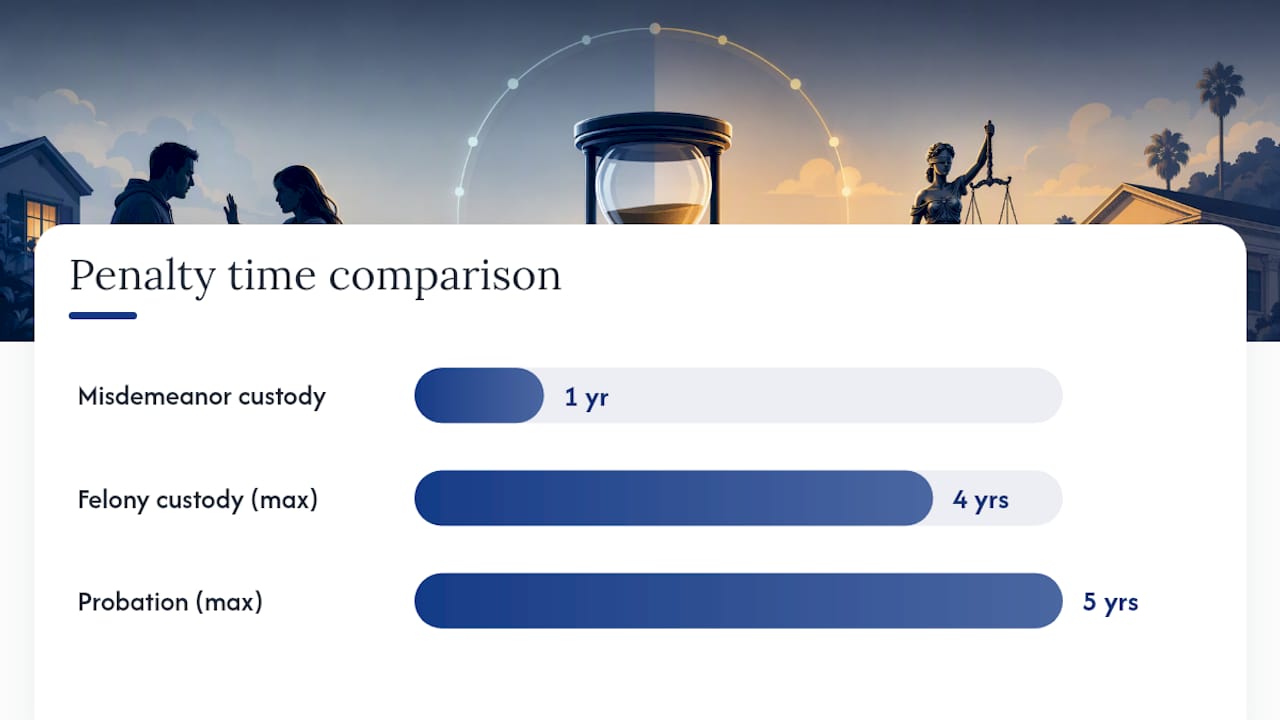
A misdemeanor conviction under PC 243(e)(1) carries up to one year in county jail and a fine of up to $2,000. Felony PC 273.5 convictions expose a defendant to two, three, or four years in state prison, and that range climbs further if the victim suffered great bodily injury or the defendant has prior DV convictions.
Sentencing isn't just jail time. Nearly every domestic violence conviction, misdemeanor or felony, comes bundled with conditions that outlast any custody:
- Formal probation, often three to five years, with regular check-ins.
- A 52-week batterer's intervention program, which Judicial Council guidance confirms is a standard condition of probation in these cases.
- Mandatory fees under PC 1203.097, which fund victim services and program administration on top of any base fine.
- A criminal protective order barring contact with the victim for the length of probation.
Pro Tip: Ask any attorney you consult specifically how PC 1203.097 fees stack with restitution in your case; the total financial exposure is often higher than the base fine alone suggests.
A conviction, or even an active protective order, can also trigger firearm surrender. That's a separate and immediate consequence worth understanding on its own.
DV Restraining Order California: TROs, DVROs, and Firearms
A domestic violence charge and a restraining order run on separate tracks, and the civil order often moves faster than the criminal case.
There's no court fee to request a domestic violence restraining order in California, and a judge typically rules on a temporary restraining order the same day or the next business day, according to California Courts self-help guidance. If granted, a full hearing follows within about three weeks, and a long-term DVRO issued at that hearing can last up to five years.
A DVRO can order more than "no contact." Common provisions include:
- Stay-away distance requirements, often 100 yards from the protected person, home, and workplace.
- Move-out orders, forcing the restrained party out of a shared residence regardless of whose name is on the lease.
- Firearm surrender, since anyone subject to a DVRO must relinquish guns, a requirement the California Attorney General's office enforces closely.
- Temporary custody and visitation terms for shared children.
If you've been served with a TRO or DVRO, read every line before doing anything else. Violating even one term, including an accidental text message, can become a separate criminal charge. Talk to counsel before you attempt any contact, even to discuss logistics like picking up personal belongings.
The Criminal Court Process: From Arrest to Sentencing
Domestic violence cases in California criminal courts move through a fairly predictable sequence, though timing varies by county caseload.
- Arrest and booking. Police typically make a warrantless arrest at the scene when they find probable cause, and the accused is booked and often held until arraignment.
- Arraignment, usually within 48 hours of arrest, is where charges are formally read and a plea is entered. This is the point to have an attorney in place, not after.
- Pretrial phase. Discovery, motions, and plea negotiations typically stretch over several weeks to a few months. A preliminary hearing applies in felony cases to determine if enough evidence exists to proceed.
- Trial or plea. Most domestic violence charges California cases resolve through plea agreements rather than trial, but either path can add several more months to the timeline.
- Sentencing follows a conviction or plea, where the judge sets custody, probation terms, and program requirements.
Some domestic violence matters split across tracks entirely. California Courts resources note that criminal, family, and juvenile dependency courts each handle different pieces of the same underlying conflict, which is part of why one incident can generate multiple, simultaneous court cases.
How to Defend Against Domestic Violence Charges
Effective defense strategy in these cases rarely hinges on a flat denial. It usually comes down to challenging the specifics: timeline gaps, inconsistent statements, and what the physical evidence actually shows.
Common defenses include self-defense, mistaken identity, lack of corroborating injury, and, in a meaningful number of cases, false or exaggerated allegations made during a custody dispute or breakup. Attorneys often focus on inconsistencies between a 911 call, medical records, and witness statements rather than arguing the incident never happened at all.
If you're under investigation or already charged, work through this in order:
- Get to a safe location and stay there.
- Photograph any injuries immediately, on both sides if applicable.
- Save texts, voicemails, and call logs without editing or deleting anything.
- Avoid all contact with the accuser, directly or through mutual friends.
- Write down witness names and contact information before memories fade.
- Contact a defense attorney before speaking further with police.
Pro Tip: Never delete a text thread or voicemail, even one that seems to hurt your case. Deleted messages can look like evidence tampering and often do more damage than the content itself.
A 72-hour post-arrest playbook can help you understand the practical steps around release while you line up representation. Legalleads exists precisely for the moment after that checklist: describe your situation in plain English and get matched with a qualified California attorney fast, without hunting through directories or waiting on hold.
Collateral Consequences of a Domestic Violence Conviction
The impact of a domestic violence conviction reaches well beyond the sentence itself.
- Employment and licensing: Many professional licenses, teaching credentials, and security clearances require disclosure of DV convictions, and some fields bar anyone with a domestic violence record outright.
- Immigration status: A domestic violence conviction is frequently treated as a deportable offense for noncitizens, regardless of sentence length.
- Custody and visitation: Family courts weigh a DV conviction heavily when deciding parenting time, sometimes requiring supervised visitation.
- Public record visibility: Court records are searchable, and background checks routinely surface DV convictions to landlords and employers.
Expungement under Penal Code 1203.4 doesn't erase everything. Firearm prohibitions and some licensing disclosures survive even after a case is expunged. Noncitizens and anyone in a regulated profession should raise these specific consequences with an attorney before entering any plea, not after.
Who's Actually Running the Case: The DA and Victim's Advocate
The named victim in a domestic violence case doesn't control whether charges move forward. The district attorney's office does.
Once police forward a report, a deputy district attorney reviews it and decides independently whether to file charges, what level, and whether to pursue enhancements. A victim asking to "drop the charges" doesn't end the case; California prosecutors regularly proceed even over a victim's objection, particularly when there's documented injury or a 911 recording that supports the allegation on its own.
Victim's advocates, usually attached to the DA's office or a local nonprofit, play a different role entirely. They don't decide charges. They help the accuser understand court dates, connect them with shelter or counseling resources, and explain what a protective order can and can't do. For the accused, understanding this separation matters: the advocate isn't a neutral party, but they also aren't the one making charging decisions. That authority sits with the prosecutor's office alone, guided by California domestic violence laws and internal charging policies that vary somewhat by county.
Victim Notification Rights and Procedures
California law requires prosecutors and courts to keep alleged victims informed at defined points in a domestic violence case, and this isn't optional courtesy. It's built into the process.
Victims typically receive notice of the defendant's release from custody, upcoming court dates, and any modification to a protective order. Many counties use automated victim notification systems that send alerts by phone or text when a defendant's custody status changes, which matters directly for safety planning.
Victims also have the right to submit a statement before sentencing and to request that a no-contact or protective order remain in place as a condition of probation. Prosecutors' offices generally coordinate this through victim-witness units, separate from the advocate resources mentioned above.
For the accused, this system has a practical implication worth understanding: prosecutors treat victim safety as a standing obligation throughout the case, not a one-time consideration at filing. That's part of why plea negotiations in domestic violence charges California cases so often include protective order terms even when jail time is minimal.
911 Calls and Digital Evidence in Domestic Violence Prosecutions
A 911 call is often the single most consequential piece of evidence in a domestic violence prosecution, sometimes more than the victim's later testimony.

Statements made during an active emergency generally qualify as admissible "excited utterance" evidence, meaning the recording can be played for a jury even if the alleged victim later declines to testify or recants. This is why prosecutors often build a case around the call itself rather than relying entirely on live testimony that could change.
Digital evidence beyond the 911 call increasingly shapes these cases too. Text messages, location data, video doorbell footage, and social media posts all get pulled into discovery. Timestamps matter enormously. A defense built around timeline inconsistencies, gaps between when an incident allegedly happened and when it was reported, often depends on exactly this kind of digital record. Attorneys frequently request preservation of surveillance footage or phone records early, before it's automatically deleted or overwritten.
If you're facing a charge, treat every digital trace as potential evidence in either direction. That includes anything on your own devices, which is part of why contacting counsel immediately, rather than trying to explain things directly to police, tends to protect your position better.
Risk Assessment Tools in Custody and Bail Decisions
Courts increasingly rely on structured risk assessment factors, not just a judge's instinct, when setting bail or deciding custody arrangements in domestic violence cases.
For bail and pretrial release, judges weigh factors like prior DV history, whether a weapon was involved, the severity of alleged injury, and any violation history on prior protective orders. Some California counties use formal risk assessment instruments to flag high-risk cases for closer pretrial supervision.
In family court, judges apply a similar lens when a domestic violence allegation intersects with a custody dispute. A documented DV conviction creates a rebuttable presumption against awarding primary custody to the convicted parent under California family law. That presumption can be overcome, but it requires an affirmative showing, not silence. This is one of the clearest places where a criminal case and a family law case collide, and it's worth raising with a family law attorney early if children are involved, rather than treating the criminal and custody matters as separate problems.
Diversion Programs and Alternatives to Prosecution
Not every domestic violence charge in California ends in a standard conviction track. Diversion, where available, lets a qualifying defendant complete specific conditions in exchange for reduced or dismissed charges.
Eligibility is narrower here than in many other misdemeanor categories. Legislative restrictions limit diversion access in domestic violence cases more than in general misdemeanor matters, and prosecutors retain significant discretion over whether to offer it at all. Where it is available, conditions typically mirror standard probation terms: batterer intervention classes, counseling, and no further contact with the protected party.
Mental health diversion under separate provisions can also apply in some domestic violence charges California cases when an underlying condition contributed to the conduct, though courts scrutinize these petitions carefully given public safety considerations. An attorney familiar with the local county's charging practices is often the fastest way to find out whether diversion is realistically on the table, since informal policies vary noticeably from one district attorney's office to the next.
Why Speed Matters More Than People Realize
Most people researching domestic violence charges California cases assume the criminal case is the whole story. It isn't. The restraining order track often moves faster and hits harder in the first 30 days, reshaping where someone lives and whether they can legally own a firearm before a single criminal hearing happens.
Legalleads built its intake process around that urgency. Describe the situation in plain English, get a case brief in under two minutes, and get matched to a qualified attorney within 24 hours. No long forms, no waiting on hold trying to find someone who handles domestic violence charges California cases specifically. Clients like Maria and David used the platform under real time pressure and got connected to counsel fast enough to matter for their restraining order hearings, not just their eventual trial dates.
— Admin
Get Matched With a California Attorney Today
Legalleads gets you in front of a qualified attorney faster than searching directories or cold-calling law firms one by one, which matters enormously when a restraining order hearing could be days away.

The process takes minutes, not days. Describe your situation in plain English, and the platform generates a case brief automatically, then routes it to attorneys who actually handle domestic violence charges California cases in your area. Most people hear back within 24 hours. There's no long intake form to fill out and no waiting on a call queue while a deadline approaches.
If your case involves both criminal charges and a family court dispute, Legalleads can also connect you with a family law attorney in Los Angeles so custody issues don't get handled separately from your criminal defense strategy. You can also browse matched attorneys directly if you'd rather review options before reaching out.
Your information stays confidential throughout the intake process. Start now: find a lawyer and get matched today.
Official California Resources and Court Forms
- DV-100 through DV-110 restraining order forms, the core paperwork for requesting a domestic violence restraining order.
- DV-505-INFO guidance from the Judicial Council, explaining how to complete forms and describe abuse.
- California Courts domestic violence resource hub, covering criminal, family, and juvenile court tracks.
- California Code, Penal Code 13700, the statutory definition of domestic violence.
- California Attorney General firearm surrender guidance for protective order compliance.
This article is general information, not a substitute for advice from a qualified lawyer. Consult a qualified legal professional about your own circumstances before acting on anything here.
Sources
- Ask for a domestic violence restraining order | California Courts | Self Help Guide
- California Code, PEN 13700
- DV-505-INFO How to Ask for a Domestic Violence Restraining Order (Domestic Violence Prevention) — Judicial Council
- California Attorney General guidance on firearm surrender tied to protective orders
FAQ
How long do you stay in jail for domestic violence in California?
Jail time depends on the charge level: a misdemeanor conviction under PC 243(e)(1) carries up to one year in county jail, while felony PC 273.5 convictions can bring two to four years in state prison, more with enhancements.
What happens to first-time domestic violence offenders in California?
First-time offenders often face probation with a 52-week batterer's intervention program, fines under PC 1203.097, and a protective order, though jail time is still possible depending on injury severity.
What happens in a domestic violence case in California?
A case typically starts with arrest and arraignment, moves through discovery and possible preliminary hearing, and resolves through a plea agreement or trial, often running parallel to a separate restraining order proceeding.
What percentage of domestic violence cases get dismissed?
Dismissal rates vary widely by county and case specifics, and no single reliable statewide figure applies; the outcome depends heavily on evidence strength, victim cooperation, and prosecutorial discretion.
Can a domestic violence charge affect child custody in California?
Yes. A documented conviction creates a rebuttable presumption against awarding primary custody to the convicted parent, and family courts weigh pending charges heavily even before a case resolves.