
The earliest a California divorce can be finalized is six months and one day from the date the respondent was served, a Response was filed, or a Stipulation was signed, whichever happens first. Uncontested cases with full agreement typically wrap up in 6 to 12 months. Contested cases involving custody fights, hidden assets, or business valuations often run 12 to 24 months or longer. Residency rules require six months in California and three months in the filing county before you can start.
TL;DR:
- Fully uncontested divorces typically take 6 to 9 months, starting from the earliest procedural event, such as signing an appearance or stipulation.
- Cases involving minor children often last 12 to 18 months due to custody evaluations and mandatory disclosures, which extend the timeline.
- Complex disputes over assets or high-net-worth cases can exceed 24 months because of business valuations, forensic accounting, and multiple discovery rounds.
- The divorce process begins once the respondent is served or responds, with the six-month waiting period only starting after the earliest of three procedural triggers.
- Proper preparation, early use of settlement options, and experienced legal help can reduce delays but cannot shorten the legally mandated six-month minimum wait.
Table of Contents
- How Long Does a California Divorce Take? Quick Scenarios
- The Step-by-Step California Divorce Process
- Forms and Deadlines You Need to Know
- What Actually Delays a California Divorce
- How to Keep Your Divorce on Schedule
- When an Attorney Changes Your Timeline
- An Editorial Take on DIY vs. Hiring Counsel
- How to Find a Family Law Attorney Fast
- Sources
- FAQ
How Long Does a California Divorce Take? Quick Scenarios
The six-month waiting period is a floor, not a target. Where your case lands on the calendar depends almost entirely on whether both spouses agree and how complicated your finances or parenting plan turn out to be.
Here's how the main scenarios typically play out:
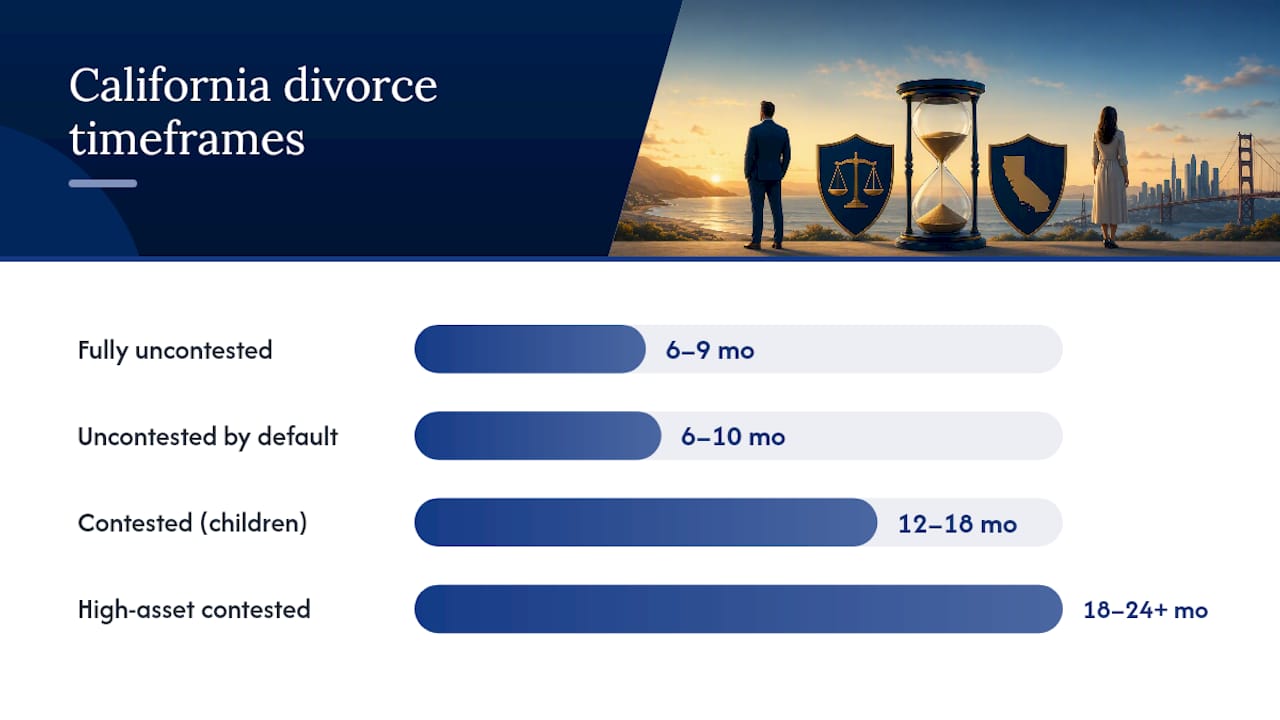
- Fully uncontested (both spouses agree on everything): Roughly 6 to 9 months. The clock starts the day the respondent signs an Appearance, Stipulation, or Waiver, which is often the fastest possible trigger since it doesn't require waiting for formal service.
- Uncontested by default (respondent never answers): Around 6 to 10 months. The clock starts on the date of service, and the petitioner must wait out the 30-day response window before moving toward a default judgment.
- Contested with minor children: Often 12 to 18 months. Custody evaluations, parenting plan disputes, and mandatory disclosure exchanges push most of these cases well past the statutory minimum.
- High-asset or contested property division: Frequently 18 to 24+ months. Business valuations, forensic accounting, and multiple rounds of discovery are the biggest time drains here.
Notice that the six-month clock rarely starts on your wedding anniversary of separation, and it never starts on the filing date alone. It starts on whichever of three procedural events happens first: service of the Summons and Petition, the filing of a Response, or the filing of an Appearance, Stipulation, or Waiver. That distinction trips up a lot of people who assume the moment they file for divorce is the moment the clock begins.
Your first move should match your scenario. If you're filing and your spouse agrees, get the Appearance/Stipulation signed as early as possible to start the clock sooner. If you expect resistance, budget time for formal service and the 30-day response window. If children or shared assets are involved, start gathering financial disclosures immediately. Don't wait for a court date to begin that paperwork.
The Step-by-Step California Divorce Process
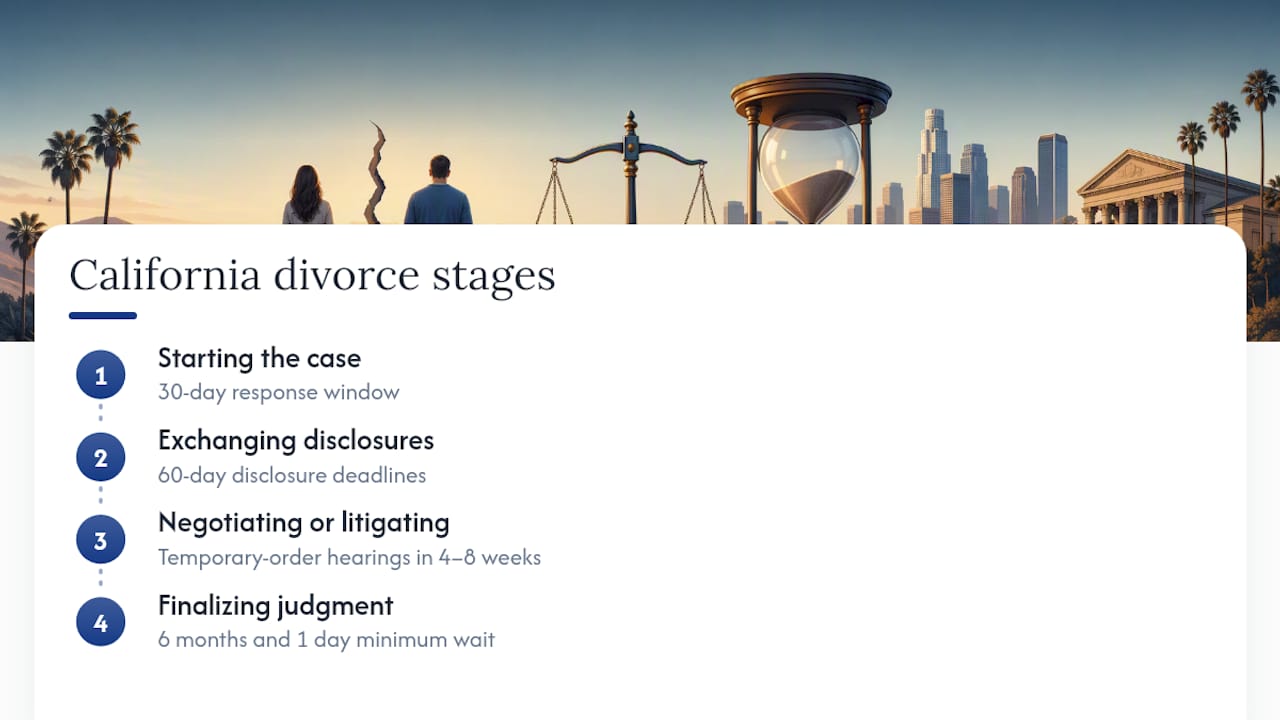
California calls it "dissolution of marriage," and the California Courts self-help system breaks it into four functional stages: starting the case, exchanging disclosures, negotiating or litigating the terms, and finalizing judgment. Here's what happens at each stage and roughly how long it takes.
1. Starting the case
You begin by filing a Petition (FL-100) for divorce, legal separation, or annulment, along with a Summons (FL-110). If you have minor children, you'll also file a Declaration Under UCCJEA (FL-105). Once filed, your spouse must be formally served with copies of these documents, and you'll file a Proof of Service (FL-115) confirming it happened. This stage takes anywhere from a few days (if your spouse agrees to sign a Notice and Acknowledgment of Receipt) to several weeks if you need a process server to track them down.
2. Service and response: the 30-day countdown
Once served, the respondent has 30 days to file a Response (FL-120). This deadline shapes everything downstream. If your spouse responds on time, the case moves into a two-sided negotiation or litigation track. If they don't respond at all, you can typically move toward a default judgment after that 30-day window closes, which is often faster since there's no opposing party to negotiate with. Missing this window is one of the most common reasons uncontested cases stall. A spouse who assumes silence works in their favor may find the case frozen until someone takes the next procedural step.
3. Financial disclosures: the 60-day window
Both spouses must exchange Preliminary Declarations of Disclosure, which include a Schedule of Assets and Debts (FL-142) or Property Declaration (FL-160), plus an Income and Expense Declaration (FL-150). The petitioner must serve these within 60 days of filing the petition, and the respondent must serve their own within 60 days of filing their Response. These disclosures are not optional paperwork you can skip if you're on friendly terms. California requires full financial transparency before a judge will finalize anything, and incomplete disclosures are one of the most frequent causes of delayed judgments.
4. Negotiation, mediation, and temporary orders
While disclosures are underway, many couples work through custody, support, and property terms through direct negotiation or court-connected mediation. If one spouse needs immediate relief, either can request temporary orders covering child support, spousal support, custody, or exclusive use of the family home while the case is pending. Temporary orders require a hearing, which typically adds four to eight weeks depending on your county's court calendar. Settlement conferences, whether informal or court-ordered, often happen here too, and a signed marital settlement agreement at this stage is what turns most contested filings into functionally uncontested ones by the time judgment rolls around.
5. Trial and final judgment
If spouses can't agree on every term, the case proceeds to trial, where a judge decides the unresolved issues. Trial adds significant time. Simply getting a trial date in a busy county can take several months due to court backlog, and the trial itself may span multiple hearing days spread over weeks. Once terms are settled, either by agreement or court order, the petitioner submits a Judgment (FL-180) for the judge's signature. After the judge signs, the court issues a Notice of Entry of Judgment (FL-190), which officially finalizes your divorce, but never before the six-month-and-one-day mark has passed. Courts won't backdate this. Even a fully agreed, paperwork-perfect case sits until that statutory floor is met.
Forms and Deadlines You Need to Know
Every California divorce runs on the same statutory skeleton, regardless of how contentious the case gets. Knowing the forms and deadlines below saves you from the most common paperwork mistakes.
Residency requirements:
- One spouse must have lived in California for at least 6 months, and in the filing county for at least 3 months, immediately before filing the Petition.
- Legal separation carries no residency requirement and no six-month waiting period, but converting a legal separation into a full divorce later means starting an entirely new dissolution case with its own six-month clock.
Core forms you'll encounter:
- FL-100 (Petition): Opens the case and states what you're asking the court to do.
- FL-110 (Summons): Formally notifies your spouse of the case and their 30-day response deadline.
- FL-115 (Proof of Service): Confirms the court that service was properly completed.
- FL-120 (Response): The respondent's formal answer to the Petition.
- FL-140 (Declaration of Disclosure): Cover sheet confirming financial disclosures were exchanged.
- FL-142 or FL-160 (Schedule of Assets and Debts / Property Declaration): Itemizes everything owned and owed.
- FL-150 (Income and Expense Declaration): Details income, expenses, and support calculations.
- FL-180 (Judgment): The proposed final judgment submitted for the judge's signature.
- FL-190 (Notice of Entry of Judgment): The court's confirmation that judgment has been entered.
Key deadlines:
- Response due 30 days after service.
- Disclosures served 60 days after filing (petitioner) or after Response (respondent).
- Earliest possible judgment date: 6 months and 1 day from the earliest qualifying start date.
The complete, current versions of every form live on the California Courts family law forms page, and it's worth downloading directly from there rather than a third-party template site, since forms get revised periodically.
What Actually Delays a California Divorce
Most divorces that blow past the six-month floor don't do it because of one dramatic fight. They do it because of a handful of predictable, well-documented friction points.
- Discovery disputes and hidden assets. When one spouse suspects the other is underreporting income or hiding accounts, formal discovery, including subpoenas, depositions, and sometimes forensic accountants, can add several months on its own.
- Custody disputes. Court-ordered parenting evaluations and custody assessments are common in contested cases involving minor children, and scheduling those evaluators alone can eat up weeks before a report even gets written.
- Business or property valuation fights. Valuing a family business, a pension, or investment real estate often requires a neutral appraiser, and disagreements over valuation methodology can trigger competing expert reports.
- Court backlog. Some counties simply have more filings than judges. Getting a hearing date or trial slot in a high-volume county can take longer than the underlying dispute would suggest.
- Uncooperative parties. Repeated continuances, missed disclosure deadlines, or a spouse who won't accept service all stretch out cases that would otherwise be simple.
Pro Tip: If you suspect your spouse is hiding assets, don't wait for the disclosure deadline to raise it. Flag your concerns to the court or your attorney early, since forensic accounting requests take time to schedule and even longer to complete once ordered.
Custody-heavy cases deserve a special note. When a judge orders a full parenting evaluation, that process alone often adds several months, independent of anything else happening in the case. If your case involves questions about a parent's fitness or a child's safety, review resources on restraining orders in California, since temporary protective orders can run on a parallel track that affects your overall schedule.
How to Keep Your Divorce on Schedule
You can't shorten the six-month floor, but you have real control over almost everything else. Here's where to focus your energy.
- Gather your financial documents before you file. Pull together the last two years of tax returns, recent bank and retirement statements, mortgage or title paperwork, and pay stubs. Having these ready before the 60-day disclosure clock starts prevents the single most common source of delay.
- Use mediation or settlement conferences early. A neutral mediator or a written settlement agreement resolves disputes without waiting for a trial date, and many California courts require a settlement conference before they'll even schedule one.
- Request temporary orders if you need immediate stability. If support, custody, or use of the home can't wait six months, file for temporary orders early. It adds a hearing, but it prevents bigger blowups later that could genuinely derail the case.
- Serve papers correctly the first time. A Proof of Service filled out incorrectly, or service that doesn't meet legal requirements, can force you to restart the response clock. A tool like a custody schedule generator can also help you walk into negotiations with a concrete parenting plan proposal rather than starting from scratch.
- Bring in an attorney when the stakes justify it. If your case involves a business, significant retirement assets, or a custody dispute, a lawyer familiar with your county's court calendar can move things faster than most people manage alone. Platforms that match you with family law counsel quickly can matter here, particularly when you're racing to get in front of a judge for temporary orders.
When an Attorney Changes Your Timeline
A straightforward, fully agreed divorce with no kids and modest assets often doesn't need a lawyer to hit the six-month floor. Complexity is where legal representation starts paying for itself in time saved, not just outcome quality.
Legalleads lets you describe your situation in plain English and get a case brief in under two minutes, then connects you with a qualified family law attorney within 24 hours. There's no lengthy intake call, no stack of forms to fill out just to get a referral. For someone dealing with a custody dispute that needs a temporary order this week, or a spouse who suspects hidden business income, that speed matters. The gap between "I think I need a lawyer" and "I'm talking to one" is often where cases lose weeks.
An attorney tends to shorten your timeline most when your case involves contested custody, a business or complex asset pool, or a spouse who's dragging out discovery. In simpler cases, the value shows up more in avoiding mistakes than in shaving months off the calendar.
An Editorial Take on DIY vs. Hiring Counsel
Most people default to one of two extremes: they either assume they need a lawyer for everything, or they assume a divorce is simple paperwork they can handle alone with a weekend and a court website. Neither instinct holds up well once you look at where cases actually go sideways.
The honest dividing line isn't income level or how amicable the split feels on day one. It's whether your case involves minor children, a business, or assets complicated enough that a mistake in the disclosure phase could cost you real money later. If none of those apply, methodical use of the official California Courts forms and a cooperative spouse can genuinely get you through in something close to the statutory minimum.
Where people get burned is assuming goodwill early in the process will survive a disagreement over a 401(k) valuation eight months in. Document everything from day one. Assume the disclosure deadlines are real even if your spouse is being friendly about it. And if custody or a business is on the table, get a professional opinion before you're deep enough into the process that switching strategies costs you months you don't have.
— Admin
How to Find a Family Law Attorney Fast
Once you know your case needs professional help, the next problem is speed. Calling firms one by one, sitting through intake calls, and waiting days for a callback burns exactly the kind of time a contested custody dispute or a hidden-asset fight can't afford.

Legalleads was built for that gap. Describe your situation in plain English, get an AI-generated case brief in under two minutes, and get matched with a qualified family law attorney within 24 hours, no phone tag, no lengthy forms. It works particularly well when you need to move fast: requesting an emergency temporary order, responding to a Petition before the 30-day deadline closes, or untangling a property dispute before disclosures are due. If you're in Los Angeles, Orange County, or San Bernardino County, Legalleads also maintains local attorney directories for family lawyers in Los Angeles, Orange County, and San Bernardino. Start by describing your case on the Legalleads attorney matching page and see who you're matched with.
This article is general information, not a substitute for advice from a qualified lawyer. Consult a qualified legal professional about your own circumstances before acting on anything here.
Sources
- FL-107-INFO: Legal steps for a divorce or legal separation (California Courts)
- The divorce process | California Courts | Self Help Guide
- How Long Does a Divorce Take in California? A Complete Timeline Guide
FAQ
How long does it take to get a divorce in California on average?
Uncontested cases typically finish in 6 to 12 months, while contested cases involving custody or complex assets often run 12 to 24 months or longer. The legal floor is six months and one day from the qualifying start date, but very few cases finalize exactly on that date.
What assets can't be split in a California divorce?
Separate property, meaning assets owned before marriage, inheritances, or gifts received individually, generally stays with the original owner rather than being divided. Community property, which includes most assets acquired during the marriage, is subject to division, though tracing separate property that got mixed with community funds can complicate the split.
What is the typical timeline for getting a divorce in California?
The process runs through four phases: filing and serving the Petition, exchanging financial disclosures within 60 days, negotiating or litigating unresolved terms, and finalizing judgment no earlier than six months and one day after the case's qualifying start date. Simple, agreed cases move through these phases in roughly 6 to 9 months.
What is the "10 year rule" for divorce in California?
The 10-year rule refers to spousal support duration, not the divorce timeline itself: in marriages lasting 10 years or longer, courts generally don't set a fixed end date for spousal support, leaving it open for future modification. It has no bearing on how long the divorce case itself takes to finalize.
Can I speed up my California divorce past the six-month minimum?
No. The six-month-and-one-day waiting period is a statutory floor that courts cannot waive, regardless of how quickly both spouses agree on terms. What you can control is everything leading up to that date, like completing disclosures early and avoiding unnecessary continuances, so your judgment is ready to finalize the moment the clock runs out.