
The base filing fee for a California divorce is $435 to $450 per petition, with fee waivers available for low-income filers. Beyond that fee, total costs vary enormously: an uncontested divorce with no lawyers typically runs a few hundred to a few thousand dollars, while a contested case involving custody fights or complex assets can climb into the tens of thousands per spouse. The single biggest cost driver isn't the court. It's how much your spouse disagrees with you.
TL;DR:
- The total cost of a California divorce varies widely, from under $1,000 for uncontested cases to tens of thousands for contested disputes.
- Court fees are fixed at about $435 to $450, but ancillary costs like appraisals, QDROs, and custody evaluations can significantly increase the total expenditure.
- Contested divorces involving custody, assets, or complex property often run around $17,500 per spouse, with higher amounts if multiple court appearances or expert witnesses are needed.
- Mediation, with fees between $150 and $400 an hour split between spouses, generally offers the most affordable route for reaching agreements without trial.
- Getting written estimates from multiple attorneys early can help prevent unexpected expenses and provide a clearer budget before proceeding.
Table of Contents
- Divorce Cost California: Price Ranges by Path
- What Drives Costs From Cheap to Expensive
- Court Fees, Fee Waivers, and the New Low-Cost Filing Option
- The Hidden Costs Nobody Budgets For
- How to Actually Lower Your Divorce Costs
- How Long It Takes and Why That Affects Your Bill
- Finding an Attorney Without Losing Weeks to Phone Calls
- Cost Implications of Custody and Support Proceedings
- What Divorce Mediation Sessions Actually Cost
- Spousal Support Costs: Negotiation and Enforcement
- Why the Filing Fee Is the Least Important Number
- Get Matched With a California Family Lawyer Fast
- Sources
- FAQ
Divorce Cost California: Price Ranges by Path
Every California divorce starts with the same $435 to $450 filing fee for Form FL-100. What happens after that filing determines whether you spend $600 or $60,000.
DIY or summary dissolution. If you and your spouse agree on everything and qualify for summary dissolution (short marriage, limited assets, no kids), total cost often lands under $1,000. That covers the filing fee, service costs, and maybe a notary. No attorney required.
Online document services plus flat-fee review. Many uncontested couples use a document preparation service, then pay a flat fee to a lawyer to review the paperwork before filing. Expect $500 to $2,500 total, depending on how much attorney oversight you want.
Mediation and collaborative divorce. Couples who need help reaching agreement but want to avoid litigation typically spend $3,000 to $10,000 combined, split between both spouses. That figure covers mediator time and any attorney consultations along the way.
Contested litigation. This is where costs separate from everything else. Aggregated estimates from legal-cost trackers put litigated divorces commonly in the tens of thousands of dollars per spouse, and a statewide average cost of about $17,500 per spouse has been reported when children or disputed assets are involved.
Statistic Callout: Journalistic reporting places the average California divorce cost at roughly $17,500 per spouse, a figure driven up sharply by contested custody and property disputes rather than the base court fee.
A few things shift these ranges regardless of path:
- Los Angeles and San Francisco attorneys commonly bill higher hourly rates than attorneys in inland counties, which raises total cost even for straightforward cases.
- Every added asset category (a house, a business, retirement accounts) adds paperwork and often a professional fee.
- Cases that start uncontested but turn contentious mid process jump cost brackets fast.
Aggregated fee estimates from legal-cost calculators consistently show this same pattern: the gap between "we agree" and "we don't" is worth tens of thousands of dollars, not hundreds.
What Drives Costs From Cheap to Expensive
Attorney billing structure explains most of the spread between a $2,000 divorce and a $40,000 one. California family lawyers typically charge hourly rates and require an upfront retainer, a deposit drawn down as work happens. Every hearing, every round of document exchange, every phone call adds hours. A case that needs three court appearances instead of zero can add $5,000 to $15,000 in fees alone.
Certain case elements reliably push costs higher:
- Custody disputes. Contested parenting time often triggers custody evaluations, additional hearings, and sometimes a court-appointed evaluator.
- Business ownership. Valuing a business for division commonly costs $3,000 or more on top of legal fees.
- Real property and retirement accounts. Splitting a house or a pension usually requires an appraisal and a Qualified Domestic Relations Order (QDRO), each a separate professional fee.
- Discovery and expert witnesses. When one spouse suspects hidden assets or income, formal discovery and forensic accountants enter the picture, and their invoices add up fast.
- Enforcement hearings. Going back to court after judgment to enforce support or custody orders restarts the billing clock.
Pro Tip: Ask your attorney to flag, in writing, which parts of your case are likely to require outside experts before you sign a retainer. A five-minute conversation up front can save you from an unpleasant $4,000 surprise later.
Court Fees, Fee Waivers, and the New Low-Cost Filing Option
The statewide filing fee for a Petition for Dissolution (Form FL-100) runs $435 to $450, but each county court publishes its own exact clerk charge, so confirm the number with your local court before you file.
If that fee would create a real financial hardship, you can request a waiver:
- File Judicial Council Form FW-001 with your petition.
- Qualify automatically if you receive certain public benefits, or show your household income falls under a set threshold.
- Ask the clerk about partial waivers if you don't qualify for a full one.
California also recently widened the door for low-cost joint filing. SB1427 expanded eligibility for a streamlined joint petition, letting more couples, including many with children, file together for a single $435 fee when they've already agreed on custody, support, and property terms before filing. The catch: this route only works when both spouses agree in advance. If there's still a live dispute over any major term, you're back to the standard contested track.
The Hidden Costs Nobody Budgets For
The filing fee is the number everyone quotes. It's rarely the number that determines your final bill. Ancillary costs pile up around the edges of a case, and they hit hardest in the categories below.
- Service of process. Having your spouse formally served typically costs $50 to $150 through a process server, plus any certified copy fees from the court clerk.
- Appraisals. Real estate and business valuations run $400 to $700 for a standard property appraisal, with business valuations frequently starting at $3,000 and climbing depending on complexity.
- QDRO drafting. Dividing a 401(k) or pension requires a Qualified Domestic Relations Order, typically $750 to $3,000 or more depending on the plan and drafting attorney.
- Custody evaluators. When parents can't agree on a parenting plan, court-appointed evaluators commonly charge $2,500 to $6,000 for a full evaluation.
- Two-household living costs. Once spouses separate, rent, utilities, and health insurance often double before the divorce even finalizes, an expense that outlasts the legal process itself.
None of these costs show up on the court's fee schedule. All of them show up on your bank statement.
How to Actually Lower Your Divorce Costs
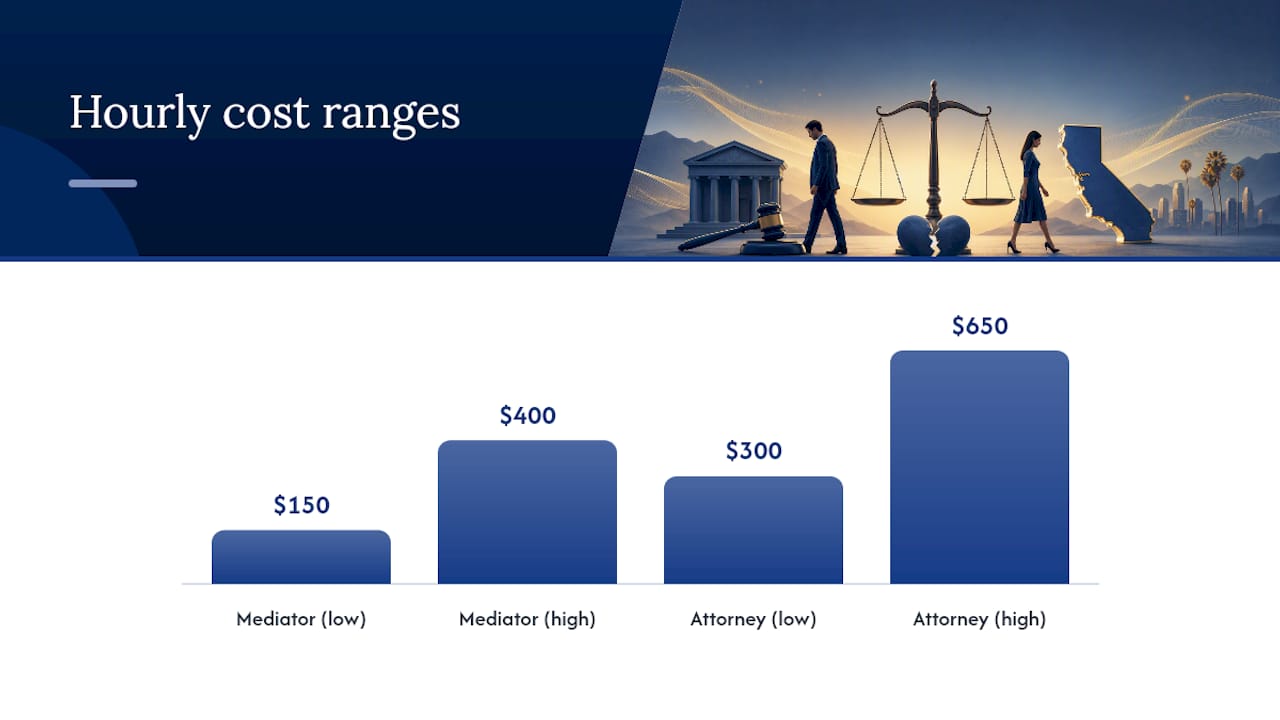
Mediation is the most reliable cost lever available to most couples. Mediators in California typically charge $150 to $400 an hour, compared to attorney hourly rates commonly running $300 to $650 in major metro areas. Because mediation resolves disputes in joint sessions instead of adversarial motions, it usually takes fewer total hours to reach agreement, which compounds the hourly savings.
A few other moves keep the bill down without giving up representation entirely:
- Check summary dissolution eligibility first. Short marriages with limited assets and no kids may qualify for the fastest, cheapest track available.
- Use online document services carefully. They can handle routine paperwork cheaply, but skipping attorney review on anything involving property or support is a common way to create expensive problems later.
- Ask for limited-scope representation. Many California attorneys will handle just the parts of your case you need help with, a single hearing, a document review, rather than full representation billed hourly for everything.
- Get a written estimate before you sign anything. A written breakdown separating base attorney fees from likely ancillary costs (appraisals, QDROs, experts) makes budgeting far more accurate than a verbal ballpark.
Pro Tip: If mediation feels like a stretch because you and your spouse can't agree on much, ask about a hybrid model: mediation for the easy issues, limited-scope attorney help for the one or two sticking points. It's often cheaper than an all-or-nothing choice between full litigation and full mediation.
Reviewing how to identify the type of legal help you actually need before you hire anyone can prevent you from paying for full representation when limited-scope help would do the job.
How Long It Takes and Why That Affects Your Bill
California imposes a mandatory six-month waiting period that starts running from the date your spouse is formally served, not the date you file. Even the fastest, most amicable divorce cannot finalize before that clock runs out.
In practice, timelines break down roughly like this: uncontested cases typically wrap up around 7 to 8 months once you account for the waiting period and paperwork processing. Mediated cases usually run 6 to 12 months, depending on how many sessions it takes to reach full agreement. Contested cases routinely stretch 12 to 24 months or longer when custody battles or asset disputes drag through discovery and hearings.
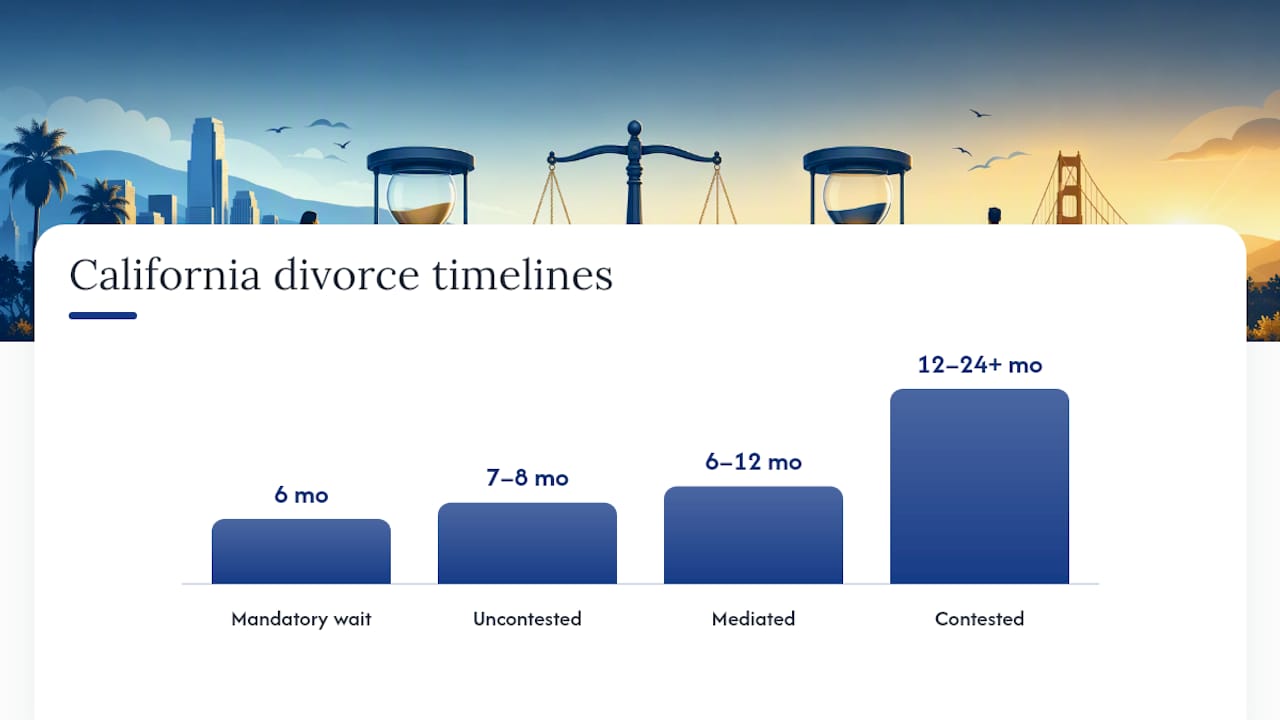
Time and money move together here. Every extra month in a contested case is another round of attorney billing, another month of running two households, and another month before you can move on financially. For a deeper look at how the waiting period mechanics work, see California's divorce timeline explained.
Finding an Attorney Without Losing Weeks to Phone Calls
Comparing fee estimates matters, but only if you can actually get in front of attorneys fast enough to compare. A certain intake process addresses that exact bottleneck: describe your situation in plain English, and the platform generates a case brief in under two minutes, then matches you with qualified California attorneys within 24 hours.
That speed matters most in the early cost-comparison stage. Instead of calling five family law firms and waiting days for callbacks, you get connected directly and can request written estimates from multiple attorneys in the same week. Some clients have used the platform to get matched quickly rather than spending weeks cold-calling firms.
Once you're matched, ask each attorney the same set of questions: What's your hourly rate? What's the retainer amount? What ancillary costs do you expect for a case like mine? Get every answer in writing before you sign.
Cost Implications of Custody and Support Proceedings
Adding children to a divorce case changes the cost equation more than almost any other factor. A childless uncontested divorce might resolve with a single mediation session and a signed agreement. Add custody and child support into the mix, and you introduce an entirely separate set of legal issues: parenting schedules, decision-making authority, and support calculations that both spouses have to agree on or litigate.
When parents disagree on custody, courts often order mediation through Family Court Services first, sometimes at low or no cost through the county. If that doesn't resolve things, the case moves toward custody evaluations, which commonly run $2,500 to $6,000, plus additional attorney hours preparing for and attending custody hearings.
Child support calculations themselves are formula driven under California guidelines, so the math isn't usually contested. What gets expensive is disagreement over the inputs: one parent's actual income, work-related childcare costs, or health insurance contributions. Each disputed input can mean another round of financial disclosure and, occasionally, a forensic accountant.
The practical takeaway: if you and your co-parent can agree on a parenting plan and support figures before involving attorneys, you skip most of this expense entirely. If you can't, budget for it as a separate cost category from your property division, because it often becomes the more expensive fight.
What Divorce Mediation Sessions Actually Cost
A single mediation session in California typically runs two to three hours, billed at the mediator's hourly rate of $150 to $400. Straightforward cases, no kids, modest assets, general agreement on major terms, sometimes resolve in two or three sessions. More complicated cases involving business interests, real estate, or contentious custody terms can take six or more sessions before both spouses sign off.
Most mediators either bill hourly per session or offer a flat package rate covering a set number of sessions plus the final agreement drafting. Flat packages tend to appeal to couples who want cost certainty, while hourly billing suits couples confident they'll wrap up quickly.
One detail people miss: mediation fees are typically split between both spouses, which is part of why total mediation costs land so far below litigation costs even at similar hourly rates. A $300 an hour mediator shared by both spouses costs each person roughly the same as a $150 an hour attorney working solo, except mediation usually needs fewer total hours because there's no opposing counsel racking up separate time.
Mediation doesn't replace legal advice entirely. Many couples still pay an attorney a flat fee to review the final agreement before signing, typically a few hundred to around $1,000, cheap insurance against a poorly worded settlement term.
Spousal Support Costs: Negotiation and Enforcement
Spousal support, commonly called alimony, adds its own layer of expense on top of the base divorce cost. Unlike child support, California has no fixed formula for long-term spousal support after judgment, which means the amount and duration are often negotiated or litigated, and negotiation takes attorney hours.
Temporary spousal support during the case is usually calculated using a guideline formula, so that part tends to move quickly. Long-term support terms, what happens after the divorce finalizes, are where disputes drag on. Disagreements over one spouse's earning capacity, the paying spouse's ability to pay, or the length of the marriage as it relates to support duration can each add rounds of financial disclosure, expert testimony, and hearing time.
Enforcement adds another cost layer entirely. If a paying spouse falls behind or stops paying, the receiving spouse typically needs to file an enforcement motion, which means another attorney retainer or hourly billing cycle just to collect money already ordered. Understanding how spousal support decisions get made and preserved before you negotiate can help you avoid agreeing to terms that are difficult or expensive to enforce later.
The practical budgeting lesson: if spousal support is likely to be contested in your case, treat it as its own line item separate from property division and custody, because it can extend your total timeline and legal spend independently of everything else.
Why the Filing Fee Is the Least Important Number
The most common mistake people make when researching divorce costs in California is fixating on the $435 to $450 filing fee as if it represents the real cost of divorce. It doesn't. It's a floor, not an estimate. The conventional advice you'll find on most cost calculators treats divorce pricing like a menu with fixed items, when in reality it behaves more like a negotiation that gets more expensive every time a disagreement can't be resolved without a judge.
What the numbers actually show is that conflict, not complexity, is the real cost driver. A couple with a business, a house, and two kids who agree on everything will spend far less than a couple with no assets and no kids who can't agree on anything. That's the opposite of how most people intuitively budget for divorce.
If there's one thing worth prioritizing above all else, it's getting a written fee estimate from more than one attorney before committing to a retainer. Verbal ballparks tend to undercount the ancillary costs that end up dominating the final bill. The fastest way to get several comparable estimates without burning weeks on phone tag is to get matched with multiple qualified attorneys at once and put the same questions to each of them.
— Admin
Get Matched With a California Family Lawyer Fast
Comparing fee estimates only works if you can get real quotes without spending weeks chasing callbacks. An online intake platform offers a faster alternative to cold-calling firms one by one: describe your situation in plain English, get a case brief in under two minutes, and get matched with qualified California family law attorneys within 24 hours.

Once matched, ask each attorney for a written fee estimate that separates their base rate and retainer from likely ancillary costs, appraisals, QDROs, custody evaluators, so you're comparing real numbers instead of guesses. Readers in the Los Angeles area can go directly to family lawyer matches in Los Angeles or family lawyer matches in Orange County. For anywhere else in the state, start with Legalleads' find-a-lawyer page and get your case brief moving today.
This article is general information, not a substitute for advice from a qualified lawyer. Consult a qualified legal professional about your own circumstances before acting on anything here.
Sources
- File divorce papers | California Courts | Self Help Guide
- SB1427 bill text | California Legislative Information
- California expands low-cost divorce option to more couples, particularly those with children - Los Angeles Times
- Divorce Cost in California (2026) | CostPrism
FAQ
What is the cheapest way to get a divorce in California?
Summary dissolution or an uncontested filing where both spouses agree on all terms is the cheapest route, often costing under $1,000 total when no attorney is involved beyond a document review.
Is California a 50/50 divorce state?
California is a community property state, meaning most assets and debts acquired during the marriage are generally divided equally, though separate property and certain exceptions can affect the split.
What is a wife entitled to in a divorce in California?
Under community property rules, a wife is generally entitled to half of the marital assets and debts, plus possible spousal support depending on income, marriage length, and earning capacity, regardless of gender.
What is the 6-month rule for divorce in California?
California requires a mandatory six-month waiting period from the date your spouse is formally served before a divorce can be finalized, even if both spouses agree on every term.
How much does an average California divorce actually cost?
Reported statewide averages put the cost around $17,500 per spouse, though uncontested cases commonly cost far less and heavily contested cases often cost more.