
Online businesses in the US operate under a layered set of legal obligations that traditional brick-and-mortar companies rarely face at the same scale. When you describe a business legal issue online, you are typically dealing with one or more of these core challenges:
- Data privacy compliance under laws like the California Consumer Privacy Act (CCPA) and the California Privacy Rights Act (CPRA)
- Intellectual property protection, including copyright, trademark, and DMCA compliance
- Sales tax obligations across multiple states following the South Dakota v. Wayfair ruling
- Contract enforceability, covering Terms of Service, Privacy Policies, and ecommerce agreements
- Online defamation and reputation damage from false reviews or social media posts
- Federal Trade Commission (FTC) advertising rules, including endorsement disclosures
- Jurisdictional complexity, where a single customer in a different state can trigger new legal duties
- Payment processing and chargeback disputes
- Domain name theft and cybersquatting
- Data breach notification requirements under state and federal law
The borderless nature of digital business is the main driver of this complexity. Invisible risks, such as a missing disclosure clause or an improperly configured tracking pixel, can scale into costly lawsuits faster than most entrepreneurs expect.
1. What are the key legal issues for internet businesses and ecommerce operations?
ECommerce businesses face a distinct set of regulatory pressures that go beyond standard business law. The Wayfair decision fundamentally changed sales tax obligations: online sellers must now collect and remit sales tax in states where they meet economic nexus thresholds, often $100,000 in annual revenue or a set number of transactions, even without a physical presence there.
Consumer protection laws add another layer. The FTC requires clear refund and return policies, accurate product descriptions, and upfront disclosure of all mandatory fees before checkout. "Drip pricing," where fees appear only at the final checkout step, is an enforcement target.
Payment processing carries its own legal risks. Your Terms of Service must align with your actual refund and cancellation practices, because clear Terms of Service are what payment processors use to adjudicate disputes and determine chargeback outcomes. A mismatch between your stated policy and your actual practice weakens your position in every dispute.
Key compliance areas for ecommerce operators:
- Sales tax nexus: Track revenue and transaction counts in each state where you sell
- CAN-SPAM Act: Governs commercial email, including opt-out mechanisms
- COPPA: Applies if your site collects data from children under 13
- Chargeback documentation: Maintain transaction records, delivery confirmations, and signed agreements
- Fraud prevention: Use address verification, CVV checks, and fraud scoring tools
2. How do domain names and trademark law protect your online brand?
Your domain name is your primary business address online, and losing it, or having a near-identical one registered by a bad actor, can redirect customers and destroy brand trust. Cybersquatters register domain names similar to established brands with the intent to sell them at inflated prices or divert traffic.

Proactive trademark registration with the US Patent and Trademark Office (USPTO) is the strongest defense against bad-faith registrations. A registered trademark gives you clear legal standing to challenge infringing domain registrations through the Uniform Domain-Name Dispute-Resolution Policy (UDRP) or the Anti-Cybersquatting Consumer Protection Act (ACPA).
Username squatting on social media platforms is a related threat. A third party can register your brand name as a social media handle, publish harmful content under your identity, and prevent you from controlling your own trademark online. Registering your brand name across major platforms early is the simplest preventive measure.
Best practices for domain and trademark protection:
- Register your trademark with the USPTO before launching publicly
- Secure your primary domain plus common variations (.net, .org, .co)
- Monitor for new domain registrations that mimic your brand using services like MarkMonitor
- Register social media usernames on all major platforms, even ones you do not actively use
- Act quickly on infringement: delay weakens UDRP and ACPA claims
3. What does DMCA compliance require from online businesses?
The Digital Millennium Copyright Act (DMCA) governs how online businesses handle copyrighted content, both content they publish and content uploaded by users. The law's safe harbor provisions protect platforms from liability for user-generated copyright infringement, but only when specific conditions are met.
To qualify for DMCA safe harbor, your business must designate a registered DMCA agent with the US Copyright Office, post a clear copyright policy on your site, and respond promptly to valid takedown notices. Ignoring a properly formatted takedown notice eliminates your safe harbor protection and exposes you to direct infringement liability.
The notice-and-takedown process works in both directions. If someone uses your copyrighted content without permission, you can send a DMCA takedown notice to the hosting platform or service provider. Platforms are required to act on valid notices. For businesses that publish substantial original content, registering copyrights with the US Copyright Office strengthens your enforcement position and enables statutory damages in litigation.
DMCA compliance checklist:
- Register a DMCA agent at copyright.gov/dmca-agent
- Publish a copyright policy and DMCA takedown procedure on your website
- Respond to takedown notices within the timeframe your policy specifies
- Document all takedown requests and responses
- Conduct periodic audits of user-uploaded content on your platform
4. What privacy laws apply to your online business, and what do they require?
Privacy compliance is one of the most consequential legal concerns for online businesses in 2026. The US does not have a single national privacy law. Instead, a patchwork of state laws applies simultaneously, depending on where your customers are located.
California's CCPA and its successor, the CPRA, are the most far-reaching. They grant California residents the right to know what personal data you collect, the right to delete it, and the right to opt out of its sale. Intentional CCPA violations can result in substantial fines per violation, with no defense based on ignorance of the requirements. Virginia's Consumer Data Protection Act (VCDPA), Colorado's Privacy Act, and similar laws in more than a dozen other states impose comparable obligations.
Statistic callout: Under the CCPA, a single intentional violation can cost a business $7,500 per incident, with no ignorance defense available.
Tracking technologies add further complexity. If your site uses tools like the Meta Pixel, Google Analytics, or session replay software, you need properly configured consent management. Recent litigation under the California Invasion of Privacy Act (CIPA) has targeted businesses that deploy these tools without adequate user consent.
Privacy compliance requirements:
- Privacy Policy: Must disclose what data you collect, how you use it, and how users can exercise their rights
- Cookie consent: Obtain explicit consent before placing non-essential cookies
- Data access requests: Respond to consumer requests to access or delete their data within required timeframes
- COPPA: Obtain verifiable parental consent before collecting data from children under 13
- Data breach notification: Most states require notification within 30–72 hours of discovering a breach
5. What social media legal risks should online businesses watch for?
Social media creates legal exposure across several categories at once: defamation, FTC advertising violations, privacy breaches, and content liability. Each carries distinct legal standards and response requirements.
Online defamation requires more than a negative review to meet the legal threshold. A statement must be false, presented as fact rather than opinion, and cause actual harm to your reputation. When a post does meet that standard, rapid action matters. Cease-and-desist letters and platform removal requests are the first steps; the longer defamatory content stays live, the harder it becomes to contain the damage.
The FTC's endorsement rules apply to every sponsored post, influencer collaboration, and paid testimonial your brand is connected to. Enforcement responsibility falls on the brand, not the influencer. Disclosures must be clear and conspicuous, not buried in hashtags or fine print. The FTC has taken enforcement action against brands whose influencer partners failed to disclose material connections.
Social media legal risks to monitor:
- Defamation exposure: False statements of fact published about your business by competitors, former employees, or customers
- FTC disclosure violations: Sponsored content without clear "#ad" or equivalent disclosure
- Privacy risks: Employee posts that inadvertently expose customer data or confidential business information
- Content ownership disputes: User-generated content repurposed without proper licensing
- Platform dependency: Account suspensions can cut off your primary customer communication channel overnight
6. Why do your Privacy Policy and Terms of Use carry legal weight?
Your website's legal documents are not formalities. They create enforceable obligations, define dispute resolution procedures, and set the boundaries of your liability. Courts treat them as contracts, and the way you present them determines whether they hold up.
Clickwrap agreements, where users actively check a box or click "I agree" before completing a purchase, are the most enforceable format. Browsewrap agreements, where terms are simply posted at the bottom of a page without requiring affirmative consent, are far less likely to be enforced by courts. The distinction matters most when a dispute reaches litigation.
Generic template legal documents can undermine your legal position. Courts have treated them as evidence of inadequate business diligence, particularly when the template language does not match the actual business operation. A refund policy that says "no refunds" while your checkout page promises "satisfaction guaranteed" creates a direct contradiction that regulators and courts will resolve against you.
Key clauses every online business needs in its Terms of Service:
- Dispute resolution: Specify arbitration or litigation, and the governing state
- Limitation of liability: Cap your exposure for indirect or consequential damages
- Refund and cancellation policy: Match exactly what your marketing copy promises
- IP ownership: Establish who owns content created on or through your platform
- Update notification: Explain how and when users will be notified of changes to terms
7. What legal rules apply to online sweepstakes, contests, and domain security?
Online sweepstakes and contests are heavily regulated and frequently misunderstood. Depending on the structure of your promotion, you may need to comply with the laws of all 50 states simultaneously, and some states require registration and bonding before you can run a sweepstakes at all. The core legal distinction is between a sweepstakes (winner chosen by chance, no purchase required), a contest (winner chosen by skill), and a lottery (chance plus consideration). Lotteries are illegal for private businesses in the US.
Transparent contest terms are a legal requirement, not just good practice. Rules must clearly state eligibility, entry methods, prize descriptions, odds of winning, and the sponsor's identity. The FTC and state attorneys general monitor promotions for deceptive terms.
Domain theft is a separate but equally serious threat. Recovering a hijacked domain is time-consuming and expensive. Preventive steps are far more practical:
- Enable domain lock features through your registrar to prevent unauthorized transfers
- Use registrar-level two-factor authentication
- Keep WHOIS contact information current so transfer notifications reach you
- Register your trademark before your domain, giving you the clearest legal basis for recovery under UDRP or ACPA if theft occurs
- Monitor expiration dates and set domains to auto-renew
8. How does multi-jurisdictional compliance create unique risks for online businesses?
Operating online means your legal obligations do not stop at your home state's border. A customer in Texas, New York, or Illinois can trigger sales tax nexus, consumer protection obligations, or privacy law requirements that differ from your home state's rules. US online businesses face a fragmented legal environment with overlapping federal and state laws requiring compliance across multiple jurisdictions at the same time.
Federal agencies including the FTC, the Consumer Financial Protection Bureau (CFPB), and the Federal Communications Commission (FCC) each regulate specific aspects of online business. State attorneys general independently enforce their own consumer protection statutes. A practice that is legal in one state may be prohibited in another.
AI-generated content introduces a newer category of digital legal risk. Content produced by AI tools may not qualify for copyright protection, meaning competitors can copy it without consequence. Employees using AI tools in their work may also inadvertently expose confidential business data to third-party systems.
Building your business entirely on third-party ecommerce platforms exposes you to sudden account suspensions with little recourse. An independent legal infrastructure, including your own domain, your own Terms of Service, and your own payment processing agreements, reduces that dependency.
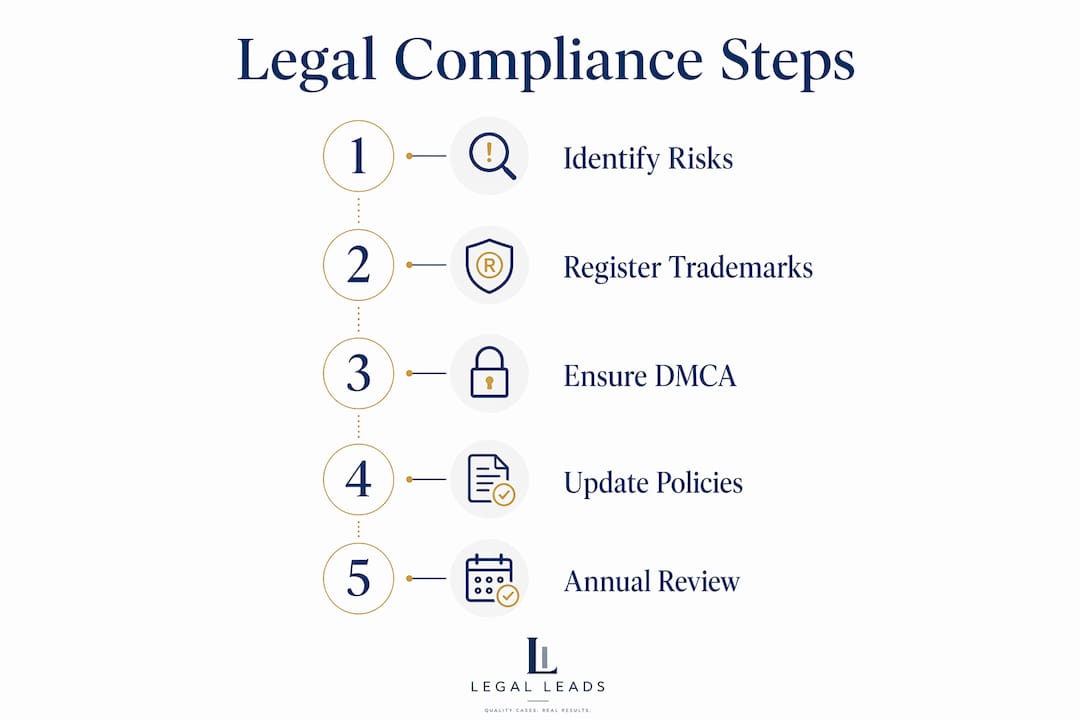
Pro Tip: Schedule a legal compliance review at least once a year, and immediately after any significant change to your products, pricing, or target markets. Document every review. Courts and regulators treat documented compliance efforts as evidence of good faith.
9. What advertising and marketing regulations govern online platforms?
The FTC is the primary federal regulator of online advertising, and its enforcement scope covers every channel: search ads, social media, email, influencer posts, and website copy. Misleading advertising and unclear website terms are consistent FTC enforcement priorities, making transparent, accurate web copy a frontline legal defense.
Website copy creates binding legal obligations. A "100% money-back guarantee" on your homepage is a promise you are legally required to honor, regardless of what your internal policy says. The FTC and state attorneys general routinely review business websites for deceptive claims, and enforcement actions can result in fines, injunctions, and mandatory corrective advertising.
Specific advertising practices that draw regulatory attention:
- Fake reviews: Generating, purchasing, or manipulating customer reviews is illegal under FTC rules
- Drip pricing: Hiding mandatory fees until the final checkout step is a deceptive practice
- Urgency claims: False "only 2 left" or countdown timers that reset are deceptive
- Endorsement disclosures: Any material connection between your brand and an endorser must be disclosed clearly
- Green claims: Environmental or sustainability statements must be accurate and substantiated; the FTC's Green Guides set the standard
- Negative option marketing: Subscription auto-renewals require clear disclosure of terms and easy cancellation options under the FTC's Negative Option Rule
State-level advertising laws add further requirements. California, New York, and Massachusetts each have specific rules on subscription disclosures, refund policy posting, and fee transparency that go beyond the federal baseline.
Ready to address your online business legal issues?
Describing a business legal issue online is the first step toward resolving it. Legalleads makes that step fast and straightforward. Describe your legal situation in plain English, receive a professional case brief in under two minutes, and connect with a qualified attorney within 24 hours. No calls, no complicated forms.
Find a qualified attorney who handles online business law, ecommerce disputes, intellectual property, and privacy compliance. You can also browse attorneys by practice area to match your specific situation.
Key Takeaways
Online businesses in the US must manage overlapping federal and state legal obligations simultaneously, and a single gap in compliance, whether in privacy policy language, advertising disclosures, or contract terms, can trigger regulatory action or litigation.
| Point | Details |
|---|---|
| CCPA fines reach $7,500 per violation | Intentional violations carry fines up to $7,500 each, with no ignorance defense available. |
| Clickwrap beats browsewrap | Courts consistently enforce clickwrap agreements; browsewrap terms posted without active consent often fail. |
| Trademark registration is the first line of defense | USPTO registration gives you the clearest legal basis to challenge domain theft and cybersquatting under UDRP or ACPA. |
| Website copy creates binding obligations | Marketing promises, refund guarantees, and pricing claims are legally enforceable, not just promotional language. |
| Multi-state compliance is unavoidable | Selling to customers in multiple states triggers sales tax, privacy, and consumer protection obligations in each of those states. |
FAQ
What are the most common legal issues for online businesses?
The most common legal issues include data privacy compliance, sales tax obligations across multiple states, intellectual property infringement, contract enforceability, online defamation, and FTC advertising violations. Each can result in fines, lawsuits, or regulatory action if not addressed proactively.
What legal issues are specific to ecommerce?
ECommerce businesses face sales tax nexus obligations following the Wayfair ruling, chargeback disputes tied to Terms of Service clarity, consumer protection disclosure requirements, and payment processor compliance. COPPA applies if the site collects data from children under 13.
What is an example of a business legal issue online?
A business that advertises a "no questions asked" refund policy on its website but refuses refunds in practice faces an FTC enforcement risk and potential state consumer protection claims. The website copy creates a binding legal obligation regardless of internal policy.
How does the CCPA affect online businesses?
The CCPA gives California residents the right to access, delete, and opt out of the sale of their personal data. Businesses that intentionally violate its requirements face fines up to $7,500 per violation, and the law applies to any business that serves California residents above certain thresholds, regardless of where the business is located.
Do small online businesses need to comply with these laws?
Yes. Regulatory agencies and law firms now use automated tools to identify compliance violations at scale, and business size does not provide protection. A small website can be flagged for a missing privacy policy, an improper endorsement disclosure, or a sales tax nexus failure just as quickly as a large platform.