
Most Americans carry at least one false belief about legal representation that could cost them their case. The biggest myths: that you get a free lawyer in civil court, that attorneys can guarantee outcomes, and that legal help is always unaffordable. A July 2024 Harris Poll commissioned by LSC found that 56% of Americans mistakenly believe they are entitled to free legal representation in civil cases. Among adults 18–34, that figure rises to 67%. These legal representation misconceptions have real consequences: missed deadlines, lost housing, and preventable legal defeats.
The top myths this article corrects:
- You have a right to appointed counsel in civil court
- Lawyers can guarantee a specific outcome
- Legal aid only covers criminal cases
- All lawyers handle all case types equally well
- Trials are the normal way civil cases end
- Affordable legal help simply does not exist
Key Takeaways
Most Americans hold at least one false belief about legal representation that directly limits their access to help they qualify for and could use.
| Point | Details |
|---|---|
| No civil right to counsel | The free-lawyer guarantee applies only in criminal cases; civil matters have no federal equivalent. |
| 56% hold the free-counsel myth | A July 2024 Harris Poll found this belief is the most widespread legal misconception. |
| 59% don't seek help | Most people who face a civil legal problem never contact an attorney, often due to cost fears or lack of awareness. |
| Affordable options exist | Legal aid, pro bono clinics, contingency fees, and law school clinics cover many case types at low or no cost, depending on eligibility and case type. |
| Legalleads speeds the match | Legalleads generates a case brief in under two minutes and connects you to a qualified California attorney within 24 hours. |
Table of Contents
- What are the most common misconceptions about legal representation?
- Why do these myths about legal aid persist?
- When should you get an attorney right away?
- How do you find affordable legal help in the U.S.?
- How do you choose and hire the right attorney?
- What patterns actually lead to better outcomes?
- Legalleads connects you to qualified attorneys fast
- Sources
- FAQ
What are the most common misconceptions about legal representation?
Myth 1: You get a free lawyer in any court case. The Sixth Amendment guarantees appointed counsel only in criminal cases where jail time is possible. Civil matters, including eviction, custody, and debt collection, carry no such federal right. LSC's survey data show this is the single most widespread false belief about legal aid. A few cities and states have created local right-to-counsel programs for eviction, but these are limited exceptions, not a national standard.
Myth 2: Lawyers can guarantee results. No attorney can ethically promise a specific outcome. Bar rules in every U.S. state prohibit result guarantees. An attorney who guarantees a win is a red flag, not a selling point. Attorneys are bound by professional conduct rules that bar such promises, and any lawyer making them should be avoided.
Myth 3: Legal aid only covers criminal defense. Lone Star Legal Aid's myth-busting guide is direct on this: civil legal aid programs handle eviction, family law, consumer debt, domestic violence protective orders, and benefits disputes. Criminal defense is handled separately through public defenders. The two systems are entirely distinct.
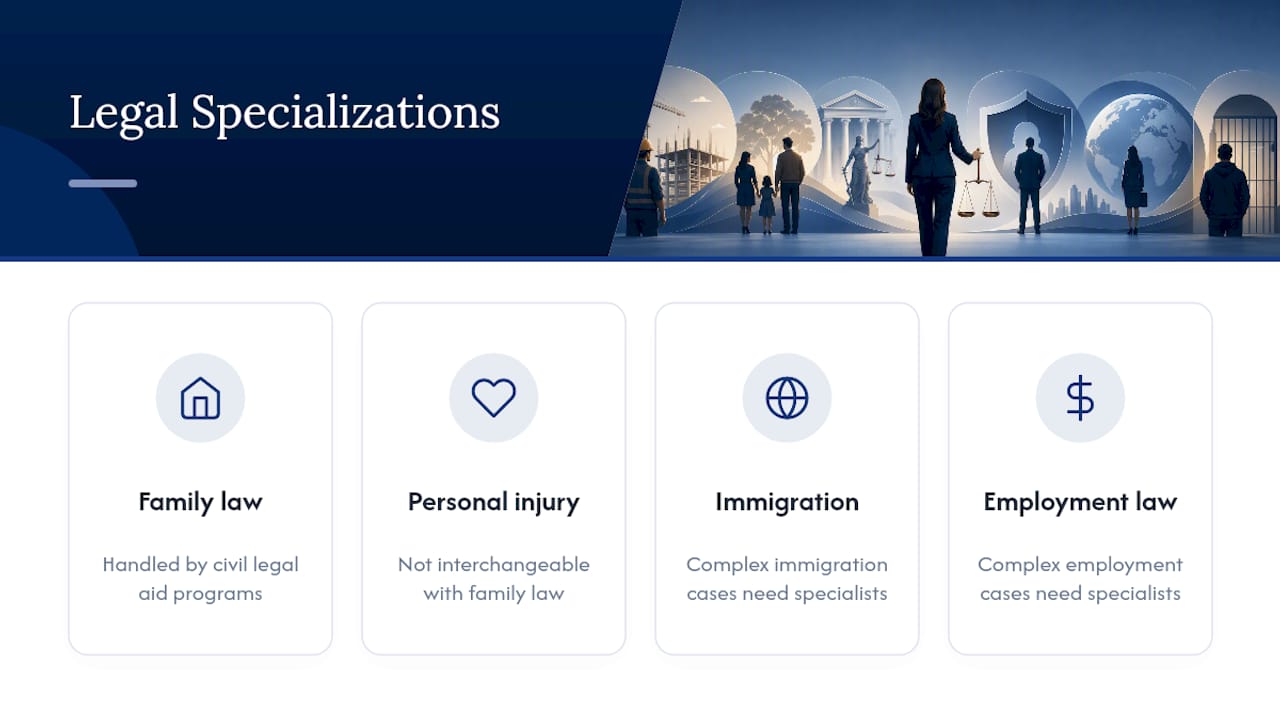
Myth 4: All lawyers are interchangeable. A family law attorney and a personal injury attorney are not substitutes for each other. Specialization matters. Choosing a generalist for a complex immigration or employment case often produces worse outcomes than finding a practitioner who handles that case type regularly.
Myth 5: Trials are the default outcome. Most civil cases settle before reaching a courtroom. Negotiation, mediation, and settlement agreements resolve the majority of disputes. Understanding this changes how you evaluate attorney experience: courtroom record matters less than negotiation skill for most clients.
Myth 6: You need extreme poverty to qualify for legal aid. Eligibility thresholds vary by program and case type. Many programs serve households up to 200% of the federal poverty level, and some accept cases based on the issue's severity rather than income alone.
Pro Tip: If you receive an eviction notice, contact a legal aid organization or attorney within 24–48 hours. Most jurisdictions give tenants a short response window, and missing it can waive your defenses entirely.
Why do these myths about legal aid persist?
Several forces keep these false beliefs in circulation.
- TV and film portrayals. Crime dramas show defendants receiving appointed counsel as a matter of course. Viewers absorb this as a general rule, not a criminal-law-specific one. The LSC Talk Justice podcast links this media effect directly to civil-counsel confusion.
- Criminal vs. civil rights confusion. The Sixth Amendment right to counsel applies only in criminal proceedings. Most people never learn where that line falls, so they assume it extends everywhere.
- Limited public outreach. Legal aid organizations are underfunded and under-publicized. Many people who qualify never learn they are eligible. LSC's survey found that 59% of people who experienced a recent civil legal matter did not seek legal help at all.
- Cost assumptions. The belief that attorneys are universally expensive leads people to stop looking before they find contingency, pro bono, or sliding-scale options.
- Language and access barriers. For non-English speakers and rural residents, the path to legal help is less visible. This compounds the information gap.
The consequences are concrete: tenants lose housing they could have kept, parents lose custody time, and debtors pay judgments they could have contested. Misunderstanding legal terms is one of the most direct ways these myths translate into financial loss.
When should you get an attorney right away?
Some situations require counsel immediately, not eventually. The key triggers:
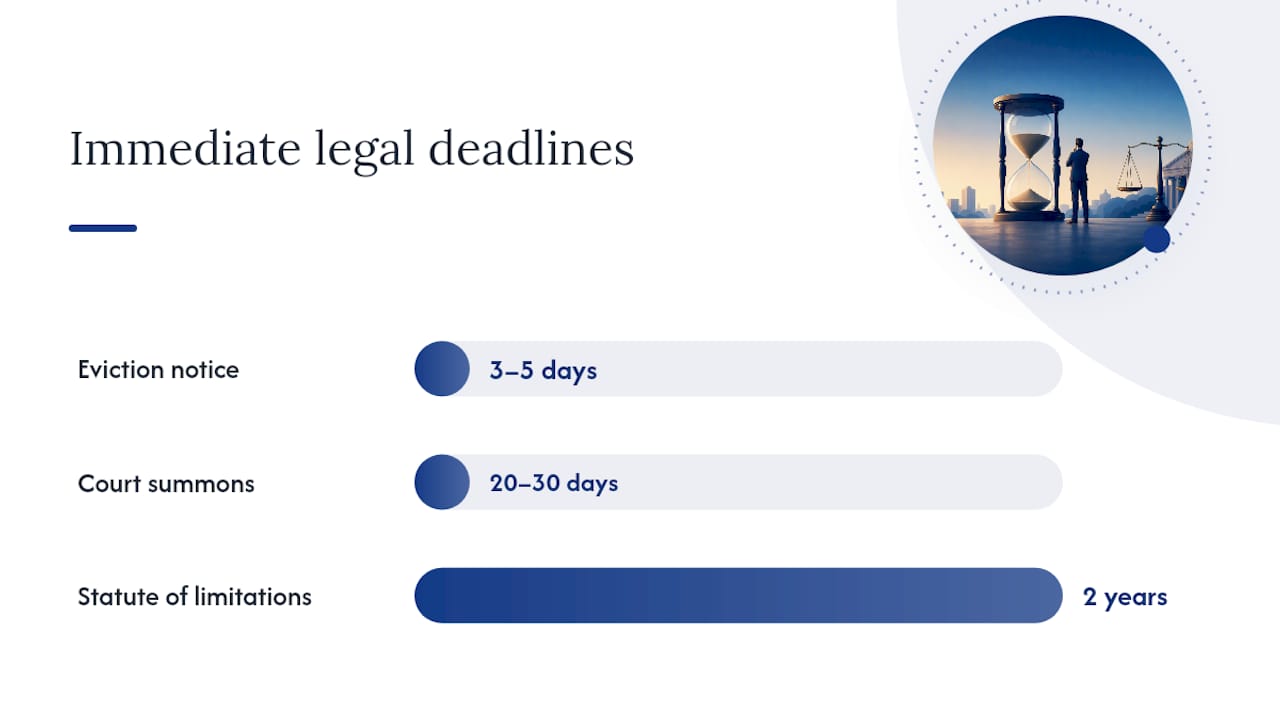
- You received a court summons or formal legal notice. Response deadlines are typically 20–30 days. Missing them can result in a default judgment against you.
- You face eviction. Most states give tenants 3–5 days to respond to an eviction notice before the landlord can file in court.
- Criminal charges are possible. Any situation involving potential jail time requires a defense attorney before you speak to law enforcement.
- Custody or domestic violence is involved. Protective orders and custody arrangements have lasting legal effects. Early representation shapes the outcome.
- A statute of limitations is approaching. Personal injury claims in California, for example, generally carry a two-year filing deadline. Missing it eliminates the claim.
Red flags that mean you should act today:
- A creditor has filed a lawsuit against you
- You received notice of a government agency action (IRS, immigration, child protective services)
- A formal restraining order has been served
- You were involved in an accident with injuries or significant property damage
Pro Tip: Before your first attorney meeting, gather every document related to the situation: notices, contracts, correspondence, photos, and dates of key events. Organized facts help an attorney assess your options faster and reduce billable time spent reconstructing the timeline.
For guidance on identifying the type of legal help you need, a structured triage process can clarify whether you need full representation or a more limited intervention.
How do you find affordable legal help in the U.S.?
Cost is the most cited barrier, but multiple pathways exist:
- Legal aid organizations. Free civil legal services for income-eligible clients. Find your local program through LSC's program directory. Legal aid covers far more than most people expect, including eviction defense, family law, and consumer protection, though capacity limits mean not every case is accepted.
- Pro bono clinics. Many state and local bar associations run free clinics for specific issues. These are often walk-in or appointment-based and do not require income verification.
- Contingency-fee attorneys. For personal injury, employment discrimination, and some consumer fraud claims, attorneys work without upfront fees and collect a percentage only if you win.
- Law school clinics. Supervised by licensed attorneys, these clinics handle real cases at no cost and often take cases legal aid programs cannot.
- Court self-help centers. Most U.S. courthouses have self-help centers with staff who can explain procedures, though they cannot give legal advice.
- Virtual legal clinics and nonprofit advice centers. Organizations like your state's legal aid hotline or online platforms offer brief consultations, often at no cost.
- Legalleads intake. For readers who want a faster path to a qualified attorney, Legalleads matches you with counsel in under 24 hours using an AI-generated case brief.
| Pathway | Typical Case Types | Cost |
|---|---|---|
| Legal aid organizations | Eviction, family law, benefits, consumer debt | Free (income-based eligibility) |
| Pro bono clinics | Varies by clinic; often housing, immigration | Free |
| Contingency-fee attorneys | Personal injury, employment, consumer fraud | No upfront fee; percentage of recovery |
| Law school clinics | Housing, immigration, small business, family | Free |
Limited-scope representation, where an attorney handles only one part of your case (drafting a motion, reviewing a contract, coaching you before a hearing), is often a cost-efficient option that many people overlook entirely.
How do you choose and hire the right attorney?
Prioritize specialization, verifiable experience in your specific issue, and transparent fees. Firm size is not a reliable quality signal.
Questions to ask in an initial consultation:
- How many cases like mine have you handled in the past two years?
- What is your fee structure, and what does it include?
- Who will actually work on my case day-to-day?
- What is a realistic range of outcomes for my situation?
- What are the key deadlines I need to know about?
Verification steps before you hire:
- Check the attorney's license and any discipline history through your state bar's public directory (e.g., the California State Bar's attorney search tool).
- Confirm their practice area matches your case type.
- Get the fee agreement in writing before signing anything.
Red flags to avoid: any attorney who guarantees a result, pressures you to sign immediately, or cannot explain their fee structure clearly. For a full list of questions to ask in urgent legal situations, a structured checklist can help you stay organized under pressure.
Fee structures vary: hourly billing is standard for most civil matters, flat fees are common for document-heavy work like wills or simple contracts, and contingency arrangements apply where the attorney's recovery depends on yours.
What patterns actually lead to better outcomes?
The clients who fare best are rarely the ones who waited for a crisis. They are the ones who sought even a brief consultation early, organized their documents before the first meeting, and asked direct questions about fees and realistic outcomes.
A common pattern: someone receives an eviction notice, assumes they cannot afford help, and waits until the court date. By then, the response deadline has passed and the defenses that existed on day one are gone. A 30-minute consultation with a legal aid attorney on day two of that notice would have changed the trajectory entirely.
Limited advice, a single document review, or one hour of coaching before a hearing can shift outcomes significantly. The myth that you need full representation or nothing at all keeps people from using the most cost-effective options available.
Legalleads connects you to qualified attorneys fast
Finding the right attorney quickly is the practical problem most people face after clearing up these myths. Legalleads solves it directly: describe your legal situation in plain English, receive a professional case brief in under two minutes, and get matched with a qualified attorney within 24 hours. No phone calls, no complicated intake forms.

The platform covers personal injury, family law, immigration, employment, criminal defense, and other major practice areas in California. For readers dealing with a custody dispute, an eviction notice, or a personal injury claim, Legalleads removes the search friction that causes most people to delay or give up. Find a lawyer through Legalleads and get matched today.
Sources
The claims in this article draw on primary survey data and legal aid organization publications. The LSC / Harris Poll survey is the most important single source here: it is the first large-scale national survey to quantify how widespread civil-counsel misconceptions are, and its findings directly explain why so many people with valid civil legal claims never get help.
- Talk Justice, an LSC Podcast: Survey Finds Americans Lack Knowledge About Civil Legal Issues | LSC - Legal Services Corporation: America's Partner for Equal Justice
- More than half of Americans mistakenly think they have a right to an attorney in civil cases — Legal Aid of Southeastern Pennsylvania
- What Legal Aid Can’t Do: Common Myths - LegalClarity Blog
- Common Misconceptions Clients Have About Attorneys
- 5 common myths about legal aid debunked — Lone Star Legal Aid
This article is general information, not a substitute for advice from a qualified lawyer. Consult a qualified legal professional about your own circumstances before acting on anything here.
FAQ
Do you have a right to a free lawyer in civil court?
No. The constitutional right to appointed counsel applies only in criminal cases where incarceration is possible. Civil matters, including eviction, custody, and debt disputes, carry no federal right to free counsel.
What does legal aid actually cover?
Legal aid organizations handle civil matters such as eviction defense, family law, consumer debt, domestic violence protective orders, and public benefits disputes. They do not provide criminal defense, which is handled by public defenders.
Can a lawyer guarantee they will win your case?
No attorney can legally or ethically guarantee a specific outcome. Bar rules in every U.S. state prohibit result guarantees; an attorney who makes one is a red flag.
How do you find a lawyer if you cannot afford one?
Legal aid organizations, pro bono clinics, law school clinics, and contingency-fee attorneys are all options depending on your case type and income. Legalleads also matches users with qualified attorneys in California within 24 hours at no intake cost.
When is it too late to get a lawyer?
Deadlines vary by case type, but acting within the first 24–48 hours of receiving a legal notice preserves the most options. Statutes of limitations and response deadlines can eliminate valid claims entirely once they pass.