
Pick a lawyer who specializes in your injury type, has verifiable results in similar cases, and offers clear contingency terms in writing. Do this now: check the attorney's state bar standing, then book two or three free consultations. If you want to skip the search, LegalLeads can match you with a qualified attorney fast.
TL;DR:
- Ensure the lawyer specializes in your injury type and has recent successful case results within the last two to three years in your jurisdiction.
- Verify the attorney's license status on your state bar website to confirm active standing and absence of disciplinary actions before proceeding.
- Confirm that contingency fee terms and case costs are clearly written in your agreement and understand how costs are deducted from your settlement.
- Gather and document evidence promptly, including photographs, medical records, police reports, and witness contact details, to strengthen your case early.
- Use services like LegalLeads to get a quick attorney match based on your description, but still conduct thorough verification and consultation before signing any agreement.
Table of Contents
- How to Choose a Personal Injury Lawyer: Where to Find Real Candidates
- What to Look For: The Evaluation Checklist That Actually Predicts Outcomes
- Questions to Ask at the Initial Consultation
- How Fees, Costs, and Settlement Splits Usually Work
- Do You Have a Case? Quick Qualification and Preservation Checklist
- Verify Credentials and Trust Signals Before You Sign Anything
- How LegalLeads Helps You Skip the Guesswork
- What Actually Matters Most When You're Choosing
- Skip the Search: Get Matched With a Vetted Attorney Directly
- Sources
- FAQ
How to Choose a Personal Injury Lawyer: Where to Find Real Candidates
Start with people you trust. A referral from a friend, coworker, or another attorney (even one in a different practice area) tends to produce better matches than a search engine ad, because someone has already vetted the outcome.
When personal referrals run dry, move to structured sources. Your state bar association maintains a searchable directory of licensed attorneys, and it's the only list that confirms licensing status in real time. Beyond that, established directories like Justia and Best Lawyers publish attorney profiles with practice history, though they vary in how rigorously they screen listings.
Here's where most people go wrong: they treat every name on page one of a search as pre qualified. It isn't. Paid ad placement has nothing to do with case competence.
Once you have a shortlist, filter fast:
- Specialty match. A lawyer who handles slip and falls, dog bites, and car wrecks with equal frequency knows less about your specific injury than one who focuses on it. Specialty improves familiarity with the statutes, defenses, and typical damages tied to your type of case, according to Forbes Advisor.
- Recent representative results. Ask for outcomes from the last two or three years, not a decade-old settlement.
- Jurisdictional licensing. Confirm the attorney is licensed in the state where your injury occurred, not just where the firm has an office.
- Free consultation availability. Nearly every reputable personal injury firm offers one; if a firm charges for an initial meeting, that's worth asking about directly.
Watch for red flags while you filter. A lawyer who guarantees a dollar amount before reviewing your medical records or accident report is either inexperienced or overselling. Heavy sales pressure during a first call, testimonials that read suspiciously uniform, or reviews with no detail beyond "great lawyer" are all reasons to keep looking. Consumer guides consistently recommend running multiple consultations and comparing them side by side rather than trusting a single ad or a single Google review, a point echoed in AllLaw's guidance on finding the right attorney.
What to Look For: The Evaluation Checklist That Actually Predicts Outcomes
Not every factor on a "how to pick a lawyer" checklist carries equal weight. Some determine whether your case gets fair value. Others are just noise.
- Specialty and recent case wins. Ask directly: "How many cases like mine have you handled in the past two years, and what happened?" A vague answer here is a bigger red flag than a firm's office decor or website polish.
- Trial readiness, not just settlement focus. Insurance adjusters price cases differently depending on whether they believe the opposing attorney will actually take the case to verdict. A firm known for settling everything quietly, without ever filing suit, tends to get lower offers. Ask how many cases the attorney has personally tried, and how recently.
- Firm resources. Complex injury cases often need accident reconstructionists, medical experts, or economic analysts to prove damages. A firm's willingness to invest in experts early is a real signal that it's prepared for a contested case rather than a quick settlement, according to Chaikin & Sherman.
- Communication and team structure. Find out who actually works your file. Many firms hand cases to junior associates or paralegals after the partner signs you up.
- Reputation signals, read correctly. Peer recognitions like Super Lawyers or Best Lawyers carry more weight than a five-star review count, but neither substitutes for checking license status and case-specific experience yourself.
Pro Tip: Ask the attorney to name the toughest obstacle in your specific case during the first call. A lawyer who hasn't thought about your case's weaknesses yet hasn't really evaluated it.
Questions to Ask at the Initial Consultation
A free consultation is your best diagnostic tool. Bring this exact list and don't leave until you get direct answers:
- Who will handle my case day to day, and who do I call with questions?
- How many cases like mine have you handled recently, and what were the typical outcomes?
- What contingency fee do you charge, and what happens to costs if we don't win?
- What's your strategy for settlement versus trial in a case like mine?
- What obstacles do you see in my case, and how would you address them?
Pay attention not just to the answers but to how directly they come. An attorney who dodges the fee question or gives a rehearsed nonanswer about strategy is telling you something about how they'll communicate later, when you're the one waiting on an update. If you want a prepared version of this list before your first meeting, a structured question set for urgent legal situations can help you walk in ready.
How Fees, Costs, and Settlement Splits Usually Work
Most personal injury lawyers work on contingency, meaning you pay nothing upfront and nothing if you lose. Fees commonly range from a typical percentage of the recovery, and that percentage can climb if the case goes to litigation instead of settling early, per Best Lawyers.
Fees and costs are two different things. The contingency percentage covers the attorney's fee. Case costs, expert witness fees, court filing fees, and medical record retrieval, get deducted separately, usually before or after the fee split depending on the firm's agreement.
- Get the fee percentage and cost handling in writing before signing anything.
- Ask whether the percentage increases at specific stages (filing suit, going to trial).
- Ask whether unrecovered costs come out of your pocket if the case is lost.
Firms that handle employment or other contingency-adjacent cases sometimes structure costs differently. A comparison of employment lawyer fee structures shows how much these arrangements can vary by practice area, which is useful context even outside personal injury.
Do You Have a Case? Quick Qualification and Preservation Checklist
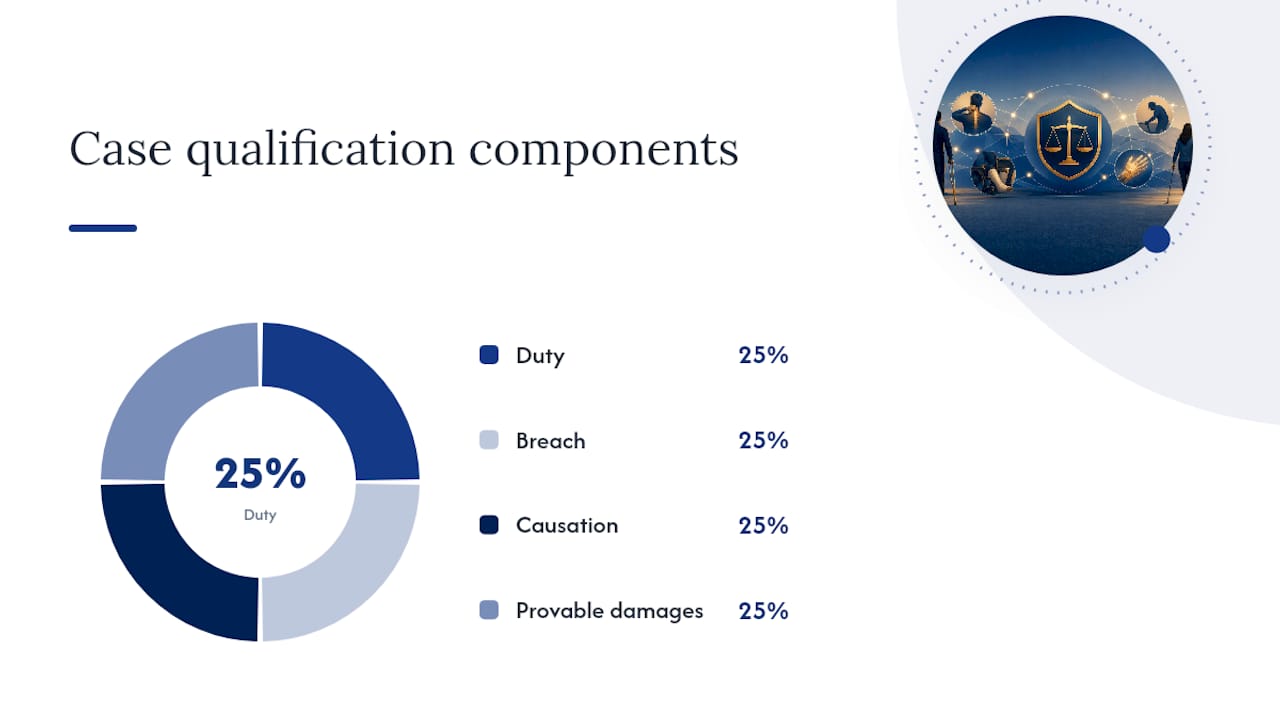
Attorneys screen new cases against four elements: duty, breach, causation, and damages. In plain terms, someone owed you a duty of care, they breached it, that breach caused your injury, and you suffered damages that can be proven, according to DK Law's case qualification test. Miss any one of the four and you likely don't have a viable claim.
Collectability matters too. A legally strong case against someone with no insurance and no assets may still produce little recovery, so ask any attorney you consult about realistic paths to payment, including your own underinsured motorist coverage.
Time works against you. Evidence disappears, witnesses forget details, and every state enforces a statute of limitations that can bar your claim entirely if you wait too long.
- Photograph the scene, your injuries, and any property damage immediately.
- Get copies of medical records and notes from every provider you see.
- Request incident or police reports the same week, while details are fresh.
- Collect witness names and contact information before people scatter.
Early documentation directly shapes how an attorney values your claim; see how medical records influence injury claims for a closer look at why timing matters so much here.
Verify Credentials and Trust Signals Before You Sign Anything
Every state bar website lets you search an attorney by name and see their license status instantly. A clean record shows active licensure with no history. A record showing suspension or public reprimand is a serious warning sign you should not ignore, according to the State Bar Court's public records guidance.
Peer recognitions like Super Lawyers or Best Lawyers add useful context, but they're not a substitute for your own verification. The same goes for client reviews: a pattern of specific, detailed reviews mentioning communication and outcomes is meaningful; a wall of generic five-star ratings is not, a distinction US Injury Act draws out clearly.
| Check | What it tells you |
|---|---|
| State bar lookup | Active license, disciplinary history, standing |
| Peer recognitions | Professional reputation among other lawyers |
| Detailed client reviews | Real communication and outcome patterns |
| Case results (recent) | Actual competence in cases like yours |
Stop the process immediately if you find a suspension, a pattern of communication complaints, or "results" the firm can't back up with specifics.
How LegalLeads Helps You Skip the Guesswork
Running down referrals, checking bar records, and scheduling multiple consultations takes real time, time you may not have if a filing deadline is approaching. LegalLeads was built to shorten that search without skipping the diligence.
You describe your situation in plain English, and the platform generates a professional case brief in under two minutes, then connects you with a qualified attorney within 24 hours, according to LegalLeads. There are no intake calls to schedule and no complicated forms to fill out.
- Fast intake: plain English description, no legal jargon required.
- Case brief generated in under two minutes.
- Attorney match delivered within 24 hours.
Getting a match isn't the finish line. Still verify the attorney's license through your state bar, run through the consultation questions above, and confirm the firm's resources before you sign a retainer agreement. A matching service speeds up discovery; it doesn't replace your own diligence.
What Actually Matters Most When You're Choosing
Most guides on this topic list ten or twelve factors and treat them as equally important. They aren't. Three things predict outcomes: whether the attorney specializes in your specific injury type, whether their standing and resources hold up under verification, and whether the fee terms are in writing before you sign anything. Everything else, office location, website design, how fast someone answers the phone, is comfort, not competence.
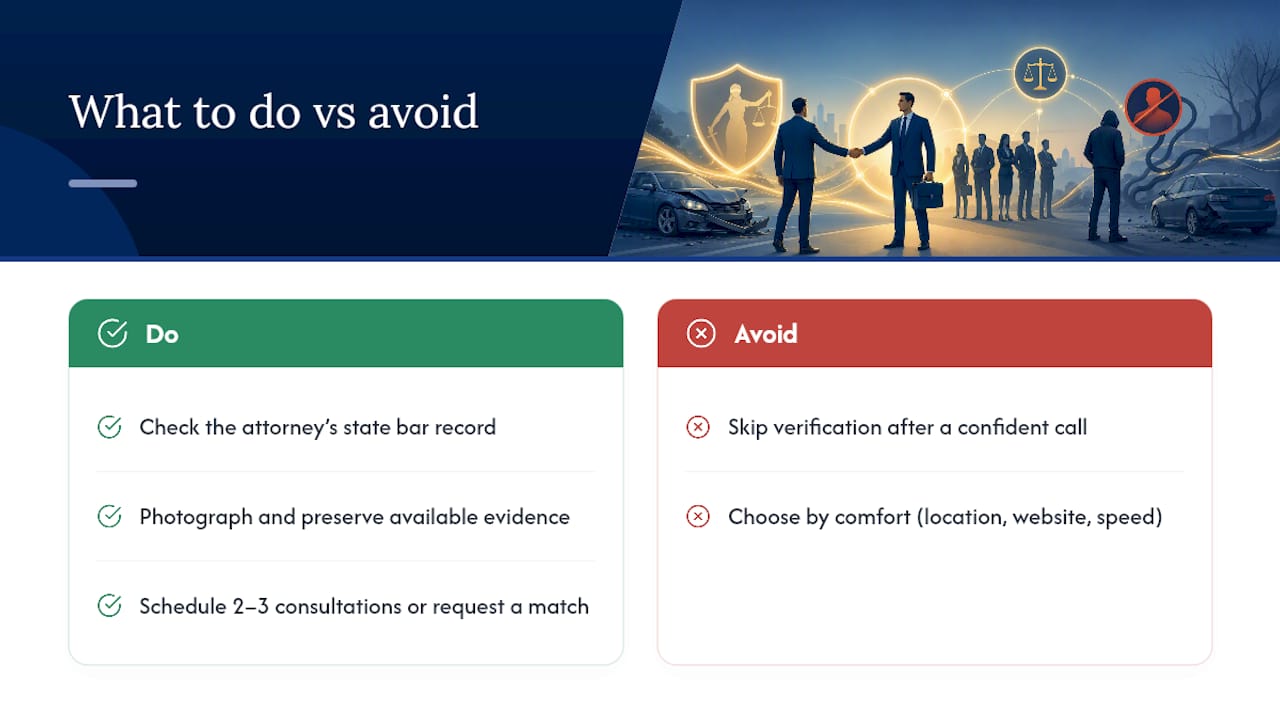
The mistake I see people make most often is skipping verification because a lawyer "seemed confident" in the first call. Confidence is cheap. A clean state bar record and a specific answer about recent case outcomes are not.
If you're starting today, do three things: pull the attorney's state bar record, gather and photograph whatever evidence you still have access to, and schedule two or three consultations, or request a LegalLeads match if your timeline is tight. Every other decision in this process gets easier once those three are done.
— Admin
Skip the Search: Get Matched With a Vetted Attorney Directly
Some services provide a faster path than sorting through directories and cold-calling firms one by one by generating a professional case brief quickly and delivering an attorney match promptly, with no forms or wait times.

This fits you especially well if you're already dealing with medical appointments, insurance calls, and lost work, and the last thing you need is a weeks-long attorney search on top of it. Legalleads doesn't replace the verification steps in this guide; it just gets you in front of a qualified attorney faster so you can start running those checks sooner. If you're in Southern California, Legalleads also connects readers with local matches, including personal injury attorneys near Los Angeles and Riverside.
Start by describing your situation on the LegalLeads matching page and see who you're matched with within a day.
Sources
- State Bar Court public records and information
- Find a personal injury lawyer – Forbes Advisor
- How to Choose a Personal Injury Lawyer: A Practical Guide — Best Lawyers
- Do I Have a Personal Injury Case? — DK Law
FAQ
How Do I Choose the Best Personal Injury Lawyer?
Prioritize specialty in your injury type, verifiable recent case results, transparent contingency fee terms, and confirmed clean standing with your state bar before hiring.
Is It Worth Suing for Personal Injury?
It depends on whether you can prove all four elements, duty, breach, causation, and provable damages, and whether the at-fault party or their insurance can actually pay a judgment.
What Shouldn't I Say to a Personal Injury Lawyer?
Avoid guessing at facts, exaggerating your injuries, or admitting fault speculatively; stick to what you know for certain and let your attorney fill gaps with evidence and records.
How Much of a $25,000 Settlement Will I Get?
After paying a typical contingency fee plus case costs like expert or filing fees, you would receive the remainder of the settlement, with the exact amount depending on your fee agreement and deducted costs.
Does LegalLeads Charge Individuals for Attorney Matches?
No. Individuals use LegalLeads's intake and matching service at no cost; the platform's paid packages are for attorneys and law firms seeking client leads.