
Verify the lawyer's license and standing first. Then match their case experience to your specific matter, ask a short set of consultation questions, and get scope and fees in writing before you pay anything. Check the state bar for active status and any discipline. Confirm Form G-28 will be filed. Look for immigration concentration or AILA membership. A matching service can speed up finding candidates, but verification always comes after the match, never instead of it.
TL;DR:
- Verify the lawyer’s active license status through the state bar and confirm they will file Form G-28 before hiring.
- Ensure the attorney has recent, relevant experience handling cases similar to yours, especially if appellate or courtroom work is needed.
- Use a flat fee for straightforward filings and obtain a written agreement detailing the scope, services, and additional charges up front.
- Focus consultations on clear questions about case experience, timelines, fee structure, and whether they will handle all necessary forms and filings.
- Be cautious of red flags such as guarantees, pressure to pay cash, refusal to provide a bar number, or prohibited use of titles like notario or immigration consultant.
Table of Contents
- Where to Find a Qualified Immigration Lawyer
- How Do You Verify an Immigration Lawyer's Credentials?
- Does the Lawyer's Experience Actually Match Your Case?
- What Fees and Contract Terms Should You Expect?
- What Should You Ask at the First Consultation?
- What Are the Warning Signs of an Immigration Scam?
- When Do You Not Need a Private Immigration Lawyer?
- Can Technology Speed Up Finding a Vetted Attorney?
- Get Matched With a Vetted Immigration Attorney Fast
- Sources
- FAQ
Where to Find a Qualified Immigration Lawyer
Not every directory serves the same purpose. Some are built for verification, some for affordability, and some for speed. Knowing which to use first saves you from wasted calls.
The AILA lawyer directory is the strongest starting point for anyone with a specific type of case. It lets you filter attorneys by sub-practice, so someone facing removal proceedings and someone applying for a family-based petition end up looking at different shortlists entirely.
State bar referral services matter for a different reason: they confirm local licensing and give you a place to check standing later. Most state bars run a lawyer-referral service that lists attorneys by practice area and location.
If cost is the primary barrier, nonprofit legal aid and DOJ-accredited representatives fill that gap. Immigrationlawhelp lists free and low-cost immigration legal services by state, which matters because private counsel isn't always financially realistic for every case.
- AILA directory: best for matching specialists to specific case types like asylum or employment visas.
- State bar referral services: best for confirming local licensing and building a shortlist you can verify.
- Nonprofits and DOJ-accredited reps: best when cost is the limiting factor.
- Community referrals and review sites: useful for names, but treat star ratings as a starting point, not proof of competence. Cross-check any name against a state bar lookup before trusting it.
How Do You Verify an Immigration Lawyer's Credentials?
Verification takes minutes, not days, and it's the step most people skip because it feels redundant after finding a promising name. Skip it anyway at your own risk.
- Run a state bar lookup. Search the attorney's name or bar number and confirm the status reads "active," not "inactive" or "suspended." Public discipline records, when they exist, appear on the same page.
- Ask for the bar number directly. A licensed attorney will give it to you without hesitation, since only licensed attorneys admitted to a U.S. state bar and DOJ-accredited representatives may legally represent clients in immigration matters for a fee.
- Check AILA membership. It signals ongoing immigration-specific education, though membership is voluntary, so pair it with the bar check rather than relying on it alone.
- Confirm Form G-28 will be filed. This is the formal notice of representation submitted to USCIS. Refusal to file it is one of the clearest signs something is wrong.
- Verify DOJ accreditation for nonprofit reps. The Recognition and Accreditation program publishes a roster of accredited organizations and representatives you can check by name.
Does the Lawyer's Experience Actually Match Your Case?
Years licensed tells you almost nothing on its own. A lawyer who has practiced for fifteen years but handled mostly business immigration won't necessarily be the right fit for a removal defense case that needs courtroom reps and appellate familiarity.
Immigration law splits into sub-practices that barely overlap in daily skill. Someone building family-based petitions spends their time on documentation and USCIS processing. Someone doing removal defense spends it in immigration court, arguing before a judge. Asylum work leans heavily on country-condition evidence and credible testimony. Corporate immigration runs on visa categories and employer compliance timelines.
- Ask how many cases similar to yours the lawyer has handled in the past 12 months, not over their whole career.
- Request sample outcomes or general case results for that specific case type.
- If your case could end up in appeal, ask directly about appellate experience. Not every immigration attorney has it.
- Weigh recent, relevant practice more heavily than total years licensed. A niche specialist with three focused years often beats a generalist with fifteen scattered ones.
What Fees and Contract Terms Should You Expect?
Billing models vary by case type, and knowing which one applies to yours helps you spot a quote that doesn't add up. Straightforward filings, like family-based petitions or naturalization, are commonly billed flat fee. Removal defense and litigation, where hours are unpredictable, are more often billed hourly.
A written fee agreement should spell out exactly what's covered, not just the headline number.
- Which forms are included in the flat fee, and which trigger an additional charge.
- Whether responding to a Request for Evidence (RFE) is included or billed separately.
- Whether interview representation is part of the base fee.
- Payment plan options and the firm's refund policy if the case ends early.
- Any language that lets the firm add undefined "administrative" or "processing" fees later.
Pro Tip: Ask for the fee agreement in writing before your first payment, not after. A firm that hesitates to put terms on paper is telling you something about how disputes will get handled later.
Vague scope language is the biggest red flag in any contract. If the agreement doesn't name the specific forms, deadlines, and included services, push back before signing.
What Should You Ask at the First Consultation?
Consultations exist for you to evaluate the lawyer, not the other way around; for practical tips on assessing attorneys, see How to Choose the Right Family Law Attorney in NH. Structured questions beat an open-ended chat because they force specific, comparable answers.
- How many cases like mine have you handled in the past year, and what were the general outcomes?
- Who will actually do the work on my case, and what's the typical turnaround for a response?
- What is your fee structure, and does it include filing Form G-28?
- Can you walk me through the timeline, the required forms, and realistic deadlines for my situation?
- Do you have references or past clients I can speak with?
A strong consultation should leave you with a clear suggested course of relief, the eligibility requirements behind it, the deadlines involved, and a fee breakdown, all before you leave the room. If an attorney can't give you at least a working version of that, keep looking. Watch for confidence that doesn't match the complexity of your case: guarantees of success are a warning sign, not a selling point.
What Are the Warning Signs of an Immigration Scam?
Some red flags show up before you've even paid anything, and catching them early saves you money and time.
- Someone using the title "notario" or "immigration consultant" while implying they can practice law. In the United States, that title carries no legal authority to represent you.
- Refusal to provide a bar number, or a bar number that doesn't match the name given.
- Guarantees of visa approval. No legitimate attorney can promise a government agency's decision.
- Pressure to pay in cash immediately, or to sign documents you haven't been given time to read.
- Refusal to file Form G-28, which leaves you with no formal representative of record.
Consumer protection resources specifically warn against unauthorized practitioners exploiting immigrant communities, and recommend verifying credentials before any payment changes hands. If you suspect fraud, report it through USCIS's consumer-protection channels or file a complaint with your state bar.
When Do You Not Need a Private Immigration Lawyer?
Some filings are routine enough that many people handle them without an attorney. Basic naturalization applications and straightforward green card renewals often fall into this category, especially when there's no criminal history or prior denial complicating the case.
Cases involving removal proceedings, past denials, criminal records, or asylum claims almost always benefit from representation, given how many turns on deadlines and courtroom procedure.
- DOJ-accredited nonprofit reps offer a lower-cost path, though intake capacity is limited and waitlists are common.
- Limited-scope or online attorney services can work for narrow, defined tasks, but verify the provider's bar credentials the same way you would for a full-service firm.
- Free or low-cost help through ImmigrationLawHelp.org is worth checking before assuming private counsel is your only option.
Can Technology Speed Up Finding a Vetted Attorney?
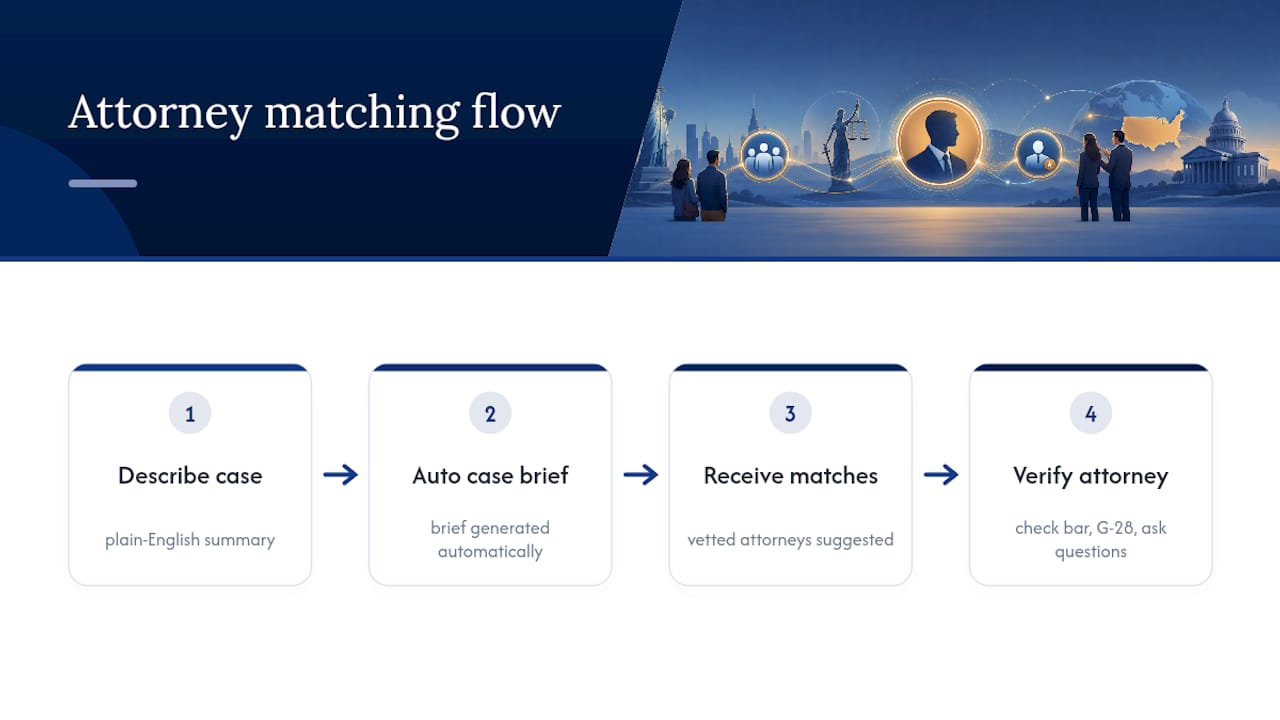
Matching platforms shorten the discovery phase. Instead of cold-calling firms, you describe your case and get connected to attorneys who handle that type of matter. Some platforms work this way, turning a plain-language case description into a brief that goes to vetted attorneys.
That speed doesn't replace verification. Every step covered above, the bar lookup, the G-28 confirmation, the consultation questions, still applies to a matched attorney exactly as it would to one found through a directory search. Treat a fast match as a shortcut to candidates, not a shortcut around due diligence.
— Admin
Get Matched With a Vetted Immigration Attorney Fast
Skip the directory-scrolling and cold calls. Some platforms turn a plain-English description of your situation into a case brief quickly, then connect you to vetted attorneys, with no forms or phone tag.

The flow is simple: describe what's happening (a pending filing, a denial, a removal notice, a family petition), get a case brief generated automatically, and receive attorney matches suited to that specific case type. It works well for family-based petitions, asylum matters, and other common immigration situations, though the verification steps in this guide still apply once you have a name in hand: check the bar number, confirm Form G-28 will be filed, and ask your consultation questions.
Have your basic case details ready, including any prior filings, denial notices, or deadlines, so the matching process can route you accurately. Start at Find Lawyer to get your case brief and see who you're matched with.
This article is general information, not a substitute for advice from a qualified lawyer. Consult a qualified legal professional about your own circumstances before acting on anything here.
Sources
FAQ
What is the average cost of an immigration lawyer?
Costs vary widely by case type. Flat fees are common for straightforward filings like family petitions, while hourly billing is more typical for removal defense or litigation, so always get the fee structure in writing before comparing quotes.
What is the 7 year rule for immigration?
This isn't a single standardized rule, definitions and applications vary by context (such as certain cancellation-of-removal eligibility standards), so ask your attorney how any specific time-based requirement applies to your exact case.
How do I find a good immigration lawyer?
Start with the AILA lawyer directory or your state bar's referral service, then verify the attorney's bar status, confirm relevant case experience, and use a structured consultation checklist before hiring. A matching service can speed up the initial shortlist, but the same verification steps still apply.
Who is the best immigration attorney in Houston?
No single attorney is universally "best" for every case type or budget. Use the AILA directory filtered by sub-practice and location, verify credentials through the state bar, and compare experience against your specific matter instead of relying on a single ranking.
Should I hire an immigration lawyer or use a consultant?
In the United States, only licensed attorneys and DOJ-accredited representatives may legally represent clients in immigration matters for a fee. Anyone using the title "immigration consultant" to imply legal representation without one of those credentials is a red flag, not a legitimate alternative.