
In California, personal injury claims must be filed within two years of the accident, and property damage claims within three years; claims involving government entities require an administrative claim within six months. Missing these deadlines will often result in loss of recovery rights regardless of case strength.
TL;DR:
- Most personal injury claims must be filed within two years of the crash, but the discovery rule can delay this deadline if injuries aren't immediately apparent.
- Property damage claims have a separate three-year limit, and wrongful death claims start on the date of death, not the crash.
- Claims against government entities require an administrative claim within six months, with a separate six-month window to file a lawsuit after denial.
- Filing a lawsuit is the only action that pauses the statutory clock; negotiations or settlement offers do not toll the deadlines.
- Missing these deadlines typically results in complete loss of your right to recover unless you qualify for tolling due to minors, incapacity, or other specific exceptions.
Table of Contents
- Car Accident Statute California: The Deadlines That Control Your Case
- When the Clock Actually Starts Ticking
- Tolling and Common Exceptions That Pause the Deadline
- Government Claims Work on a Different, Much Shorter Clock
- Reporting Duties: What DMV and Police Require After a Crash
- Evidence That Protects Your Claim, and What Doesn't Stop the Clock
- What Happens When You Miss the Deadline
- Government Entities vs. Private Parties: Two Very Different Clocks
- Can an Expired Deadline Ever Be Revived?
- Does a Criminal Case Change Your Civil Deadline?
- A Faster Path to Legal Help Preserves More Options
- Get Matched With a California Car Accident Attorney Fast
- Sources
- FAQ
Car Accident Statute California: The Deadlines That Control Your Case
California law sets different deadlines depending on what you're claiming. Personal injury claims fall under California Code of Civil Procedure § 335.1, which gives you two years from the date of the crash to file a lawsuit. Property damage claims run on a separate clock under CCP § 338, which allows three years.
This distinction trips people up constantly. A driver who suffered a broken arm and $8,000 in vehicle damage might assume one deadline applies to the whole case. It doesn't. The injury claim expires after two years. The property damage claim stays open for a third year after that, though most attorneys file both together to avoid confusion and preserve settlement leverage.
Wrongful death claims work differently. The clock starts on the date of death, not the date of the crash. If a passenger dies three months after an accident from complications, the two-year window begins on the death date, not the collision date. That gap matters when a family is dealing with hospital bills, funeral arrangements, and the last thing on their mind is a legal calendar.
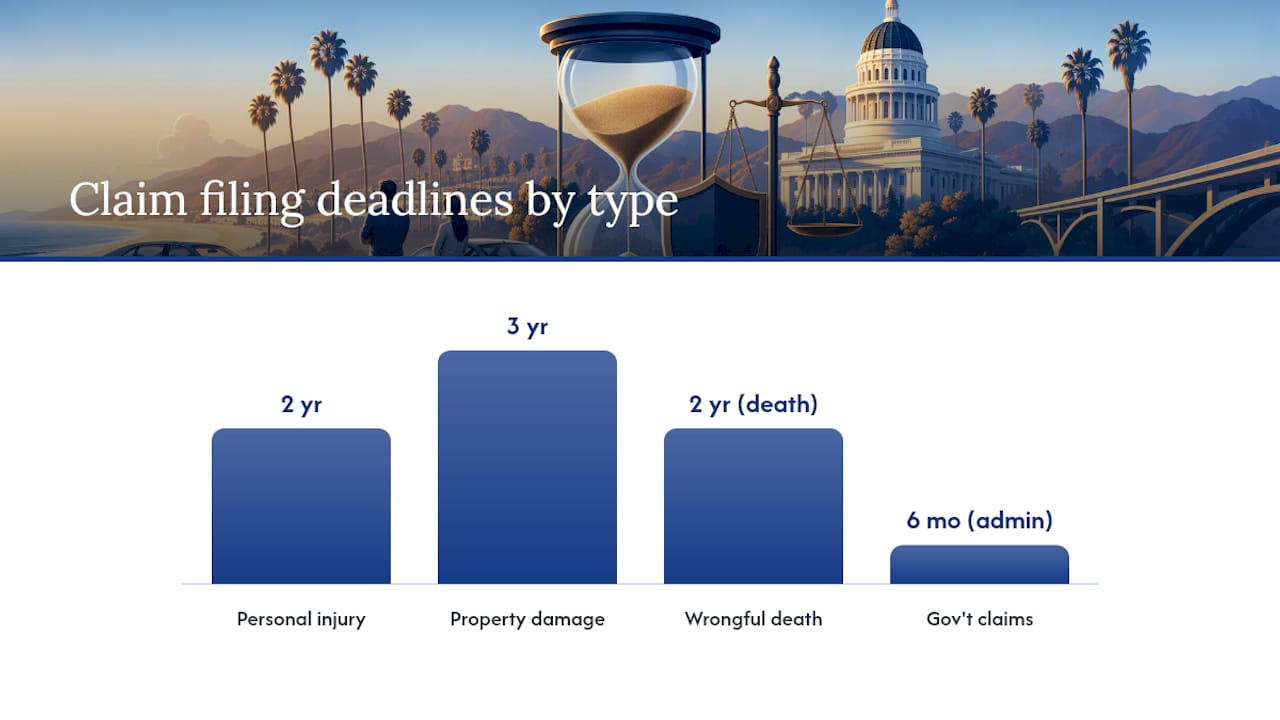
One more point that gets misunderstood often: these deadlines govern when you must file a lawsuit in court, not when you should send a demand letter to an insurance company. Sending a demand letter, negotiating with an adjuster, or even reaching a tentative settlement offer does nothing to stop that clock. Only a filed complaint counts.
Here's how the deadlines break down by claim type:
- Personal injury (most car accidents): 2 years from the date of the crash, per CCP § 335.1.
- Property damage (vehicle repair, totaled car): 3 years from the date of the crash, per CCP § 338.
- Wrongful death: 2 years from the date of death, which may differ from the crash date.
- Claims against a government entity: an administrative claim often due within 6 months, addressed in detail below.
These four categories cover the overwhelming majority of California traffic accident claims. The rest of this guide walks through what changes those deadlines, what pauses them, and what happens if you miss one.
When the Clock Actually Starts Ticking
Most people assume the statute of limitations starts on the day of the crash. Usually, that's correct. Lawyers call this the accrual date, the moment your legal right to sue technically begins.
But California recognizes a discovery rule that can move the accrual date later. If an injury isn't obvious at the scene, the clock doesn't start until you discover it, or reasonably should have discovered it.
Here's how accrual typically plays out across different scenarios:
- Standard crash injury: The clock starts the day of the collision. A driver with a broken wrist filed at the scene knows immediately she's injured, so her two years begin that day.
- Delayed-onset injury: Soft tissue damage, spinal issues, or traumatic brain injury symptoms sometimes surface weeks later. If a doctor diagnoses a herniated disc six weeks after a rear-end collision that seemed minor at the time, the discovery rule may push the accrual date to the diagnosis, not the crash.
- Wrongful death: Accrual runs from the date of death, which can occur well after the crash itself if a victim survives on life support or dies from complications during recovery.
- Latent property damage: Rare, but possible. If frame damage isn't discovered until a later mechanical inspection, the discovery rule can apply to property claims too, though courts scrutinize these claims closely.
The discovery rule isn't a loophole for procrastination. Courts expect you to have acted with reasonable diligence. If your symptoms were apparent enough that a reasonable person would have sought treatment sooner, a court can rule that the clock started earlier than you claim, regardless of when you personally noticed the problem.
Tolling and Common Exceptions That Pause the Deadline
Tolling means the statutory clock stops running for a defined period, then resumes. It doesn't erase the deadline. It pauses it, usually because the injured party couldn't reasonably be expected to act.
California recognizes a handful of tolling scenarios that matter for car accident claims:
- Minors: Under CCP § 352, if the injured person was under 18 at the time of the crash, the statute of limitations generally doesn't start running until they turn 18. A 15-year-old passenger injured in a crash may have until their 20th birthday to file, not just two years from the accident date.
- Mental incapacity: If a victim is mentally incapacitated, whether from the crash itself (a severe brain injury) or a preexisting condition, the clock can pause under similar tolling principles until capacity is restored.
- Defendant leaves the state: Under CCP § 351, if the at-fault driver leaves California after the crash and before you can serve them, the time they're absent doesn't count against your filing window.
- Military service: Active-duty service members can receive tolling protections under federal law during deployment.
Courts don't take tolling claims on faith. They expect documentation: medical records establishing incapacity, DMV or address records showing when a defendant left the state, or birth certificates confirming age at the time of the crash. A vague claim that "I wasn't in a good place mentally" won't toll a deadline without medical evidence behind it.
Pro Tip: Keep a simple written timeline from the day of your crash forward, listing every doctor visit, every insurance call, and every address change for the at-fault driver if you know it. If a tolling argument ever becomes necessary, that timeline turns into the evidence your attorney needs, instead of a memory you're reconstructing two years later.
Government Claims Work on a Different, Much Shorter Clock
If a government vehicle, government employee, or dangerous condition on public property caused your crash, the two-year and three-year deadlines above don't apply first. You have to clear a separate hurdle: an administrative claim, and it's due fast.
Under Government Code § 911.2, most claims against public entities, cities, counties, school districts, transit agencies, or Caltrans, must be filed within six months of the incident. That's a quarter of the time you'd otherwise have for a private personal injury claim.
Six months. Not two years. That single fact catches more accident victims off guard than almost any other rule in California traffic accident law, and practitioners often describe it as the deadline people trip over most, precisely because it's so much shorter than what they expect.
Here's how the government claims process generally works:
- File a written administrative claim with the specific public entity responsible, using their required claim form and including a description of the incident, your damages, and the amount claimed.
- The agency has 45 days to respond after receiving your claim.
- If the agency denies the claim, or doesn't respond within 45 days (a "deemed denial"), you generally have six months from the denial to file a lawsuit in court.
- If the agency accepts the claim or offers a settlement, you may resolve the matter without ever filing suit.
Attorneys who handle these claims typically draft them to include every category of observed damage, medical bills, lost wages, and property repair costs, because the initial claim can limit what you're allowed to argue for later in litigation. Missing details in the administrative claim can restrict your options even if you file the lawsuit itself on time.
Where to file depends on the entity. Claims against a city go to that city's clerk. Claims against the state, including Caltrans for road-defect crashes, go through the Victim Compensation and Government Claims Board. Getting the venue wrong wastes time you don't have.
Reporting Duties: What DMV and Police Require After a Crash
California law requires specific reports after a collision, separate from any lawsuit deadline. Miss these and you risk fines, license suspension, or a weaker position if your case ever goes to court.
You must file an SR-1 with the DMV within 10 days if the crash caused injury, death, or more than $1,000 in property damage, according to the California Driver Handbook. This applies even if the crash felt minor. A crumpled bumper often exceeds that $1,000 threshold once you get an estimate.
Separately, Vehicle Code §§ 20000 to 20004 require drivers to stop at the scene, exchange information, and render reasonable aid. When a crash causes injury or death, drivers or law enforcement must submit a written report, and failing to stop or report can carry criminal penalties on top of civil liability.
Here's the order of operations that protects both your health and your legal rights:
- Stop immediately and check for injuries. Call 911 if anyone is hurt.
- Exchange information with the other driver: name, address, insurance, license plate.
- Photograph the scene before vehicles move, including damage, skid marks, and road conditions.
- Collect witness contact information while people are still on scene.
- File the SR-1 with the DMV within 10 days if injury, death, or damage over $1,000 occurred.
- Notify your insurer promptly, even if the other driver was clearly at fault.
Skipping the SR-1 doesn't erase your right to sue, but it can complicate your credibility and your insurer's willingness to cooperate.
Evidence That Protects Your Claim, and What Doesn't Stop the Clock
The strongest personal injury claims rest on evidence gathered close to the crash date, before memories fade and physical evidence disappears. A detailed injury record built early carries far more weight with an attorney or insurer than one assembled from memory a year later.
The core evidence set includes:
- Time-stamped photographs of the scene, vehicle damage, and visible injuries
- Police or CHP incident reports
- Medical records with objective findings, not just self-reported pain
- Witness names and contact information
- Repair estimates and shop invoices
- Receipts for medication, rental cars, or lost work documentation
Now the part that causes the most confusion: none of this activity pauses your filing deadline. Negotiating with an insurance adjuster, submitting a claim to your own carrier, or even receiving a settlement offer does not toll the statute of limitations. Only filing a lawsuit in court stops that clock. Plenty of accident victims spend eighteen months in slow-moving settlement talks, only to discover their two-year window closed while they were waiting for a callback.
Pro Tip: Mark your filing deadline on a physical calendar the day of the crash, not a mental note. If settlement talks with the insurer stretch past the 18-month mark, treat that as your signal to consult an attorney immediately, since you have very little room left to file if talks collapse.
What Happens When You Miss the Deadline
Courts in California dismiss late-filed claims as a matter of course. The statute of limitations is one of the most reliable defenses an insurance company or defense attorney can raise, and they raise it as an affirmative defense almost automatically once a case looks even slightly late.
There's no general sympathy exception. A judge won't extend your deadline because negotiations were ongoing, because you didn't know the rule, or because your injuries got worse over time. The exceptions that do exist, tolling for minors, incapacity, or an absent defendant, require documented proof, not a compelling story.
If you believe your deadline has passed or is about to, take these steps immediately:
- Check the exact accrual date against your calendar, don't estimate.
- Gather every medical record and incident report you have, regardless of how complete you think your file is.
- Consult an attorney specifically about whether tolling or the discovery rule might apply to your situation.
- If you're arguing a delayed-discovery date, collect the medical documentation that shows when symptoms actually became apparent or diagnosable.
Acting within days of realizing a deadline is close, rather than weeks, is often the difference between a claim that survives and one that doesn't.
Government Entities vs. Private Parties: Two Very Different Clocks
The single biggest structural difference in California traffic accident claims is who you're suing. Against a private driver, you get two years for injury and three years for property damage, full stop. Against a government entity, city, county, school district, or state agency, you face the six-month administrative claim deadline first, under Government Code § 911.2.
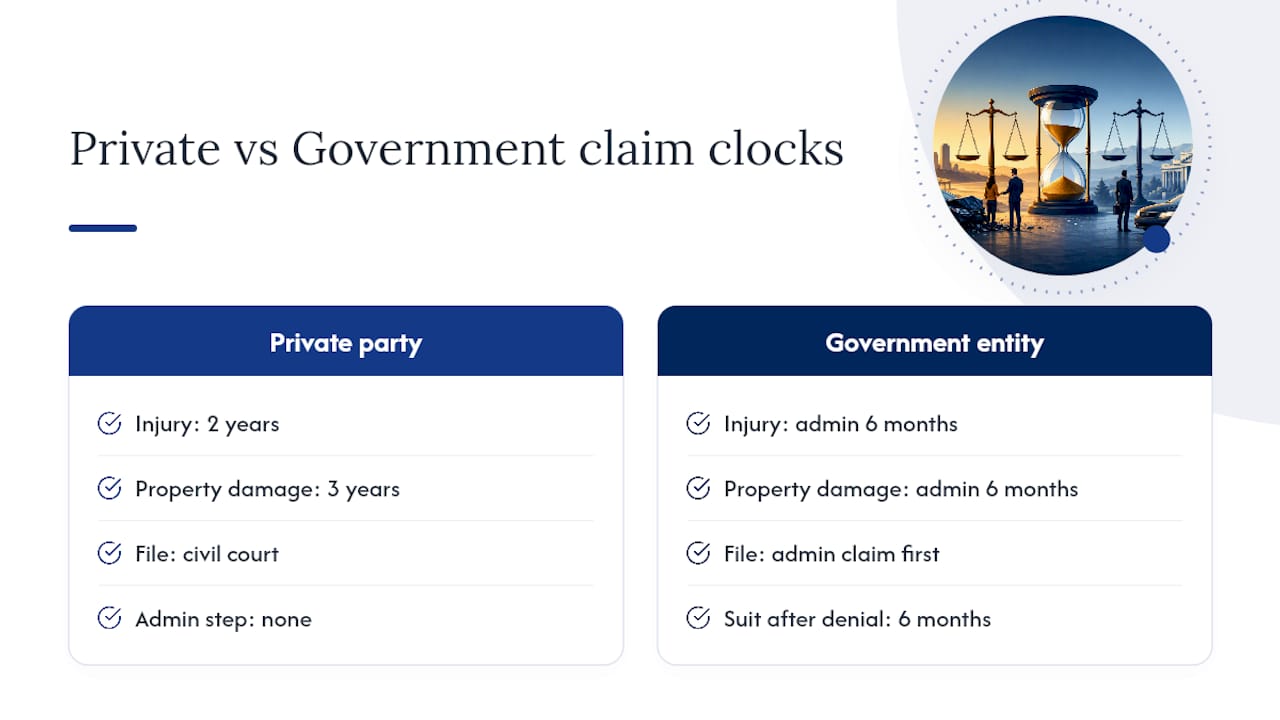
That's not the only difference. Private lawsuits go straight to civil court once you file. Government claims require you to clear the administrative process first, wait for a response or denial, and only then does a separate lawsuit deadline begin running, typically six months from that denial.
Damage caps and immunity defenses also differ. Government entities can raise design-immunity or discretionary-act defenses that private drivers can't use. A pothole-related crash against Caltrans involves proving a "dangerous condition of public property," a legal standard that doesn't exist in a simple rear-end collision case between two private drivers.
Determining which category applies isn't always obvious. A crash involving a city bus is clearly a government claim. A crash involving a pothole that caused a driver to swerve into another vehicle might involve both a private driver and a government entity simultaneously, each with its own deadline running on its own clock.
Can an Expired Deadline Ever Be Revived?
Rarely, and never as a matter of routine. California courts don't offer a general "extension" process for expired statutes of limitations. The rare paths that exist are narrow and fact-specific.
Equitable tolling is the most commonly cited doctrine, but courts apply it sparingly. It typically requires showing that you pursued another legal remedy in good faith, that the defendant had timely notice of your claim despite the delay, and that no unfair prejudice resulted. Simply forgetting the deadline or being confused about the rules doesn't qualify.
The discovery rule, discussed earlier, isn't technically a revival mechanism, but it can function like one if you can prove your injury genuinely wasn't discoverable until later. This requires medical documentation, not just a claim that you "didn't realize how bad it was."
For government claims specifically, there's a formal process to request late-claim relief. Under the Government Claims Act, you can petition the public entity for permission to file a late claim, generally within one year of the incident, but you must show a legitimate reason for the delay, such as incapacity, minority, or excusable neglect. If denied, you can ask a court to grant relief, but courts deny these petitions more often than they grant them.
None of these paths are reliable substitutes for filing on time. Treat them as emergency exits, not planning tools.
Does a Criminal Case Change Your Civil Deadline?
Criminal charges against the at-fault driver, DUI, reckless driving, hit-and-run, don't pause your civil statute of limitations. The two clocks run independently. Prosecutors handle the criminal case on the state's timeline; you still need to file your civil lawsuit within your own two or three-year window regardless of how the criminal case proceeds.
That said, a criminal case can help your civil claim in practical ways. A DUI conviction or guilty plea creates a public record that can support your civil case's liability argument, sometimes significantly. Hit-and-run cases prosecuted under Vehicle Code § 20001 can also surface information, like the driver's identity or insurance status, that you need for your own claim.
Don't wait for the criminal case to resolve before acting on your civil deadline. Criminal trials often take longer than two years to conclude, especially with appeals. If you wait for a verdict before filing your own lawsuit, you can lose your right to sue entirely, even if the driver is eventually convicted.
A Faster Path to Legal Help Preserves More Options
The deadlines covered here share one theme: the sooner you act, the more choices you keep. Early attorney contact lets counsel calendar every relevant deadline, identify whether a government entity is involved, and start preserving evidence before it degrades or disappears.
There are platforms designed to close that gap by letting you describe your accident in plain language, automatically generating a case brief, then connecting you with a California attorney, often within 24 hours. For a claim where the real deadline might be six months instead of two years, that speed isn't a convenience. It's the difference between a claim an attorney can still help with and one that's already closed.
— Admin
Get Matched With a California Car Accident Attorney Fast
Our service offers an alternative to cold-calling law firms or filling out multiple intake forms. You describe what happened in your own words, the platform builds a case brief automatically, and a California attorney typically reaches out within 24 hours.

This matters most for the exact problem this article covers: government-claim deadlines that run out in six months, or discovery-rule questions that need a lawyer's read on your medical timeline right away. Waiting weeks to find the right attorney can cost you options you didn't know were disappearing.
If your crash involved a public vehicle, a road hazard, or you're simply unsure which deadline applies to your case, find a California personal injury lawyer through Legalleads and get a case brief started today. Drivers in the Los Angeles area can also connect directly with a personal injury lawyer in Los Angeles for faster local matching.
This article is general information, not a substitute for advice from a qualified lawyer. Consult a qualified legal professional about your own circumstances before acting on anything here.
Sources
- Car Accident Claim Deadline | Nolo
- California Driver Handbook — Financial responsibility, insurance requirements, and collisions | DMV
- California Vehicle Code Division 10 — Accidents and accident reports
FAQ
Is there a statute of limitations on car accidents in California?
Yes. Personal injury claims generally must be filed within two years of the crash under CCP § 335.1, while property damage claims allow three years under CCP § 338. Claims against government entities require an administrative claim within six months instead.
How much is a good settlement for pain and suffering?
There's no fixed formula, and settlement values depend heavily on injury severity, medical documentation, and comparative fault. California's pure comparative negligence rule means your recovery gets reduced by your own percentage of fault, so a strong evidence record built early tends to support higher settlement offers than a thin one assembled later.
Does my car insurance rate stay high after a crash in California?
California law doesn't set a fixed timeline for how long a crash affects your insurance premium; that depends on your insurer's own rating rules and the severity of the claim. It's a separate question entirely from the statute of limitations, which governs your right to sue, not your policy pricing.
Is California still a no-fault state?
No. California is a fault-based, pure comparative negligence state, not a no-fault state. That means the at-fault driver's insurance is generally responsible for damages, and an injured party who was partly at fault can still recover, just with their award reduced by their share of the blame.
What's the deadline if a government vehicle or agency caused my crash?
You typically must file a written administrative claim within six months under Government Code § 911.2, far shorter than the standard two-year injury deadline for private-party crashes. Missing that six-month window can bar your case before a lawsuit is ever filed.