
Minor injury claims in California typically settle for $5,000 to $25,000. Moderate injuries land between $25,000 and $150,000, and severe or catastrophic cases can reach $150,000 to $2 million or more. The biggest constraint isn't your injury; it's the at-fault driver's insurance policy limits, which often cap what you actually collect regardless of what your case is worth on paper. California's comparative fault rules and 2025 minimum coverage changes both shift these numbers in ways worth understanding before you sign anything.
TL;DR:
- Settlement amounts are capped by insurance policy limits, with most minor injuries settling below $25,000 and severe cases often exceeding $150,000, but limits vary.
- Documentation quality and objective medical evidence significantly influence the case value, especially for moderate to severe injuries, where poorly documented cases receive lower settlements.
- The at-fault driver's insurance coverage is a key constraint, and underinsured motorist policies may be necessary when damages surpass policy limits, especially in catastrophic cases.
- The total settlement covers specific damages like medical expenses, lost wages, and pain and suffering, with careful documentation and timely medical treatment improving the payout potential.
- Deadlines such as the two-year statute of limitations and timely accident reporting are critical, and legal deadlines for government claims and uninsured driver limits can further restrict recovery if missed.
Table of Contents
- Average Car Accident Settlement Amounts in California by Injury Severity
- What Does a Car Accident Settlement Actually Cover?
- Factors That Move Your Settlement Value Up or Down
- How Insurance Adjusters Try to Reduce Your Payout
- California Laws That Directly Affect Your Settlement
- When the Other Driver Has No Insurance or Not Enough
- How to Calculate a Realistic Settlement Estimate
- Settlement or Trial: Weighing Your Options
- How Long Does a California Car Accident Settlement Take?
- Real Settlement Examples Across Injury Levels
- What To Do in the First 72 Hours After a Crash
- Finding a California Car Accident Attorney Without the Runaround
- Where to Verify These Numbers Yourself
- Sources
- FAQ
Average Car Accident Settlement Amounts in California by Injury Severity
Settlement figures move in tiers based on how severe the injury is and how well it's documented. Treating these as fixed prices misses the point. Two people with the same diagnosis can walk away with settlements $50,000 apart because one had gaps in treatment and the other didn't.
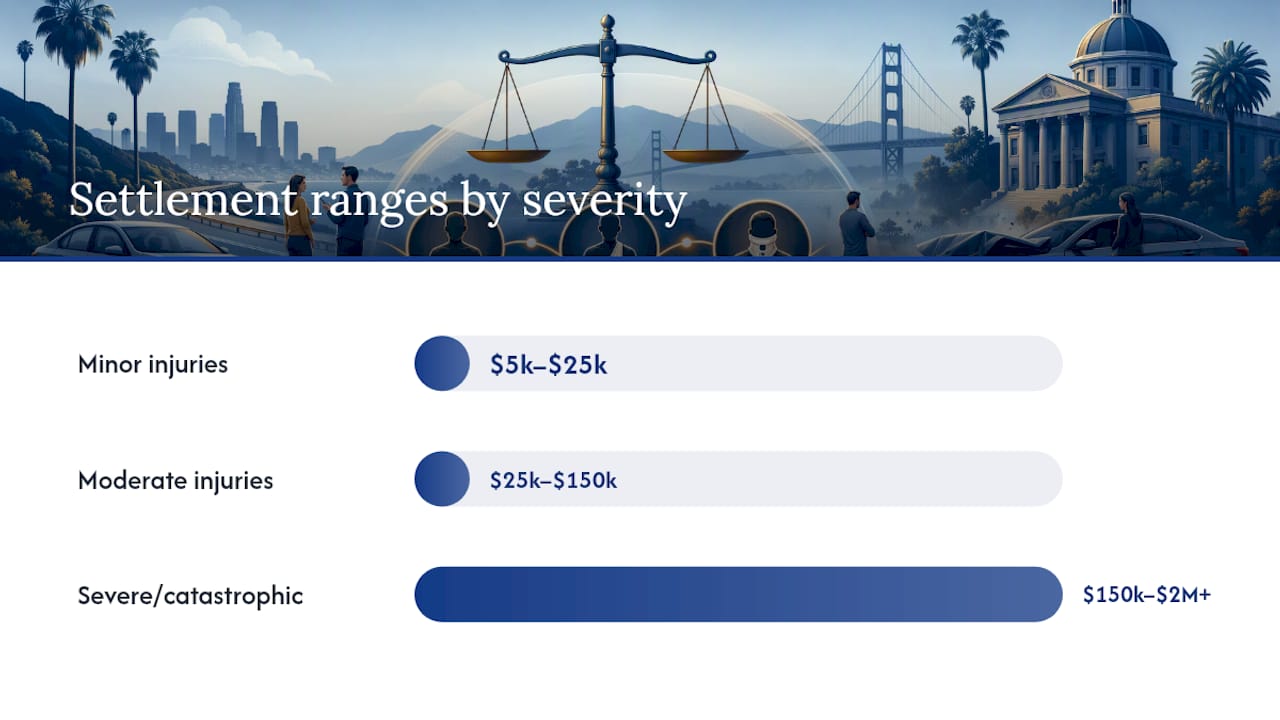
Minor injuries typically resolve for $5,000 to $25,000. This covers soft-tissue injuries like whiplash, minor sprains, and cases requiring a few weeks of physical therapy with full recovery. Insurers move fast on these because the exposure is low and the medical record is usually clean.
Moderate injuries run from $25,000 to $150,000. Think fractures that heal without surgery, herniated discs, concussions with lingering symptoms, or injuries requiring months of physical therapy. This tier is where negotiation matters most, since the range is wide and adjusters have real room to lowball an unrepresented claimant.
Severe and catastrophic injuries span $150,000 to $2 million or beyond. Traumatic brain injuries, spinal cord damage, multiple fractures requiring surgery, and injuries causing permanent disability fall here. These cases often exceed the at-fault driver's policy limits entirely, which forces a separate conversation about underinsured motorist coverage.
A distinction that trips up a lot of claimants: the difference between median and mean settlement figures. NAIC auto insurance claim severity data gets cited constantly as a benchmark for average payouts, but averages get pulled upward by a small number of massive catastrophic settlements. A handful of million-dollar spinal injury cases can drag the "average" figure well above what a typical claimant with a broken wrist will ever see. Median figures, or better yet, tiered ranges by injury type, give a far more honest picture of what to expect.
Here's how the tiers break down at a glance:
- Minor ($5,000 to $25,000): soft-tissue injuries, short-term physical therapy, full recovery expected
- Moderate ($25,000 to $150,000): fractures, concussions, herniated discs, extended treatment
- Severe/catastrophic ($150,000 to $2 million+): traumatic brain injury, spinal cord injury, permanent disability, lifetime care needs
Where your case lands within a tier depends heavily on documentation quality, consistency of treatment, and whether a doctor can point to objective findings like imaging results rather than self-reported pain alone.
What Does a Car Accident Settlement Actually Cover?
A settlement isn't a single number pulled out of thin air. It's the sum of specific damage categories, and knowing what belongs in that sum helps you spot a lowball offer immediately.
Economic damages are the costs you can point to with receipts and records:
- Past medical bills (ER visits, imaging, surgery, physical therapy)
- Future medical costs, projected by a treating physician or life-care planner
- Lost wages from time missed at work
- Loss of future earning capacity if the injury limits your ability to work long-term
- Property damage to your vehicle
- Out-of-pocket costs like rideshare fares to appointments or medication
Non-economic damages cover the harder-to-quantify impact: pain and suffering, emotional distress, and loss of enjoyment of life. These get calculated using methods discussed later, and they're often where the real negotiating happens.
Punitive damages show up rarely, and only when the at-fault driver's conduct rises to malice, fraud, or oppression under California Civil Code § 3294. Drunk driving or a driver fleeing the scene are the kinds of facts that can trigger this. A routine rear-end collision from distracted driving almost never qualifies.
Future medical costs and lost earning capacity require more than a hunch. They're proved through medical expert testimony, vocational assessments, and sometimes a life-care planner who projects decades of treatment costs into a present-day dollar figure.
Pro Tip: Keep every receipt, even the small ones. Parking fees at medical appointments and over-the-counter medication add up, and adjusters take a claim more seriously when the documentation is airtight down to the last detail.
Factors That Move Your Settlement Value Up or Down
Some factors matter far more than others when an adjuster or a jury puts a number on your case. Ranked roughly by impact:
- Injury severity and objective documentation. MRI results, X-rays, and specialist diagnoses carry more weight than subjective pain complaints alone.
- Timing of treatment relative to Maximum Medical Improvement (MMI). Settling before you reach MMI, the point where your condition has stabilized, risks leaving future costs uncompensated.
- Liability evidence. Police reports, dashcam footage, and witness statements determine how clearly fault falls on the other driver.
- Comparative fault percentage. Under California's pure comparative negligence rule, your recovery gets reduced by your own percentage of fault, even if that's 90%.
- Available insurance coverage. A driver carrying only the state minimum limits caps what you can collect under that policy, regardless of how strong your case is.
- Lost earning capacity evidence. A construction worker with a permanent shoulder injury has a stronger wage-loss claim than someone in a desk job with the same diagnosis.
- Pre-existing conditions. Insurers routinely argue your symptoms stem from a prior injury rather than the crash; rebutting this requires prior medical records showing your baseline condition before the collision.
- Early evidence preservation. Photos of the scene, vehicle damage, and visible injuries taken within hours of the crash carry more credibility than reconstructions built weeks later.
The comparative fault piece deserves extra attention. California follows a pure comparative negligence system, meaning a jury or insurer can assign you partial fault and reduce your recovery by that exact percentage. If you're found 20% at fault in a $100,000 case, you collect $80,000. There's no cutoff that bars recovery entirely, unlike some states, but every percentage point of assigned fault comes straight out of your check.
How Insurance Adjusters Try to Reduce Your Payout
Adjusters aren't adversaries exactly, but their job includes protecting the insurer's bottom line, and that shapes every conversation you have with them.
The most common tactic is the lowball opening offer, sent early and often before you've finished treatment. It's designed to test whether you'll accept quick cash before you know the full scope of your injury. A close second is challenging treatment necessity, where the adjuster argues your physical therapy went on too long or wasn't medically required, using it to shave down your medical damages.
Other frequent moves include:
- Delaying claim processing to pressure you into accepting less out of frustration or financial need
- Requesting recorded statements designed to get you to minimize your own injuries on tape
- Shifting fault toward you, even in clear rear-end or red-light cases
- Requesting broad medical record releases that dig into unrelated history
Document requests aren't inherently hostile, but hand over only what's relevant to the crash injury, not your entire medical history going back a decade. If an adjuster pushes for a recorded statement within days of the crash, that's usually a signal they're trying to lock in a version of events before you've had time to fully assess your injuries.
Pro Tip: If you feel rushed toward a quick settlement in the first two weeks after a crash, treat that urgency as a warning sign, not a courtesy. Insurers move fast when they think a low number will work.
California Laws That Directly Affect Your Settlement
State law shapes settlement outcomes more than most claimants realize, and a few statutes in particular determine how much money actually ends up in your pocket.
Pure comparative negligence under Civil Code § 1714 means your fault percentage directly reduces your recovery, dollar for dollar, no matter how small or large that percentage is.
SB1107, effective January 1, 2025, raised California's mandatory minimum liability limits from $15,000/$30,000/$5,000 to $30,000 per person, $60,000 per accident for bodily injury, and $15,000 for property damage.
That's a meaningful jump in the coverage floor. It still leaves a real gap in moderate-to-severe injury cases, where a $60,000 policy limit gets exhausted fast against six figures in medical bills.
Proposition 213, California's "no pay, no play" law, bars uninsured drivers from recovering non-economic damages like pain and suffering. If you were driving without insurance at the time of the crash, Prop 213 limits your recovery to economic losses only, which can cut a case's value by half or more.
Deadlines matter just as much as dollar figures:
- Statute of limitations: generally two years from the date of injury for a personal injury claim against a private driver
- Government claims: as short as six months if a government vehicle or road defect is involved, a trap that catches a lot of claimants off guard
- DMV SR-1 report: must be filed within 10 days of any crash involving injury, death, or more than $1,000 in property damage, or you risk license suspension
If your accident might involve a public entity, from a pothole to a city bus, read up on the six-month government claim deadline immediately. Missing it can bar your claim entirely, regardless of how strong the facts are.
When the Other Driver Has No Insurance or Not Enough
An uninsured or underinsured driver doesn't mean you're out of options. It means your own policy becomes the primary source of recovery, assuming you carry uninsured/underinsured motorist (UM/UIM) coverage.
UM coverage applies when the at-fault driver has no insurance at all. UIM coverage kicks in when they have a policy, but the limits are too low to cover your damages, a common scenario now that even the new SB1107 minimums often fall short in serious injury cases. Your insurer effectively steps into the at-fault driver's shoes for the claim, then may pursue subrogation against that driver separately.
California law requires insurers to offer UM/UIM coverage, but drivers can reject it in writing. Pull out your policy's declarations page right now and check whether you carry this coverage and at what limit; a lot of drivers assume they have it and find out otherwise only after a crash.
Practical paths forward if you're facing an uninsured or underinsured driver:
- File a UIM claim with your own carrier once you've confirmed the at-fault driver's limits are insufficient
- Negotiate directly with your own insurer, understanding they still have a financial incentive to minimize your payout
- Consider arbitration or litigation against your own carrier if negotiations stall, since UM/UIM disputes often end up there
- Explore whether other insurance sources apply, such as an umbrella policy or a resident relative's coverage
How to Calculate a Realistic Settlement Estimate
Estimating case value isn't guesswork if you follow a structured approach. Insurance adjusters and attorneys both lean on a version of the same method.
- Total your economic damages. Add every medical bill, projected future treatment cost, lost wages, and property damage figure. This is your hard-cost baseline.
- Apply a multiplier for pain and suffering. Multiply your economic damages by a factor typically ranging from 1.5 for minor injuries to 5 or higher for severe, permanent injuries. This multiplier framework is a common negotiation tool insurers and attorneys reference, not a legal formula written into any statute.
- Reduce for comparative fault. If you're assigned 15% fault, subtract that percentage from your total.
- Subtract liens and fees. Medical liens, attorney contingency fees (typically one third of the gross settlement), and case costs come out before you see a check.
Worked example: Say your economic damages total $40,000 (medical bills plus two weeks of lost wages). Given a moderate injury with lasting symptoms, you apply a multiplier of 3, bringing your total demand to $160,000. After a one third contingency fee ($48,000) and a $5,000 medical lien, your net recovery lands around $91,000.
An alternative to the multiplier method is the per-diem approach, where you assign a daily dollar value to pain and suffering (often tied to your daily wage) and multiply it by the number of days you were actively recovering. It's used less often than the multiplier method but comes up in cases with a clear, finite recovery period.
Settlement or Trial: Weighing Your Options
Most California car accident claims settle before trial, and for good reason. Settling gets you paid in weeks or months rather than years, and it removes the uncertainty of a jury verdict entirely. If an offer covers your medical bills, lost wages, and a fair non-economic component, taking it is usually the right call.
Litigation makes more sense in specific situations:
- The insurer's offer falls well below your policy limits despite clear liability and serious injury
- You suspect bad faith conduct, such as unreasonable delay or a refusal to negotiate in good faith
- Liability is disputed and only a jury can resolve who's at fault
- The case involves catastrophic injuries where the true value likely exceeds what's being offered
Contingency fees reshape this math. Most California personal injury attorneys charge around a third of the settlement if the case resolves before trial, sometimes rising to 40% if it goes to trial, plus case costs like expert witness fees and filing costs. A $200,000 settlement with a one third fee nets you roughly $133,000 before medical liens.
Timelines vary widely. Mediation-driven settlements often resolve in a matter of months once treatment concludes. A case that goes to trial in California can take 18 months to three years from filing to verdict, given how backed up many county court calendars remain.
How Long Does a California Car Accident Settlement Take?
Timelines track directly with injury complexity. Minor injury claims typically resolve in 3 to 6 months, since treatment ends quickly and the medical record is straightforward. Moderate injury claims run 6 to 12 months, largely because you shouldn't settle until treatment concludes or symptoms stabilize. Severe or catastrophic cases can take 12 to 36 months or longer, especially when litigation, expert testimony, or a life-care plan gets involved.
Several factors commonly stretch these timelines out further:
- Delayed or incomplete medical records from providers
- Disputed liability requiring accident reconstruction
- Multiple insurers involved when more than one party shares fault
- An insurer slow to respond to demand letters or discovery requests
Waiting until you reach Maximum Medical Improvement, rather than settling early, consistently produces better outcomes. Once you settle, you can't reopen the claim if your condition worsens six months later.
Real Settlement Examples Across Injury Levels
Anonymized case outcomes help ground these numbers in something concrete. Public case result listings from California injury firms show the wide spread between minor property-only claims and multi-million-dollar catastrophic recoveries.
- A rear-end collision causing whiplash and six weeks of physical therapy settled for approximately $18,000, reflecting clear liability and a short, well-documented recovery.
- A broken wrist requiring surgical pinning and four months of rehabilitation settled around $85,000, factoring in lost wages for a manual-labor worker.
- A T-bone collision causing a herniated disc and ongoing chronic pain settled near $210,000, pushed higher by permanent restriction on physical activity.
- A traumatic brain injury from a high-speed highway crash resulted in a settlement exceeding $1.2 million, driven by lifetime care costs and lost earning capacity for a young professional.
- A pedestrian struck in a crosswalk with multiple fractures and a spinal injury settled for roughly $650,000, limited in part by the at-fault driver's available policy limits.
Every case turns on its own facts, and past results never guarantee a similar outcome in a different case. Compare your situation against these examples on the variables that actually matter: injury severity, documentation quality, liability clarity, and available insurance coverage. Where your case sits will often become obvious once you weigh those four factors honestly.
What To Do in the First 72 Hours After a Crash
Getting medical care immediately matters more than almost anything else you'll do. Even if you feel fine, some injuries, particularly concussions and soft-tissue damage, don't show symptoms for days.

File your DMV SR-1 report within 10 days if the crash involved injury, death, or more than $1,000 in property damage. Skipping this risks license suspension entirely separate from your injury claim. Photograph the scene, vehicle damage, and visible injuries before anything gets repaired or fades. Notify your own insurer promptly, but keep statements factual and brief.
When you're ready to talk to an attorney, have these ready: the police report number, photos, medical records so far, insurance information for every driver involved, and a rough timeline of your treatment. Having this organized turns a first intake call from a scattered conversation into a focused one, and it's exactly what lets a case brief move quickly once it reaches an attorney's desk.
— Admin
Finding a California Car Accident Attorney Without the Runaround
A qualified California attorney can be contacted quickly through a platform that avoids the usual cycle of cold calls, voicemail tag, and repeated forms. Describe your accident in plain English, and the platform can generate a professional case brief quickly and connect you with an attorney promptly.

This matters most in the early days after a crash, when evidence is fresh and deadlines like the SR-1 filing and statute of limitations are already running. The intake is free, and there's no upfront cost to use it. If your case involves a truck accident, a slip and fall connected to the crash scene, or a straightforward auto claim, the same fast matching process applies. Whether you're weighing a settlement offer or you're not sure you need a lawyer yet, find a lawyer and get a clear answer on where your case stands before you sign anything an insurance adjuster hands you.
Where to Verify These Numbers Yourself
Every figure and deadline in this guide traces back to a primary source you can check directly.
- California Department of Insurance for the 2025 minimum liability limit changes under SB1107
- California DMV for SR-1 accident reporting requirements
- California Legislative Information for the punitive damages statute under Civil Code § 3294
- NAIC Auto Insurance Database and NHTSA crash statistics for claim severity and crash frequency data
- Legislative Analyst's Office for the full analysis of Proposition 213
This article is general information, not a substitute for advice from a qualified lawyer. Consult a qualified legal professional about your own circumstances before acting on anything here.
Sources
- California Department of Insurance: New Year Means New Changes for Insurance
- NAIC Auto Insurance Database (publication)
- NHTSA crash statistics publication
- California Legislative Information — Civil Code § 3294
- California DMV — Accident Reporting (SR-1)
- Legislative Analyst's Office — Proposition 213 (1996) analysis
FAQ
What is the average settlement for a car accident in California?
There's no single average that applies broadly; minor injuries typically settle for $5,000 to $25,000, moderate injuries for $25,000 to $150,000, and severe or catastrophic injuries from $150,000 to $2 million or more, based on NAIC claim severity data.
How much of a $25,000 settlement will I get?
After a typical one third contingency attorney fee and any outstanding medical liens, the net amount you receive from a $25,000 settlement may be substantially reduced, with exact figures varying depending on specific lien amounts and case costs.
How much of a $50,000 settlement will I get?
With a one third contingency fee plus medical liens and case costs, the net amount from a $50,000 settlement can be significantly less, with actual amounts depending on the particular liens and expenses.
How much do lawyers take from a car accident settlement in California?
Most California personal injury attorneys work on contingency, typically charging around one third of the settlement if the case resolves before trial, sometimes rising to 40% if the case goes to trial, plus separate case costs.
Does being partly at fault ruin my California claim?
No. California's pure comparative negligence rule under Civil Code § 1714 reduces your recovery by your percentage of fault rather than barring it, so even 50% fault still leaves you eligible to recover the other half.