
Update every live ad immediately: name a California-licensed attorney, disclose a bona fide office city, town, county, or address of record, and strip out any outcome claim you can't factually substantiate. SB 37 added a private right of action with statutory damages, so an ad that violated only Rule 7.1 last year can now trigger a lawsuit under the new enforcement framework. Pull your ad copies, confirm your vendor contracts assign compliance responsibility, and start a retention file today.
TL;DR:
- Civil enforcement under SB 37 allows private lawsuits with damages from 5,000 to 100,000 dollars per noncompliant ad, regardless of proof of harm.
- Every ad must disclose a licensed attorney's name and a bona fide office location, with placement and readability tested to ensure visibility across formats.
- Content that guarantees outcomes, mimics officials, or claims awards obtained through payment are strictly banned, and factual substantiation is essential for all claims.
- Response deadlines are tight: seven days to provide ad copies and nine days to withdraw broadcast ads, with failure risking civil damages and bar sanctions.
- Firms must implement ongoing compliance with vendor contracts, including approval rights and record retention, to prevent liability for third-party advertising content.
Table of Contents
- What California Attorney Advertising Rules Actually Require
- What Disclosures Does Every California Legal Ad Need?
- What Advertising Claims and Formats Are Banned?
- When Does an Ad Become a Solicitation Under California Law?
- How Does the State Bar Handle an Advertising Complaint?
- Compliance Checklist and Remediation Playbook
- Managing Vendor Risk in Attorney Advertising
- Why Early Compliance Beats Reactive Cleanup
- How Legalleads Supports Compliant Attorney Marketing
- Primary Sources to Read Before You Finalize Any Ad
- Sources
- FAQ
What California Attorney Advertising Rules Actually Require
SB 37 didn't replace the State Bar's advertising rules. It sits on top of them, adding a civil enforcement layer that didn't exist before. Understanding both pieces matters because they answer different questions: the Rules of Professional Conduct tell you what a compliant ad looks like, while the new statute tells you what happens when it isn't.
Article 9.5 of the Business and Professions Code (sections 6157 through 6159.2) governs legal advertising directly. It bars false, misleading, or deceptive statements in any ad and requires conspicuous disclosure of the name of at least one licensed attorney or firm, plus a bona fide office city, town, county, or address of record. The statute also builds out a complaint, withdrawal, and enforcement process that runs on strict deadlines, which we cover in detail further down.
Rule 7.1 through 7.3 of the Rules of Professional Conduct do the underlying ethics work. Rule 7.1 prohibits false or misleading communications about a lawyer or the lawyer's services. Rule 7.2 permits advertising, but only subject to Rules 7.1 and 7.3, and it requires the name and office address of at least one lawyer responsible for the ad's content. Rule 7.3 governs solicitation, the more targeted category of outreach we'll separate from general advertising in a later section.
Legacy Rule 1-400 technically predates the current numbering, but you'll still see it cited in older State Bar guidance and in some firm compliance manuals. It defines "communication" and "solicitation" broadly and requires retention of copies or recordings of written or electronic communications for two years. If your compliance documents still reference 1-400 language, that's not wrong, it's just been layered over by Rule 7.1 through 7.3 and now by SB 37.
Here's what's genuinely new: SB 37 gives private individuals standing to sue over noncompliant ads and creates statutory damage ranges independent of State Bar discipline. Before, a bad ad meant a bar complaint and possible discipline. Now it can mean:
- A civil lawsuit filed directly against your firm
- Statutory damages that don't require proof of actual harm
- Exposure that runs through your marketing vendors, not just your own copy
Practitioner analysis of the law notes that SB 37 broadens enforcement by reaching vendor accountability, meaning a landing page your marketing agency wrote can create liability for you even if you never personally approved the specific language.
What Disclosures Does Every California Legal Ad Need?
Every compliant ad needs the same core disclosures, but how you display them changes with the format. Get the substance right first, then adapt the placement.
- Named attorney or firm. At least one licensed California attorney's name must appear, tied to the content of the ad.
- Bona fide office location. A city, town, county, or address of record where the attorney or firm actually practices, not a virtual mailbox or a marketing address with no attorney presence.
- Referral service disclosures. If a referral service or lead-generation service placed or paid for the ad, that relationship must be disclosed, along with any payment arrangement under Rule 7.2's reciprocal referral provisions.
- Joint-ad attribution. When multiple firms co-sponsor an ad, each participating attorney's disclosure obligations still apply individually.
The tricky part is format. A billboard has room for a full disclosure line. A 15-second paid social video does not. Regulators read electronic ads as a "message as a whole," meaning the disclosure has to be intelligible whether the viewer is reading captions or listening to audio. On paid search, a shortened firm name in the headline paired with a full disclosure on the landing page generally works, but the disclosure can't be buried three clicks deep or in a footer nobody scrolls to.
Pro Tip: Test every video and social ad with the sound off and the captions off, separately. If the disclosure disappears in either version, it's not conspicuous enough.
Retention matters as much as display. You must keep a true and correct copy of every ad you run, and the State Bar can request it during a complaint review. Legacy Rule 1-400 set that retention window at two years for written or electronic communications. Treat two years as your floor, not your ceiling, since a civil claim under SB 37 can surface well after an ad stops running.
What Advertising Claims and Formats Are Banned?
Some ad content isn't a gray area. It's flatly prohibited, and the statute gives you specific categories to check against before anything goes live.
- Guarantees or warranties of a particular outcome, including implied promises like "fast cash" or "instant settlement"
- Statements suggesting a case will settle quickly or for a specific amount before intake even happens
- Impersonation of a judge, court official, or government agency in dramatized content
- Dramatized testimonials or reenactments without a clear on-screen disclaimer identifying them as such
- References to awards, rankings, or recognitions that were purchased or conferred automatically through paid membership
That last point trips up more firms than you'd expect. State Bar guidance is specific here: awards and recognitions are permissible in advertising only if they weren't conferred by virtue of membership and weren't contingent on payment. A "Top Attorney" badge that came with a $500 directory listing fee doesn't clear that bar, and running it in an ad without qualification is a real exposure point.
The statute's phrase "factually substantiated" is doing a lot of work here, and it's worth unpacking. It means the claim, viewed as a whole in its ad context, must be capable of verification by a credible source at the time you publish it. Vague hedges like "results vary" tacked onto an otherwise absolute claim generally don't cure the underlying problem, since regulators and courts read the disclaimer against the overall impression the ad creates, not in isolation.
A quick before/after illustrates the fix. Noncompliant: "Guaranteed settlement in 30 days or your money back." Compliant: "Our attorneys have resolved similar cases within 30 to 60 days; results depend on case specifics." One example: a firm's website case-results page can model this by pairing specific figures with a clear disclaimer about case-by-case variation, which is a workable template for print and digital ads alike.
When Does an Ad Become a Solicitation Under California Law?
Advertising and solicitation aren't the same thing, and the line matters because solicitation carries tighter rules. General advertising reaches an undefined audience, think billboards, TV spots, or a firm's homepage. Solicitation is targeted communication aimed at a specific person the attorney knows needs legal services, and Rule 7.3 (echoing legacy Rule 1-400's definition) treats it with more suspicion because of the pressure it can put on someone in a vulnerable moment.
- Direct mail to a named accident victim generally counts as solicitation and must be labeled "Advertisement" on the envelope and in the letter itself
- Recorded or electronic solicitations need the same labeling, placed where the recipient will actually see or hear it, not buried in fine print
- Real-time, live telephone solicitation of a prospective client who hasn't sought you out is restricted, particularly where the person is a stranger to the attorney
- Contacting someone you know is represented by counsel, or someone in a state of physical or emotional distress connected to the reason for the solicitation, carries heightened risk of a rule violation
- Email, SMS, and PPC retargeting occupy a gray zone. Broad-audience PPC generally reads as advertising, but a personalized SMS follow-up to someone who submitted an intake form starts to look like solicitation and should carry the same labeling discipline
If you're running paid social campaigns that retarget people who visited a specific injury-related landing page, treat that campaign like solicitation for labeling purposes, even though the platform categorizes it as advertising. The safer assumption protects you.
How Does the State Bar Handle an Advertising Complaint?
The enforcement timeline moves fast, and missing a deadline turns a fixable problem into a much bigger one.
- Complaint filed. A consumer, competitor, or the State Bar itself flags an ad as noncompliant.
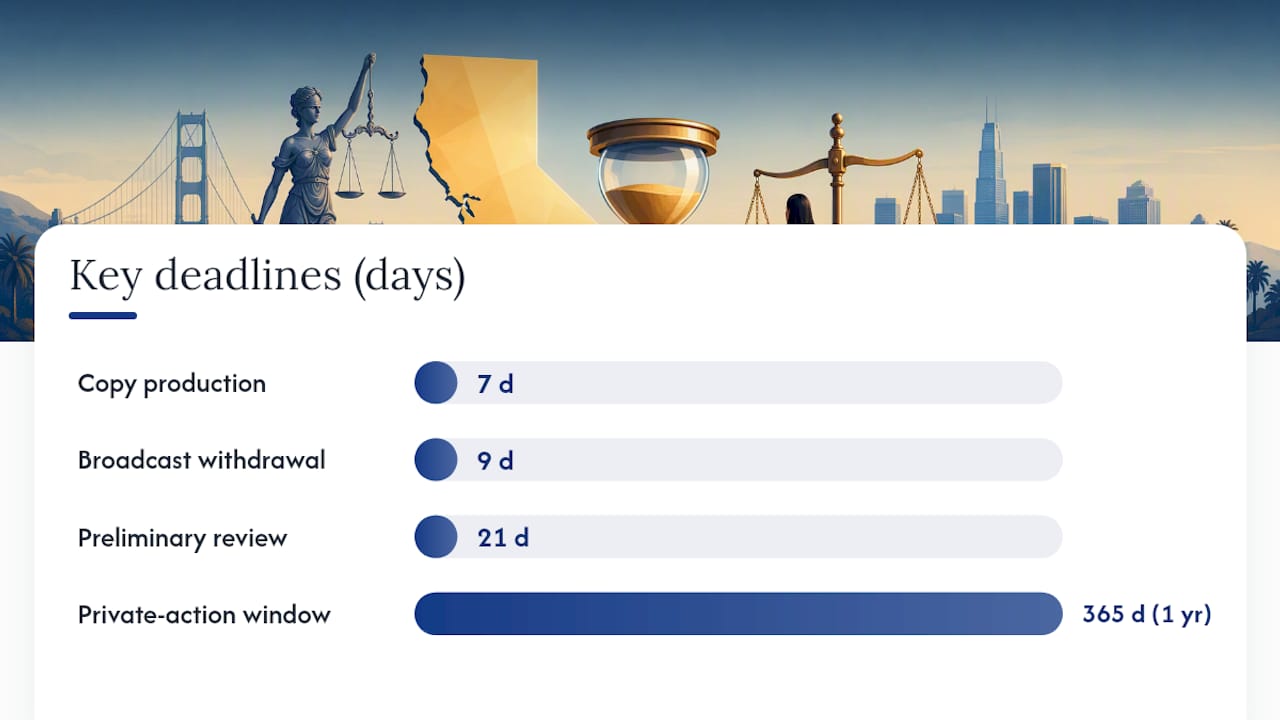
- Seven-day copy production. The advertiser must provide a true copy of the complained-of ad within seven days of service.
- Nine-day voluntary withdrawal window. For broadcast ads specifically, the advertiser has nine days from service to voluntarily pull the ad.
- Twenty-one-day preliminary review. The State Bar issues its initial review determination within 21 days.
- Escalation if uncured. Failure to withdraw a flagged ad within the window can lead to further State Bar action and separately opens the door to civil claims.
The civil side is where SB 37 changes the math. A consumer harmed by a noncompliant ad can bring a private action within one year, and the statutory damages range from $5,000 to $100,000 per violating ad, regardless of whether the plaintiff proves actual monetary loss. Courts can also award treble actual damages as an alternative where actual harm exceeds the statutory range, plus attorneys' fees and injunctive relief ordering the ad taken down.
Pro Tip: The moment you receive any complaint, whether from the State Bar or a demand letter, preserve every version of the ad, the media buy records, and the vendor's production files before you touch anything. Voluntary withdrawal helps your position, but only if you can also show exactly what ran and when.
Practitioners tracking the law's rollout advise building fast-removal procedures before you ever need them, since scrambling to identify which platform is running a flagged ad on day six of a seven-day deadline is not a position you want to be in.
Compliance Checklist and Remediation Playbook
Start with what's live right now, then move to what's dormant but still technically published.
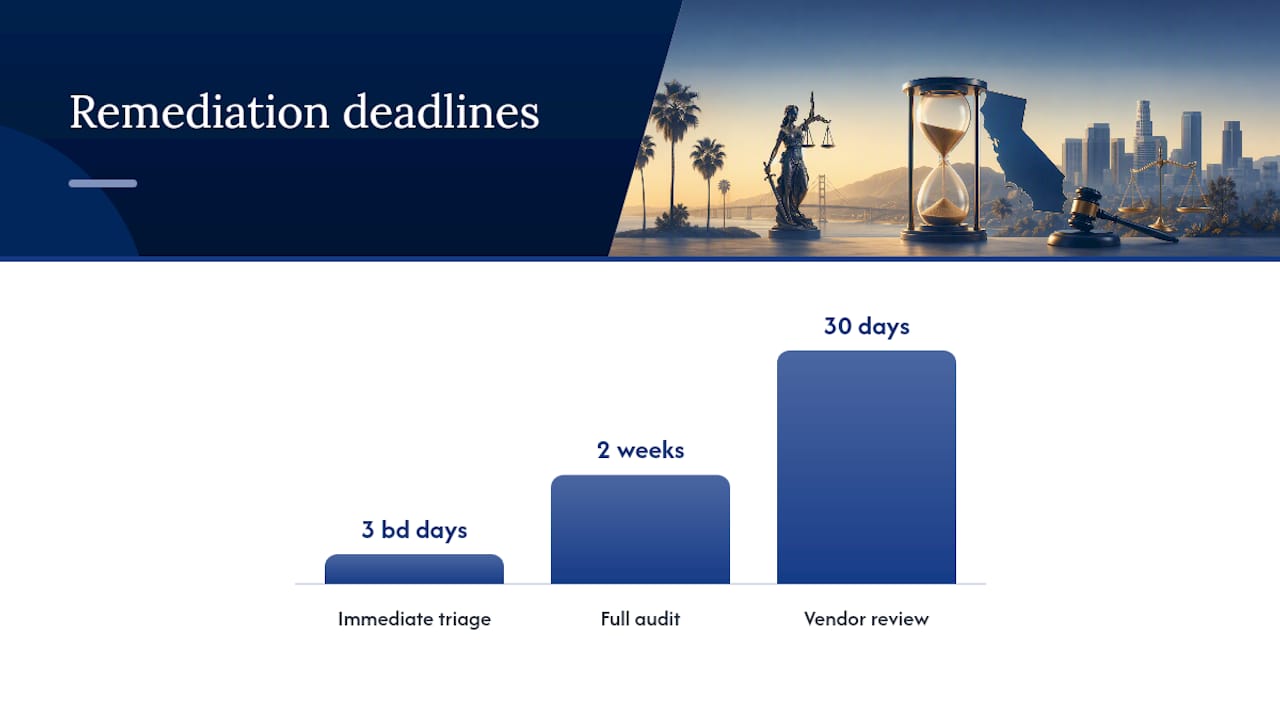
Immediate triage (do this week):
- Confirm every active ad names a California-licensed attorney and discloses a bona fide office city or address of record
- Pull any "guaranteed," "fast cash," or specific-outcome language from headlines, video scripts, and landing page hero sections
- Check that disclosure text on landing pages is visible without scrolling past a fold, not just in a footer
- Verify paid search ad extensions and call-only ads carry a compliant name and location reference
Full audit (do this month):
- Review every testimonial for compliance with dramatization disclosure rules
- Confirm dramatized reenactments carry an on-screen "not an actual client" or equivalent disclaimer
- Check award and ranking badges against the purchased-versus-earned distinction
- Review contingency-fee language for accuracy, since misstating fee structure or omitting that fees are contingent on recovery is its own substantiation problem
- Audit PPC ad copy across every active campaign, not just the ones your team remembers running
- Review social media creative, including organic posts your firm's account published, not just paid spend
- Confirm video disclaimers appear both visually and in the audio track or captions
Retention and access: Store ad copies, including screenshots, media files, and landing page archives, in a system your compliance lead controls directly, not solely inside a vendor's platform. If the vendor's contract ends or the platform is discontinued, your two-year retention obligation doesn't end with it.
Vendor contract clauses to require:
- Content-approval rights before any ad goes live
- Indemnification for claims arising from vendor-drafted copy
- Record retention matching or exceeding your own two-year floor
- A written representation that all factual claims in vendor-produced content are substantiated at the time of publication
| Remediation phase | Owner | Target timeline |
|---|---|---|
| Immediate triage of live ads | Marketing team | Within 3 business days |
| Full creative and testimonial audit | Compliance officer or GC | Within 2 weeks |
| Vendor contract review and amendment | GC or outside ethics counsel | Within 30 days |
| Ongoing quarterly ad audit | Marketing + compliance jointly | Recurring, every quarter |
Assign a single owner for each phase. A checklist nobody owns is just a document, and the seven-day and nine-day statutory windows don't leave room for figuring out who's responsible after a complaint lands.
Managing Vendor Risk in Attorney Advertising
You're on the hook for what your vendor publishes, even when you never personally wrote a word of it. That's the practical reality SB 37 created, and it's why vendor diligence now belongs in the same conversation as your own ad copy review.
Before signing with any marketing or lead-generation vendor, confirm the contract gives you approval rights over content before it publishes, an indemnity clause covering claims tied to their copy, and a record-retention commitment matching your own two-year floor. Ask directly whether they'll represent, in writing, that outcome claims and testimonials in their work are factually substantiated.
- Require pre-publish sign-off from someone at your firm, not just the vendor's internal review
- Ask for an archive export option so you're not dependent on the vendor's platform for retention
- Confirm disclosure language (attorney name, office location) is baked into every template, not added manually per campaign
A workable governance flow looks like this: marketing drafts the ad, compliance or ethics counsel reviews it against Rule 7.1 through 7.3 and Article 9.5, someone signs off before it publishes, and the same team re-audits quarterly. An effective intake and case-brief workflow can benefit from a structured handoff approach, generating a case brief quickly without requiring calls or complicated forms, which reduces improvised, ad-hoc content creation that tends to generate compliance gaps.
Pro Tip: Ask any vendor for a sample compliance-review workflow before you sign. If they can't describe one, you're the compliance department by default.
Why Early Compliance Beats Reactive Cleanup
Firms that treat this as a legal problem to solve later, rather than a marketing checklist to fix now, are the ones facing ad take-downs mid-campaign and rewriting creative under a seven-day deadline. That's expensive and disruptive in ways a quarterly audit never is.
The math favors moving early. Statutory damages start at $5,000 per ad regardless of provable harm, so a firm running a dozen noncompliant ads across platforms is looking at exposure that dwarfs the cost of a proper compliance review. Build the audit into your regular marketing operations, not as a one-time reaction to SB 37's arrival, and you'll never be scrambling when a complaint lands.
— Admin
How Legalleads Supports Compliant Attorney Marketing
Vendor risk is the piece most firms underestimate, and it's exactly where a lead-generation partner needs to prove its process rather than just its reach. Some platforms connect individuals describing a legal situation in plain English to a professional case brief quickly, then match them to qualified attorneys within a day, without the back-and-forth of calls or complicated intake forms. That structured intake process means the content driving those matches is built around factual case details rather than the kind of dramatized or unsubstantiated marketing copy that creates SB 37 exposure.
For firms handling personal injury, family law, or other high-volume practice areas, that matters directly at the point of contact. Legalleads' attorney-matching platform gives firms a way to receive qualified case leads without maintaining a separate, ad-hoc marketing pipeline that has to be individually audited for every claim it makes. If your firm handles personal injury matters in Los Angeles, the personal injury lawyer Los Angeles page shows how a practice-area-specific matching page is structured around case facts rather than outcome promises. Reach out to Legalleads directly to talk through how a compliant lead-generation workflow could fit into your firm's marketing operations this quarter.
Primary Sources to Read Before You Finalize Any Ad
Read the statute and rules directly before signing off on compliance language, since secondary summaries (including this one) simplify for clarity.
- Business & Professions Code Article 9.5, sections 6157–6159.2
- Rules of Professional Conduct, Rule 7.1–7.6 PDF
- Rule 7.2 executive summary and redline
- Legacy Rule 1-400 advertising and solicitation
Cite the specific rule number in your internal compliance documentation, not just a general reference to "the advertising rules," so your audit trail holds up if a complaint arrives.
This article is general information, not a substitute for advice from a qualified lawyer. Consult a qualified legal professional about your own circumstances before acting on anything here.
Sources
- Codes Display Text — Article 9.5. Legal Advertising 6157 - 6159.2
- Chapter 7. Information About Legal Services (Rules 7.1–7.6)
- Rule 7.2 Advertising (Executive summary and redline)
- Rule 1-400 Advertising and Solicitation — The State Bar of California
- California’s New Advertising Rules for Law Firms and Lawyers: SB 37 and Section 6153 of the Business and Professions Code
FAQ
What Is SB 37 and How Does It Change Attorney Advertising?
SB 37 adds private civil enforcement to California's existing legal advertising rules, creating statutory damages between $5,000 and $100,000 per noncompliant ad that consumers can pursue directly in civil court.
Do I Need to Disclose My Office Address in Every Ad?
Yes. Article 9.5 and Rule 7.2 both require conspicuous disclosure of a named attorney and a bona fide office city, town, county, or address of record in every advertisement.
How Long Must I Keep Copies of My Attorney Ads?
Legacy Rule 1-400 sets a two-year retention requirement for copies of written or electronic communications, and firms should treat that as a floor given SB 37's one-year civil action window that can start well after an ad stops running.
Can I Advertise Awards or Rankings My Firm Received?
Only if the award wasn't conferred automatically through paid membership and wasn't contingent on payment; purchased "top attorney" badges generally don't meet that standard without qualification.
What Happens If I Don't Respond to a State Bar Advertising Complaint?
Failure to provide a copy within seven days or voluntarily withdraw a broadcast ad within nine days can lead to further State Bar action and separately expose the firm to civil claims under SB 37.
How Can I Reduce Compliance Risk From Marketing Vendors?
Require content-approval rights, indemnification, and matching record-retention commitments in vendor contracts, and consider working with a platform like Legalleads that builds attorney matching around structured case intake rather than open-ended promotional claims.