
AI in law firms is already doing three things well: legal research, first-draft generation, and document review. Adoption has increased rapidly year over year, according to the ABA's Legal Industry Report, yet most firms still lack formal training or written policy. That gap, not the technology itself, is the real liability. Every output still needs a lawyer's verification before it touches a client file or a court filing.
TL;DR:
- Most law firms lack formal AI training and policies, making verification and governance the key factors for safe adoption and risk management.
- AI tools currently provide the greatest value in tasks like legal research, drafting, document review, and intake automation, saving significant time in routine work.
- Effective AI implementation relies on integrating tools within existing workflows, starting with low-risk pilots, and establishing clear standards for verification and role-based access.
- Barriers such as data security, privilege protection, ethical concerns, and lack of trust continue to slow widespread adoption, emphasizing the need for purpose-built legal AI solutions.
- Future developments will likely integrate AI across the entire legal process, with increased focus on compliance, verification, and transparent client communication.
Table of Contents
- Where AI in Law Firms Actually Delivers Value Today
- How AI Is Reshaping Firm Economics and Staffing
- Adoption Barriers: Privilege, Accuracy, and Trust in AI Output
- How to Evaluate a Legal AI Vendor Before You Sign
- Rolling Out AI in Your Firm Without Blowing Up Governance
- A Client-Facing Example: How Intake Automation Complements In-House AI
- What Successful AI Rollouts Actually Look Like
- Where AI in Legal Practice Is Headed Next
- Regulatory and Compliance Rules Firms Can't Ignore
- How AI Changes the Client Relationship
- Training Your Team to Use AI Without Creating Risk
- What Law Firm Leaders Should Prioritize Next
- LegalLeads: A Faster Path to Client Flow While You Build Out AI Internally
- Sources
- FAQ
Where AI in Law Firms Actually Delivers Value Today
The practical wins cluster around a handful of repeatable tasks. Attorneys who've adopted AI tools report the biggest time savings in work that used to eat hours of billable time without much intellectual payoff.
- Legal research: Pulling relevant case law and statutes in minutes instead of hours, with tools like Lexis+ with Protégé grounding results in authoritative databases rather than open web content.
- Drafting first drafts: Motions, contracts, and correspondence get a starting point that a lawyer edits rather than writes from a blank page. Bloomberg Law documents this as one of the most common uses across firms of every size.
- Document review and e-discovery: AI flags relevant documents in large productions faster than manual review teams, cutting review timelines for litigation and transactional due diligence alike.
- Contract analysis: Spotting nonstandard clauses, missing terms, or risk language across hundreds of agreements at once.
- Intake automation: Turning a client's plain-language description of their problem into a structured case summary before a human ever picks up the phone.
In litigation, that might mean a paralegal running an e-discovery pass overnight instead of over a week. In transactional work, it means a junior associate reviewing an AI-flagged redline instead of reading every page cold. In intake, it means a prospective client gets a same-day response instead of waiting for a callback.
The friction point is rarely the AI itself. It's switching costs. Tools that live inside Microsoft Word or a firm's existing practice-management platform see far higher actual usage than standalone apps that require attorneys to leave their normal workflow. If the tool asks a lawyer to change how they work, adoption stalls no matter how good the underlying model is.
How AI Is Reshaping Firm Economics and Staffing
AI adoption is changing how firms price, staff, and scale their work, not just how fast they produce it. Work that used to justify hourly billing because it was slow now gets done more quickly, and clients notice.
Firms that automate high-volume, repeatable tasks free up capacity for higher-value advisory work, according to Harvard's Center on the Legal Profession. That shift opens the door to alternative fee arrangements, since a firm confident in its AI-assisted turnaround time can quote a flat fee instead of an hourly estimate. It also changes staffing profiles: some junior-level document review work shrinks, while demand grows for people who can supervise AI output and catch what it misses.
Statistic Callout: Legal AI adoption has increased rapidly year over year, yet the ABA/8am Legal Industry Report found that a majority of firms still report no formal AI training program.
That gap between usage and governance is exactly where the economic upside gets risky. Consider what this means in practice:
- Faster turnaround on routine matters supports productized, flat-fee service packages instead of pure hourly billing.
- Paralegal and junior associate roles shift toward review and verification rather than first-pass drafting.
- Clients increasingly expect faster responses and clearer pricing, having seen AI-driven speed elsewhere.
None of this means fewer lawyers. It means the lawyers a firm keeps spend more time on judgment calls and less on repetitive drafting.
Adoption Barriers: Privilege, Accuracy, and Trust in AI Output
Firms that hesitate on AI usually cite the same four concerns, and the data backs up their caution. As of 2026, the top barriers to firm-wide adoption are data security (46%), ethical issues (42%), privilege protection (39%), and lack of trust in AI outputs (39%), per the American Bar Association.
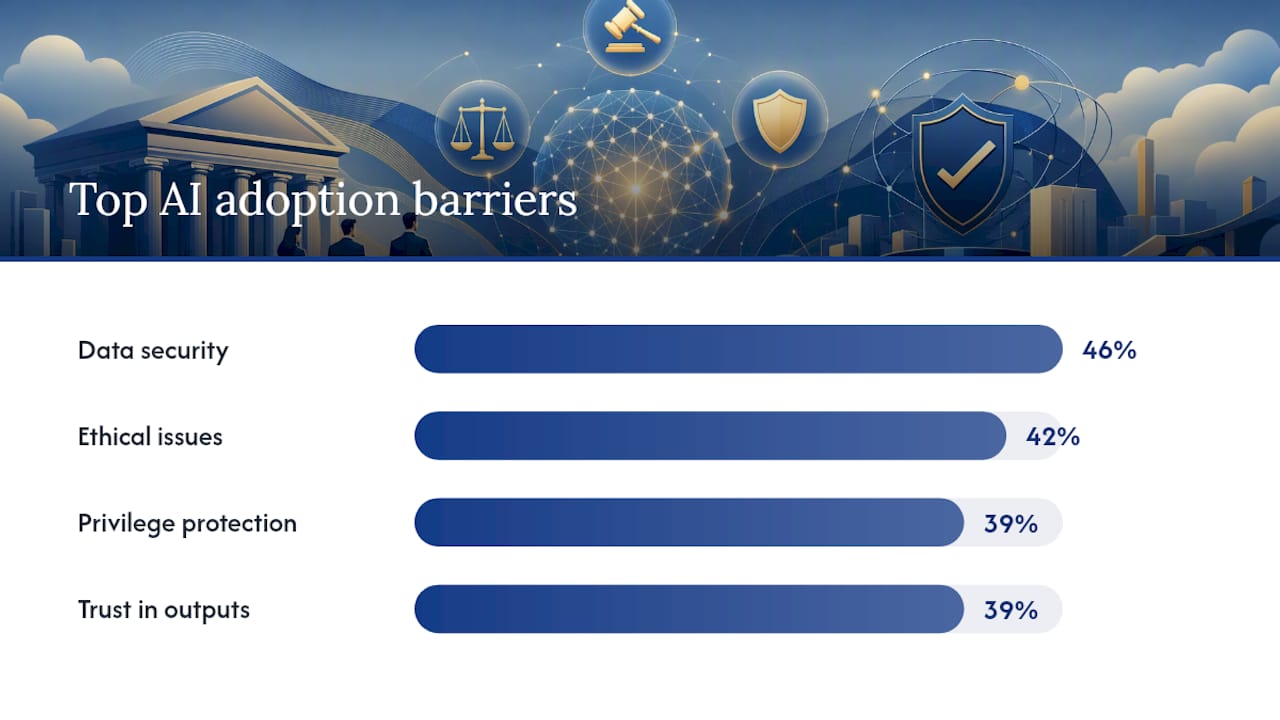
Those numbers explain why a general-purpose chatbot is the wrong tool for privileged work. A consumer LLM has no obligation to keep firm data out of its training pipeline, no citation trail a court would accept, and no audit log a malpractice carrier would want to see. Purpose-built legal AI, grounded in authoritative legal databases, is built specifically to reduce that exposure by keeping outputs traceable to real sources rather than statistically plausible guesses.
Pro Tip: Never let an associate paste client facts into a public AI chat window to "just check something quickly." That single habit is how privilege waivers happen. Build the firm's approved tools into the default workflow so the risky shortcut isn't the easy one.
A working governance checklist looks like this:
- Put the AI usage policy in writing, including which tools are approved and which data categories are off limits.
- Require training before any attorney or staff member touches a client matter with AI assistance.
- Set a verification standard: every citation, quote, or factual claim gets checked against a primary source before filing or sending.
- Apply role-based access so sensitive matters route through tools with appropriate confidentiality controls.
Statistic Callout: Data security is commonly cited as a leading adoption barrier, ranking ahead of ethical concerns, privilege issues, and trust in AI outputs, according to the ABA.
Enterprise vendors like Harvey have built their pitch around exactly this concern, emphasizing secure workspaces and firm-level governance controls rather than open consumer access.
How to Evaluate a Legal AI Vendor Before You Sign
Procurement for legal AI tools should look more like due diligence than a typical software purchase. The stakes are higher because a bad output can become a malpractice exposure, not just a wasted subscription fee.
Core evaluation criteria to run through with any vendor:
- Citation traceability: Can every generated statement be traced back to a specific, checkable source?
- Integration: Does it work inside Word, your practice-management system, or does it require a separate login and workflow?
- Security certifications: What compliance standards (SOC 2, encryption at rest and in transit) does the vendor hold?
- Data residency and access controls: Where is client data stored, who can access it, and can the firm restrict access by matter or practice group?
Firms weighing embedded tools like Lexis+ with Protégé against specialist add-ons should default to the embedded option when the firm already relies heavily on that platform for research or case management. Specialist tools make more sense when a firm has a narrow, high-volume need, like large-scale e-discovery, that a general research platform doesn't cover well.
Before signing, ask vendors these questions directly:
- What happens to our data if we cancel the contract?
- Can you show us an audit trail for a sample output, including sources cited?
- What's your incident response process if the model generates a factual error in a client-facing document?
- Do you offer role-based permissions matched to our firm's practice groups?
Red flags include vagueness on data ownership, no clear citation methodology, and reluctance to name their security certifications outright.
Rolling Out AI in Your Firm Without Blowing Up Governance
The safest path to scale isn't the fastest one. It's the one that proves itself on a small, contained use case first.
- Pick one high-volume, low-risk pilot. Contract review for a standard document type or research support for a single practice group works well because errors are easier to catch and less costly if they slip through.
- Write the governance rules before the pilot starts, not after. Define who can use the tool, what data it can touch, and what verification step is mandatory before any output leaves the building.
- Choose tools that fit inside existing workflows. A pilot that requires switching apps adds friction that skews adoption data and frustrates the people you need on board.
- Instrument the pilot with real audits. Track how often outputs need correction, how much time is actually saved, and whether verification standards are being followed in practice.
- Expand by practice area only after the numbers hold up. Gilbert + Tobin's phased rollout started with operations teams and low-risk workflows, before expanding to fee-earning practice groups. That sequencing is worth copying.
Pro Tip: Run the pilot's success metrics past your malpractice carrier before you scale it firm-wide. Some insurers now ask directly about AI governance policy, and having documented verification standards in place can matter at renewal time.
A Client-Facing Example: How Intake Automation Complements In-House AI
Internal AI tools speed up research and drafting once a matter is open. LegalLeads addresses the step before that: getting the right case in front of the right attorney in the first place. A client describes their situation in plain English and receives a case brief in under two minutes, with an attorney match typically following within 24 hours.
This supports areas such as personal injury, family law, immigration, employment, and criminal defense matters, among others. For firms already running AI internally for drafting and research, faster, better-qualified intake means those tools get pointed at real matters sooner rather than sitting idle waiting for the phone to ring.
What Successful AI Rollouts Actually Look Like
The firms that scale AI well share a common trait: they treated the rollout as a change-management project, not a software purchase. Gilbert + Tobin's approach is instructive because it wasn't glamorous. Leadership visibly used the tools themselves, enablement was role-specific rather than one-size-fits-all, and pilots ran in sandboxed environments before touching live client matters.
That sequencing matters more than the specific vendor chosen. Firms that start with operations and administrative teams, where mistakes are cheaper, build institutional confidence and identify workflow problems before fee-earning lawyers ever touch the tool. By the time AI reaches litigation or transactional teams, the governance kinks are largely worked out.
Contrast that with firms that hand every associate access to a general AI tool on day one with no training and no verification standard. Usage numbers look great in a dashboard. Verification gets skipped under deadline pressure, and errors slip through, sometimes into filed documents. The difference between a case study firms want to cite and a cautionary tale in a bar publication usually comes down to whether governance was built before or after the rollout.
The pattern holds across practice areas: measurable success comes from narrow scope, defined metrics, and a documented feedback loop between the people using the tool and the people responsible for accuracy.
Where AI in Legal Practice Is Headed Next
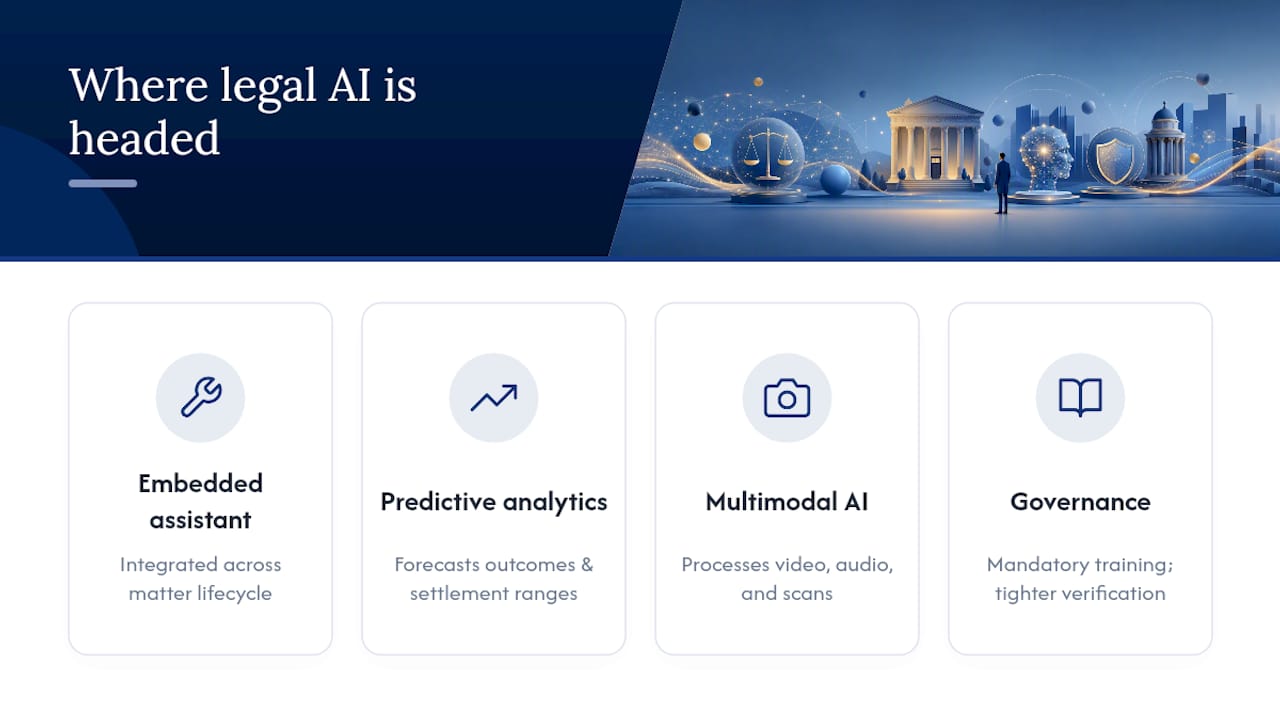
The next wave of legal AI looks less like a standalone research tool and more like an assistant embedded across the entire matter lifecycle. Expect deeper integration between research platforms, drafting tools, and practice-management systems, so an attorney doesn't have to move between five different logins to go from research to draft to filing.
Predictive analytics is also gaining ground, using historical case data to forecast likely outcomes, settlement ranges, or judge tendencies on a given motion. That's a meaningful shift from today's dominant use cases, which are mostly about speeding up work a lawyer would have done anyway rather than generating new strategic insight.
Multimodal AI, capable of processing video depositions, audio recordings, and scanned documents together rather than just text, is likely to expand e-discovery capabilities well beyond current document-based review. Expect vendors like Harvey and platforms tied to Thomson Reuters research tools to push further into this space as firms demand broader coverage from a single governed environment.
The governance side will evolve too. As mandatory training becomes standard rather than optional, expect more firms to formalize AI competency as part of associate onboarding, similar to how legal research training already works. Verification standards will likely tighten as bar associations issue clearer guidance on what "reasonable diligence" means when a lawyer relies on AI-generated content.
Regulatory and Compliance Rules Firms Can't Ignore
Bar associations across the country have started issuing formal guidance on AI use, and the common thread is simple: a lawyer's duty of competence and candor to the court doesn't change because a machine generated the first draft. If an AI tool fabricates a citation and it ends up in a filed brief, the attorney who signed it is the one facing sanctions, not the vendor.
Confidentiality rules apply with full force to AI tools. Feeding client information into a general-purpose AI platform without understanding its data retention policy can constitute an unauthorized disclosure, depending on the tool's terms of service and how the jurisdiction's ethics rules define reasonable safeguards.
Malpractice exposure is the practical enforcement mechanism here. Carriers are increasingly asking about written AI policies during underwriting, which means firms without one may face higher premiums or coverage gaps. Compliance isn't a separate workstream from AI adoption. It's the same workstream, viewed from the risk side instead of the productivity side.
Firms operating across multiple states should also watch for divergence in guidance. What one state bar treats as adequate supervision, another may not, particularly around disclosure obligations to clients about AI use in their matter.
How AI Changes the Client Relationship
Clients increasingly expect the speed AI enables, and that expectation is reshaping what "good service" means. A client who gets a same-day response to an intake inquiry, thanks to automated case-brief generation, now treats that as a baseline rather than a bonus.
That shift cuts both ways. Faster turnaround on document review or contract analysis means clients see draft agreements or discovery responses sooner, which builds trust when the work holds up under scrutiny. It erodes trust fast when an AI-assisted draft contains an obvious error a human should have caught, because clients increasingly know AI was involved and hold the firm to a higher accuracy bar as a result.
Communication also gets more efficient. Attorneys who offload first-draft research and correspondence to AI free up time for the conversations that actually require a lawyer's judgment, like explaining strategy or managing expectations around outcomes. The relationship becomes less about waiting for updates and more about substantive check-ins, provided the firm uses the time savings for client contact rather than just squeezing in more matters.
Transparency about AI use is becoming part of the trust equation itself. Firms that are upfront about where AI assists (research, drafting) and where a human makes the final call tend to fare better with clients than firms that stay silent and let clients assume everything is fully automated or fully manual.
Training Your Team to Use AI Without Creating Risk
A tool is only as safe as the person operating it, and that's precisely where most firms are underinvesting. Despite adoption more than doubling, a majority of firms still report no formal AI training program in place.
Effective training programs cover three layers. First, practical tool competency: how to write a useful prompt, how to interpret confidence signals in an output, and how to spot when a result looks suspiciously generic. Second, verification discipline: treating every AI-generated citation or factual claim as unverified until checked against a primary source, no exceptions for deadline pressure. Third, ethical boundaries: what data categories can never go into a given tool, and what disclosure obligations apply to the client.
Training works best when it's role-specific rather than a single firm-wide seminar. A paralegal doing document review needs different skills than a partner using AI for research synthesis, and a one-size-fits-all training session tends to under-serve both. Firms following Gilbert + Tobin's model built enablement around specific roles and use cases rather than a generic rollout, which produced faster, safer adoption.
Ongoing refreshers matter more than a single onboarding session, since AI tools update frequently and yesterday's best practice can become today's blind spot. Firms that treat AI training as a one-time event tend to see verification standards slip within a few months, right around the time the novelty wears off and deadline pressure creeps back in.
What Law Firm Leaders Should Prioritize Next
Governance and mandatory training come first, before rollout speed. Embed AI inside tools attorneys already use daily to cut supervision overhead and reduce the temptation to route around approved systems. Traceability and client-facing quality control matter more than raw output volume. Firms that get this sequence backward tend to scale risk faster than they scale value.
— Admin
LegalLeads: A Faster Path to Client Flow While You Build Out AI Internally
Building internal AI capability takes time. There are platforms that give firms and solo attorneys a way to accelerate client flow while that internal work is still underway. These platforms generate structured case briefs from clients' descriptions quickly, then match those clients to qualified attorneys within about 24 hours, without a single intake call or complicated form on either side.

This works as a complement, not a replacement, for internal AI investment. A firm's own drafting and research tools handle the matter once it's open. LegalLeads handles getting qualified matters into the pipeline faster, which matters most for practice areas with high inquiry volume, like personal injury and family law, where speed of response often determines whether a prospective client sticks around. Firms looking to supplement intake capacity, rather than hire another front-desk coordinator, can start by browsing the attorney matching directory to see how the process fits their practice area.
This article is general information, not a substitute for advice from a qualified lawyer. Consult a qualified legal professional about your own circumstances before acting on anything here.
Sources
- What's really holding law firms back from embracing AI? — American Bar Association
- AI in legal practice explained — Bloomberg Law
- The impact of artificial intelligence on law firms’ business models — Harvard CLP
- Lexis+ with Protégé — LexisNexis
- Harvey — AI software for legal and professional services
FAQ
What Is the Biggest Barrier to AI Adoption in Law Firms?
Data security is the top concern, cited by 46% of firms, followed by ethical issues, privilege protection, and lack of trust in AI outputs, according to the American Bar Association.
Can AI Replace Legal Research Entirely?
No. AI tools like Lexis+ with Protégé accelerate research by surfacing relevant case law quickly, but every citation still requires human verification before it goes into a filing.
Is It Safe to Use ChatGPT for Legal Work?
General consumer AI tools lack the citation traceability, data governance, and confidentiality controls that purpose-built legal AI platforms provide, making them a poor fit for privileged client work.
How Do Law Firms Verify AI-Generated Content?
Firms should require every AI-generated citation, quote, or factual claim to be checked against a primary source before it's used in client-facing or court-filed documents.
Does AI Speed Up Attorney-Client Matching?
Yes. Some services use AI to convert a client's plain-English description into a case brief in under two minutes, with attorney matches typically following within 24 hours.